The Common Sense Institute (CSI) released the first report in its 2026 Ballot Guide series, examining the fiscal, educational, and family impacts of the proposed “Protect Education Act.” The analysis concludes that the measure would immediately disqualify approximately 20,300 current universal ESA families through a new income cap, while gradually excluding more than half of Arizona families with school-aged children over time as incomes rise faster than the cap’s limited adjustment.
The proposal would also impose new accreditations, testing, and spending restrictions on participating schools, potentially disrupting educational choices for over 100,000 Arizona students currently using Empowerment Scholarship Accounts (ESAs).
Arizona’s K-12 landscape has been shifting for more than a decade, with district enrollment declining since 2008 as families increasingly turned to charter, private, homeschool, and micro school options. District schools lost roughly 50,000 students in 2021-2022 alone—before universal ESA eligibility—and today enroll about 75,000 fewer students than in 2019-2020.
Fewer than 70% of Arizona’s school-aged children now attend district schools, down from 80% a decade ago.
In response to these trends and parent demand for alternatives, lawmakers expanded ESA eligibility in 2022 to all school-aged children, removing prior public-school attendance requirements. Participation surged to more than 100,000 students (nearly 10% of Arizona’s K-12 population), with annual awards totaling around $1.1 billion. One quarter of participants remain in pre-universal categories, including a rapidly growing share of students with disabilities.
Key Impacts of the Proposed Act
The Protect Education Act would limit universal ESA scholarships to households earning under $150,000 annually, require participating private schools to register, accredit, and/or conduct mandatory state testing, and further restrict allowable uses of funds by tightening definitions of “noneducational” and “luxury” items.
CSI’s analysis estimates that 24% of current ESA users have household incomes above the proposed threshold, immediately affecting roughly 20,300 universal-eligibility families.
Statewide, approximately 400,000 school-aged children—potentially up to 40% when accounting for family sizes—could be permanently excluded from universal ESAs based on 2024 income distributions.
Although the cap includes a 2% annual inflation adjustment. Arizona household incomes have historically risen closer to 4% per year, leading CSI to project that more than 52% of families with school-aged children could be income-excluded by 2045.
The restriction could also indirectly reduce participation in other eligibility categories. Growth in ESA usage among students with disabilities accelerated after universal expansion; without it, there might have been roughly 10,000 fewer participants in those targeted groups.
“Arizona’s K-12 system has been evolving for more than a decade as enrollment patterns, family preferences, and educational models continue to diversify,” stated Director of Policy & Research at CSI, Glenn Farley. “This analysis finds the proposed Act would not simply adjust ESA eligibility requirements, but could significantly reshape access to nontraditional education options over time. More families are signaling that one size does not fit all and are seeking educational choices that better meet their children’s needs.”
Fiscal Analysis: ESA Delivers Savings
ESA students receive significantly less funding than their public-school peers. The average universal ESA award is approximately $7,700 per student, compared to nearly $15,000 per public-school student. CSI estimates that shifting 20,000 universal ESA students back into district classrooms would increase annual taxpayers costs by about $115 million.
Despite serving over 100,000 students, the total number of publicly funded K-12 students (district, charter, and ESA) remains consistent with pre-2020 projections. The funding mix has simply shifted to better align with actual enrollment and family preferences, producing net savings for taxpayers. Arizona is also spending 30% more per-public school pupil (inflation-adjusted) than a decade ago, yet the share of funding reaching classrooms has declined slightly while support services have grown.
Academic Performance and Oversight
According to CSI, Arizona district students score low on state assessments with only 39% proficient in reading, 32% in math, and 27% in science. Available data indicate stronger outcomes in private and homeschool settings.
ACT scores show private school students outperforming public school counterparts by 19% and homeschool students by 12%. National Assessment of Educational Progress (NAEP) results similarly suggest private school students outperform roughly 70% of their public peers where comparable data exist.
CSI’s survey of participating private schools revealed that 84% already administer standardized testing and about two-thirds hold accreditation from recognized bodies. All respondents imply background checks and staff qualification standards. Private school leaders warned that the Act’s new requirements would create administrative burdens, with three-quarters indicating possible tuition increases and one in five suggesting they might stop accepting ESA students—potentially displacing over 4,600 reported ESA users.
Oversight mechanisms already exist in the ESA program. Arizona Department of Education audits found only 1.9% of sampled spending “unallowable” and 0.3% “egregious”—rates lower than many other public programs.
“Arizona was one of the first states to broadly expand Empowerment Scholarship Accounts, and a growing number of states have since adopted similar programs as demand for educational flexibility has increased,” added Farley. “If approved by Arizona voters, the proposal could significantly narrow access to options many Arizona families have increasingly turned to as part of the state’s changing education landscape.”
Ethan Faverino is a reporter for AZ Free News. You can send him news tips using this link.
This week’s erroneous attack on Arizona’s popular Empowerment Scholarship Accounts (ESAs) is another example of how biased reporting is misleading lawmakers and the public.
When the Arizona Auditor General last week released its Single Audit Report on the state for fiscal year 2024, Craig Harris of Channel 12 News had another fairy tale ready for viewers and readers. The ESA program, he claimed, is “plagued by weak controls, questionable spending, and internal management failures.”
No mention was made of the Arizona Department of Education’s recent finding that only 2% of ESA funds were spent on unallowed items (mostly innocent errors like backpacks and lunch boxes), and only 0.3% of ESA funds were spent fraudulently.
A new Arizona Auditor General report finds the the percentage of misspending in the state's Empowerment Scholarship program was a stunning 34 percent, based on a sample of transactions from July 23-October 25.
The report also is highly critical of @RealTomHorne management….
Both halves of that claim are false. And the falsehoods are not minor.
Start with “random.” The Auditor General’s report describes the relevant sample in unambiguous language: “we judgmentally selected 63 expenditure transactions for review occurring between July 2023 and October 2025 totaling $251,446.” [Emphasis added.]
A footnote on the same page adds, for the benefit of any reader who might be tempted to make the mistake that Harris did: “We selected our audit sample(s) to provide sufficient evidence to support our findings, conclusions, and recommendations. Unless otherwise noted, the results of our testing using these samples were not intended to be projected to the entire population.” [Emphasis added.]
Judgmental sampling and random sampling are not synonyms. They are distinct methodologies with distinct inferential properties. A random sample can be projected to a population; that is its entire purpose. A judgmental sample cannot, which is why auditors use it to probe suspected weaknesses rather than measure their prevalence.
In this case, the auditor general was testing the robustness of the Arizona Department of Education’s review process, not trying to determine the prevalence of misspending in the ESA program.
More responsible journalists, such as Garrett Archer of ABC 15, made sure to clarify that the auditor general’s findings were not generalizable to the entire program.
Note: This is not a program transaction error rate. The Auditor General's focus was on the review process itself.
— The AZ – abc15 – Data Guru (@Garrett_Archer) May 12, 2026
In other words, Harris completely misrepresented the auditor general’s methods and findings. That is sloppy at best, dishonest at worst.
Not only is the “34% misspending” figure not generalizable, it’s also not all misspending.
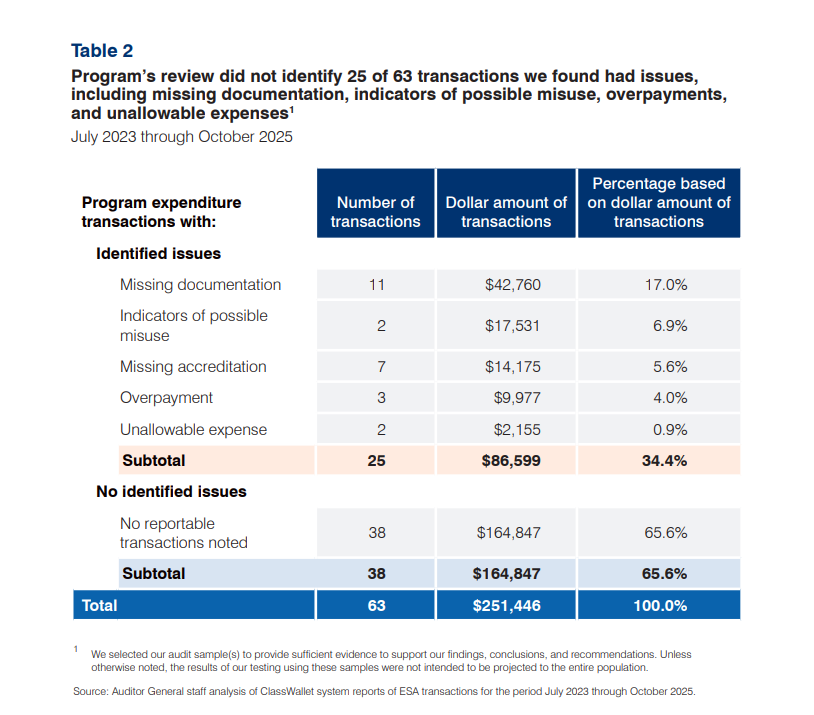
The 34.4% figure comes from dividing $86,599 in flagged transactions by the $251,446 sample. But Table 2 of Finding 2024-04 breaks those flagged transactions into five categories, and only two of them — “unallowable expense” ($2,155) and “overpayment” ($9,977) — involve money the program should not have disbursed.
The other three — missing documentation ($42,760), missing accreditation ($14,175), and “indicators of possible misuse” ($17,531) — are paperwork and compliance gaps. A tutor’s accreditation certificate that wasn’t uploaded is not the same thing as a misspent dollar. The actual confirmed misspending share within the sample (combining 0.9% unallowable expenses plus 4% overpayments) is about 4.9%, not 34%. Moreover, as the report concedes, even the 4.9% figure cannot be projected to the entire program.
In short, Harris conflates paperwork issues with misspending and treats a non-generalizable sample as generalizable, even though the auditor general warned readers not to do exactly that. Then Harris’s manufactured anti-ESA talking points are repeated ad nauseum by politicians and political activists.
Harris built an entire investigative series on a Department of Education internal review that supposedly reported a 20% misuse rate — except the internal review, like the auditors’ sample, was not designed to be projected. Harris projected it anyway.
When the same Department then produced a separate analysis suggesting misuse was minimal, Harris turned around and faulted that study for over-generalizing from its sample. For Harris, non-generalizable findings become generalizable when they damage ESA. Generalizable findings become non-generalizable when they don’t.
The convenient feature of this method is that the error always points the same direction. A reporter who genuinely struggled with the statistics of audit sampling would make mistakes in both directions over time. Harris’s don’t. They cluster.
And they remain uncorrected. Harris’s original 20% claim has never been retracted. The “random sample” language and the 34% framing are now circulating through campaign statements, legislative press releases, and social media posts, citing Harris’s distorted reading of the Auditor General report.
One cannot help but notice that Harris’s manufactured anti-ESA talking points come at a moment when anti-ESA groups are gathering signatures for two ballot initiatives to curb and regulate the ESA program. One also cannot help but wonder whether the downstream political effect is more than incidental to the reporting.
The Auditor General’s findings on ESA are real and worth engaging on their own terms. The program’s risk-based audit methodology is likely better than any other program in the state, but it could still be improved. The auditor has some substantive criticisms, and ADE will have to answer them.
Arizonans deserve honest reporting on those findings, not statistical fictions dressed up as “journalism.”
Jason Bedrick is a Senior Research Fellow and Corey DeAngelis is a Research Fellow at The Heritage Foundation’s Center for Education Policy.
Arizona’s trailblazing Empowerment Scholarship Accounts program enables the families of more than 102,000 students to choose the learning environments that work best for their children.
All Arizona K-12 students are eligible for an education savings account, which lets families direct their children’s education funding toward private schools, tutoring, curricula, therapies, and other educational expenses that fit their children’s unique needs.
Families love it. Three-quarters of parents of school-aged children in Arizona support it.
Yet, although the ESA program is very popular and highly accountable, special-interest groups pushing two separate ballot initiatives are seeking to curtail and regulate it. Advocates working on both campaigns have been caught on camera giving false information to voters whom they are soliciting to sign their petitions.
The initiative aims to regulate the Empowerment Scholarship Account program in several ways, including restricting eligibility to families earning under $150,000 annually—less than the median income of an Arizona firefighter married to a registered nurse—which could kick tens of thousands of children out of the program.
Although students with special needs would still be eligible, they would have to spend 45 days in a public school before getting access to the ESA.
As the Goldwater Institute detailed, the initiative would impose a host of unnecessary and harmful regulations on private schools and homeschoolers. It would also severely restrict what families can buy with their ESA funds, and it would confiscate any unspent funds remaining in a family’s ESA at the end of the year, punishing families who have spent wisely and saved. Those funds would be redirected to district schools that did not educate the ESA students.
The second campaign, Fortify AZ, is more surprising. It is backed by the American Federation for Children, a pro-school choice group.
Their initiative mostly mirrors the union-backed anti-ESA initiative, including a modified version of a provision that the Goldwater Institute has warned “[t]hreatens to block parents from buying basic school supplies and grind the ESA program to a halt with mindless bureaucratic red tape.” However, it would retain the ESA program’s universal eligibility and would not confiscate yet-to-be-used ESA funds.
Nevertheless, the American Federation for Children initiative is worse in other ways, as it would impose regulations and restrictions that the union-based initiative does not.
For example, it would require all ESA students to take a standardized test—something no school choice law in Arizona has required in three decades—and would eliminate two of the four ways that families can spend their ESA funds, leaving only direct pay and “Marketplace,” which is an online platform managed by ClassWallet.
The last provision is particularly puzzling, as the American Federation for Children claims its initiative is intended to “strengthen fiscal accountability and prevent fraud,” which it would supposedly accomplish through “an online marketplace payment system.” According to the Arizona Department of Education, only 0.3% of ESA funds have been spent on fraudulent or egregious purchases, and nearly all the fraud was in Marketplace.
Meanwhile, the two payment methods that the American Federation for Children would inexplicably eliminate—debit cards and reimbursements—have almost no fraud. It makes zero sense to eliminate the more accountable payment options in the name of “accountability.”
The American Federation for Children ballot initiative goes against the wishes of nearly every ESA family, 90% of whom say they support having ESA debit cards.
Arizona School Choice Advocates Oppose Both Initiatives
“The entire Arizona school choice coalition opposes both anti-ESA initiatives,” explains Jenny Clark, the founder and executive director of Love Your School, a local school choice group.
“These initiatives have the potential to disrupt the education of tens of thousands of students,” warned Clark. “They would make it harder for families to use their ESAs, impose unnecessary regulations of private schools and homeschoolers, and even throw children out of the program and potentially out of the schools that serve them.”
Dan Kuiper, the executive director of the Arizona Christian Education Coalition, agrees. “These initiatives were crafted and funded by out-of-state special interest groups without any input from Arizona families or education providers.”
Kuiper worries that if either initiative were to pass, it “would force education providers who serve even one ESA family, including those who serve children with disabilities and special needs, to become part of the government bureaucracy that has already failed many of these families, causing them to seek the alternatives that the ESA offers their children.”
National school choice organizations are also weighing in. EdChoice, the nation’s premier school choice organization, also opposes both ballot initiatives because they would impose “new restrictions” that “would do little to improve accountability while directly reducing the flexibility that families value most.”
Caught on Camera: Initiative Backers Misleading Voters
Under Arizona law, citizens can bypass the Legislature by collecting enough signatures to place a measure directly before voters. Once enough valid signatures are gathered, the initiative goes on the ballot, and a simple majority decides the law.
The ballot initiative process depends entirely on voters understanding what they’re signing. That process is undermined when activists give false or misleading information to voters.
Unfortunately, that is exactly what signature gatherers working for both initiatives are doing.
In one video taken by an ESA parent, a signature gatherer working on behalf of the American Federation for Children initiative made it appear as though the ballot initiative was creating a new school choice program rather than curtailing an existing one. She claimed erroneously that the ballot initiative was “to help out with the cost of charter schools, private schools, tutoring, for the kids.”
Not only do charter schools not charge tuition, but full-time charter school students are not eligible for ESAs.
Worse, the American Federation for Children signature gatherer appeared to encourage Arizona voters to also sign the other, union-backed anti-school choice petition, claiming that it is “the same thing,” albeit with an income cap. “This is just to help get it onto the ballot,” she explained, “either or, whichever one you sign.”
When the ESA parent challenged the signature gatherer, noting that the ESA program already exists, she had no response.
This was no isolated incident.
In another video, a signature gatherer working for the American Federation for Children erroneously stated that their initiative was “to keep the ESA scholarship for families.” Of course, no initiative is needed for that.
Even more troubling, the American Federation for Children signature gatherer misrepresented the initiative, falsely portraying it as “not restrict[ing] ESA funds.”
As in the other video, the American Federation for Children signature gatherer told the voter that she could “sign both” anti-ESA petitions.
In a third video, a pair of signature gatherers representing each of the two initiatives falsely claimed that their ballot initiatives expanded school choice.
When asked what the ballot initiative would do, one signature gatherer misrepresented that it was “to support the children so that they get the funding … to receive the funding and expand the Empowerment Scholarship program.” The second gatherer also fraudulently asserted it was “to expand the [ESA] program.”
When the voter asked the first signature gatherer how the initiative would expand the ESA program, she replied, “By adding more funds.” That is false. The ESA program is already fully funded via the state funding formula. Neither initiative adds additional funding.
The series of false statements by the signature gatherers working for both anti-ESA initiatives could lead to legal trouble.
Arizona Revised Statutes § 19-116 states: “A person who is a circulator of an initiative or referendum petition and who induces any other person in the circulator’s presence to sign the initiative or referendum petition by knowingly misrepresenting the general subject matter of the measure is guilty of a class 1 misdemeanor.”
Likewise, Arizona Revised Statutes § 19-119.01 states that “any fraudulent means, method, trick, device or artifice to obtain signatures on a petition” constitutes “petition signature fraud.”
Whether Arizona’s anti-school choice attorney general actually prosecutes the fraud is an open question. But one thing is certain: Both anti-ESA ballot initiatives would hurt the children who currently benefit from the ESA.
“Neither of these initiatives deserves to reach the ballot,” said Clark. “If you’re approached to sign either one, the right answer is simple: Decline to sign.”
Jason Bedrick is a Senior Research Fellow at the Heritage Foundation’s Center for Education Policy.
The coalition behind a ballot initiative to roll back the universality of Arizona’s school choice program is facing a campaign finance complaint.
On Thursday, the Protect Education Accountability Act Now Committee (PEANC) was made subject to a complaint, reviewed by AZ Free News. PEANC was accused of falsely claiming that out-of-state contributors amounted to a mere nine percent of funding.
PEANC filed the ballot initiative, “Protect Education Act” last month. If approved, the initiative would impose an income cap on enrollment in the Empowerment Scholarship Account Program, among other restrictions to include an elimination of funding rollover. The Protect Education Act superseded an earlier version, the “Protect Education, Accountability Now Act.”
In order to make the ballot, the initiative will need nearly 256,000 signatures. PEANC reported gathering over 150,000 signatures during a virtual press conference on Friday.
The complainant, Jack Johnson Pannell, cited a disclaimer posted to the bottom of PEANC’s website. That disclaimer reflects PEANC’s total out-of-state contributors account for only nine percent of its total funding.
Arizona law requires political action committee advertisements to disclose the aggregate percentage of out-of-state contributors as calculated at the time the advertisement was produced for publication, display, delivery, or broadcast.
Pannell’s complaint called for a declaration that PEANC violated Arizona campaign finance disclosure law and an action against the committee.
Pannell said on X that Arizona families deserve the truth behind PEANC. Pannell is the founder of Trinity Arch Prep School for Boys, a microschool.
“More than 100,000 families are choosing great options for educating their children,” said Pannell. “It’s a cheap shot to accuse hardworking people of cheating the system. It just ain’t true.”
I’m proud to file this complaint because AZ families deserve the truth. More than 100,000 families are choosing great options for educating their children. It’s a cheap shot to accuse hardworking people of cheating the system. It just ain’t true. #schoolchoicehttps://t.co/FFz9MkTWLh
Contrary to this disclaimer, campaign finance records reveal that 98 percent — $4.5 million, or nearly all of PEANC’s $4.6 million in funding — have come from special interest groups in Washington, D.C.
That $4.5 million came from the National Education Association in four allotments delivered throughout February and March. The first payments from the NEA (over $2.3 million) came on February 13 — exactly a week after PEANC registered their website domain.
The earliest available archived version of the site captured on February 12 reflected an out-of-state contributions disclosure totaled at 50 percent.
Other major donors included the Arizonans For Quality Education ($50,000), Nita and Phil Francis ($25,000), and Arizona Education Association ($10,000).
99 percent of AFQE’s funding has come from “shadow sponsors”: unnamed corporations and LLCs. The remainder of the funding, less than half of a percent, came from Christopher Kotterman on behalf of the Friends of ASBA.
Kotterman became a senior policy advisor for Gov. Katie Hobbs in late 2024.
Phil Francis is the retired chairman and CEO of PetSmart; Nita Francis formerly chaired the Valleywise Health Foundation board.
Correction: A previous version of this story incorrectly listed Justan Rice as the current chairman of Arizonans For Quality Education (AFQE). Rice left AFQE in June 2025 before the donation to PEANC was made.
AZ Free News is your #1 source for Arizona news and politics. You can send us news tips using this link.
For more than a decade, the teachers’ unions and their allies at Save Our Schools (SOS) have made their mission clear: stop school choice in Arizona. They fought the expansion of our state’s Empowerment Scholarship Account (ESA) Program at every turn. And after the program was made universal in 2022, they have endlessly pushed to repeal the expansion—including a failed ballot initiative where their signature count was off by more than 50,000. (Yes. These are the people pushing public education.)
With another election around the corner, SOS and the teachers’ unions have once again launched a ballot initiative designed to cripple ESAs. But a funny thing has happened in their efforts to get on the ballot. SOS and the teachers’ unions are suddenly claiming that the initiative isn’t about “eliminating the program.” And they’re pushing a talking point that their only concern is that the program isn’t “functioning properly.”
It’s a remarkable rewrite of history—and Arizona voters shouldn’t buy it…