Activists reported that they have turned in more than 420,00 signatures for a ballot initiative that would end the universality of Arizona’s school choice program.
Supporters wearing red shirts reading “Public School Proud” affiliated with Save Our Schools Arizona (SOSA) gathered outside the secretary of state’s office to watch the box truck delivery of the boxes containing the signatures for the ballot initiative. Both SOSA and the Arizona Education Association (AEA) were behind the initiative.
SOSA and the AEA contend the universality of the Empowerment Scholarship Account (ESA) program diverts far too much in funding away from public schools. Families within the program don’t have to depart their public schools; however, since the expansion of the ESA program to all students in 2022, enrollment in public schools has declined. Defenders of the ESA program counter that per-pupil spending in the program costs less than in public schooling.
ESA program funds may be used for private school tuition, tutoring, online courses, homeschool curriculum, educational therapies, textbooks, educational software, testing fees, and college courses.
The Protect Education Act (PEA) would impose income restrictions on the ESA program.
Estimates show that approximately 20,300 current students in the ESA program would be disqualified under the PEA initially, though that number would grow to exclude more than half of Arizona’s families with school-aged children due to inflationary impact on incomes outpacing the income cap adjustment.
The act would also impose accreditation requirements and further restrictions on spending.
The ESA program has reported the enrollment of more than 100,000 students. More than 8,200 were listed as new students enrolled for the next school year.
Those who support keeping the universality of the ESA program have been maneuvering to preserve protections for some member families.
The Republican majority in the state legislature passed a ballot measure of their own last month: HCR 2048, the “Military Families College Savings and Scholarship Protection Act,” which would amend the Arizona Constitution to prohibit the confiscation of ESA program funds from students belonging to military families.
Should voters approve both the lawmakers’ measure and PEA, it is likely the latter would be voided under language included in the former.
In addition, Doug Ducey, the former governor who signed universal school choice into Arizona law, made an announcement Thursday of a political action committee dedicated to securing school choice protections for military families. Ducey was announced as the chairman of the Protect Military Families PAC.
“Out-of-state special interests and their union allies are trying to take educational scholarships away from the children of Arizona’s military families,” said Ducey.
Serving alongside Ducey on the political action committee is Ashley Ragan, president of InCompliance AZ.
Out-of-state special interests and their union allies are trying to take educational scholarships away from the children of Arizona’s military families.
That is why today, we are proud to launch Protect Military Families PAC @ProtectMilFam.
The Goldwater Institute, a public policy think tank and litigation organization, filed a motion in the Maricopa County Superior Court earlier this week on behalf of two military families involved in the ESA program.
The organization said that about 1,000 other military families stand to be disqualified from the ESA program should the universalization end.
AZ Free News is your #1 source for Arizona news and politics. You can send us news tips using this link.
For months, we have documented the pattern of errors, distortions, and outright fabrications that characterize the coverage of Arizona’s Empowerment Scholarship Account program by Channel 12’s political reporter Craig Harris. Each new episode—the fabricated 20% fraud claim, the defiance in the face of correction by the Arizona Department of Education itself, the constant shifting of goalposts as each of his claims is debunked—seemed like it might result in Channel 12 taking appropriate corrective action.
But they never did.
Last week, at the Arizona Legislature’s final stretch of its 2026 session, the mask came off entirely.
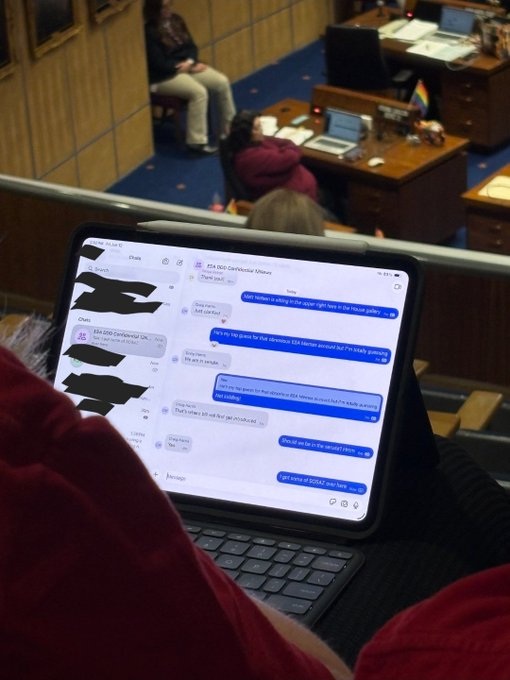
While lawmakers debated a series of consequential ESA-related bills and resolutions on Thursday and Friday—including a constitutional amendment to protect military family scholarships—Harris was captured on camera doing something that no journalist who takes the job title seriously can explain away: coordinating, via text message, with members of Save Our Schools Arizona, the anti-school-choice advocacy group that is a principal sponsor of the Protect Education Now ballot initiative, about where they should position themselves inside the Capitol building for maximum political impact.
Text message conversation between Channel 12’s Craig Harris and anti-school choice activists.
Let that sink in. A reporter on the education beat, covering legislation in real time, was not observing the advocacy groups in the building. He was directing them.
The text exchange was visible on the screen of a Save Our Schools activist—readable thanks to a conspicuously large font and no privacy screen—and was flagged by our Heritage Foundation colleague Corey DeAngelis, who shared images of the messages on social media after receiving them from a local activist. Harris subsequently confirmed on X that the images of the group chat, named “ESA DDD Confidential 12News,” were real.
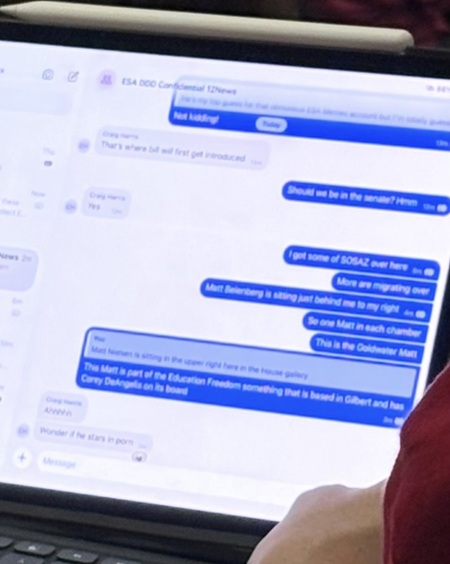
After Harris told the activist that he was in the state senate chamber as that is “where [the] bill will first get introduced,” Save Our Schools board member Kathy Boltz asked Harris for advice regarding where their team of activists should place themselves in the capitol building. “Should we be in the senate? Hmm,” she asked. Within a minute, Harris answered in the affirmative.
This is not ambiguous. This is not a misunderstanding. This is a journalist using his knowledge of the Arizona Legislature’s political process to provide tactical advice to an advocacy group that has a direct political stake in the legislation he is supposed to be covering neutrally.
Harris was no longer covering the news. He was helping to manufacture it.
But that wasn’t the worst of it.
The same captured text conversation revealed Harris mocking a local school choice supporter, asking whether the individual “stars in porn.”
This derision was not just a lapse in professionalism. This was contempt—contempt for the families, advocates, and ordinary citizens who show up at the Capitol to make the case for educational freedom, expressed in a private conversation with advocates on the other side of the issue.
Text message conversation between Channel 12’s Craig Harris and anti-school choice activists.
Multiple Arizona politicos were quick to call out the behavior publicly. State Senator Jake Hoffman called for Channel 12 to fire Harris and called on the station to “open an investigation into every story he was involved in and retract any instance of undisclosed coordination.” Hoffman observed that this coordination with activists is “precisely the kind of unethical behavior that has caused the majority of Americans to deeply distrust the media.”
Arizona Republic columnist and former State Senator Paul Boyer called it “a really bad look” for Channel 12 to have their reporter, “who is also reporting on these same groups” to be discovered “coordinating with them at the legislature to defeat the same type of legislation he’s myopically focused on.” Similarly, J.P. Twist, executive director of Citizens for Free Enterprise, called out Harris for “literally strategizing with a partisan union to undermine parents’ rights.”
The parent company of Channel 12 publishes a “Principles of Ethical Journalism” statement committing its journalists to the values of truth, independence, public interest, fair play, and integrity. It’s hard to see how coordinating with one group of political activists and crudely mocking the other side comports with those standards.
Sadly, Harris’s breach of journalistic ethics does not end there.
Later that night, in a hearing on legislation to protect military family scholarships, Harris took to social media to characterize two of the three supporting witnesses who testified as people “making money off ESAs,” implying their support was financially motivated rather than principled.
One of those witnesses was Kevin Biesty, spokesperson for the Arizona Christian Education Coalition. As Biesty detailed on X, he reached out to Harris privately and asked him to correct or remove the post. Harris declined. As Biesty observed, the logic Harris applied to him — that representing clients who are affected by ESA policy makes one a financially conflicted advocate — is never applied to the other side. The staff and lobbyists of Save Our Schools Arizona and the teachers unions, who are paid to oppose the ESA program, are never characterized by Harris as people “making money off” the issue.
Harris also claimed that no military family spoke at the hearing. That too was false. Biesty had personally presented a written statement from a military mother who could not remain for the late-night session, and referenced letters from other military families — all of this while Harris was in the room. At no point did Harris ask Biesty for that mother’s contact information or seek to include her perspective in his coverage. He was, however, apparently attentive enough to the gallery to communicate with his Save Our Schools contact — the same ESA mother and SOS board member who, Biesty observed, is never identified as such in Harris’s stories — while sitting at the press desk on the floor.
Indeed, when ESA students and their families share their stories, Harris is quick to dismiss them. Recently, a young ESA student with disabilities named Jordan Visser shared on video about the ways the Protect Education Now initiative would harm students like himself. Harris went on social media to dispute his account, claiming that the initiative would not affect students with special needs—effectively accusing a student with disabilities of lying about the impact of a ballot measure on his own situation.
He was wrong. As the student’s mother, Kathy Visser, and others documented, the text of the initiative itself bore out what the student had said—the ESA funds that the family had saved to continue providing him with services would be seized by the state if the Save Our Schools ballot initiative were adopted.
The irony of Harris’s posture—aggressively checking the credibility of a disabled student while coordinating inside the Capitol with the very advocacy group sponsoring the initiative in question—encapsulates the problem. It is not that Harris is a journalist who occasionally makes mistakes. It is that the mistakes run in one direction, consistently, and that when corrected, he doubles down rather than acknowledging any error. And it is now documented, on camera, that he was coordinating tactics with one side of the debate he was purportedly covering.
Arizona families with children in the ESA program deserve better than a reporter who coordinates with the opposition at the very hearings he is assigned to cover. Arizona viewers deserve better than a news organization that has allowed this pattern to continue unchecked. And the thousands of children—including those with disabilities—who rely on these scholarships deserve a press corps willing to represent their stories honestly.
Channel 12 has not issued a correction or a retraction of the false fraud statistics. It has not yet acknowledged Harris’s coordination with activists or the mockery of a school choice supporter.
Channel 12’s parent company should answer a simple question: Is the behavior documented at the Capitol last week consistent with its Principles of Ethical Journalism? If not, what will it do about it?
Jason Bedrick is a Senior Research Fellow and Matthew Ladner is aSenior Advisor for education policy implementation at The Heritage Foundation’s Center for Education Policy.
Democratic Rep. Yassamin Ansari (AZ-03) again demanded that Immigration and Customs Enforcement (ICE) be abolished in her first State of the District address on Wednesday.
The address — which was not livestreamed or posted to any of Ansari’s social media accounts — was largely an indictment of President Donald Trump and his administration.
“We are living through the most corrupt and the most authoritarian administration in American history, led by a lunatic with no regard for human life,” said Ansari.
Ansari advocated for the immediate abolition of ICE. She claimed the agency was a murderous, chaotic, cruel entity lacking accountability.
“It is absolutely clear that we must do everything in our power to stop and abolish ICE as quickly as possible,” said Ansari. “Immigration enforcement [is not] locking up tens of thousands of people into what can only be described as concentration camps run by private prison companies designed to profit off of human suffering.”
The congresswoman has made similar calls for immigration enforcement abolition throughout her freshman tenure. At the Munich Security Conference in February, Ansari advocated for abolishing all immigration enforcement in addition to implementing a wealth tax and subsidizing healthcare, homeownership, and childcare.
During her State of the District, Ansari also announced her endorsement of a ballot proposal to gut universal school choice in Arizona, the Protect Education Act. Present for this recommendation were the state’s largest teacher’s union, the Arizona Education Association (AEA), and the activist group Save Our Schools Arizona.
Featured speakers at Ansari’s first State of the District were Reyna Montoya, founder and CEO of Aliento Arizona; Mike Renaud, president and CEO of Valle Del Sol; Marisol Garcia, president of the AEA; Karyleni Alburquerque, Ansari’s former ambassador for the 3rd congressional district; Dr. Matthew Whitaker, executive director of the George Washington Carver Museum and Cultural Center; and Jake Hylton, executive director of Lookout Publications.
Andrew Simek, Ansari’s field representative and community manager, claimed in a LinkedIn post that Ansari has attended over 300 community events, hosted over a dozen town halls, logged over 1,000 volunteer hours, and engaged with over 77,000 constituents.
On that last point — it was unclear whether that total for constituents included any illegal aliens facing detainment or deportation, since Ansari has claimed this class as part of her “historically underserved and underrepresented” constituency.
Ansari disclosed during her address that she prioritized community outreach to these underserved and underrepresented populations, specifically calling out the Afghan refugees, Iranian students, and Sudanese and Asian communities.
The congresswoman also advocated for government-run pharmacies, taxation on excess profits by oil companies, expansion of government-run housing, expansion of government-subsidized rent, government subsidies for house down payments, double wages for overtime, and universal healthcare.
Ansari also laid claim to securing over $17 million in federal funding for community projects, or Community Project Funding:
$2.1 million for the city of Phoenix Fire Wildland Urban Interface;
$2 million for the Arizona State University Center for Heat Resilient Communities;
$2 million for the Arizona State University CHIPS and Domestic Manufacturing Research Initiative;
$2 million for the city of Phoenix’s Real Time Crime Center;
$2 million for the town of Guadalupe’s Biehn Colony Park Reconstruction;
$1.1 million for the city of Tolleson Wastewater Digester No. 4 Project;
$1 million for the city of Tolleson Multi-Modal Path Lighting Project;
$1 million for the Arouet Foundation’s 2026 Reentry Prosperity Model;
$1 million for the Valley Metro Community Safety Project;
$850,000 for the city of Glendale Transportation Improvements;
$830,000 for the city of Phoenix Central Arizona Shelter Services’ Single Adult Shelter Renovations;
$800,000 for the city of Phoenix Alternative Fuel Vehicle Fires Mitigation;
$580,000 for Axiom Community of Recovery’s Transition to Recovery and Reentry Program; and
$250,000 for Phoenix Sky Harbor Airport Improvements
Ansari introduced 32 bills and cosponsored over 450 bills. None of her bills have advanced beyond introduction. Two bills propose to overhaul and defund ICE.
AZ Free News is your #1 source for Arizona news and politics. You can send us news tips using this link.
A new round of videos confirms that the spread of misinformation is extensive on both campaigns.
The entire Arizona school choice coalition opposes both measures because they would curtail the ESA program, which enables the families of more than 102,000 Arizona students to choose the learning environments that work best for them.
The initiatives would greatly disrupt their education by imposing new restrictions on how families can spend their funds, layering on bureaucratic red tape, and—in the case of the union-backed measure—kicking tens of thousands of children out of the program entirely.
In the latest clips, signature gatherers working for Protect Education Now, a joint project of Save Our Schools Arizona and the Arizona Education Association, and Fortify AZ, backed by the American Federation for Children, misrepresent the basics of the initiative and the ESA program itself.
Surprisingly, the talking points used by the supposedly pro-school choice campaign frequently mirror those used by ESA opponents.
Both Campaigns Grossly Exaggerate Misspending
In video after video, signature gatherers working for both initiatives wildly exaggerate the prevalence of fraud in the ESA program and hype the supposed purchase of “luxury” items such as jewelry, lingerie, trips to Disneyland, and other tabloid-ready spending that are forbidden under the ESA regulations.
One signature gatherer wearing a badge for Petition Partners, the group hired by the American Federation for Children-backed campaign, claimed that the ESA funds were used for jet skis and vacation rentals.
Another signature gatherer wearing a Petition Partners badge claimed there was $10.3 million in misspending in 2025. She failed to note that that accounts for barely 1% of total ESA spending, and that the vast majority of unallowed expenses were innocent mistakes, such as backpacks, lunch boxes, and water bottles.
Although there is room for improvement, Arizona’s ESA program is among the most accountable of any Arizona government program.
The Arizona Department of Education has confirmed that only 0.3% of ESA spending has been flagged as fraudulent or egregious—and nearly all of that occurred in the ClassWallet Marketplace channel that the American Federation for Children-backed initiative would preserve, while eliminating the debit card and reimbursement options that have almost no fraud at all.
Both Campaigns Spread Misinformation
Some gatherers from both campaigns have gone further still, telling voters verifiably false information in order to induce them to sign their petitions.
One Petition Partners signature gatherer told a voter that ESA parents were not required to submit receipts and that they could “buy a puppy” with their ESA and “say it’s for science class.” In fact, parents are required to provide receipts and other documentation. Moreover, the Arizona Department of Education confirmed that no ESA funds have been spent on puppies.
Another Petition Partners signature gatherer told a voter that parents were using ESA funds on cruises and home remodeling, while yet another claimed they were buying “cars and houses” with ESA funds. The Arizona Department of Education confirmed that no ESA funds have been spent on cruises, cars, houses, or home remodeling.
In some cases, the signature gatherers misrepresent the ballot initiatives to make them appear to be providing more education options for students.
In one video, a signature gatherer wearing a badge for FieldWorks, the group hired by the union-backed campaign, falsely tells voters that signing the petition would “help low-income students go to college.” The ballot initiative does no such thing.
In another video, a signature gatherer wearing a Petition Partners badge claims that the ballot initiative was “for everybody to be able to qualify for the [ESA] program.”
When the voter pushed back, noting that all students already qualify now, he replied (incoherently), “Because there’s something that’s against it already, so we [are] trying to get it on the ballot to be voted on instead of it just being changed.”
Ballot initiative workers have even spoken falsely to voters about the nature of their employment. In one video, a signature gatherer wearing a FieldWorks badge falsely tells a voter that he works for the Secretary of State’s office.
FieldWorks, the Arizona Education Association, and Save Our Schools Arizona did not respond to a request for comment.
It is unsurprising, if dishonest, when a teachers’ union and an avowedly anti-choice group resort to these tropes. It is genuinely appalling when a campaign backed by a self-described school choice organization spreads misinformation about a popular school choice program.
The American Federation for Children did not respond to a request for comment.
Previous videos have shown workers from the two campaigns colluding to gather signatures. In a new video, a signature gatherer with a FieldWorks badge that identifies her as a “team leader” introduces a voter to her fiancé, whom she claims is working for the “other education petition,” seemingly referring to the American Federation for Children-backed campaign.
The FieldWorks worker claims to be the “top signature gatherer in the state.” Her fiancé does not appear to be wearing a badge identifying the campaign for which he works, but he is holding a clipboard for the Fortify AZ petition.
When asked for comment, the owner of Petition Partners, Drew Chavez, deferred to their spokesperson David Liebowitz, who runs a self-described “public relations, political and crisis communication firm.”
The spokesperson declined to answer questions about the involvement of the American Federation for Children in crafting the messaging provided to the Petition Partners signature gatherers, instead providing the following statement: “Petition Partners has hands down the most thorough training program in the industry. Each of the more than 800 circulators hired for this effort has spent hours training on how to comply with state law and the facts of the measure itself.” The Petition Partners spokesperson said that they “have had reports of people pretending to be [Petition Partners] team members in an effort to discredit our work.” When asked to confirm or deny the employment of individuals who appeared in the videos, the Petition Partners spokesperson declined to answer.
Jack Reany, an ESA parent from Tucson, says that he has spoken with more than a dozen signature gatherers. He expressed shock at how little they tend to know about the ballot initiatives they’re asking people to sign.
“The public is being dangerously misled,” says Reany. “The fraud-and-accountability narrative is a smokescreen obscuring a deeply consequential piece of legislation: one that would strip legal protections from private schools, remove children from educational environments where they are thriving, and raid savings set aside by disabled students for their future.”
Arizona law is clear. Under A.R.S. § 19-116, knowingly misrepresenting an initiative’s subject matter to induce a signature is a Class 1 misdemeanor.
The videos keep accumulating. Whether Arizona’s anti-ESA attorney general acts on them is another question.
In the meantime, the advice from Arizona’s school choice advocates remains unchanged: If a gatherer approaches you with either petition, decline to sign.
Jason Bedrick is a Senior Research Fellow at the Heritage Foundation’s Center for Education Policy.
Arizona’s trailblazing Empowerment Scholarship Accounts program enables the families of more than 102,000 students to choose the learning environments that work best for their children.
All Arizona K-12 students are eligible for an education savings account, which lets families direct their children’s education funding toward private schools, tutoring, curricula, therapies, and other educational expenses that fit their children’s unique needs.
Families love it. Three-quarters of parents of school-aged children in Arizona support it.
Yet, although the ESA program is very popular and highly accountable, special-interest groups pushing two separate ballot initiatives are seeking to curtail and regulate it. Advocates working on both campaigns have been caught on camera giving false information to voters whom they are soliciting to sign their petitions.
The initiative aims to regulate the Empowerment Scholarship Account program in several ways, including restricting eligibility to families earning under $150,000 annually—less than the median income of an Arizona firefighter married to a registered nurse—which could kick tens of thousands of children out of the program.
Although students with special needs would still be eligible, they would have to spend 45 days in a public school before getting access to the ESA.
As the Goldwater Institute detailed, the initiative would impose a host of unnecessary and harmful regulations on private schools and homeschoolers. It would also severely restrict what families can buy with their ESA funds, and it would confiscate any unspent funds remaining in a family’s ESA at the end of the year, punishing families who have spent wisely and saved. Those funds would be redirected to district schools that did not educate the ESA students.
The second campaign, Fortify AZ, is more surprising. It is backed by the American Federation for Children, a pro-school choice group.
Their initiative mostly mirrors the union-backed anti-ESA initiative, including a modified version of a provision that the Goldwater Institute has warned “[t]hreatens to block parents from buying basic school supplies and grind the ESA program to a halt with mindless bureaucratic red tape.” However, it would retain the ESA program’s universal eligibility and would not confiscate yet-to-be-used ESA funds.
Nevertheless, the American Federation for Children initiative is worse in other ways, as it would impose regulations and restrictions that the union-based initiative does not.
For example, it would require all ESA students to take a standardized test—something no school choice law in Arizona has required in three decades—and would eliminate two of the four ways that families can spend their ESA funds, leaving only direct pay and “Marketplace,” which is an online platform managed by ClassWallet.
The last provision is particularly puzzling, as the American Federation for Children claims its initiative is intended to “strengthen fiscal accountability and prevent fraud,” which it would supposedly accomplish through “an online marketplace payment system.” According to the Arizona Department of Education, only 0.3% of ESA funds have been spent on fraudulent or egregious purchases, and nearly all the fraud was in Marketplace.
Meanwhile, the two payment methods that the American Federation for Children would inexplicably eliminate—debit cards and reimbursements—have almost no fraud. It makes zero sense to eliminate the more accountable payment options in the name of “accountability.”
The American Federation for Children ballot initiative goes against the wishes of nearly every ESA family, 90% of whom say they support having ESA debit cards.
Arizona School Choice Advocates Oppose Both Initiatives
“The entire Arizona school choice coalition opposes both anti-ESA initiatives,” explains Jenny Clark, the founder and executive director of Love Your School, a local school choice group.
“These initiatives have the potential to disrupt the education of tens of thousands of students,” warned Clark. “They would make it harder for families to use their ESAs, impose unnecessary regulations of private schools and homeschoolers, and even throw children out of the program and potentially out of the schools that serve them.”
Dan Kuiper, the executive director of the Arizona Christian Education Coalition, agrees. “These initiatives were crafted and funded by out-of-state special interest groups without any input from Arizona families or education providers.”
Kuiper worries that if either initiative were to pass, it “would force education providers who serve even one ESA family, including those who serve children with disabilities and special needs, to become part of the government bureaucracy that has already failed many of these families, causing them to seek the alternatives that the ESA offers their children.”
National school choice organizations are also weighing in. EdChoice, the nation’s premier school choice organization, also opposes both ballot initiatives because they would impose “new restrictions” that “would do little to improve accountability while directly reducing the flexibility that families value most.”
Caught on Camera: Initiative Backers Misleading Voters
Under Arizona law, citizens can bypass the Legislature by collecting enough signatures to place a measure directly before voters. Once enough valid signatures are gathered, the initiative goes on the ballot, and a simple majority decides the law.
The ballot initiative process depends entirely on voters understanding what they’re signing. That process is undermined when activists give false or misleading information to voters.
Unfortunately, that is exactly what signature gatherers working for both initiatives are doing.
In one video taken by an ESA parent, a signature gatherer working on behalf of the American Federation for Children initiative made it appear as though the ballot initiative was creating a new school choice program rather than curtailing an existing one. She claimed erroneously that the ballot initiative was “to help out with the cost of charter schools, private schools, tutoring, for the kids.”
Not only do charter schools not charge tuition, but full-time charter school students are not eligible for ESAs.
Worse, the American Federation for Children signature gatherer appeared to encourage Arizona voters to also sign the other, union-backed anti-school choice petition, claiming that it is “the same thing,” albeit with an income cap. “This is just to help get it onto the ballot,” she explained, “either or, whichever one you sign.”
When the ESA parent challenged the signature gatherer, noting that the ESA program already exists, she had no response.
This was no isolated incident.
In another video, a signature gatherer working for the American Federation for Children erroneously stated that their initiative was “to keep the ESA scholarship for families.” Of course, no initiative is needed for that.
Even more troubling, the American Federation for Children signature gatherer misrepresented the initiative, falsely portraying it as “not restrict[ing] ESA funds.”
As in the other video, the American Federation for Children signature gatherer told the voter that she could “sign both” anti-ESA petitions.
In a third video, a pair of signature gatherers representing each of the two initiatives falsely claimed that their ballot initiatives expanded school choice.
When asked what the ballot initiative would do, one signature gatherer misrepresented that it was “to support the children so that they get the funding … to receive the funding and expand the Empowerment Scholarship program.” The second gatherer also fraudulently asserted it was “to expand the [ESA] program.”
When the voter asked the first signature gatherer how the initiative would expand the ESA program, she replied, “By adding more funds.” That is false. The ESA program is already fully funded via the state funding formula. Neither initiative adds additional funding.
The series of false statements by the signature gatherers working for both anti-ESA initiatives could lead to legal trouble.
Arizona Revised Statutes § 19-116 states: “A person who is a circulator of an initiative or referendum petition and who induces any other person in the circulator’s presence to sign the initiative or referendum petition by knowingly misrepresenting the general subject matter of the measure is guilty of a class 1 misdemeanor.”
Likewise, Arizona Revised Statutes § 19-119.01 states that “any fraudulent means, method, trick, device or artifice to obtain signatures on a petition” constitutes “petition signature fraud.”
Whether Arizona’s anti-school choice attorney general actually prosecutes the fraud is an open question. But one thing is certain: Both anti-ESA ballot initiatives would hurt the children who currently benefit from the ESA.
“Neither of these initiatives deserves to reach the ballot,” said Clark. “If you’re approached to sign either one, the right answer is simple: Decline to sign.”
Jason Bedrick is a Senior Research Fellow at the Heritage Foundation’s Center for Education Policy.