by Staff Reporter | May 17, 2026 | News
By Staff Reporter |
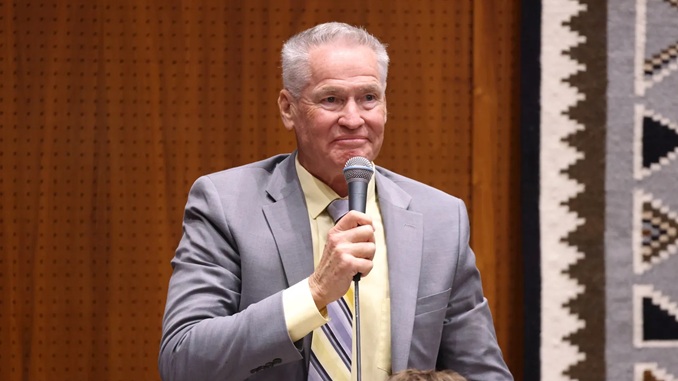
State Rep. Ralph Heap (R-LD10) would like to take the Arizona Corporation Commission (ACC) off the path of green energy and onto a different path in line with President Trump’s energy agenda.
The state’s largest regulated utilities, APS and TEP, are pursuing 14 percent rate hikes with the ACC after receiving other double-digit rate hikes the past few years. Heap, an “Arizona First” candidate, argues that the ACC should be prioritizing ratepayers, and that his approach to the ACC would end the constant upward trend of rates.
Heap’s platform prioritizes individual ratepayers over trendy policy and cash-flush companies: implementing greater protections for rural Arizonans’ energy and water access, rejecting “radical” agendas like the Green New Deal and “corporate welfare” programs, encouraging a free-market energy system, and creating more resistance to rate hikes.
The lawmaker laid claim to the engrossment, passage, or sponsorship of multiple energy-related bills from 2024 to present. Those bills were:
- HB4097: authorizing “bring your own power,” or self-supply, for large customers to expand energy supply options without creating an open retail-choice program;
- HB2679: establishing a defined legal path for financing utility transition costs;
- HCR2022: committing support for nuclear generation through the Palo Verde Generating Station;
- HB2042: creating enforcement on geoengineering activity by prohibiting intentional in-state release of materials for solar radiation management, prohibiting public funding for those technologies, and authorizing attorney general investigations;
- HB2328: limiting rate disparity in intermunicipal water service by requiring municipal providers selling water to another municipality’s public to charge rates constrained by specified comparators;
- HB2331: ensuring reliability within long-range resource planning by requiring covered public power entities and electric utilities to ensure at least 85 percent of relied-on generating capacity comes from reliable resources by 2030;
- HB2915: granting county-administered property tax reductions to homeowners suffering depleted property values due to nearby renewable energy facilities; and,
- HB2918: ending property tax breaks for new utility-scale renewable energy projects.
Since taking office last January, Heap has maintained several leadership positions, including vice chairmanship of the Natural Resources, Energy, and Water Committee.
Prior to his legislative service and ACC run, Heap practiced orthopedic medicine in the East Valley for nearly 40 years. During that time, he participated in medical missions to developing countries where the presence or absence of reliable energy meant life or death. Heap attributes his “ratepayer first” attitude and interest in reliable, affordable energy to those experiences.
Heap married his high school sweetheart, Denise. Together they have three children—including Maricopa County Recorder Justin Heap—and eight grandchildren.
As part of his “ratepayer first” approach, Heap qualified as a Clean Elections candidate. He has sworn against taking money from regulated utilities or their PACs.
Heap has received many endorsements from grassroots leaders along with state and municipal elected officials, including former ACC Commissioner and current state representative Justin Olson (R-LD10), Rep. Eli Crane (R-AZ-02), and a leading Republican lawmaker who resigned earlier this year to run for Congress, Joseph Chaplik.
Many of the heavyweights in the Arizona legislature put in their support for Heap: Arizona Freedom Caucus leader and State Sen. Jake Hoffman (R-LD15) as well as State Reps. Michele Pena (R-LD23), Laurin Hendrix (R-LD14), Khyl Powell (R-LD14), Lisa Fink (R-LD27), Rachel Keshel (R-LD17), Alexander Kolodin (R-LD03), Beverly Pingerelli (R-LD), Michael Way (R-LD15), John Gillette (R-LD30), Teresa Martinez (R-LD16), Leo Biasiucci (R-LD30), Pamela Carter (R-LD04), and Chris Lopez (R-LD16).
Among those municipal endorsements were supervisors from Gila and Navajo counties; the mayors of Payson, Snowflake, and Springerville; and council members for Payson.
Photo credit: Gage Skidmore / CC BY-SA 2.0
AZ Free News is your #1 source for Arizona news and politics. You can send us news tips using this link.
by Ethan Faverino | Feb 8, 2026 | Economy, News
By Ethan Faverino |
Arizona House Republicans on the Natural Resources, Energy, and Water Committee have taken action to address skyrocketing gas prices and utility bills, passing a sweeping package of bills designed to lower fuel costs, enhance energy reliability, and defend ratepayers.
Under the leadership of Chairman Gail Griffin (R-LD19), the measures align with the House Republican Majority Plan’s core priorities of unleashing economic prosperity, promoting government efficiency, and protecting individual rights and liberties.
The legislation, which advanced on a party-line vote with Democrats in opposition, targets the challenges faced by Arizona families, particularly in Maricopa and Pinal Counties, where severe summer fuel blend requirements have driven up prices at the pump. By prioritizing affordability and reliable power, these bills aim to ease the financial burden on households amid rising energy demand.
“The cost of living for Arizona families, including gas and electricity, continues to increase, and Republicans are acting,” stated Chairman Griffin. “This package puts affordability first by lowering fuel costs, protecting ratepayers from higher utility bills, and making sure Arizona has dependable power as demand grows. The Majority Plan is clear: government should work to ease the cost burden on families, not make them worse.”
Bills Tackling High Gas Prices
- HB 2145 (Rep. Griffin): Amends motor fuel statutes to empower the President of the Senate and Speaker of the House to jointly request EPA fuel waivers during shortages if the Governor does not act, providing a defense against price surges.
- HB 2400 (Reps. Willoughby, R-LD13, and Biasiucci, R-LD30): Implements a seasonal suspension of the state’s 18-cent gas tax from May through September in Maricopa and Pinal Counties. The bill ensures local governments are reimbursed for lost highway revenue through allocations from the Arizona Highway User Revenue Fund, including $27.588 million to counties, $39.93 million to cities and towns, and $5.082 million to larger municipalities. It also includes an emergency clause for immediate implementation and exempts the Department of Transportation from rulemaking for one year.
- HB 2696 (Rep. Willoughby): Directs the Arizona Commerce Authority to prioritize reducing fuel and gas prices as its primary objective for two years, expiring December 31, 2029. The authority must collaborate with the oil and gas industry to study repealing the cleaner-burning gasoline blend, building new pipelines, establishing a strategic reserve, and exploring in-state refineries, including reviving a proposed facility in Yuma County. Status updates will be provided to legislative committees, with a final report due by October 1, 2026.
- HB 2955 (Rep. Willoughby): Amends motor fuel standards to end the expensive summer fuel blend in populous counties, subject to EPA waiver under the Clean Air Act. It allows for gasoline compliant with ASTM D4814 and vapor pressure limits, addressing supply shortages and enabling lower-cost alternatives.
- HCM 2008 (Rep. Willoughby): A concurrent memorial urging Congress and the EPA to eliminate the federal gas tax on Arizona’s cleaner-burning gasoline in Maricopa and Pinal Counties from May to September or grant the EPA administrator emergency waiver authority for costlier blends. This recognizes Arizona’s progress toward National Ambient Air Quality Standards while highlighting the undue tax burden on specialized fuels.
Supporting these efforts are additional bills to promote long-term solutions:
- HB 2014 (Rep. Fink, R-LD27): Requires the Department of Environmental Quality (ADEQ) and Arizona Department of Agriculture to conduct air emissions modeling and feasibility studies on alternative gasoline blends, including federal reformulated, California phase 3, and conventional options. Reports must be published by September 30, 2027, with $100,000 appropriations each for modeling and studies.
- HB 2401 (Willoughby and Biasiucci): Mandates biennial reviews by ADEQ of fuel formulations available under federal standards, assessing air quality impacts in regulated areas, and submitting recommendations to the Department of Agriculture, the Governor, the President of the Senate, the Speaker of the House, and the Secretary of State by December 31 of each review year.
- HB 2428 (Griffin): Authorizes voluntary mobile emissions reduction credit programs, permitting emissions credits for nonroad engines under Clean Air Act guidelines, with permits issued by ADEQ for up to 20 years, supported by chambers of commerce, utilities, and Maricopa County.
“Today we heard from organizations with the time and resources to lobby against affordable prices for Arizona families, but not from the families paying more at the pump,” explained Majority Whip Julie Willoughby. “Working families cannot take time off to come to the Capitol and ask for relief; that is why we are here to help be their voices.”
“Eighteen cents a gallon may sound small to some, but it matters to families trying to make ends meet,” Willoughby added. “I will do everything in my power to deliver relief now while we continue working to fix the fuel blend and supply problems. Families need lower prices, not excuses.”
Bills Ensuring Energy Reliability and Ratepayer Protections
- HB 2331 (Reps. Marshall, R-LD7 and Heap, R-LD10): Renames and expands energy reliability statutes to require public power entities and service corporations to prioritize domestically produced fuels, minimize foreign reliance, and evaluate resources for affordability, reliability, and cleanliness. Defines “clean energy” to include low-emission sources like nuclear and natural gas, with reliable sources needing at least 50% capacity factor and rapid ramp-up capabilities. The bill emphasizes hydrocarbons and finds domestic sourcing essential for public health and safety.
- HB 2756 (Reps. Griffin and Blackman, R-LD7): Adds provisions for public power entities and electric corporations to report quarterly on new extra-high load factor customers, including interconnection requests and completions. These customers must be factored into load growth projections. The Arizona Corporation Commission (ACC) is directed to adopt rules on contracts, minimum billing, and pre-execution reviews to protect other ratepayers, excluding member-owned cooperatives. Requires cost-of-service studies within 180 days and an ACC workshop within 90 days to assess impacts on residential bills and potential new customer classes.
These bills now advance for further legislative consideration.
Ethan Faverino is a reporter for AZ Free News. You can send him news tips using this link.
by Matthew Holloway | Jan 30, 2026 | News
By Matthew Holloway |
The Arizona House Republican Majority advanced five of six bills aimed at aligning state law with key provisions of the Trump administration’s signature legislation, H.R. 1, the One Big Beautiful Bill Act, during a meeting of the House Health and Human Services Committee on Monday.
According to a pre-meeting press release from the Arizona House GOP Conference, the six-bill package focuses on Medicaid eligibility verification, reporting requirements, rural health workforce issues, and related health policy changes. GOP leaders said the measures are intended to mirror select federal reforms included in H.R. 1, including restoring accountability to Medicaid, strengthening rural health care access and workforce participation, and protecting taxpayer resources.
The following bills were identified by House GOP leadership as part of the package:
Medicaid-related measures:
- HB 2796 (Rep. Michael Carbone, R-LD25) — AHCCCS; enrollment verification; presumptive eligibility: Strengthens eligibility verification for the Arizona Health Care Cost Containment System (AHCCCS) by requiring cross-agency data matching to verify income, residency, deaths, and out-of-state activity. The bill limits reliance on self-reporting where not federally required and tightens presumptive eligibility primarily to children and pregnant women. Advanced 7–5.
- HB 2689 (Rep. Ralph Heap, R-LD10) — Hospitals; patient immigration status; reporting: Establishes reporting requirements related to hospital patient immigration status. Advanced 7–5.
Public assistance, health access, and workforce-related measures
- HB 2396 (Rep. Leo Biasiucci, R-LD30) — SNAP; allowed purchases; waiver: Addresses Supplemental Nutrition Assistance Program (SNAP) policy options, including purchase eligibility and waiver authority. Advanced as amended 7–5.
- HB 2190 (Rep. Julie Willoughby, R-LD13) — Physician Assistant Licensure Compact: Seeks to join Arizona in an interstate compact to facilitate licensure portability for physician assistants. Advanced 11–1.
- HB 2437 (Rep. Selina Bliss, R-LD1) — EMS reciprocity; compact: Would establish an interstate compact for emergency medical services credential reciprocity. Held.
- HB 2233 (Rep. Walt Blackman, R-LD7) — Arizona Rural Health Transformation Fund; reporting: Requires additional reporting related to the Arizona Rural Health Transformation Fund. Advanced as amended/strike everything 7–5.
The One Big Beautiful Bill Act was passed by the U.S. Congress under budget reconciliation and signed into federal law on July 4, 2025. It includes broad federal policy changes affecting tax policy, Medicaid funding, SNAP, border security, and other areas.
The House Health and Human Services Committee meeting was open to the public and available for viewing online via the Arizona Legislature’s official video player.
Matthew Holloway is a senior reporter for AZ Free News. Follow him on X for his latest stories, or email tips to Matthew@azfreenews.com.
by Ethan Faverino | Jan 17, 2026 | Economy, News
By Ethan Faverino |
State Representatives David Marshall (R-LD7) and Ralph Heap (R-LD10) introduced House Bill 2269, a measure to eliminate the state sales tax on electric and gas utility bills for Arizona residents and businesses.
The proposed legislation would suspend the state’s 5.6% sales tax on electricity and natural gas utilities until either $2.3 billion in cumulative tax relief has been provided to Arizonans or December 31, 2046—whichever comes first.
Once the $2.3 billion threshold is reached, the Legislature would then decide whether to extend, modify, or reinstate the exemption.
“People are getting crushed by rising costs, making it harder to live and do business in our state,” said Representative Marshall. “Almost everyone pays a local utility for electricity or gas. Eliminating the tax on this expense represents one of the most immediate and direct ways we can help working families keep costs affordable.”
The 5.6% tax on electricity and gas quietly adds up on monthly bills, leaving the average household paying more than $100 a year in utility tax—funds that could instead support necessities like groceries, housing, and childcare.
Representative Marshall highlighted a structural concern with the current system: “Taxing electric and gas utilities creates a perverse incentive for the government to support increased rate hikes. If rates go up, the state gets more money. That leads some to view rate increases as a source of potential funds for their liberal pet projects. That’s not right; it’s time to put the people of Arizona first.”
“While we’re unsure of any legal way to get ratepayers’ money back, there are things we can do to help reduce costs today,” Marshall continued. “In my opinion, the next best thing we can do is try to provide justice by eliminating taxes on electric and gas utilities moving forward. That’s why, over the next 20 years, we are proposing no state tax on utilities until every penny of the $2.3 billion that was wrongfully extracted from the Arizona ratepayer is metaphorically ‘paid back’ to hardworking families.”
He added, “This bill will save most residents between $100 and $120 per year, on average. Once the $2.3 billion threshold has been met, then the state can determine what it wants to do with the exemption from there, including whether to reassess the tax or extend the exemption even further.”
Representative Heap pointed to actions taken by the Arizona Corporation Commission as the basis for the bill’s $2.3 billion figure: “In 2006, Arizona Corporation Commissioner Kris Mayes catered to outside special interests and adopted expensive renewable energy surcharges that cost ratepayers more than $2.3 billion over the last 20 years. This special interest slush fund also led to foreign-owned boondoggles like the Solana Generating Station, which Kris Mayes personally supported, and which cost ratepayers more than three times the above-market rate of power.”
“While repealing these mandates may help to prevent new costs,” Heap added, “it will do nothing to compensate customers for the unjust surcharges that Kris Mayes forced ratepayers to pay over the last 20 years.”
Ethan Faverino is a reporter for AZ Free News. You can send him news tips using this link.
by Matthew Holloway | Jun 20, 2025 | News
By Matthew Holloway |
Only weeks after refusing to comply with an Executive Order to reactivate the Cholla Power Plant in Northern Arizona, Arizona Public Service (APS) has filed documents with the Arizona Corporation Commission (ACC) requesting an increase in the state-regulated electrical utility’s revenue of $579.5 million. That equates to a jump in residential electrical rates of approximately 14.5%. The hike would represent a 30% increase in residential rates since 2023.
The utility is also seeking permission from the Commission to unilaterally adjust prices annually using “rate design schedules.” APS justified this request to the ACC in the 2,323-page application docket claiming, “The costs to ensure reliable service to customers have rapidly increased due to high rates of inflation, persistently high interest rates, and continued supply chain and trade policy volatility.”
The utility alleged that a “significant revenue deficiency … based on the 12-month period that ended on December 31, 2024 (Test Year), demonstrates that APS’s current rates do not recover sufficient revenue to ensure reliable service.”
Notably, APS and its parent company, Pinnacle West Capital Corp., did have enough revenue to give Governor Katie Hobbs $250,000 for her inauguration and even bankrolled her legal battle with Kari Lake to the tune of $100,000.
“The tremendous growth across APS’s service territory shows no sign of letting up, with the Company’s infrastructure and reliable energy supply providing the backbone of this historic expansion,” APS said. “And yet, with high rates of inflation, persistently high interest rates, and continued supply chain volatility, the costs to serve current APS customers (let alone prepare for growth) are substantially higher than when the test year concluded in the Company’s last rate case.”
Just one year ago, the ACC approved a rate increase for residential customers of approximately 8 percent. That was followed by significant turnover in the commission with Republican newcomers Rachel Walden and Rene Lopez joining incumbent Lea Márquez Peterson to defeat the Democrat nominees and lock down all five seats for the GOP.
In the upcoming 2026 election, Arizona Reps. David Marshall and Ralph Heap are challenging incumbent commissioners Chairman Kevin Thompson and Vice Chairman Nick Myers. During a Tuesday presser, Marshall and Heap accused the commissioners of excessive price hikes and blocking President Donald Trump’s energy agenda.
“We have some families now who have to make a decision. Do I buy less groceries so I can pay my power bills? Or just deal with it or go without power,” Marshall told reporters.
“The Corporation Commission may not always make the headlines,” he added. “But the decisions made there affect every one of us every single day.”
In a statement responding to the primary challenge from Reps. Marshall and Heap, Commissioners Thompson and Myers defended their record saying, “We’ve taken steps to ensure our utilities are planning responsibly and not chasing costly, agenda-driven energy mandates. That’s why we required APS to prove in its 2023 Integrated Resource Plan that it has enough reliable and dispatchable generation to replace retiring plants. And it’s why we initiated the termination of Kris Mayes’ Renewable Energy Standard, which was an outdated mandate that artificially inflated utility costs by forcing ratepayers to subsidize unreliable, high-cost sources like wind and solar.”
Matthew Holloway is a senior reporter for AZ Free News. Follow him on X for his latest stories, or email tips to Matthew@azfreenews.com.