Last legislative session our organization led the opposition to the Maricopa Association of Governments’ (MAG) Prop 400 sales tax extension, SB1356, criticizing the plan for its massive expansion of transit spending, lack of oversight, and vague allocations of spending that amounted to a slush fund for government bureaucrats. It was astonishing the lack of answers we received to simple questions about the plan and how funds would be spent.
We suspected at the time that we weren’t being told the whole story and that ulterior motives were at play. Only now do we know how right we were.
Governor Ducey’s veto of MAG’s defective Prop 400 plan provided a reset of the Prop 400 debate. Coupled with new legislative leadership not beholden to MAG and the transit lobby, they could no longer avoid a debate of their unvetted proposal. So, after several months of legislative hearings and substantive meetings at the Capitol, what critical information has MAG been hiding from lawmakers and the public?
Tucson taxpayers are likely to be on the hook for the costs of public transit indefinitely.
The city council voted last Tuesday to make public transit free for good, according to Councilman Steve Kozachik, after three years of not charging for transportation services.
Kozachik clarified to the University of Arizona (UArizona) student newspaper that the council’s actions last week meant that they wouldn’t reinstate transit fares until the council took an affirmative vote to do so.
The council voted to extend free public transit through this December during last Tuesday’s study session at a cost of $4.6 million. According to Kozachik, this motion was within the context of the council’s true intention to keep public transit free indefinitely.
The council also moved to establish a task force of stakeholders to determine how to keep public transit free. Mayor Regina Romero expressed concern that the council was essentially kicking the can down the road.
“To be honest, we’re moving the item every six months, and so I think we really need to figure out what is the long-term solution,” said Romero. “If we don’t have long-term funding options, then we need to start talking about what’s a fair fare. We just need to make sure that we do have the possible stakeholders and investors in the system.”
Councilman Steve Kozachik cautioned that this strategy of holding out to inspire funding from stakeholders was likely to backfire. He added that it was “highly improbable” the council would actually move to reinstate fares after December.
“I don’t agree that us treading water on the decision about fares is necessary to get the other stakeholders to the table. I don’t agree with that as a negotiating strategy,” said Kozachik.
Councilman Paul Cunningham raised the concern that the task force may not actually accomplish its appointed task of sourcing adequate funding or structuring the reinstatement of fares, pointing back to a three-year trend over the COVID-19 pandemic of alleged complacency and falling behind on goals due to virtual meetings.
“As much as I wish I was Obi-Wan Kenobi who could, like, use the Force to see what’s going to unfold, I can’t,” said Cunningham.
The council opted to maintain their position of free public transit, despite not having funding secured beyond December. Current funding sources for the remainder of the year, totaling $4.1 million — a $486,000 deficit, which Tucson will cover through the public Investment Plan funds — come from hotel and motel taxes, the Tucson Medical Center partnership, SunTran efficiency expense reductions, and a Visit Tucson funding formula adjustment.
UArizona also gave about $780,000 gleaned from student fees to fund the public transit. However, the estimated annual cost of public transit reaches around $11 million.
Some council members also mentioned that they’re attempting to tap Raytheon for long-term funding.
Prior to this year, federal COVID-19 relief funds covered the transit costs. Fares were scheduled to resume on January 1 of this year, but the city opted to source funds to cover the cost.
Back in December, the council considered additional parking garage fees or property taxes to cover the transit costs.
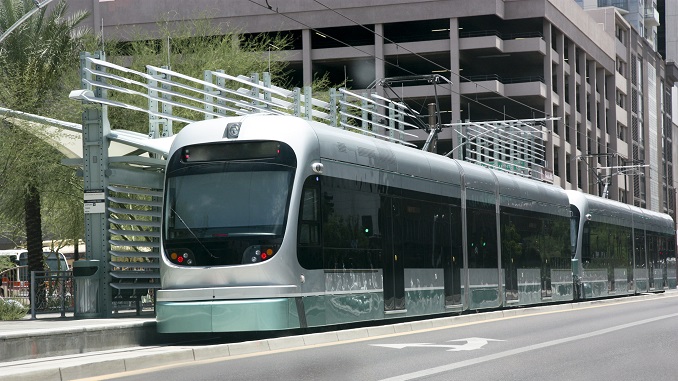
Tucson isn’t the first city to attempt totally free transit in the state, let alone in the country. Phoenix’s Valley Metro offers free busing for its neighborhood circulators, and the first year of its streetcar services is free. The city also subsidized a limited number of free public transit passes in 2021 using $1 million of American Rescue Plan Act (ARPA) funds.
There are dozens of other cities around the country, as well as university campuses, that offer free public transit.
As AZ Free News reported just prior to the Tucson City Council’s most recent decision, community members have criticized the three-year-long trial run of free public transit as more of a burden than a help. Locals have complained to several media outlets that the free transit enables criminal behavior and public nuisances.
Unionized bus drivers have also complained, claiming that free transit has lowered the quality of passengers and required them to become the “transit police.”
Watch the Tucson City Council study session here:
Corinne Murdock is a reporter for AZ Free News. Follow her latest on Twitter, or email tips to corinne@azfreenews.com.
Arizona legislators will soon have to choose between two very different plans to spend funding from the highway sales tax originally passed in 1985. One plan, SB1246 by Senator Farnsworth, would keep faith with the promises made to voters that the sales tax would fund highways to relieve traffic congestion around Phoenix.
The alternative proposal, SB1102 by Senator Carroll, would siphon off money from road projects and instead fund “green energy” giveaways proposed by the bureaucrats at the Maricopa Association of Governments (MAG). SB1102 proposes to divert $2 billion from highway construction to fund bike lanes, walking trails, bus lanes, and other unspecified “special projects.” In other words, it establishes a slush fund comparable to the “Green New Deal” of the Biden Administration.
The Farnsworth bill, on the other hand, will fully fund the freeway expansions promised to the voters, and there will be no green slush fund. Also, none of the transportation money could be used to remove traffic lanes to make room for bike paths.
It also requires government-subsidized transit to operate efficiently and recover 25% of the cost from the riders, as they promised. In reality, the government-run system falls woefully short of that requirement, collecting a mere 7% currently. Senator Farnsworth’s bill will make public transit meet their revenue projections. If they fail to do so, private companies could bid to provide transit services and guarantee the revenue as promised to the voters.
The Left’s fixation with public transit has resulted in hundreds of millions pouring into the black hole of failing transit systems. Yet, despite the clear evidence that transit systems run by the government are a white elephant, they keep pumping more tax dollars into them. They cannot point to any city where the ridership has met their projections. The reason is simple. When pollsters ask the public, they say they want more public transit. However, when asked if they intend to use it, they say they have no intention of using it. They want other drivers to use transit to get those cars off the freeways.
SB1102 would help MAG pursue their far-Left agenda, which now includes imposing California-like restrictions on Arizonans, including banning the internal combustion engine and gas appliances. We must end such power grabs by the bureaucracy, and the Arizona Legislature can start by killing this bill and passing Senator Farnsworth’s SB1246.
The late, great conservative Senator Everett Dirksen famously explained the thinking of legislators when he said, “When I feel the heat, I see the light.” Taxpayers can hold legislators’ feet to the fire by telling them to vote NO on SB1102 and AYE for SB1246.
Pat Nolan is the Director Emeritus of the Nolan Center for Justice at the American Conservative Union and lives in Prescott.
Governor Ducey made the right decision vetoing HB2685, the Maricopa County transportation sales tax increase that was forced through the House and Senate during the final days of the legislative session.
But the reality is, it never should have gotten to his desk.
HB 2685 typified everything that is broken at the Capitol these days: a swampy political culture built around cronyism and backroom deals, legislative leadership pushing major policy through despite overwhelming opposition from their own caucus, and a complete breakdown in statesmanship, evident by the fact that most Republican lawmakers that supported the bill never actually read it or the MAG transportation plan that underpinned the legislation…
State taxpayers should not be bailing out a broken Maricopa Association of Governments (MAG) plan. But that’s exactly what lawmakers are doing in the recently enacted Arizona state budget. That’s right. Your elected leaders just passed a budget that includes hundreds of millions of dollars for road projects—all being paid for with your tax dollars. (You can see for yourself on pages 9-11 right here.)
At first glance, that probably doesn’t seem like a big deal. After all, it makes sense for tax dollars to go toward necessary road projects. But the problem is that these road projects are supposed to be paid for by the Maricopa County Prop 400 regional plan that was assembled by MAG…