by Corinne Murdock | Jul 15, 2023 | News
By Corinne Murdock |
The National Defense Authorization Act (NDAA) for the upcoming year, which outlines the annual budgets and expenditures for the Department of Defense, has a historic number of amendments — 23 of which were filed by Arizona’s representatives.
Over 1,500 amendments have been filed onto the NDAA, H.R. 2670. Congress anticipates final passage on Friday. However, the House Freedom Caucus has expressed opposition to it. The caucus consists of 45 members, of which four are Republican Reps. Andy Biggs, Eli Crane, Debbie Lesko, and Paul Gosar. Biggs, Crane, and Gosar filed 14 of the amendments.
The caucus expressed opposition to the NDAA over the military’s progressive policies and stances on abortion; China-Taiwan relations; critical race theory; climate change; diversity, equity, and inclusion (DEI); LGBTQ+ issues; and the Russo-Ukrainian war.
The following are amendments filed by Arizona’s congressmen (all amendments and the bill text are available here):
Rep. Andy Biggs (R-AZ-05)
Amendment 365 (Version 1): require the Department of Defense to perform an audit. If not, the DOD’s discretionary budget authority would be reduced by .5 percent. Cosponsors: Reps. Crane, Andrew Clyde (R-GA-09), Michael Burgess (R-TX-26), and Mary Miller (R-IL-15).
Amendment 367 (Version 1): urge the importance of the U.S.-Israel relationship and the need to continue offering security assistance and related support. Cosponsors: Crane, Beth Van Duyne (R-TX-24), and Miller.
Amendment 369 (Version 1): terminate the designation of the Islamic Republic of Pakistan as a major non-NATO ally.
Amendment 371 (Version 1): prohibit the use of funds for any project or activity related to NATO until the Secretary of Defense certifies to the congressional defense committees that each NATO member country spent two percent of their respective GDP on defense expenditures. Cosponsors: Crane and Miller.
Amendment 373 (Version 2): require the Secretary of State, Secretary of Defense, and United States Agency for International Development to give Congress a report on agreements made with the Taliban.
Amendment 375 (Version 1): exempt defense-related activities from the Endangered Species Act.
Rep. Juan Ciscomani (R-AZ-06)
Amendment 816 (Version 1): insert text of H.R. 2393, the Combating Cartels on Social Media Act of 2023 to the bill. This bill requires DHS to report and implement a strategy to combat the use of social media by transnational criminal organizations to recruit individuals in the United States to support illicit activities at the border. Cosponsors: Abigail Spanberger (D-VA-07) and Burgess.
Amendment 948 (Version 1): direct United States Geological Survey to provide for the inclusion of Copper on its’ critical minerals list. Cosponsor: Bob Good (R-VA-05)
Rep. Eli Crane (R-AZ-02)
Amendment 995 (Version 1): condemn Lieutenant General DeAnna Burt for politicizing the military’s stance on domestic policies during the DOD LGBTQ+ Pride Event and emphasize the importance of the military remaining apolitical to maintain its readiness and effectiveness. Cosponsors: Biggs, Gosar, Miller, and Lauren Boebert (R-CO-03).
Amendment 1000 (Version 1): prohibit the DOD from making participation in training or support for certain race-based concepts a requirement for hiring, promotion, or retention of individuals. Also ensures that employees and service members cannot be compelled to declare belief in or participate in training that promotes such concepts as a condition of favorable personnel actions. Cosponsors: Biggs, Gosar, Good, Miller, and Boebert.
Rep. Paul Gosar (R-AZ-09)
Amendment 441 (Version 1): authorize employees at the Yuma Proving Grounds to use nonelectric vehicles in the performance of their duties. Cosponsor: Biggs.
Amendment 598 (Version 1): require the Secretary of Defense to expeditiously disclose to the public all records relating to the war in Afghanistan. Cosponsors: Biggs, Boebert, Byron Donalds (R-FL-19), Randy Weber (R-TX-14), and Andy Ogles (R-TN-05).
Amendment 672 (Version 1): authorize the Army and Corp of Engineers to complete, reinforce, and maintain the wall on the southern border. Cosponsors: Crane, Biggs, Boebert, Donalds, Weber, Ogles, and Ken Buck (R-CO-04).
Amendment 711 (Version 1): grant Congress exclusive power to declare a national emergency. Cosponsors: Crane, Boebert, Weber, and Ogles.
Amendment 739 (Version 1): designate phosphate, copper, and uranium as minerals critical to national security.
Amendment 1415 (Version 1): declare Congress’ responsibility to provide compensation for all individuals that developed radiation-induced cancer from past nuclear weapons testing. Cosponsor: Crane.
Rep. Raúl Grijalva (D-AZ-07)
Amendment 861 (Version 1): strike language that exempts Air Force activities from any requirements under the Marine Mammal Protection Act that would protect the critically endangered Rice’s Whale.
Amendment 898 (Version 1): extend the protections necessary for the continued use by the Air Force of the Barry M. Goldwater Range in Arizona. Cosponsor: Ruben Gallego (D-AZ-03).
Amendment 1378 (Version 2): prohibit the amounts authorized to be appropriated or otherwise made available by this act be used to establish or maintain any relationship between the Department of Defense and the Government of Ecuador, including any office or agent of such government, in order to provide, authorize, or assist in any way in the transfer of weapons, military equipment, crowd control supplies, or any other supplies, to such government or to coordinate joint exercises with the military and police forces of such government until certain criteria is met.
Rep. Greg Stanton (D-AZ-04)
Amendment 465 (Version 1): expand a program to compensate “downwinders” in Arizona and Nevada exposed to and affected by DOD-led atmospheric nuclear testing from 1945 to 1962.
Amendment 1400 (Version 1): direct the State Department to create a strategy for subnational cooperation between local law enforcement, civil society, and government to combat fentanyl trafficking holistically. Also directs the State and Treasury to review how to best expand financial access to countries in the Caribbean.
Amendment 1424 (Version 2): direct the Secretary of the Veterans Affairs (VA) to regularly ensure the accuracy of the VA Accreditation Search database, to submit an annual report on the accreditation process for agents/attorneys/representatives, and to create a trademarked insignia for accredited agents/attorneys/representatives to use.
Amendment 1425 (Version 1): prohibit the use of federal funds for the maintenance of civilian vehicular assets (yachts, jets, cars, etc.) seized in response to Russia’s invasion of Ukraine or belonging to sanctioned Russian oligarchs and officials.
Corinne Murdock is a reporter for AZ Free News. Follow her latest on Twitter, or email tips to corinne@azfreenews.com.
by Corinne Murdock | Apr 12, 2023 | News
By Corinne Murdock |
Three years and some change later, President Joe Biden signed Rep. Paul Gosar’s (R-AZ-09) bill to end the national COVID-19 emergency. Biden signed Gosar’s resolution, HJR 7, on Monday.
In addition to the national emergency that Gosar’s resolution terminated, there’s another declared emergency in play concerning COVID-19: the public health emergency declared in January 2020 by Health and Human Services (HHS), which impacts the ability of the federal government to use Title 42 for expedited illegal immigrant expulsion. The Biden administration said that it would end the public health emergency, which allows Title 42 to take place, on May 11.
There was also the emergency declared by former President Donald Trump via the Stafford Act. That declaration enabled Federal Emergency Management Agency (FEMA) assistance for 75 percent federal matching on disaster-related costs, like law enforcement and state emergency operation centers.
An end to the national emergency per Gosar’s resolution would have lifted the pause on student loan repayments — however, the Biden administration announced its student loan forgiveness program last August to work around the end of the emergency. That program is being considered currently before the Supreme Court (SCOTUS). Repayments are scheduled to resume either 60 days after the SCOTUS ruling or after June 30.
The end of the national emergency also means federal agencies will return to regular protocols, such as the Department of Housing and Urban Development’s COVID-19 mortgage forbearance program ceasing by the end of May.
The lift of the emergency will also tighten up rules on Medicare, Medicaid, and CHIP programs, impacting eligibility, as well as waivers for alternative provider settings, or for forgoing application fees or criminal background checks. It will also cease the provision of free COVID-19 rapid tests, and allow states to cease COVID-19 data tracking.
Gosar’s resolution passed the Senate last month with bipartisan support, including both Democratic Sens. Mark Kelly and Kyrsten Sinema. Only two Arizona representatives opposed the resolution during House consideration in February: Reps. Raúl Grijalva (D-AZ-07) and Greg Stanton (D-AZ-04).
Leading up to Biden signing the resolution, some Democratic leaders expressed frustration with a perceived lack of communication from the White House. Rep. Dan Kildee (D-MI-08) reported that the Biden administration hasn’t communicated with House Democrats.
“The White House’s lack of communication with House Democrats has been frustrating,” said Kildee. “Going forward, we’re going to need greater clarity out of the administration. They’ve got to do better.”
Biden voiced opposition to the resolution leading up to and after the Senate’s passage of Gosar’s resolution. Despite his opposition, a White House spokesperson told media outlets that the president would sign the resolution.
“The President strongly opposes HJ Res 7, and the administration is planning to wind down the COVID national emergency and public health emergency on May 11,” said the spokesperson. “If this bill comes to his desk, however, he will sign it, and the administration will continue working with agencies to wind down the national emergency with as much notice as possible to Americans who could potentially be impacted.”
Corinne Murdock is a reporter for AZ Free News. Follow her latest on Twitter, or email tips to corinne@azfreenews.com.
by Corinne Murdock | Mar 31, 2023 | News
By Corinne Murdock |
A bill from Rep. Paul Gosar (R-AZ-09) to end the COVID-19 National Emergency Declaration passed the Senate on Wednesday.
The legislation now heads to President Joe Biden for his signature. The resolution, HJR 7, was first filed in January. It received bipartisan support: 68 senators voted for the resolution, with 23 against. Both Sens. Mark Kelly and Kyrsten Sinema voted for it.
“Looking forward to Joe Biden signing this to finally end this national nightmare,” tweeted Gosar.
Biden won’t veto the measure — meaning that the end of the emergency could come more quickly than anticipated. The Biden administration promised to end the emergency declaration on May 11.
The president’s goodwill on a Republican-led bill has some Democratic leaders frustrated. Rep. Dan Kildee (D-MI-08) told Fox News in a statement that the Biden administration hasn’t been communicating with House Democrats.
“The White House’s lack of communication with House Democrats has been frustrating,” said Kildee. “Going forward, we’re going to need greater clarity out of the administration. They’ve got to do better.”
Rep. Lloyd Doggett (R-TX-37) issued similar remarks, saying that Biden’s approval of the resolution was surprising. Doggett remarked that he desired more consistency from the administration.
Their confusion is understandable. Biden has consistently voiced opposition to the resolution, even in response to the Senate’s passage of it. However, a White House spokesperson informed outlets that the president would sign the resolution.
“The President strongly opposes HJ Res 7, and the administration is planning to wind down the COVID national emergency and public health emergency on May 11,” said a Biden spokesperson. “If this bill comes to his desk, however, he will sign it, and the administration will continue working with agencies to wind down the national emergency with as much notice as possible to Americans who could potentially be impacted.”
The House passed the resolution in February, 229-197. Gosar praised God at the time for its passage.
Only two Arizona congressmen voted against the resolution at the time: Reps. Raúl Grijalva (D-AZ-07) and Greg Stanton (D-AZ-04).
The Senate’s approval came just over three years after President Donald Trump initially declared the emergency, on March 13, 2020.
An end to the emergency means that relaxed rules on Medicare, Medicaid, and CHIP programs will be tightened up — that includes waivers allowing providers to operate out of alternative settings, or forgo application fees or criminal background checks.
It also means that the student loan repayment pause would resume, if not for the Biden administration’s student loan forgiveness program which is before the Supreme Court (SCOTUS) currently. Repayments are scheduled to resume either 60 days after the SCOTUS ruling or after June 30.
However, lifting the emergency wouldn’t impact Title 42 immigration policy according to White House Press Secretary Karine Jean-Pierre. Title 42 allows for the expedited expulsion of illegal immigrants under the interests of a public health emergency.
Corinne Murdock is a reporter for AZ Free News. Follow her latest on Twitter, or email tips to corinne@azfreenews.com.
by Corinne Murdock | Jan 4, 2023 | News
By Corinne Murdock |
It appears that Rep. Paul Gosar (R-AZ-09) wasn’t a white supremacist posing a real threat of violence after all.
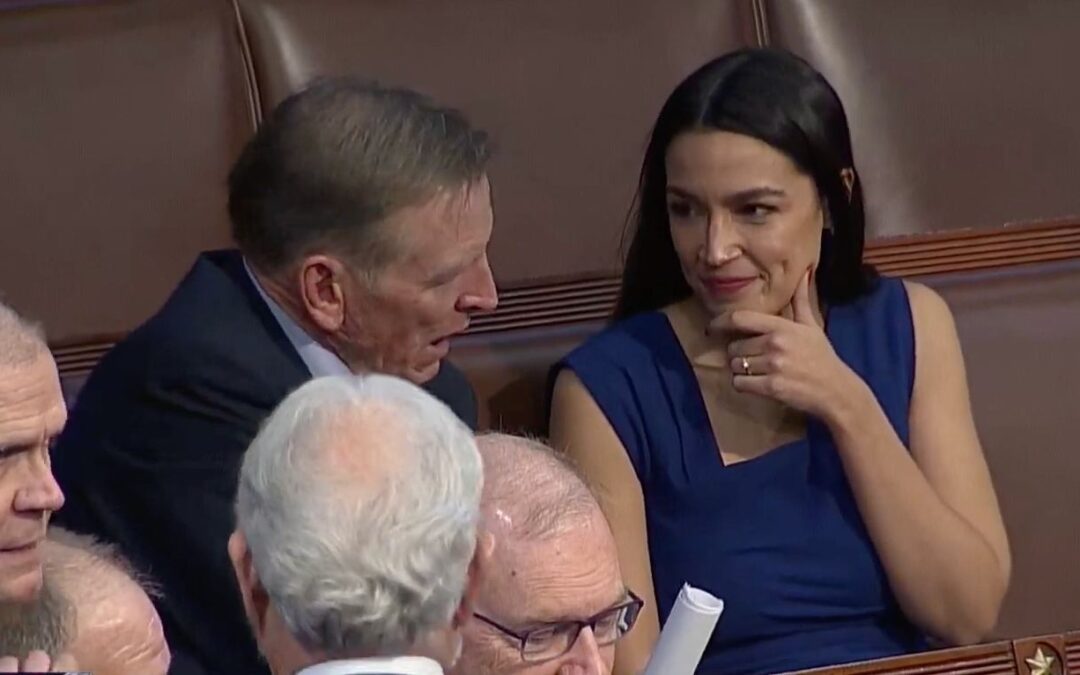
On Tuesday, Rep. Alexandria Ocasio-Cortez (D-NY-14) was captured engaging in a friendly conversation with Gosar. This interaction occurred a little over a year after she accused Gosar of white supremacy and threats of violence for posting a meme video portraying her and other Democrats as slain anime villains. Her claims of fear resulted in Gosar’s censuring and removal from two committees.
Ocasio-Cortez later clarified to reporters that the floor conversation with Gosar concerned Democrats’ support for Rep. Kevin McCarthy (R-CA-20) or Rep. Hakeem Jeffries (D-NY-08) as House Speaker. She told MSNBC that Gosar spoke to her to keep GOP leadership “honest,” dispelling McCarthy’s claim that he had Democrats’ support.
McCarthy reportedly told Republicans that he had promises of votes from Democrats to secure the speakership.
The fallout from Gosar’s meme occurred in November 2021. Ocasio-Cortez derided Gosar, insisting that the meme portrayed Gosar’s “fantasy” of killing her. She also claimed that institutions don’t protect women of color.
“White supremacy is for extremely fragile people and sad men like him, whose self concept relies on the myth that he was born superior because deep down he knows he couldn’t open a pickle jar or read a whole book by himself,” tweeted Ocasio-Cortez.
Rather than an apology, Gosar posted another meme mocking Democrats’ sensitivity.
Outcry from Democrats resulted in Gosar’s censure, which took four hours of debate to reach.
The congressman was removed from two committees: the National Resources Committee and the Oversight and Reform Committee. Gosar’s censure broke an 11-year dry spell for censures. Only two Republicans voted with Democrats to censure Gosar: Reps. Adam Kizinger (R-IL-16) and Liz Cheney (R-WY).
During the censure vote, Ocasio-Cortez claimed the meme was an incitement to violence. Since the meme’s posting, Ocasio-Cortez hasn’t been subject to any publicized attacks.
Although Gosar ultimately removed the offending video, he didn’t apologize for the meme.
Corinne Murdock is a reporter for AZ Free News. Follow her latest on Twitter, or email tips to corinne@azfreenews.com.
by Corinne Murdock | Dec 3, 2022 | News
By Corinne Murdock |
Republican Reps. Paul Gosar (AZ-04) and Andy Biggs (AZ-05) joined an amicus brief with 15 other lawmakers to prevent future airplane mask mandates.
Specifically, the lawmakers challenged the CDC’s legal authority to issue a mask mandate for airplane travel in Health Freedom Defense Fund v. Biden. They contested that Congress hadn’t and couldn’t grant the CDC the authority for such a mandate.
Rep. Thomas Massie (R-KY-04) led the amicus brief, joined by Biggs and Republican Reps. Barry Moore (AL-02), Lauren Boebert (CO-03), Bill Posey (FL-08), Brian Mast (FL-18), Andrew Clyde (GA-09), Marjorie Taylor Greene (GA-14), Matt Rosendale (MT), Dan Bishop (NC-09), Warren Davidson (OH-08), Ralph Norman (SC-05), Chip Roy (TX-21), Bob Good (VA-05), and Alex Mooney (WV-02).
Sen. Rand Paul (KY) also joined the amicus brief. These Congress members represent 13 different states.
READ THE AMICUS BRIEF HERE
The case is before the Eleventh Circuit Court of Appeals currently.
The Florida Middle District Court ruled against the Biden administration in April, finding that the CDC exceeded its statutory authority and failed to follow notice and comment rulemaking. Following the loss, the Department of Justice (DOJ) issued a joint statement with the CDC pledging an appeal of the ruling.
“The Department continues to believe that the order requiring masking in the transportation corridor is a valid exercise of the authority Congress has given CDC to protect the public health,” stated the DOJ.
CASE DOCUMENTS: HEALTH FREEDOM DEFENSE FUND V. BIDEN
The lawsuit follows legislative attempts to end the mandate and prevent future ones, and years of aggressive crackdowns on resistance to mask-wearing on flights.
Last July, Biggs and Paul introduced legislation to prohibit mask mandates for public transportation. Neither version of the legislation made it to a committee in the Democratic-controlled Congress.
For two years, airlines put passengers who refused to mask up on their “no-fly list.” In February, Delta Airlines asked other airlines to share their no-fly lists to expand its own.
Negative public response to the move caused the company to backtrack. By April, Delta began removing people who refused to adhere to masking requirements from its no-fly list.
Last December, the CEO of Southwest Airlines testified to the Senate his doubts about masks’ ability to prevent COVID-19 transmission in airplanes. The fully vaccinated, double-boosted CEO caught COVID-19 a day after that testimony.
Corinne Murdock is a reporter for AZ Free News. Follow her latest on Twitter, or email tips to corinne@azfreenews.com.