In September 2023, four DUSD high schools were named 2023-2024 Best High Schools by U.S. News & World Report. Three of the four were also named A+ Schools of Excellence by the Arizona Educational Foundation. Although DUSD has a lot of work to do, school board members across the Valley now have a model for governing with sense and sensibility.
Of course, every free-thinking, constitutional, conservative board member will have progressive dogs nipping at their heels. Such is the case with the uprising of emotional activists after DUSD opted to not renew Elementary and Secondary School Emergency Relief (ESSER) funds.
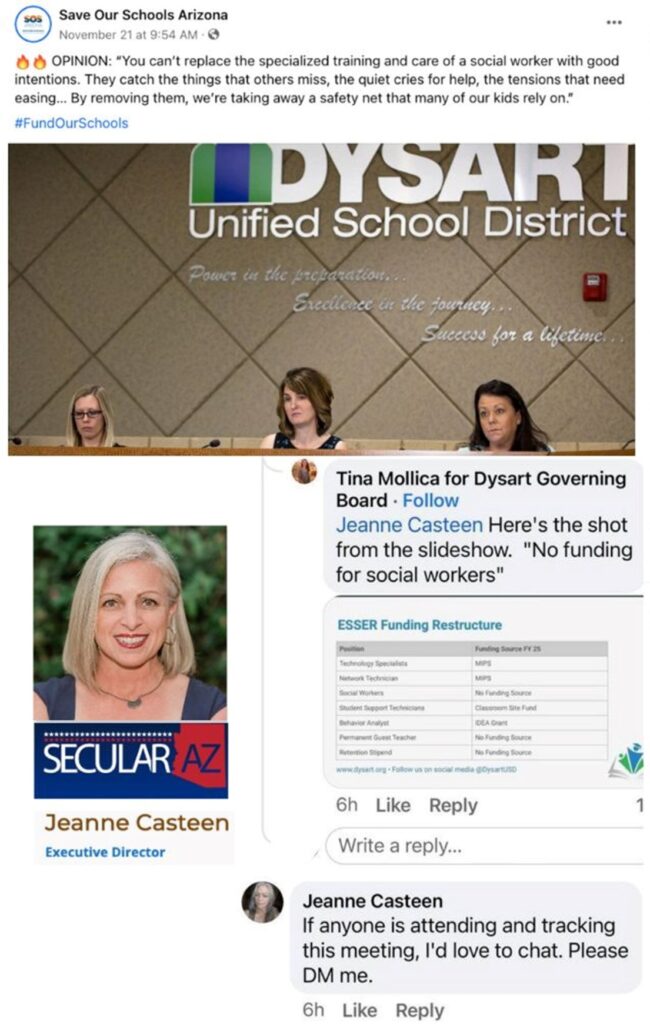
Save Our Schools Arizona—a leftist group that identifies as a “nonpartisan community based organization”—led the campaign of oppression by posting a hack opinion editorial on social media. Anxiety-ridden constituents (including the director of an anti-God organization) manifested in the comment section with cries of outrage. Wow. I didn’t know saving Arizona schools meant converting every campus into psychiatric medical facilities!
With sensational clarity, Arizona’s Family reported that DUSD’s decision came amid “a fiery exchange after [board] members voted to eliminate the role of social workers within their school district.” Did anybody in the bullpen even watch the November 16 board meeting? I did. Of course, I don’t have a predisposition to rage, so I viewed it as a thoughtful discussion with differing opinions. Board Member Jo Grant blessed me with her deliberate and persistent, social-emotional vantage point. She got outvoted. Where’s the fire?
Board Members Dawn Densmore and Jennifer Drake personally assured me that because ESSER funds were drying up, it was in the district’s best interest not to renew without a financial plan to supplement looming deficiencies. They also confirmed the district would retain numerous student support positions, including psychologists, counselors, and behavior interventionists.
Densmore said, “For me…it’s not a slam on the profession of social workers. I genuinely don’t think all of them [have a leftist agenda]. But at the same time…places of education should not be healthcare institutions. If parents have children who go through issues where they need additional support—and I [personally] had one child who needed it—take them out of school and get them into counseling. I would have never expected the school to take care of that and replace me as a parent in that situation.”
Drake agreed, “It is the parent’s responsibility [to take care] of the health and wellbeing of their child—not the school. When a child is at school, their priority is safety and education. If your child needs mental health or medical services, then as a parent, it is your responsibility to provide that. The school can get outside resources, but having these services inside the school is unacceptable. Taxpayers should not be paying for this.”
Densmore and Drake also emphasized that educators should not bear the consequences of attendance deficits and low test scores when emotional needs become disruptive to learning environments.
In response to the small faction of obnoxious critics who branded DUSD “cruel” and “irresponsible,” Densmore and Drake said, “Parents need to start parenting. Stop using schools as a crutch—for vaccinations, for dental work, etc.…If your kid is sick, whether it’s physical or mental, take them to the doctor. If your kid is suffering mentally, why would you rely on a school [district] for something like that?”
I’ll wrap this up by pointing out that 2020 was America’s Enlightenment period where we discovered a supposed new and improved job function for social workers. According to the National Association of Social Workers, these mental health warriors are now equipped to practice a more inclusive, equitable, anti-racist approach. And they want us to rest assured that no matter what issues students face inside or outside the classroom, affirming their gender-identity and empathizing with their skin color is sure to be the cure.
Seriously, parents, why haven’t you pulled your kids out of Arizona public schools?
For nearly two decades, Tiffany Benson’s creative writing pursuits have surpassed all other interests. When she’s not investigating Kennedy Assassination conspiracy theories, she enjoys journaling and contributing to her blogBigviewsmallwindow.com. She encourages average citizens to take on an active role in the grassroots fight for future generations.
From the South Lawn of the White House to the pulsing heartbeats of North America’s bustling metropolises, Democrats are stepping into the 2024 electoral fray armed with a transgender-dominated platform that makes the riots of 2020 look like a block party.
This time, the spotlight is focused on the very future of the country: our children.
In a repudiation of the family as the foundation of society, the Democrat platform contends, “Your children are not your children.” And it doesn’t stop there. The Democrats are loud and proud that they’re “coming for your children.”
This was echoed by President Biden himself in April when he proclaimed at a White House event, “There’s no such thing as someone else’s child. Our nation’s children are all our children.”
His sentiment was further reinforced by the LGBTQ activists during their Pride Month celebrations. The rallying cry of “We’re here. We’re queer. We’re coming for your children!” may have escaped the notice of those consuming mainstream media, but as Tucker Carlson has demonstrated, the traditional news platforms no longer control the narrative.
America is turning to Twitter for an unfiltered snapshot of reality, and reality is not pretty. The videos of the LGBTQ agenda are being shared, as citizen journalists take over telling a truth that legacy media won’t touch.
One could write off a single declaration of seizing the children as a mere slip of the tongue, but the unwavering commitment of the progressives suggests deliberate intent to make it a bedrock principle woven into the very fabric of the Democratic Party.
The party finds itself flanked by a president whose mental acuity is questionable at best and demonstrators whose behaviors set a new standard for raunch. By raunch, I refer to the naked men dangling their parts at children along the Pride parade route, and naked women in heavy makeout sessions in a public fountain, while children played nearby.
These individuals are the ones taking over our schools, libraries, parks, and city councils.
Even a top cabinet official – Rachel Levine, the Secretary of Health and Human Services – has officially declared that it’s not just Pride Month but Pride Summer.
Levine, a transgender individual, is determined to see the Democratic Party transgender platform permeate the cultural fabric of America. Levine’s aim is to dismantle the traditional family unit and supplant it with the state, utilizing the powers of the DHHS to cement this agenda ahead of the 2024 elections.
Democrats like Levine appear to be drawing from the Marxist ideology of Frederick Engels and Karl Marx, who famously critiqued the family and foresaw its inevitable demise.
Engels said “On what foundation is the present family, the bourgeois family, based? On capital, on private gain. In its completely developed form, this family exists only among the bourgeoisie. But this state of things finds its complement in the practical absence of the family among the proletarians, and in public prostitution.”
Thus, he predicted, the family “will vanish as a matter of course.”
His colleague Marx explained how that would be achieved: “The education of all children, from the moment that they can get along without a mother’s care, shall be in state institutions at state expense.”
The American middle class, with its inherent kindness and compassion, has proven to be fertile ground for this Democrat redefinition of “love,” which amounts to actual hatred of the nuclear family.
Leveraging the tolerance of centrists, the Left has weaponized the Christian principle of “What Would Jesus Do” to quell debate and sway major Christian denominations to their cause. It has worked with many mainstream Christians, who haven’t found a good response to that rhetorical question.
The platform for 2024 looks set to feature a triumvirate of transgender dominance, the sexualization of children, and a critique of the traditional family. Why this direction? Because the Democratic Party, now under the influence of its most radical elements, finds itself incapable of reining in its fringe. The genie cannot be returned to the bottle.
Parents, brace yourselves: They are coming for your children. Alphabet agencies and unions like the National Education Association, and even the State of California, have made it clear and are leading the charge.
California Republican State Sen. Scott Wilk issued a warning: A new bill that would criminalize parents who don’t affirm their child’s “gender transition” is a bridge too far. It’s time for parents to run for the border.
“If you love your children, you need to flee California,” he said.
Democrats, seemingly emboldened by favorable polling in the 18- to 34-year-old demographic, are confident they have the winning issues for 2024.
For much of America, however, Democrats have simply packed the powder keg, stretched out the fuse, and are holding a match aloft.
After a period of relative peace between Arizona Legislative Republicans and Democrat Governor Katie Hobbs, her veto pen has again enflamed the political division between the two sides.
On Monday, Arizona Senator John Kavanagh announced that Governor Hobbs had vetoed SB 1001, relating to school policies about pronouns and biological sex. According to Kavanagh’s release, his bill “would have prohibited a school district or charter school from knowingly referring to students under the age of 18 by a pronoun that differs from the child’s biological sex, or a first name that is not listed in school records;” and it “would have also prevented schools from requiring their staff to use a pronoun that differs from a person’s biological sex, if doing so is contrary to their own personal convictions.”
Kavanagh blasted Hobbs for her veto, saying, “Parents have a right to know if their children are in psychological turmoil. Parents also need to know if their children are confused, depressed, anxious, isolating themselves, having suicidal thoughts or are in need of mental health care because of gender dysphoria. Parents can’t get their children the counseling or therapy needed if their school is hiding this information from them. Additionally, if a child is receiving mental health care and that child’s physician advises not to treat the child as a different gender, then a school going against the doctor’s wishes without the parent’s permission would create reason for a lawsuit. This is a dangerous situation for children who are struggling with mental health issues. For the Governor to turn a blind eye to what’s happening is reckless and irresponsible. I would expect more from a former social worker.”
Last week, Hobbs transmitted a veto letter to the Arizona Senate, explaining her justification, writing, “As politicians across the country continue to pass harmful legislation directed at transgender youth, I have a clear message to the people of Arizona: I will veto every bill that aims to attack and harm children. I want to thank the young people that bravely testified against SB 1001 at the Legislature. To you, I promise to be an ally and to uplift your stories. Additionally, I would like to thank Representative Lorena Austin for telling their story and speaking their truth. I would like to reemphasize their words to all the young people of the state, ‘You have every right to be who you are.’”
Today, I proudly vetoed SB1001, which was an attack on transgender youth. Instead of coming up with new ways to target and isolate our children, we should be working together to create an Arizona where everyone has the freedom to be who they are without fear of harassment or…
— Governor Katie Hobbs (@GovernorHobbs) May 22, 2023
After the Arizona House of Representatives passed the bill last week, Janae Stracke from Heritage Action issued a statement in support of the Legislature’s efforts, writing, “As the Left continues to push radical gender ideology in schools and strip parents of their right to know what their children are learning, it’s time for parents and legislators in Arizona to start fighting back with common sense. By passing SB 1001, legislation that ensures school systems obtain parental consent before changing a student’s name and pronouns and protects school employees from violations of their religious or deeply-held beliefs, the Arizona Legislature upheld parental rights across the Grand Canyon State.”
Daniel Stefanski is a reporter for AZ Free News. You can send him news tips using this link.
Many are surprised to learn that Mesa Public Schools (Unified District #4) has had a co-ed option for restrooms, locker rooms, and overnight facilities since 2015. The district leadership at the time quietly developed a Transgender Support Plan for children. This includes choosing which facilities the child wants to use along with a new name and new pronouns. This plan involves no parental consent or parental notification.
Due to public comment and internal questions, Board President Hutchinson, under the guidance of Superintendent Fourlis, asked for a legal opinion from the Board’s counsel, Udall Shumway. A brief memo was placed on the agenda for the meeting May 9, 2023, and Udall Shumway determined that the Transgender Guidelines stand.
In the meeting I asked about the criteria for a child to be placed on this plan. Kacey King, the district’s counsel said, “for younger children a teacher or counselor might suggest that they put it into writing.” I was shocked at this statement. This is absolutely not the role of teachers or counselors. I have been told that school counselors are simply there to determine what barriers exist that may prohibit classroom learning.
To have a counselor or teacher help put a child on a Transgender Support Plan is simply wrong, particularly without any communication with the parents. The U.S. Supreme Court has repeatedly recognized that parents possess the fundamental right to direct the upbringing, education, and health care of their children. This right does not belong to any school or staff. Public school offers a service to the community—a service to teach children the academic standards to prepare them for a future to be able to be confident and self-reliant adults. Schools need to stay in their lane if they are going to retain public trust.
Opportunities exist for children to develop personal relationships with counselors and without parental consent. In one such example, the district had an elementary school student who was struggling in math. She would ask to see the counselor during the math lesson. Her mother was never notified because they weren’t official counseling sessions. The mother eventually found out when she confronted the school about her daughter’s below average math performance. No one previously told her that her daughter was behind in math or that she was visiting with a counselor.
Counselors may also have informal visits with children who don’t want to go to lunch or recess with their classmates and decide to visit with a counselor instead. Perhaps a child opens up about personal struggles, then the option exists for that trusted authority figure to guide the child to complete a private Transgender Support Plan. How would the parents know?
There is no other program or plan in the district that is comparable in secrecy or purpose to the Transgender Support Plan. Specialized learning plans, after school clubs, field trips, photographs, all require parental consent. Yet, a student can be given a new identity, and no one will notify the parents?
The main legal justification for these guidelines right now stems from the 9th Circuit case Parents for Privacy v Barr. The court ruled against parental rights, ruled against freedom of religion, and ruled against privacy. I have spoken to attorneys who believe this ruling will be overturned. In the meantime, one of the best courses of action is to make sure our parents are informed. There is no legal argument against notifying parents about a child discussing “gender identity” or any other such topics at school. In fact, the law is on the side of the parents. I will continue this fight for parental rights and transparency.
Rachel Walden is a member of the Mesa Public Schools Governing Board. You can follow her on Twitter here.
Republicans in the Arizona Legislature continue to advance bills that would increase parental choice, transparency, and involvement in their children’s education; and some of those proposals are being met with incredible opposition from Democrats and interest groups.
Last month, SB 1700, sponsored by Senator Justine Wadsack, was considered by the Senate Education Committee. According to the fact sheet provided by the Arizona Senate, SB 1700 “requires the Arizona Department of Education to maintain a list of books that public educational institutions may not use or make available to students, including books that are lewd or sexual, promote gender fluidity or gender pronouns or groom children into normalizing pedophilia.” The bill also “grants parents the right to request removal of school district or charter school library or classroom materials, extends public review periods for library materials and district textbooks and removes exceptions from district curriculum approval and school library access requirements.”
Debate on this bill in committee was fierce, and opponents railed against its eventual passage. One teacher, in particular, made national headlines when she compared the “advanced degrees” of Arizona teachers with the education and background parents may or may not have to “choose the curriculum and the books that our children are going to read.”
These comments caught the attention of Arizona Republican lawmakers, who used the rhetoric in the committee hearing to continue to make their case for parental choice legislation. Wadsack, the bill’s sponsor, tweeted, “And THIS is why I fight for Parental Rights! THIS right here. This was a Leftist Teacher speaking in my committee last week – You just can’t write this stuff.”
And THIS is why I fight for Parental Rights! THIS right here!
The Arizona Department of Education also weighed in on the teacher’s outburst in the Senate Education Committee: “Superintendent Horne will always empower parents because they should be in charge of their children’s education. #EducationForAll”
Despite the backlash against the bill, Republican Senators held their ground and successfully cleared SB 1700 from the Education Committee. Senators Steve Kaiser, Anthony Kerr, and Chairman Ken Bennett joined Senator Wadsack in fending off three Democrat Senators.
Representatives from the Arizona Association of County School Superintendents, the Arizona Education Association, the National Association of Social Workers – Arizona Chapter, Save Our Schools Arizona, the Arizona Charter Schools Association, Arizona National Organization for Women (NOW), Arizona Library Association, and Equality Arizona all opposed the bill.
Representatives Rachel Jones and Cory McGarr were co-sponsors of this bill.
SB 1700 has not been considered by the Rules Committee, nor by the entire Senate chamber.
Daniel Stefanski is a reporter for AZ Free News. You can send him news tips using this link.