Earlier this week, a court-appointed Special Master confirmed that nearly 40,000 initiative signatures were duplicates and thus invalid. But on Thursday, Maricopa County Superior Court Judge Frank Moskowitz still ruled that, because Proposition 140 cannot be removed from the ballot, votes for the Ranked Choice Voting and Open Primary initiative will be counted.
The court’s affirmation of the initiative, despite Petition Signature Fraud being proven, sent shockwaves through the Arizona political scene.
Arizona Free Enterprise Club President Scot Mussi released a statement following the ruling, openly accusing Moskowitz of bias in favor of the initiative.
“From the moment he was unanimously rebuked by the AZ Supreme Court for blocking the removal of nearly 40,000 duplicate signatures, Judge Moskowitz has been trying to find a way to place Prop 140 on the ballot, irrespective of whether it had enough signatures to qualify. Today he issued a ruling manufacturing that outcome, deciding that the statutory method for determining the number of valid signatures for ballot initiatives is now unconstitutional. He made this radical determination despite the fact that the statute Moskowitz invalidated is nearly 30 years old and was reviewed and upheld against a constitutional challenge by the AZ Supreme Court in 2022 (Mussi v Hobbs).”
🚨 URGENT: Judge Moskowitz has issued a radical ruling invalidating the statutory method for determining the number of valid signatures for ballot initiatives in an effort to place #Prop140 on the ballot! https://t.co/VOT0dtnBrR
Prior to Moskowitz’s ruling, Arizona Supreme Court Chief Justice Ann Timmer ordered that if the Special Master ruled the signatures invalid, then the Make Elections Fair PAC would be permitted to argue against enjoining the vote count on grounds that court precedent typically required ruling prior to ballot printing, something not required in statute.
This ruling would appear to validate concerns many opponents of the Proposition have voiced, that Secretary of State Adrian Fontes, defending legal council, and Moskowitz himself all sought to deliberately slow-roll the court proceedings beyond the printing date to ‘run out the clock’ and force the vote through.
In the ruling AZFEC deemed “radical” in a post to X, Moskowitz claimed that the confirmation of duplicated, invalid signatures was “moot,” having passed the printing deadline. He curiously cited a statute NOT being present in his justification and leaned purely on case law. He wrote, “Although there is no statutory authority for the proposition that petition challenges must end before ballot printing begins, there is case law that supports such a ‘bright light’ end to such litigation.”
He continued, “Here, the time pressures were such that not every duplicate signature was reviewed and verified by clear and convincing evidence before the August 23, 2024 ballot printing deadline, such that the underlying action is moot as of that deadline.”
In a staggering move, Moskowitz claimed that the court cannot grant injunction against counting the signatures, citing “Perhaps the absence of such express authority in statute,” as expressing the intent of the legislature.
In full he wrote, “That is not a sufficient basis for this Court to grant such a remedy, especially given the injunction allowable under (the law), the statute upon which Plaintiffs initially brought this action, does not include enjoining the canvassing of votes,” Moskowitz wrote. “Perhaps the absence of such express authority in statute is because the Legislature never intended for initiative challenges to go past the ballot printing deadline.”
Mussi wrote in the AZFEC statement that the organization intends to bring the matter to the State Supreme Court once again, “The bottom line is that after the removal of the duplicate signatures, Prop 140 lacks the required number of valid signatures needed to qualify for the ballot. The committee behind the measure was aware of this fact, which is why they obstructed and delayed the review of the duplicate signatures for over a month.
We are confident that after a careful review of the facts, ruling, and trial court record, the AZ Supreme Court will again overturn this outrageousruling by Judge Moskowitz and enjoin Prop 140 from being tabulated.”
The Arizona Free Enterprise Club (AFEC) is demanding an investigation into an alleged misuse of taxpayer funds by Secretary of State Adrian Fontes.
AFEC published a press release on Tuesday accusing Fontes of misusing taxpayer funds by filing a “politically motivated” brief in the ongoing Arizona Supreme Court case, Smith v. Fontes. The organization also requested that Fontes recuse himself from all ballot tabulation procedures concerning the other initiatives.
“By filing his brief at the Arizona Supreme Court, Fontes unequivocally signaled his position that 40,000 duplicate signatures should be ignored and counted in favor of passing Proposition 140,” said AFEC in its press release. “In short, to Fontes, the ends justify the means to ensure that Arizona’s elections system can be operated like California’s radical system.”
AFEC and other critics compare the components within Proposition 140 to current election procedures exercised by California.
Proposition 140 seeks to remove the partisan split in primary voting — instead implementing open, or “jungle,” primaries — and determine winners using ranked-choice voting. Ranked-choice voting allows voters to rank their preferred candidates each election until one candidate accrues over 50 percent of the vote.
That claim of political motivation stems from Fontes’ role as a “team member” for the nonprofit organization (Save Democracy) supporting the political action committee (Make Elections Fair Arizona) pushing Proposition 140. Those two entities are also united by the involvement of Sarah Smallhouse as their president and treasurer, respectively: a longtime Democrat donor from Tucson who served as leadership for a University of Arizona board and the Southern Arizona Leadership Council.
Fontes’ brief petitioned the court to count any votes cast for Proposition 140, even if the ongoing review of the ballot-qualifying signatures determined that there weren’t enough signatures gathered. Fontes argued that the proposition should be considered valid since the ballots were already being printed with the contested proposition on them.
“Once the ballots have gone to print, it is in the hands of Arizona’s voters,” said Fontes. “The person contesting an issue (or candidate) can make a case to the voters, but the Courts cannot usurp the voters’ decision once it goes to them.”
AFEC sued to stop Proposition 140 earlier this summer after reportedly discovering that over half of the gathered signatures were in violation of state law — around 40,000 duplicates. Should all those alleged duplicate signatures be removed, the proposition would lack the number of signatures required to qualify for the ballot.
AFEC President Scot Mussi said in a statement that Fontes’ brief amounted to the secretary of state taking a side in a ballot measure rather than maintaining an impartial role in the elections process.
“Far from acting as a fair and impartial elections chief, Fontes has officially taken a side in a controversial measure that would be potentially on the ballot, showing Arizonans that he is using taxpayer dollars to make the case for a California-style amendment that would fundamentally transform the way we vote and select our candidates for public office,” said Mussi. “This is not saving democracy; this is trampling the will of the people and the laws that govern how elections should be executed.”
AZ Free News is your #1 source for Arizona news and politics. You can send us news tips using this link.
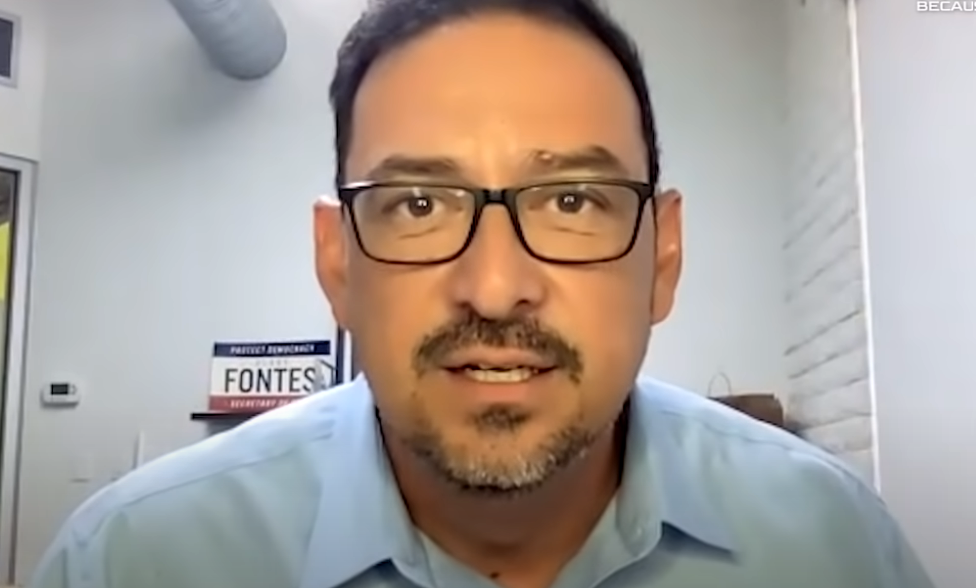
Secretary of State Adrian Fontes argued in a new brief for an ongoing court case that duplicate signatures shouldn’t be cause for Proposition 140 to be removed from the ballot. Challengers to the proposition say they found around 40,000 duplicate signatures.
Prop 140, the Make Elections Fair Act, proposes open primaries (called “jungle” primaries by opponents) which remove the partisan segregation defining Arizona elections, as well as the implementation of ranked-choice voting.
Fontes is one of the listed “team members” for Save Democracy, the nonprofit entity supporting the political action committee pushing the measure, Make Elections Fair Arizona.
Save Democracy’s president, Sarah Smallhouse, also serves as treasurer of the Make Elections Fair Committee. Fontes also conducted a webinar sponsored by Save Democracy in which he advocated for open primaries.
In the brief issued on Friday for the case Smith v. Fontes, Fontes argued that the proposition should be considered valid since the ballots had already gone to print with the contested proposition included. Otherwise, the secretary argued, the court would be denying Arizonans their right to “free and equal” elections.
“Once the ballots have gone to print, it is in the hands of Arizona’s voters,” said Fontes. “The person contesting an issue (or candidate) can make a case to the voters, but the Courts cannot usurp the voters’ decision once it goes to them.”
Fontes proposed that those challengers to the validity of Prop 140’s gathered signatures should seek recourse through future elections.
“After investing their time educating themselves about this ballot measure, it would be wrong for the Arizona electorate later to be told their vote will not be counted,” said Fontes. “Given the far-reaching implications of this Court potentially enjoining the canvass, the Secretary requests this Court to reconsider its previous ruling and affirm the principle that once the ballots have gone to print, any challenge must end.”
The Arizona Free Enterprise Club (AFEC) sued to stop the Make Elections Fair Act after reportedly discovering over half of the proposition’s gathered signatures were gathered in violation of state law.
🚨 Second lawsuit filed!!
If the unconstitutionality of the the radical Make Elections Fair Initiative wasn’t bad enough, it turns out after a thorough review of their petitions, that over half of their signatures have been collected in violation of state law! https://t.co/mUMNXsOub7pic.twitter.com/ztrwbIIFaw
— Arizona Free Enterprise Club (@azfec) July 27, 2024
The Arizona Supreme Court sided with AFEC’s challenge last month, ruling that the lawsuit should continue in order to determine whether the tens of thousands of challenged signatures were valid (around 40,000), even though ballots began to be printed on the same day it handed down its decision.
The state supreme court ordered that an injunction be issued preventing the counting of any votes on the proposition should it be discovered that the proposition lack the required number of signatures.
AFEC reported discovering that, of the 40,000 duplicates, around 250 individuals had signed their name five or more times. One individual reportedly signed 15 times.
AFEC has argued that the mass amount of duplicate signatures indicated that Fontes shouldn’t have approved the proposition for inclusion on the ballot in the first place.
With 40,000 duplicate signatures, it's clear that #Prop140 should’ve never been on the ballot in the first place because the people of Arizona don’t want to follow in California’s footsteps with jungle primaries or ranked choice voting.https://t.co/RXH6xGdcMG
An activist group wants to overhaul elections processes with ranked-choice voting (RCV), open primaries, and a uniform signature-gathering limit.
Voter Choice Arizona (VCA) is behind the effort. During a monthly public meeting on Wednesday, VCA treasurer and founding member Richard Cook claimed RCV is nonpartisan, tried and true, and good for all parties.
“We’re not here to change an election system, we’re not here to generate support,” said Cook. “We’re here because we believe in a more effective government. We believe we can elect better leaders to lead the future of Arizona.”
In its presentation, VCA claimed that the current election system fails to eliminate the “spoiler effect” from independents and third parties, limits honest choice in the voting booth, thwarts majority rule by helping divisive candidates succeed in crowded fields, distracts from healthy-issue based campaigns, and chooses candidates in low participation primary elections. It cited low primary election participants as a reason for RCV.
RCV lets voters rank multiple candidates in order of preference, with the initial leading candidate receiving the most “first-preference votes.” However, even second, third, and so on rankings carry weight that can flip a final outcome. A candidate who originally led with the highest percentage of votes but no majority could fall behind another candidate when factoring lesser rankings.
In an example scenario: out of three candidates, none received a majority under RCV though one had the highest percentage of votes cast for them. The third-place candidate drops off, and the rankings assigned to the third-place candidate are shifted onto the first- and second-place candidates. If the second-place candidate far outranked the first-place candidate, theoretically, the second-place candidate could win.
Those elections that allow for multiple winning candidates, such as for the Arizona Corporation Commission, would need to meet a lower threshold for the majority.
VCA is partnering with several organizations: Rank the Vote, the Institute for Political Innovation, Represent Us, Unite Arizona, and Save Democracy Arizona. VCA said it planned to form a C4 organization with these organizations to fundraise and gather signatures.
In addition to its partners, VCA is endorsed by League of Women Voters Arizona, as well as a cohort of Democrat, Libertarian, independent, and moderate Republican elected officials. Members of the VCA advisory board include:
Alison Porter: Save Our Schools founder
Former Democratic State Rep. Sarah Liguori
Sam Coppersmith: former Democratic Congressman; founder of a top law firm for Democrats, Coppersmith Brockelman, from which newly appointed Ninth Circuit Court of Appeals Judge Roopali Desai hailed as a partner
Lauren Kuby: former Tempe City Councilwoman and Democratic candidate for the Arizona Corporation Commission
Heather Carter: executive vice president of Greater Phoenix Leadership and former Republican state representative
Art Babbott: former member of the Flagstaff City Council
VCA will attempt to file its constitutional ballot initiative for 2024 later this year. They likely need around 600,000 signatures to make the ballot, since the minimum is around 356,000. If approved, RCV would go into effect in the 2026 election.
23 other states allow RCV at varying levels: Alabama, Alaska, Arkansas, California, Colorado, Delaware, Georgia, Illinois, Louisiana, Maine, Maryland, Massachusetts, Michigan, Minnesota, Mississippi, New Mexico, New York, Oregon, South Carolina, Utah, Vermont, Virginia, and Washington.
Two states banned RCV: Tennessee and Florida.
Corinne Murdock is a reporter for AZ Free News. Follow her latest on Twitter, or email tips to corinne@azfreenews.com.