by Staff Reporter | Nov 2, 2025 | News
By Staff Reporter |
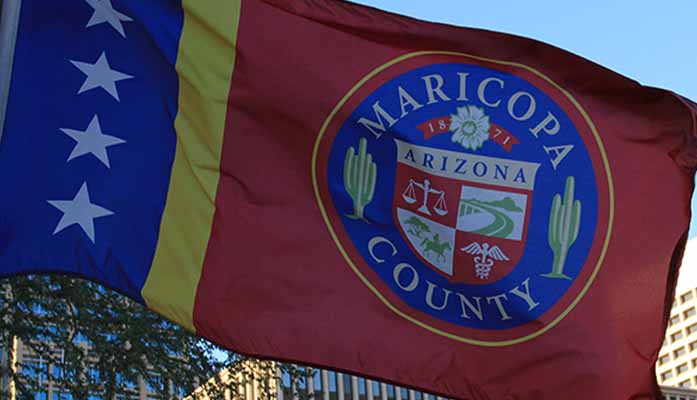
Maricopa County continues to house a diversity and inclusion initiative page.
According to the dedicated page for the diversity and inclusion initiative, Maricopa County continues to align the county’s workforce to complement constituent demographics. The county page declares that diversity yields net benefits culturally, socially, and economically.
“Maricopa County’s diversity and inclusion strategies are focused on creating an engaged workforce representative of the citizens we serve and reflective of the changing demography of our communities,” states the initiative page. “The significant cultural, social and economic dividends arising from our diverse employee base will ensure in the future our ability to provide sound government to the residents of Maricopa County.”
The page also credits differences among employees in terms of cultures, backgrounds, beliefs, and abilities as points of strength.
“Diversity and inclusion are global visions in today’s marketplace and Maricopa County realizes that by understanding, respecting and using creatively the differences of our employees, we will continue to meet the needs of the citizens we serve,” stated the initiative page.
Per the county, supporting diversity and inclusion among its workforce also consists of recognizing, rewarding, and compensating employees — specifically, based on the merits.
“The foundation of our diversity and inclusion strategies are to clearly articulate to both our employees and the general public our intention to create a culture that enhances our ability to hire, retain, develop, manage and promote a diverse, engaged workforce,” added the initiative page.
According to the page, the diversity and inclusion initiative is housed within the county’s Human Resources Department, and falls under the county’s “Government Operations” strategic priority: one of five within the 2023-2026 fiscal year strategic goals and performance measures.
This strategic priority focuses on improving infrastructure to improve government services and the county workforce.
However, on the performance dashboard page for the “Government Operations” strategic goal, the policy initiative of diversity and inclusion is not mentioned. The page mentions only three goals within the overarching strategic goal: optimizing technology by creating and launching a governance committee with the Office of Enterprise Technology; building trust by developing an online county data and services portal for residents; and developing a performance dashboard.
Nowhere else in the county’s current strategic plan is there mention of diversity and inclusion, or diversity or inclusion.
With the page remaining active as a seemingly standalone initiative, it is unclear the role diversity and inclusion plays within county governance — especially since the strategic plan it purportedly exists within doesn’t mention it at all.
Available archived versions of the diversity and inclusion page date back to 2017. The 2019-2022 fiscal year strategic goals and performance measures did not mention diversity and inclusion, and neither did the 2015-2018 version.
Earlier this year following President Donald Trump’s crackdown on diversity, equity, and inclusion (DEI) within the public sector, Maricopa County Community College District dropped its DEI policies and moved to repurpose or offload entirely individuals or groups previously dedicated to DEI.
In addition to the expected removal of its diversity page online, the district disbanded Equality Maricopa, its largest identity-based group (LGBTQ+ individuals), and advised the removal of specific identity-based groups across its campuses, like the Black Student Union.
Maricopa County School Superintendent Shelli Boggs also put the K-12 schools on notice to drop their DEI policies.
AZ Free News is your #1 source for Arizona news and politics. You can send us news tips using this link.
by Jonathan Eberle | Oct 18, 2025 | News
By Jonathan Eberle |
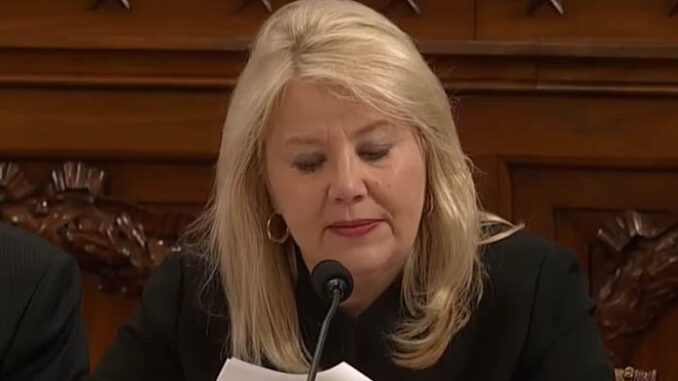
As Maricopa County voters begin casting ballots in the off-year election, Supervisor Debbie Lesko is raising concerns about Proposition 409 — a $898 million bond proposal to fund major upgrades for Valleywise Health, the county’s public hospital system.
“I’m not a fan of Prop. 409, the Valleywise Health ballot measure,” Lesko wrote on X. “This is a new tax in addition to their existing tax. If this passes, we’ll be paying for two Valleywise bonds on our property taxes.”
The measure, now appearing on ballots mailed to voters this week, would allow the county to issue bonds backed by property taxes to improve and expand Valleywise facilities across the region. The hospital system says the funding would be used to construct a new 200-bed behavioral health facility, expand emergency services, and replace aging community health centers.
If approved, Prop. 409 would raise property taxes by 11 cents per $100 of assessed limited property value. Valleywise leaders and public health advocates argue the investment is essential to meet growing mental health needs across the Valley. Supporters say the measure reflects the community’s commitment to improving access to behavioral health services and modernizing the hospital’s aging infrastructure.
The Arizona Public Health Association and Maricopa County Medical Society have also endorsed the proposal, calling it a nonpartisan issue with long-term benefits for residents. However, Lesko’s opposition highlights lingering taxpayer concerns about rising costs. Critics argue that approving the new bond would result in residents paying for two concurrent Valleywise property tax levies — the existing one from an earlier bond and the new one under Prop. 409.
Mail ballots were sent out on October 8, and voters have until October 24 to request one by mail. Ballots should be mailed back by October 28 to ensure timely delivery or dropped off at a designated county drop box. Election Day is November 4, when all ballots will be counted. As debate continues, voters will decide whether the benefits of expanding Maricopa County’s public health system outweigh the costs of another property tax increase.
Jonathan Eberle is a reporter for AZ Free News. You can send him news tips using this link.
by Matthew Holloway | Oct 14, 2025 | News
By Matthew Holloway |
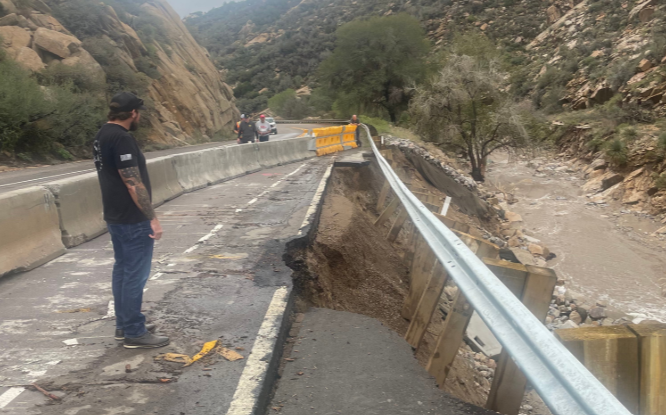
With tropical storm-fueled rains hammering various parts of Arizona and flood losses mounting, the U.S. Small Business Administration (SBA) announced that low-interest loans are now available for the victims of severe flooding in Coconino, Gila, Graham, Maricopa, Navajo, Pinal, and Yavapai Counties, as well as tribal nations.
The SBA is offering low-interest federal disaster loans to eligible businesses, nonprofits, residents, and tribal nations—similar to those provided for the Dragon Bravo Fire victims in September.
In a post to X announcing the relief for Gila County, Congressman Eli Crane (R-AZ02) called for continued prayers for those hit by the massive flooding. Remnants of Hurricane Priscilla hammered the area over the weekend, adding to late September’s monsoon deluge that devastated Globe-Miami.
Crane wrote: “@SBAgov has declared an economic disaster due to the severe flooding in Gila County. Through this declaration, SBA’s Economic Injury Disaster Loan (EIDL) program is available to eligible businesses, private nonprofits, and residents,” providing a link to resources.
He followed up: “Please continue to keep those impacted by the devastating floods in Gila County in your prayers. For those affected, @SBAgov is offering Business Physical Disaster Loans, Home and Personal Property Loans, and Economic Injury Disaster Loans.”
According to the SBA:
“Businesses and nonprofits are eligible to apply for business physical disaster loans and may borrow up to $2 million to repair or replace disaster-damaged or destroyed real estate, machinery and equipment, inventory, and other business assets.
“Homeowners and renters are eligible to apply for home and personal property loans and may borrow up to $100,000 to replace or repair personal property, such as clothing, furniture, cars, and appliances. Homeowners may apply for up to $500,000 to replace or repair their primary residence.
“Applicants may be eligible for a loan increase of up to 20% of their physical damage, as verified by the SBA, for mitigation purposes. Eligible mitigation improvements include insulating pipes, walls and attics, weather stripping doors and windows, and installing storm windows to help protect property and occupants from future disasters.”
The Economic Injury Disaster Loan (EIDL) program is also available to help small businesses, nurseries, and non-profit organizations with financial losses directly related to this disaster.
For more information, the SBA directs victims to visit this website. They can apply online, call SBA’s Customer Service Center at (800) 659-2955, or email disastercustomerservice@sba.gov.
“When disasters strike, SBA’s Disaster Loan Outreach Centers play a vital role in helping small businesses and their communities recover,” Chris Stallings, associate administrator of the Office of Disaster Recovery and Resilience at the SBA, said in a press release. “At these centers, SBA specialists assist business owners and residents with disaster loan applications and provide information on the full range of recovery programs available.”
Matthew Holloway is a senior reporter for AZ Free News. Follow him on X for his latest stories, or email tips to Matthew@azfreenews.com.
by AZ Free Enterprise Club | Oct 6, 2025 | Opinion
By the Arizona Free Enterprise Club |
The idea to extend light rail to the State Capitol has occupied the dusty shelves of bureaucratic transit plans for ages. Phoenix first floated it in their 2000 “Transit 2000” plan, their 2015 Transportation 2050 initiative, and the concept has taken up space in every MAG and regional planning cycle since 2004. The idea’s longevity is not a testament to how good ideas endure; rather how bureaucrats remain unaffected regardless of light rail’s failure; unwilling to change course despite low ridership, high costs, high crime, or changing travel patterns. The world changes but a transit plan apparently never dies.
In fact, it turns out it can’t be stopped from destroying the Capitol corridor even when lawmakers pass a law to stop it.
In 2023, Republican legislators negotiated Proposition 479, Maricopa County’s half cent sales tax for transportation, which included a clause prohibiting the use of any public resources for light rail coming within 150 feet of the State Capitol. The goal of the provision was to insulate lawmakers from the disruption and destruction caused by light rail. This neat trick of making the “Capitol Line” someone else’s problem would likely backfire.
Well, it turns out we were right, and what Phoenix has in store for the Capitol corridor is worse than anyone could have imagined.
>>> CONTINUE READING >>>
by Jonathan Eberle | Sep 25, 2025 | Economy, News
By Jonathan Eberle |
Maricopa County has retained the highest possible credit rating. Standard & Poor’s Global Ratings affirmed its AAA rating with a stable outlook, signaling strong financial health amid broader economic challenges.
County officials say the rating reflects careful fiscal management and a solid economic foundation. According to Chairman of the Board of Supervisors Thomas Galvin, District 2, the AAA rating demonstrates that “Maricopa County is not only financially strong but fiscally responsible.”
The County operates well below its maximum property tax levy and carries no general obligation debt, a distinction rare for large counties. Officials note that these measures help reduce costs for residents while supporting strategic investments in infrastructure and public services.
The AAA rating reflects several factors, including:
- Conservative budgeting and prudent financial management.
- Healthy reserves that protect against economic uncertainty.
- A diverse local economy, with strong employment in government, education, health care, and aerospace.
- Taxpayer protection through levying nearly $270 million below the County’s maximum property tax capacity.
- Absence of general obligation debt, limiting taxpayer liabilities.
Maintaining the AAA rating also allows the County to borrow at lower interest rates, which can save millions of dollars on capital projects such as public safety facilities, technology upgrades, and infrastructure improvements. Officials say these savings benefit residents through enhanced services and lower costs.
The affirmation comes at a time when many counties nationwide face economic pressures, highlighting Maricopa County’s continued focus on long-term fiscal stability.
Jonathan Eberle is a reporter for AZ Free News. You can send him news tips using this link.