by Jonathan Eberle | Oct 18, 2025 | News
By Jonathan Eberle |
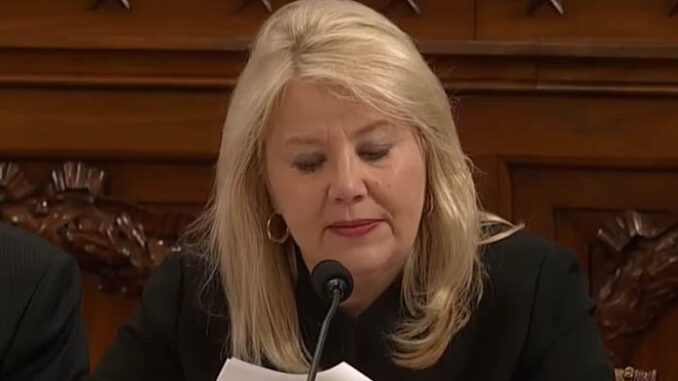
As Maricopa County voters begin casting ballots in the off-year election, Supervisor Debbie Lesko is raising concerns about Proposition 409 — a $898 million bond proposal to fund major upgrades for Valleywise Health, the county’s public hospital system.
“I’m not a fan of Prop. 409, the Valleywise Health ballot measure,” Lesko wrote on X. “This is a new tax in addition to their existing tax. If this passes, we’ll be paying for two Valleywise bonds on our property taxes.”
The measure, now appearing on ballots mailed to voters this week, would allow the county to issue bonds backed by property taxes to improve and expand Valleywise facilities across the region. The hospital system says the funding would be used to construct a new 200-bed behavioral health facility, expand emergency services, and replace aging community health centers.
If approved, Prop. 409 would raise property taxes by 11 cents per $100 of assessed limited property value. Valleywise leaders and public health advocates argue the investment is essential to meet growing mental health needs across the Valley. Supporters say the measure reflects the community’s commitment to improving access to behavioral health services and modernizing the hospital’s aging infrastructure.
The Arizona Public Health Association and Maricopa County Medical Society have also endorsed the proposal, calling it a nonpartisan issue with long-term benefits for residents. However, Lesko’s opposition highlights lingering taxpayer concerns about rising costs. Critics argue that approving the new bond would result in residents paying for two concurrent Valleywise property tax levies — the existing one from an earlier bond and the new one under Prop. 409.
Mail ballots were sent out on October 8, and voters have until October 24 to request one by mail. Ballots should be mailed back by October 28 to ensure timely delivery or dropped off at a designated county drop box. Election Day is November 4, when all ballots will be counted. As debate continues, voters will decide whether the benefits of expanding Maricopa County’s public health system outweigh the costs of another property tax increase.
Jonathan Eberle is a reporter for AZ Free News. You can send him news tips using this link.
by Matthew Holloway | Oct 14, 2025 | News
By Matthew Holloway |
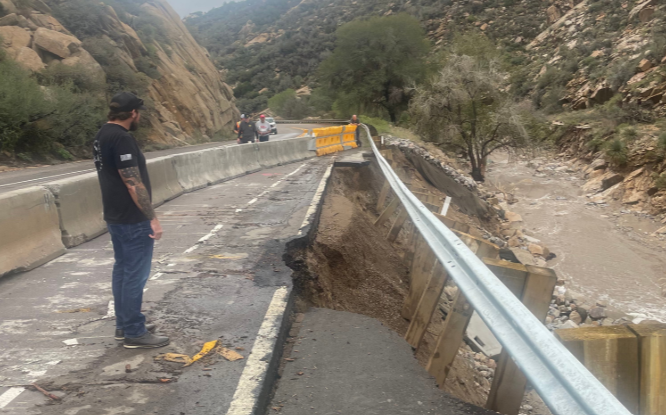
With tropical storm-fueled rains hammering various parts of Arizona and flood losses mounting, the U.S. Small Business Administration (SBA) announced that low-interest loans are now available for the victims of severe flooding in Coconino, Gila, Graham, Maricopa, Navajo, Pinal, and Yavapai Counties, as well as tribal nations.
The SBA is offering low-interest federal disaster loans to eligible businesses, nonprofits, residents, and tribal nations—similar to those provided for the Dragon Bravo Fire victims in September.
In a post to X announcing the relief for Gila County, Congressman Eli Crane (R-AZ02) called for continued prayers for those hit by the massive flooding. Remnants of Hurricane Priscilla hammered the area over the weekend, adding to late September’s monsoon deluge that devastated Globe-Miami.
Crane wrote: “@SBAgov has declared an economic disaster due to the severe flooding in Gila County. Through this declaration, SBA’s Economic Injury Disaster Loan (EIDL) program is available to eligible businesses, private nonprofits, and residents,” providing a link to resources.
He followed up: “Please continue to keep those impacted by the devastating floods in Gila County in your prayers. For those affected, @SBAgov is offering Business Physical Disaster Loans, Home and Personal Property Loans, and Economic Injury Disaster Loans.”
According to the SBA:
“Businesses and nonprofits are eligible to apply for business physical disaster loans and may borrow up to $2 million to repair or replace disaster-damaged or destroyed real estate, machinery and equipment, inventory, and other business assets.
“Homeowners and renters are eligible to apply for home and personal property loans and may borrow up to $100,000 to replace or repair personal property, such as clothing, furniture, cars, and appliances. Homeowners may apply for up to $500,000 to replace or repair their primary residence.
“Applicants may be eligible for a loan increase of up to 20% of their physical damage, as verified by the SBA, for mitigation purposes. Eligible mitigation improvements include insulating pipes, walls and attics, weather stripping doors and windows, and installing storm windows to help protect property and occupants from future disasters.”
The Economic Injury Disaster Loan (EIDL) program is also available to help small businesses, nurseries, and non-profit organizations with financial losses directly related to this disaster.
For more information, the SBA directs victims to visit this website. They can apply online, call SBA’s Customer Service Center at (800) 659-2955, or email disastercustomerservice@sba.gov.
“When disasters strike, SBA’s Disaster Loan Outreach Centers play a vital role in helping small businesses and their communities recover,” Chris Stallings, associate administrator of the Office of Disaster Recovery and Resilience at the SBA, said in a press release. “At these centers, SBA specialists assist business owners and residents with disaster loan applications and provide information on the full range of recovery programs available.”
Matthew Holloway is a senior reporter for AZ Free News. Follow him on X for his latest stories, or email tips to Matthew@azfreenews.com.
by AZ Free Enterprise Club | Oct 6, 2025 | Opinion
By the Arizona Free Enterprise Club |
The idea to extend light rail to the State Capitol has occupied the dusty shelves of bureaucratic transit plans for ages. Phoenix first floated it in their 2000 “Transit 2000” plan, their 2015 Transportation 2050 initiative, and the concept has taken up space in every MAG and regional planning cycle since 2004. The idea’s longevity is not a testament to how good ideas endure; rather how bureaucrats remain unaffected regardless of light rail’s failure; unwilling to change course despite low ridership, high costs, high crime, or changing travel patterns. The world changes but a transit plan apparently never dies.
In fact, it turns out it can’t be stopped from destroying the Capitol corridor even when lawmakers pass a law to stop it.
In 2023, Republican legislators negotiated Proposition 479, Maricopa County’s half cent sales tax for transportation, which included a clause prohibiting the use of any public resources for light rail coming within 150 feet of the State Capitol. The goal of the provision was to insulate lawmakers from the disruption and destruction caused by light rail. This neat trick of making the “Capitol Line” someone else’s problem would likely backfire.
Well, it turns out we were right, and what Phoenix has in store for the Capitol corridor is worse than anyone could have imagined.
>>> CONTINUE READING >>>
by Jonathan Eberle | Sep 25, 2025 | Economy, News
By Jonathan Eberle |
Maricopa County has retained the highest possible credit rating. Standard & Poor’s Global Ratings affirmed its AAA rating with a stable outlook, signaling strong financial health amid broader economic challenges.
County officials say the rating reflects careful fiscal management and a solid economic foundation. According to Chairman of the Board of Supervisors Thomas Galvin, District 2, the AAA rating demonstrates that “Maricopa County is not only financially strong but fiscally responsible.”
The County operates well below its maximum property tax levy and carries no general obligation debt, a distinction rare for large counties. Officials note that these measures help reduce costs for residents while supporting strategic investments in infrastructure and public services.
The AAA rating reflects several factors, including:
- Conservative budgeting and prudent financial management.
- Healthy reserves that protect against economic uncertainty.
- A diverse local economy, with strong employment in government, education, health care, and aerospace.
- Taxpayer protection through levying nearly $270 million below the County’s maximum property tax capacity.
- Absence of general obligation debt, limiting taxpayer liabilities.
Maintaining the AAA rating also allows the County to borrow at lower interest rates, which can save millions of dollars on capital projects such as public safety facilities, technology upgrades, and infrastructure improvements. Officials say these savings benefit residents through enhanced services and lower costs.
The affirmation comes at a time when many counties nationwide face economic pressures, highlighting Maricopa County’s continued focus on long-term fiscal stability.
Jonathan Eberle is a reporter for AZ Free News. You can send him news tips using this link.
by Matthew Holloway | Aug 31, 2025 | News
By Matthew Holloway |
The legal fight between Maricopa County Recorder Justin Heap and the County Board of Supervisors escalated Monday. America First Legal filed two motions on Heap’s behalf, and Arizona’s legislative leaders submitted an amicus brief supporting him.
In a press release, the County Recorder’s Office stated that the motions filed by America First Legal “reveal how the County Board of Supervisors and County Attorney Rachel Mitchell have weaponized county government against duly-elected Recorder Justin Heap simply because he dared to fulfill his statutory duties and protect the sanctity of Arizona elections.”
Heap said in a statement, “It’s unfortunate that the Board’s unprofessional and bad faith actions have forced us to litigate this issue; however, it’s significantly more unfortunate that the Board continues to deny the voters of Maricopa County the positive, common sense election integrity reforms that they voted for last November when they elected me. As I’ve promised from day one, I am working to ensure honest, secure, and transparent elections for every voter in Maricopa County. I am not, and will not, waiver in my commitment to executing on this promise. I’m grateful to America First Legal for standing by my side in this battle.”
America First Legal detailed Heap’s allegations in the first filing: “The Defendants — the members of the Maricopa County Board of Supervisors (‘BOS’) — have crossed from fiscal oversight into outright sabotage. Ignoring [state law] and decades of precedent, the BOS has refused to fund the Recorder’s ‘necessary expenses’ — from modern ballot-processing equipment to indispensable IT staff — while simultaneously seizing control of the very election functions its stonewalling endangers. The BOS’s obstruction is not mere bureaucratic foot-dragging; it is a calculated power grab that throttles the Recorder’s constitutional duty to administer secure, timely elections.”
In an amici filing in support of Heap, Arizona House Speaker Steven Montenegro and Senate President Warren Petersen’s legal representation call for a strict interpretation of state statutes which govern the responsibilities of the county recorder and board of supervisors. They argue that the “court should narrowly conclude that, based on the statutes’ plain language, when the statute authorizes ‘the county recorder or other officer in charge of elections’ to act, it is the recorder’s duty to ensure the statute is complied with unless the recorder expressly agrees to delegate that duty to another ‘officer in charge of elections.’”
As previously reported by AZ Free News, the months-long negotiations between Heap and the Board, led by Chairman Thomas Galvin, devolved steadily since Heap’s election and the replacement of Stephen Richer in January until finally collapsing into litigation in June.
The crux of the disagreement between the Board of Supervisors and County Recorder Heap rests upon a Shared Services Agreement (SSA) agreed to by Heap’s predecessor, Richer, who ardently opposed the election integrity efforts that Heap ran for office to enact. For nearly six months, the two county offices negotiated; however, Heap and the Supervisors were unable to reach an agreement, culminating in a lawsuit filed by Heap.
Since then, Heap has alleged that the Supervisors have “taken retaliatory actions” describing a series of measures that “make it impossible for him to do his job, including removing nearly all his election-related IT staff; seizing the servers, databases, and websites necessary to fulfill his duties; and restricting access to necessary facilities and equipment,” as reported by The Federalist.
In a second filing, Heap and America First Legal introduced allegations involving Maricopa County Attorney Rachel Mitchell, bringing a third County office into the fray in a dispute over who may represent the County Recorder, an attorney chosen by Heap or Maricopa County Attorney Rachel Mitchell. In the legal brief, they allege, “Attorney Mitchell originally appointed a criminal defense attorney to advise the Recorder; however, in April, America First Legal agreed to represent Heap pro bono, a move that Mitchell objected to.”
“When the Recorder complained that the original attorney appointed for him lacked sufficient subject matter expertise, County Attorney Mitchell appointed former Arizona Supreme Court Justice Andrew Gould to advise the Recorder only during negotiations with the Board. However, County Attorney Mitchell and the Board did not allow Justice Gould to litigate on the Recorder’s behalf,” the filing revealed.
But according to AFL, that wasn’t the end of it. “In May of 2025, Justice Gould specifically asked the Maricopa County Attorney’s Office for permission to litigate on Recorder Heap’s behalf but was not allowed to do so because the scope of his representation was limited to negotiation of the SSA and did not include litigation, and, accordingly, the County would not compensate him for litigation-related work.”
Mitchell responded by penning a letter to the AFL attorneys, writing in part, “This letter is to inform you that I am the Recorder’s attorney and that you do not represent the Maricopa County Recorder’s Office or Recorder Heap in his official capacity.”
Per The Federalist, AFL attorney James Rogers retorted that the “County Recorder is allowed to pick his own lawyer in litigation,” adding that Heap “is not subject to the whims of the county attorney.”
In the midst of the complex legal battle between the Recorder’s Office and the Board of Supervisors, which has drawn the attention of legislative leaders, the dispute with Mitchell adds yet another layer of infighting within the already divided county government, with the calendar counting down to the 2026 elections.
Matthew Holloway is a senior reporter for AZ Free News. Follow him on X for his latest stories, or email tips to Matthew@azfreenews.com.