Voters are sending newly elected Arizona legislators to office with a clear mandate from the people of Arizona: The people must be the chief stakeholder of their representatives.
The days of woke and swampy lobbyists and consultants overriding our voices have come to an end, unless your legislator votes for the swamp grift to continue with their first vote representing you. The SECRET vote for legislative leadership picks happens tomorrow, Tuesday, November 12th at 9 am.
Leadership votes are the most evident indicator of the policy that will lead each chamber. All policy floats downstream from leadership. The leadership of each chamber of the legislature determines whether the grassroots have a seat at the table or if a quid pro quo, pay-to-play agenda will lead their administration.
The leader of the House is called the Speaker. The leader of the Senate is called the Senate President. While the grassroots worked hard to reform both chambers in 2022, only Senate President Warren Petersen performed with a complete turnover of poor-performing staff and additional efficiencies in how government runs. He also led the efforts to stop the run-amok executive authority by appointing Sen. Jake Hoffman to lead the confirmation committee process of Governor Katie Hobbs’ appointees. These efforts have been wildly successful, with Arizona voters confirming their support at the ballot box by expanding Republican majorities in both chambers.
It’s time for the House to follow suit with a Speaker who will put the mandate from the people first and help ensure that President Trump’s America First agenda takes root in Arizona. The candidates running include:
1.Joe Chaplik, a legislator in LD3 who previously ran for Speaker in 2022. Chaplik was spurred on by the grassroots and only missed it by a single vote. He has served his district since 2022. He’s a successful businessman with “25 years of executive leadership experience building and guiding top-tier companies,” according to his AZ Legislature biography. Chaplik is also a founding member of the Arizona Freedom Caucus. He gained wide popularity in leading the effort to relieve children of the abusive mask mandates in schools. Chaplik’s lifetime Arizona Free Enterprise Club scorecard score is 100%.
2.Leo Biasiucci, a legislator in LD30 currently serving as Majority Leader. Biasiucci has no biography on record. He’s served in his district since 2020. Ballotpedia says he has a background in “owning Mohave Traffic Survival School and working as an actor with SAG-AFTRA, a claims analyst with GEICO, and a financial auditor with GE Capital.” He is known to have led the House Victory PAC effort. And he’s also been a friend to both the grassroots and moderate members of the Caucus. Biasiucci’s lifetime Arizona Free Enterprise Club scorecard score is 84%, with a recent session score of 78%.
3. Steve Montenegro, a legislator in LD29 since 2023. Montenegro also doesn’t have a biography on record. He previously served as a legislator from 2008 to 2017. Montenegro previously ran for Congress against Debbie Lesko and lost mainly due to a myriad of reports of an inappropriate relationship with a young staffer while serving in legislative leadership, even though he was married and a pastor. He also previously worked in former Congressman Trent Franks‘ office for a decade. Franks was also plagued by a scandal involving a young female staffer. Montenegro’s Ballotpedia says he previously worked as a principal consultant of Coronam Consulting. He’s also served as an executive with Patrick Byrne’s The America Project. Montenegro has also previously been a big champion of eliminating the Electoral College with a yes vote on the National Popular Vote initiative in 2016 on HB2456—a popular radical left initiative to upend our Constitutional Republic. It died thanks to then-Senate President Andy Biggs, who blocked it from being voted on in the Senate. Montenegro’s lifetime Arizona Free Enterprise Club scorecard score is 91%, with the most recent session clocking in at 81%.
When looking at the most recent legislative track records, the voters get a clearer picture of the leadership each candidate offers. Montenegro ran 29 bills this session, with only two passing or 6.9%. Chaplik ran seven bills, with one passing or 14%. Biasiucci ran 34 bills, with eight passing or 23.5%. Unfortunately, most passed bills were victim to Governor Hobbs’ veto stamp.
Chaplik’s keen understanding of government efficiency stands out most in this record. Chaplik has long been preaching a message that poor management in the House has led to chaos, an all-powerful lobbyist and consultant class overriding the will of the people, and unsupported legislators with few tools to serve the best interests of their constituents and fulfill the people’s mandate. He’s walked the walk by limiting the number of bills he’s personally run, ensuring staff time isn’t wasted on silly messaging bills.
Chaplik also advocates for sessions to return to 100 days as our state Constitution prescribes to prevent swampy budgets and pay-to-play sweetheart deals benefiting the lobbyist and consulting class.
Finally, Chaplik offers a vision where the legislature prioritizes its only constitutional mandate – the budget – and presents that to the Governor early in the session to avoid gridlock and threats of government shutdowns. Senate President Petersen has supported early budget preparation and was successful in this endeavor in 2023. It changed the power dynamic with the radical left executive branch and restored power to the people’s representatives. The people benefit greatly when efficiency is prioritized by leading with the budget first.
These reforms, coupled with cleaning house of staff leadership who have promoted chaos and undermined the body and Speaker historically on many occasions, are a winning combination for the majority party to fulfill the mandate from the voters.
Legislators who genuinely seek to serve the people should make it known now whether they intend to make the people the chief stakeholders of their government or the political lobbyist consultant class.
The voters should demand transparency in their legislators’ first vote, setting the tone for the next two years. Transparency dies in darkness, and no legislator should keep their leadership votes secret from their constituents.
A quick search on X shows the grassroots favors Chaplik to lead the House. Do you know who your legislators will vote for tomorrow in the House Speaker race? Have they asked you who you want to lead the AZ People’s House?
Merissa Hamilton is the founder and chairwoman of the nonpartisan nonprofit organizations Strong Communities Foundation of Arizona and Strong Communities Action, also known as EZAZ.org, which are focused on making civic education and action as easy as pie. She’s an elected Member at Large of Congressional District 1 for the Arizona Republican Party and previously ran for Mayor in 2020. Merissa is also the Director of Integration and Policy at The R.O.A.R. PAC, which is on a mission to restore our American Republic.
The nation’s largest university is balking its years-long trend of growth and expansion with the closure of one of its campuses.
Arizona State University (ASU) announced earlier this week that it will close its Lake Havasu campus in the summer 2025, affecting over 200 students and 20 faculty members. The Lake Havasu campus opened just over a decade ago in 2012.
The university will also be increasing tuition for those on campus: full-time students will pay another $350, with part-time students to pay a lower, “proportional” amount.
ASU blamed state budget cuts for the campus closure in its Monday announcement, citing an $11 million reduction in funding. ASU President Michael Crow said this latest reduction was part of a longtime refusal by the state legislature and governor to fund higher education adequately.
“These necessary actions reflect the continuing lack of public investment from state government for higher education in Arizona,’’ said Crow. “ASU simply cannot be asked to fund the expansion of higher education across the state without state investment as a part of the financial structure to do so. These budget cuts put the state of Arizona even further behind in ensuring that Arizona has the talent and workforce necessary to advance its economy.”
Governor Katie Hobbs — often at odds with the slim Republican majority of the state legislature — was supportive of this most recent budget, including the cuts to higher education and nearly all other agencies.
“[T]his bipartisan, balanced budget puts our state on solid financial ground,” said Hobbs at the time.
A spokesperson for Hobbs told outlets that the governor remains supportive of the budget, but didn’t elaborate whether the governor was supportive of ASU’s decision.
However, lawmakers have refuted this claim. House Majority Leader Leo Biasiucci, who resides in Lake Havasu City, issued a joint statement with Republican State Rep. John Gillette expressing disappointment with ASU’s decision and concern for the lack of public discussion or stakeholder involvement.
“ASU’s strong financial health simply does not justify its action. The State Legislature has made significant investments in ASU over the past few years,” said the lawmakers. “ASU’s budget has increased by 22 percent since FY20, and by 40 percent since 2015, with $408 million allocated to the university this year, reflecting our commitment to higher education, even while difficult decisions were made to balance the budget.”
Gillette also added the speculation in a separate post of his own that ASU’s decision was politically motivated.
“When times are good, it will receive new funds; when times are tough, it should tighten its belt — just like every other agency that serves the public,” said Gillette. “We call on ASU to immediately reconsider this closure and urge the Arizona Board of Regents to take a much closer look at this decision as it looks very politically motivated this close to the election.”
We are deeply troubled by ASU’s surprise decision to close the Lake Havasu campus,even more frustrating is that ASU’s financial standing clearly doesn’t justify such drastic action. The legislature prioritized higher education with significant investments in ASU over the past…
According to Lake Havasu City leadership, ASU kept the city out of their decision to close the campus. It was members of the community and city leadership that served on the committee that brought ASU to the city over a decade ago.
Mayor Cal Sheehy toldHavasu News the city wasn’t given the opportunity to seek an alternative to closing the campus.
“It’s really sad that ASU has made the decision to close the college at Lake Havasu City, but the real challenge is that we haven’t had a chance to discuss any alternatives,” said Sheehy. “They believe the legislature put them here, but Lake Havasu has shown we are innovative, starting with the $2 million it took to get it here in the first place, and a conversation about what solutions could be there and what the opportunities are.”
One of the committee members, business owner Steve Greeley, also didn’t buy ASU’s claim that financial woes had forced their hand.
“I saw the quote by President Crow in regards to the Legislature cutting back on funding. I understand that, but you would think they would have a workaround before making a decision so burdensome,” said Greeley. “It was a huge effort by the community all those years ago, that took a lot of time, resources and money. I’m hoping something can be resolved.”
Havasu News editorial staff reported that their community raised $2 million in an effort to assist ASU in coming to their city.
“Our community deserved a seat at the table,” said the outlet. “We should be angry about this. The closure will affect students, families, and local jobs. And ASU’s promise to relocate students doesn’t make up for the loss of a school that became a part of our town. ASU has broken its promise to Lake Havasu City, and they owe us more than a simple goodbye.”
AZ Free News is your #1 source for Arizona news and politics. You can send us news tips using this link.
The Arizona House of Representatives continues to make inroads across the world.
Last week, members of the Arizona House of Representatives hosted a delegation from the Republic of Indonesia at the state capitol. According to the press release from the state House, the delegation from the foreign nation was comprised of 12 individuals and consisted of “elected officials, government representatives, and business leaders.” The release revealed that Rahayu Saraswati Dhirakanya Djojohadikusumo, “a recently elected member of the People’s Representative Council, Indonesia’s House of Representatives, and the Deputy Chairperson of the Great Indonesia Movement Party (GERINDRA),” led the delegation to Arizona.
House Speaker Ben Toma, Majority Leader Leo Biasiucci, Representative Justin Wilmeth, and other legislators met the Indonesian delegation. Wilmeth, the Vice Chairman of the House International Trade Committee, issued a statement after the visit from the overseas group. He said, “It was a privilege to meet with the Indonesian delegation and exchange insights on potential trade and investment opportunities between Arizona and Indonesia. Through our discussions, it was evident that Arizona and Indonesia share a strong interest in fostering new opportunities in education, mining, and technology manufacturing. We look forward to exploring ways to strengthen our economic ties and foster mutually beneficial partnerships in the future.”
The Indonesian delegation’s visit to Arizona is another episode in a growing list of relationships that have been cultivated by the Arizona Legislature – particularly through this trade committee. The Committee has been active in traveling outside of the United States and welcoming delegations to its house (no pun intended).
Daniel Stefanski is a reporter for AZ Free News. You can send him news tips using this link.
Another potential attempt on former President Donald J. Trump’s life was met with outrage from Arizona Republicans.
On Sunday, the world received shocking news when reports hit the airwaves that gunshots had been fired at one of President Trump’s golf courses in Florida. As more details emerged, it became clear that President Trump may have escaped another assassination attempt from an individual who appeared to be hiding in wait on the outskirts of the property for the former American Commander in Chief to come into his view. A Secret Service advance agent observed this gunman’s weapon, and shots were fired in the alleged attempted assassin’s direction. The individual escaped and was later apprehended by Florida law enforcement soon after the interaction on the golf course.
President Trump was unharmed. He later issued a statement with his thoughts on the second attempt on his life in the past few months, writing, “I would like to thank everyone for your concern and well wishes – it was certainly an interesting day! Most importantly, I want to thank the U.S. Secret Service, Sheriff Ric Bradshaw and his Office of brave and dedicated Patriots, and, all of Law Enforcement, for the incredible job done today at Trump International in keeping me, as the 45th President of the United States, and the Republican Nominee in the upcoming Presidential Election, SAFE. THE JOB DONE WAS ABSOLUTELY OUTSTANDING. I AM VERY PROUD TO BE AN AMERICAN!”
Many Arizona Republicans expressed their feelings about the incident on their social media platforms.
Senate President Warren Petersen said, “2nd assassination attempt of Trump! Unbelievable. Thank heaven he is ok. Suspect in custody.”
2nd assassination attempt of Trump! Unbelievable. Thank heaven he is ok. Suspect in custody.
The Republican Party of Arizona posted, “The AZGOP thanks God for the safety of President Trump and we are grateful that law enforcement spotted the assailant before anyone was hurt. We stand with President Trump and President Trump will never surrender this country and he will never abandon the American people.”
The @AZGOP thanks God for the safety of President Trump and we are grateful that law enforcement spotted the assailant before anyone was hurt.
We stand with President Trump and President Trump will never surrender this country and he will never abandon the American people.
AZGOP Chair Gina Swoboda added, “We call for an IMMEDIATE increase in security to provide President Trump with the level of resources received by a sitting President. The chaos must be brought to an end, and we must ensure our leaders can serve without coming to harm.”
State Representative Leo Biasiucci stated, “This is getting Fing ridiculous. Give the man full protection, I don’t care if the GOP has to help pay for it. It’s obvious he is not being given adequate protection.”
This is getting Fing ridiculous. Give the man full protection, I don’t care if the @GOP has to help pay for it. It’s obvious he is not being given adequate protection. 🇺🇸https://t.co/AhVSuzfxY0
Justin Heap, a first-term state legislator and current Republican nominee for Maricopa County Recorder, wrote, “May God bless and protect Donald Trump. He is safe after a second assassination attempt on his life. Some things transcend political parties. Attempted assassinations are clearly one of them. Let’s come together to loudly condemn this kind of political violence.”
May God bless and protect Donald Trump.
He is safe after a second assassination attempt on his life.
Some things transcend political parties.
Attempted assassinations are clearly one of them.
Let’s come together to loudly condemn this kind of political violence.
Senator Janae Shamp said, “May God continue to keep the truest man of The People in His protective white light as he leads the fight to save the only Nation created in His name. Amen.”
May God continue to keep the truest man of The People in His protective white light as he leads the fight to save the only Nation created in His name. Amen https://t.co/zTcsDX6GgI
Arizona House Republicans are working to protect the sovereignty of state lands.
On Tuesday, the Arizona State House of Representatives Republican Caucus announced that a handful of its members had “introduced measures to push back against Democrat President Joe Biden’s abuse of power and control over lands in Arizona.”
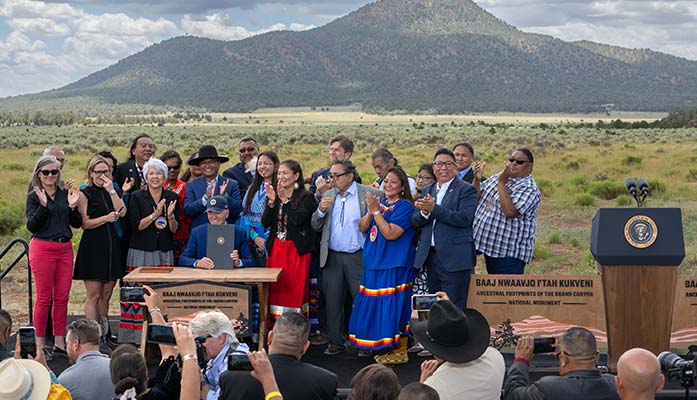
House Concurrent Memorial 2007, sponsored by House Majority Leader Leo Biasiucci. The legislation “urges the President to repeal the recent designation of the Grand Canyon Footprints National Monument in Northern Arizona and oppose any such designation in the state of Arizona in the future.”
Biasiucci said, “If allowed to stand (Biden’s Grand Canyon Footprints National Monument), it will forever close this area to new uranium production and will continue America’s reliance on uranium supplied from foreign nations.”
House Concurrent Memorial 2005, sponsored by Representative Austin Smith. The legislation would “push back against President Biden’s ‘30×30’ agenda, which seeks to take 30 percent of all federal lands out of economic production (such as mining, energy, and agriculture) and, thereby, reduce our ability to provide for national food security and energy and mineral independence.”
Smith said, “The federal government is the largest landowner in the United States, controlling almost one-third of the entire land in the country. Over 90 percent of this land is in Western States. Under the equal footing doctrine of the U.S. Constitution, this land should have been given to their respective Western States upon statehood.”
House Concurrent Memorial 2008, sponsored by Representative John Gillette. The legislation “calls for the Antiquities Act of 1906 to be repealed or amended to reaffirm that entire landscapes, animate life, such as birds and mammals, and common plants and vegetation are not considered ‘landmarks, structures, or objects’ under federal law.”
Gillette said, “The Act, which was intended to preserve only historic landmarks, structures, and other objects of historic or scientific interest, has been repeatedly misused to set aside vast parcels of real property.”
House Concurrent Memorial 2006, sponsored by Representative Gail Griffin. The legislation would “call for Congress to enact legislation that requires the express authorization of Congress, the state, and each county affected before any additional federal land grabs may be declared in Arizona.”
Griffin said, “The intrusion and overreach of the federal government, including President Biden’s economically harmful 30×30 initiative, pose the greatest threat to Arizona’s lands, further preventing the state from deciding what is best for its citizens.”
House Concurrent Memorial 2004, sponsored by Representative Austin Smith. The legislation would “urge Congress to promptly enact legislation requiring the federal government to give to an affected state or county one acre of federal land for every acre the federal government removes or withdraws from the respective state or county.”
Smith said, “Imposing federal preservation management on Arizona lands obstructs our state’s land management objectives and reduces rural communities’ ability to provide local public services. Arizona has been damaged by the inordinate cost and substantial uncertainty regarding the national government’s infringement on Arizona’s sovereign control of federally controlled lands within its borders.”
The measures from the Arizona lawmakers follow a similar legal fight from Senate President and House Speaker Warren Petersen last fall, when they filed an amicus curiae in the case of Garfield County v. Biden. The case, led by Utah Attorney General Sean Reyes, involves President Joe Biden’s “unilateral move in 2021 of declaring more than 3 million acres of land in the southern part of the state now representing two ‘national monuments.’” Arizona’s leaders are supporting the State of Utah’s position that the president’s action here violates the Antiquities Act. After a District Court Judge sided with the White House, Utah appealed the decision, leading to additional briefing.
FOR IMMEDIATE RELEASE: President @votewarren Encourages U.S. Court of Appeals to Weigh in on Biden's Abuse of Power with Land Seizures ⬇️ pic.twitter.com/guTO2XYJ4R
At the time of his filing, Petersen said, “It is time for the courts to weigh in and stop this federal corruption. Joe Biden’s unlawful maneuvers in both Utah and Arizona promise to wreak havoc on our local economies, the livelihoods of our citizens, and our national security. His end goal is to pander to radical environmentalists by ending mining, ranching and other local uses of federal lands. This has nothing to do with protecting actual artifacts.”
Daniel Stefanski is a reporter for AZ Free News. You can send him news tips using this link.