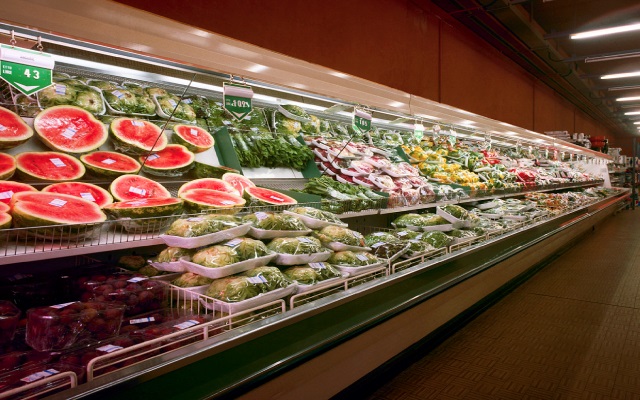
Arizona’s Republican lawmakers are looking to take on the cost of groceries by sending a referendum to the voters that would cap the transaction privilege taxes in municipalities on the sale of food items for home consumption at 2 percent.
The effort has been led by Republican State Representative Leo Biasiucci. It initially began as an outright ban, which proved to be a non-starter with State House Democrats and Governor Katie Hobbs. A bill to accomplish this was already dead on the table with the prospect of a veto from Hobbs, but this has been sidestepped through a compromise, HCR 2021.
“These are things that families need to survive,” Biasiucci told AZ Capitol Times. “This is the right thing to do. The fact that we are taxing people on eggs and milk and bread is insane.”
In a post to X Biasiucci wrote, “My bill to remove taxes from all essential food items like milk, eggs, butter, vegetables, fruit, baby food, beef and chicken passed committee 4-2. My bill also removes taxes from diapers. Taxing our food is regressive and it needs to end.”
My bill to remove taxes from all essential food items like milk, eggs, butter, vegetables, fruit, baby food, beef and chicken passed committee 4-2. My bill also removes taxes from diapers.
A previous version of the measure passed both chambers of the legislature in 2023 only to suffer a prompt veto from Hobbs after the leaders of several municipalities claimed city services, including police and fire departments, would need to be reduced without tax revenue from food sales. In her veto letter, Hobbs claimed, “It’s clear that this bill doesn’t actually eliminate costs for our residents. It simply moves those costs around.”
Rep. Neal Carter, a Republican from San Tan Valley told the Times that there have been significant increases in municipal sales tax revenue from online sales after the SCOTUS ruling in South Dakota v. Wayfair. The outlet reported that from 2019-2024, cities and towns have enjoyed a 60% increase in sales tax revenue, but city expenses have also increased in that time period as well, leaving the local governments reticent to cut spending.
“This is a terribly regressive tax. This is the most regressive tax I could possibly dream up,” Carter told the outlet. “If I was going to dream up a regressive tax, I would tax the one thing that you literally have to have to live. You don’t even, in a sense, have to have a home to live, but you have to have food.”
“I don’t know a single person in Arizona, a voter or a constituent, who’s going to say, ‘Yes, continue to tax me on these things that I have to put on the table for my family,’” Biasiucci told his colleagues. “At a time when inflation is through the roof, these taxes are going higher. You’re paying more.”
Under the compromise passed in the House, a city or town with a tax rate below 2% could elect to increase it up to the limit with voter approval. However, with approximately 70 of the 91 municipalities charging taxes on groceries ranging from 1.5% to 4%, some municipalities would be required to reduce their taxes and either reduce spending or increase taxes in other areas such as property tax.
After passing the House with limited Democrat votes and near total Republican support, the resolution was read in the Senate on March 10th and 11th and is pending review by both caucuses and a final vote.
Arizona legislators are one step closer to acting on an outdated criminal justice statute.
This week, the Arizona House of Representatives approved HB 2720 “to eliminate the sentencing disparity between crack cocaine and powder cocaine in Arizona’s legal code.” The bill was sponsored by State Representative Leo Biasiucci.
The bill passed the state House with a 59-0 vote (with one member not voting).
According to a press release from the Arizona House of Representatives, the proposal, if enacted into law, would “consolidate the threshold amount for cocaine base and hydrolyzed cocaine with the nine-gram threshold already established for powder cocaine, eliminat[ing] the outdated 750-miligram threshold for crack cocaine, a policy widely criticized for disproportionately targeting lower-income offenders without scientific justification.”
In a statement that accompanied the announcement of the bill’s progress, Biasiucci said, “For too long, Arizona’s laws have imposed an unjust sentencing disparity on two chemically identical substances. HB 2720 ensures our justice system is guided by facts and fairness, not outdated policies from nearly 40 years ago. It’s time for Arizona to align with the federal government and the majority of states that have already fixed this inequity.”
Representative Biasiucci added, “This is about being smart on crime. Punishment should fit the crime, and our laws shouldn’t unfairly penalize one group over another for the same offense.”
Earlier this month, the Arizona House Committee on the Judiciary gave the bill the green light with a unanimous 9-0 vote.
On the Arizona Legislature’s Request to Speak system, representatives from Dreamcorps, Justice Action Network, Justice Action Network, and Arizona Attorneys for Criminal Justice signed in to support the bill.
HB 2720 will now advance to the Arizona Senate for consideration.
Daniel Stefanski is a reporter for AZ Free News. You can send him news tips using this link.
One chamber of the Arizona Legislature just passed legislation to protect kids’ meals at schools.
On Monday, the Arizona House of Representatives passed HB 2164, that, if enacted, would “ban ultra-processed foods containing harmful additives from being served in public school meals.” The proposal was sponsored by State Representative Leo Biasiucci.
The bill passed out of the full House chamber with a 59-0 vote (one member not voting).
In a statement accompanying the announcement of the bill’s progress, Biasiucci said, “Our kids deserve better than artificial dyes and cheap fillers in their meals. Parents should know that when their children eat at school, they are getting real, nutritious food – not the kind of processed junk that’s banned in other countries. This is common sense, and I’m proud that my colleagues came together to pass this important bill.”
Biasiucci added, “This is a public health issued. We now have overwhelming evidence that these chemicals can contribute to everything from hyperactivity to increased cancer risk – yet they remain in school meals. We hope to end that today.”
According to the press release from the Arizona House of Representatives, the bill would “prohibit the sale or serving of school foods that contain potassium bromate, titanium dioxide, brominated vegetable oil, propylparaben, and synthetic food dyes like Red 40 and Yellow 5 – several of which are already restricted or banned in Europe due to harmful effects on children’s health.”
Earlier this month, the legislation was approved by the Arizona House Committee on Education with a 10-0 vote (one member was absent, and one voted ‘present’).
On the Arizona Legislature’s Request to Speak system, representatives from the Arizona Association of County School Superintendents, Arizona Public Interest Research Group, indicated their groups’ support for the bill; while representatives from Save Our Schools Arizona and Consumer Brands Association, signed in to oppose the proposal. Representatives from the Arizona Food Bank Network, Arizona School Administrators, Arizona Education Association, and Arizona School Boards Association, noted their organizations’ neutrality on the bills.
HB 2164 will now head to the Arizona Senate for consideration.
Daniel Stefanski is a reporter for AZ Free News. You can send him news tips using this link.
With Arizona leaders unifying statewide to back the Trump administration’s effort to make schools healthy, one Maricopa County leader is opposing.
Fountain Hills Town Council initially was unified in its support of HB2164, or the “Arizona Healthy Schools Act”: a bill to clean up the foods offered in the state’s public schools. The town council voted unanimously to issue a letter of support for the bill during its regular meeting on Tuesday. However, after the meeting officially ended, one of the council’s Democrats rescinded her vote.
Even with the rescinded vote from council member Peggy McMahon, the motion still passed.
Welp, that was a short lived beautiful moment of unity for the health of our children.
Peggy McMahon pulled her support now that the cameras are off, so I guess we’ll edit this tweet to say “the council majority”
Vice Mayor Hannah Toth — who led the council effort to file a letter of support — expressed her disappointment with McMahon’s change of heart.
“Welp, that was a short-lived beautiful moment of unity for the health of our children,” posted Toth on X. “Peggy McMahon pulled her support now that the cameras are off, so I guess we’ll edit this tweet to say ‘the council majority.’ What can ya do.”
In her motion to pass the letter of support, Toth pointed out that the U.S. is virtually the only developed country that hasn’t banned the ingredients prohibited in the Arizona Healthy Schools Act.
“[These are all chemicals] that are linked to behavioral issues, cancer, autism, even mental health because it’s chemicals. A lot of it is derived from crude oil,” said Toth. “All cities and towns in my opinion should be coming together in support of this bill – this is something that helps secure our future.”
The motion was celebrated initially as a bipartisan movement to back the Make America Healthy Again (MAHA) movement. MAHA is the primary focus of Health and Human Services (HHS) Secretary nominee and former presidential candidate Robert F. Kennedy Jr.
“[President Trump] asked me to end the chronic disease epidemic in this country,” said Kennedy. “And he said, I want to see results, measurable results, in the diminishment of chronic disease within two years. And I said, Mr. President, I will do that.”
Last month, Texas Republican Congressman Chip Roy published a 47-page report, “The Case for Healthcare Freedom,” detailing America’s health crisis as supplementary guidance for the MAHA movement.
The Arizona Healthy Schools Act, introduced by Republican State Rep. Leo Biasiucci, would restrict public schools from serving or selling “ultraprocessed” food and drink during school hours. The bill defines “ultraprocessed” foods and drinks as those which contain one or more of the following ingredients: potassium bromate, propylparaben, titanium dioxide, brominated vegetable oil, yellow dye 5 or 6, blue dye 1 or 2, green dye 3, or red dye 3 or 40. The bill doesn’t prohibit parents from providing their students with foods or drinks containing these ingredients.
An amendment to the bill also prohibited third parties from selling ultraprocessed food and drink on school campuses. The amendment also directed the Arizona Department of Education to post on its website a standardized form for public schools to certify its compliance with the legislation as well as a list of public schools certified by the department for their compliance with the legislation.
The bill passed out of the House Education Committee recently with unanimous bipartisan support.
AZ Free News is your #1 source for Arizona news and politics. You can send us news tips using this link.
Arizona Superintendent of Public Instruction Tom Horne announced his endorsement of new legislation proposed by Rep. Leo Biasiucci that would forbid Arizona schools from providing foods on campus which are deemed harmful. Horne was joined by Education Committee Chairman Rep. Matt Gress and Registered Nurse, Sen. Janae Shamp, announcing the bill to “cut the chemicals,” on Tuesday.
In a press release, the Arizona Department of Education (ADE) revealed that HB 2164 would establish a ban on schools serving or selling foods found to contain ingredients that scientific studies have found to be harmful to students health, including potassium bromate, propylparaben, titanium dioxide, brominated vegetable oil, yellow dyes 5 and 6, blue dyes 1 and 2, red dyes 3 and 40, and green dye 3.
“Our kids deserve better than artificial dyes and cheap fillers in their lunches. If we’re providing meals at school, they should be real, nutritious food—not the kind of processed junk that’s banned in other countries. This bill puts the health of Arizona’s children first, plain and simple,” Biasiucci said in the release.
In a statement, Horne said, “The time has come to eliminate harmful foods from public schools and vending machines. Synthetic food dyes are associated with behavioral issues which then affect a child’s ability to perform academically and engage socially.”
Horne explained the extent of the discrepancy between food ingredients permitted in other developed nations versus those allowed by federal authorities in the U.S.
“There are approximately 10,000 ingredients approved for use in the U.S. versus about 400 in Europe, and these issues need to be addressed. Replacing foods that contain these ingredients and synthetic dye with those that are minimally processed is achievable. Manufacturers have already worked over the past few years to remove trans-fat and reduce sodium to meet USDA requirements. ADE also administers the ‘Try it Local’ program which provides additional reimbursement to school nutrition program operators who purchase locally grown, minimally processed foods.”
Horne concluded his comments adding, “This is a familiar crusade for me. In 2006, I was successful in getting sugared sodas out of schools, and I am just as enthusiastic about seeing this effort succeed. I urge passage of this bill, and the governor should sign it.”
The move was hailed by actor, health food advocate, and an increasingly prominent figure in Arizona conservative politics, Rob Schneider, who said, “The needs of the most precious members of our community, our children, must come first. We can no longer allow school lunches to be junk foods filled with toxic chemicals, unhealthy additives, dyes and preservatives. Our kids deserve better! I look forward to working with Representative Leo Biasiucci and the wonderful Chef’s in Arizona to bring healthy organic real food to our state school’s lunch programs!”
In a post to X, Schneider followed up, “The KEEP AMERICA’S CHILDREN SICK Food Lobbyists are TRULY DESPICABLE (SEE VIDEO BELOW) & I am GLAD THE ARIZONA LEGISLATURE is NOT FALLING FOR THEIR ‘SICK’ LIES. They are JUST AS AWFUL PEOPLE AS THE CIGARETTE companies that CLAIMED THEIR PRODUCTS WERE NOT ADDICTIVE or CANCEROUS!”
The KEEP AMERICA’S CHILDREN SICK Food Lobbyists are TRULY DESPICABLE (SEE VIDEO BELOW) & I am GLAD THE ARIZONA LEGISLATURE is NOT FALLING FOR THEIR ‘SICK’ LIES. They are JUST AS AWFUL PEOPLE AS THE CIGARETTE companies that CLAIMED THEIR PRODUCTS WERE NOT ADDICTIVE or CANCEROUS! https://t.co/CMay5GWfxB
Senator Shamp, who as President Donald Trump pointed out, “is not a politician—she’s a registered nurse,” and holds her degrees from ASU in Molecular Biosciences & Biotechnology with a Nursing degree from Grand Canyon University, enthusiastically endorsed the bill.
“What we feed our kids matters. Schools shouldn’t be serving ultra-processed, chemically engineered, junk food. I’m proud to back HB2164 because Arizona’s children deserve better. And this is just the beginning—I’m excited to launch the Make America Healthy Caucus with Rep. Biasiucci to start making real change. Let’s Make Arizona Healthy Again!”