by Staff Reporter | Nov 27, 2024 | News
By Staff Reporter |
Arizonans enacted a major incentive for local governments to address homelessness.
Voters approved Proposition 312, which requires local governments to compensate its property and business owners for damages caused by the homeless. Governor Katie Hobbs certified the proposition on Monday alongside all other election results.
Proposition 312 would secure compensations through a refund on property tax payments up to an amount matching costs incurred by local government’s “failure to enforce laws and ordinances prohibiting illegal camping, loitering, obstructing public thoroughfares, panhandling, public urination or defecation, public consumption of alcoholic beverages, and possession or use of illegal substances.”
Should the cost of damages exceed the property tax bill, the proposition gives the owner the right to apply for a refund from their next property tax payment(s) in perpetuity until that initial balance is paid.
“Property owners would be eligible annually for refunds until the taxing entity begins enforcing the relevant public nuisance laws,” stated the ballot summary.
Policy experts anticipate the Arizona proposition to inspire other cities to adopt a similar policy.
The Goldwater Institute, which crafted Proposition 312, said in a statement on Monday that the measure provided another tool in addressing the homeless crisis facing Phoenix and major cities in other states. Victor Riches, Goldwater Institute’s senior communications manager, said in an opinion piece for The Wall Street Journal that the proposition should serve as sufficient motivation for local elected officials to act with more urgency.
“Proposition 312 should be a wake-up call for elected officials forcing law-abiding businesses and residents to pay the price for a crisis they didn’t create,” said Riches. “The message to politicians couldn’t be clearer: Do your job. Enough is enough.”
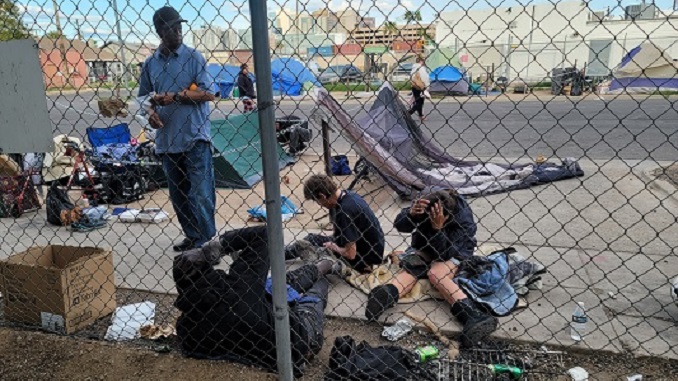
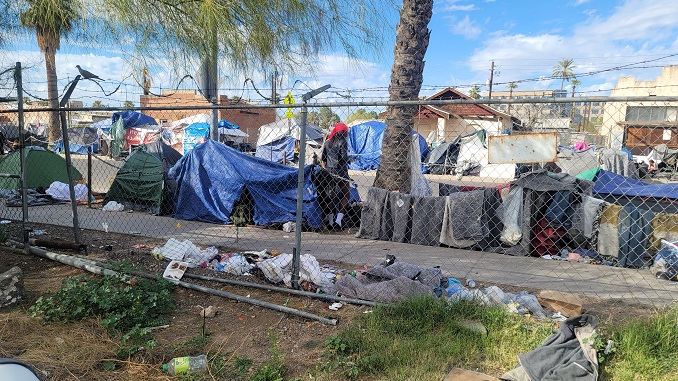
Riches identified Phoenix and its infamous downtown area unofficially cordoned off for the homeless (“The Zone”) as a prime example of the “government malfeasance” that allowed the adverse effects of homelessness on properties and businesses in the area.
“Property values plummeted in the Zone. Small businesses suffered. People lost their livelihoods as dozens of business owners had no choice but to close up shop,” said Riches. “And even as the city spent over $180 million to address the crisis (only a fraction of which is publicly accounted for), the number of homeless people in Phoenix rose 92% between 2018 and 2023.”
Nearly 59 percent of voters (1.8 million votes) approved Proposition 312. The legislative vehicle for the proposition, HCR 2023, passed in both chambers with bipartisan support earlier this year.
Major leftist organizations said in their arguments against Proposition 312 that the cities and counties shouldn’t face financial punishment for the acts of the homeless, and reduced tax revenue would hinder funding for community assistance geared toward homelessness.
Among those to oppose Proposition 312 were Civic Engagement Beyond Voting, Lutheran Social Services of the Southwest, Opportunity Arizona, Fuerte Arts Movement, Living United for Change in Arizona, and the ACLU of Arizona.
The Common Sense Institute Arizona (CSI) found in a report released last month that the proposition would likely improve property values.
AZ Free News is your #1 source for Arizona news and politics. You can send us news tips using this link.
by Daniel Stefanski | Nov 23, 2024 | News
By Daniel Stefanski |
A ballot measure to protect Arizonans from the rise of unabated homelessness in communities was overwhelmingly passed by voters in the General Election.
Earlier this month, Proposition 312 received almost 60% of the vote, cruising to a smooth victory on Election Night. The measure, which was referred to the ballot from the Arizona Legislature, stipulates that “property owners may apply for a tax refund for expenses incurred due to a governing authority’s failure to enforce certain public nuisance laws on or near the owner’s real property.”
The legislative vehicle for the measure, HCR 2023, was sponsored by House Speaker Ben Toma. It passed both chambers in the Arizona Legislature with bipartisan support and was transmitted to the Secretary of State’s Office in March of this year.
In a statement after the successful passage of the bill out of his chamber, Senate President Warren Petersen said, “There are instances where local governments routinely and repeatedly fail their citizens by not enforcing laws. An example of this would be the City of Phoenix’s handling of the former homeless encampment known as ‘The Zone.’ This area was not only a public safety and public health disaster for those who camped there, but it was also a detriment to the livelihoods of small business owners who set up their shops in the area.”
Petersen added, “Money talks, and as a way to encourage municipalities to enforce the law, Speaker Toma and I teamed up to sponsor HCR 2023/SCR 1006. This measure is a ballot referral that would protect law-abiding citizens. If approved by voters, property owners would be allowed to request a refund for expenses incurred to mitigate the problem, up to the amount of their property tax liability. The funds would be deducted from the local government’s state shared revenue.”
Speaker Toma also had said, “Business owners and residents alike are having their property stolen, vandalized, or terrorized and are desperate for help. That’s why I sponsored HCR2023, to hold our local governments accountable to our community members and to help provide some relief for property owners who have suffered damages because of a city’s purposeful failure to provide the public health and safety services we all pay for.”
The Arizona Chamber of Commerce and Industry, which was instrumental in promoting the proposition, issued a statement following the General Election win, writing, “Arizona voters have sent a clear message: Government, do your job. They do not want our state to become the next San Francisco or Los Angeles. Prop 312 is a win for property owners, businesses, and everyday Arizonans who too often shoulder the costs of unaddressed homelessness.”
The Goldwater Institute, which also pushed for Prop 312’s passage, also took a well-deserved victory lap after the positive result. The organization’s President and CEO, Victor Riches, stated, “The voters sent a clear message this election cycle: they demand their tax dollars be used to enforce the law and address rampant homelessness. Now that Prop 312 is law, business and property owners will not be left holding the bag when municipalities refuse to do their job.”
Daniel Stefanski is a reporter for AZ Free News. You can send him news tips using this link.
by Staff Reporter | Oct 31, 2024 | News
By Staff Reporter |
The nation’s fifth-largest city, Phoenix, is also home to one of the highest eviction rates in the nation.
Rising evictions appear to be a side effect of the city’s burgeoning housing crisis amid a declining economy. A report from the Wall Street Journal released this week highlighted the trend of increased evictions, featuring some of the Phoenicians who underwent evictions recently.
Phoenix has a rate of 16 eviction filings per 100 renter households according to estimates from Eviction Lab, a Princeton University research group that tracks eviction rates in 36 major cities and 10 states across the country.
According to data pulled from American Community Survey and reported by the Eviction Lab, Phoenix has over 583,600 renter households and typical rent averages nearly $1,400 a month.
Per data acquired by Eviction Lab from the Maricopa County Justice Courts, there have been over 285,300 eviction filings since March 2020, with nearly 90,600 of those (31 percent) filed within the past year and over 6,000 (two percent) within the last month. Between January and September, there were nearly 69,000 evictions. Should these evictions keep up with the monthly average of around 7,700 evictions, there would be nearly 92,000 evictions by the year’s end.
There were about 83,200 eviction filings in 2023. The all-time total high for evictions was about 83,700 evictions in 2005. The average eviction judgment from January to September sits at over $3,100, which is less than the $3,400 average of 2023.
Nearly 39,700 of recent years’ evictions were categorized demographically as white neighborhoods, nearly 22,800 were “other” neighborhoods, and over 20,700 were Latino neighborhoods.
Phoenix Mayor Kate Gallego told the Wall Street Journal that folks should look to the state for reforms on laws allowing such a high rate of evictions.
“We don’t control evictions,” said Gallego.
The increased evictions may curb the small gains the city has made in reducing its homeless population — an aspect of the fast-growing metropolitan area that also incurred national interest.
Maricopa County’s latest Point-In-Time Homeless Count from January reported over 9,400 individuals as homeless in the Phoenix area, a decline from the January 2023 total of over 9,600.
Earlier this year, we reported that the city had spent over $180 million over the course of three years to address its homeless population.
The Arizona Department of Economic Security (ADES) did offer a rental assistance program for families and those over the age of 60 years, but applications closed in August.
ADES also offers resources for emergency short-term housing.
ADES directed those in need of assistance to visit 211, the Short-Term Crisis Services Program, or their local Community Action Agency for other support services.
Community Action Agencies can provide utility or mortgage assistance, eviction or foreclosure prevention assistance, rental deposits, and emergency shelter. ADES warned that these agencies are currently experiencing high demand.
Maricopa County has five Community Action Agencies with multiple locations providing various assistance: Maricopa County Human Services, City of Glendale Community Action Programs, City of Phoenix Human Services, City of Phoenix Family Services Centers, and Mesa Community Action Network.
Those interested in knowing which health and human services programs they qualify for may use the Arizona Self Help questionnaire.
AZ Free News is your #1 source for Arizona news and politics. You can send us news tips using this link.
by Daniel Stefanski | Oct 5, 2024 | News
By Daniel Stefanksi |
Arizonans looking for more information about a ballot measure that addresses the state’s growing homelessness issues can access vital research from a local think tank organization.
Late last month, the Common Sense Institute Arizona (CSI) released a report “on the economic and fiscal impact of Proposition 312, finding that there is indeed a link between the increase in homelessness and declining property values.”
According to CSI, “Proposition 312 is aimed at tackling Arizona’s growing homelessness crisis, offering property owners the opportunity to receive tax relief for costs incurred due to unmitigated public nuisances, such as homelessness, vandalism, property crime, and drug use.”
The report from CSI found “that under the status quo, property owners in areas with unmitigated public nuisances are seeing their values decrease in real value [while] homelessness is on the rise.”
“The rising rates of crime, homelessness, and drug activity in key areas of Phoenix appear to have taken a toll on property values and overall economic activity,” said Glenn Farley, Director of Policy & Research for CSI. “In this kind of environment of declining relative property values and higher crime rates, there are ongoing problems requiring mitigation – like security and cleanup costs. In practice, though, the real impact is likely to be preventive: local governments may ultimately be more proactive about mitigating these nuisances if this proposal is enacted than they are today.”
The Arizona-based Goldwater Institute took a position in support of Proposition 312 ahead of the November General Election. On its website, the influential organization wrote, “We saw it in Phoenix’s homeless Zone when the city allowed lawlessness to run wild. We saw it in Tucson, too. Amid rampant homelessness, hardworking Arizona taxpayers are being forced to bear the burden of a city’s refusal to do its duty to protect public health and safety, paying out of pocket to install fences, hire security, clean up garbage, human waste, and other hazardous materials themselves. Prop 312 ensures that when government fails to enforce existing laws regarding illegal camping, loitering, pollution, and other nuisances, taxpayers will no longer be forced to foot the bill.”
Proposition 312 was made possible by the Arizona State Legislature earlier this year, when Republicans led the way to pass HCR 2023, which, if eventually passed by state voters in November, would “allow a property owner to apply for a primary property tax refund if the owner documents expenses caused by a city, town or county adopting a policy, pattern or practice which declines to enforce existing laws or the maintaining of a public nuisance” – according to the overview provided by the state House.
In a statement after the successful passage of the bill out of his chamber, Senate President Warren Petersen said, “There are instances where local governments routinely and repeatedly fail their citizens by not enforcing laws. An example of this would be the City of Phoenix’s handling of the former homeless encampment known as ‘The Zone.’ This area was not only a public safety and public health disaster for those who camped there, but it was also a detriment to the livelihoods of small business owners who set up their shops in the area.”
Petersen added, “Money talks, and as a way to encourage municipalities to enforce the law, Speaker Toma and I teamed up to sponsor HCR 2023/SCR 1006. This measure is a ballot referral that would protect law-abiding citizens. If approved by voters, property owners would be allowed to request a refund for expenses incurred to mitigate the problem, up to the amount of their property tax liability. The funds would be deducted from the local government’s state shared revenue.”
The chamber’s president also noted that “all Senate Democrats voted ‘no’” on the referral.
The key findings from CSI about Proposition 312 are as follows:
- “Problem increasing: Crime, drug overdoses, unsheltered homelessness, and other public nuisances have risen dramatically in Arizona and the greater Phoenix area since 2019. But the impacts are disproportionate: the problem has become more visible in certain parts of the city. This creates a negative economic impact for those parts of the city where local officials have failed to enforce existing laws
- “Property Value Loss: Commercial properties in Phoenix affected by unmitigated public nuisances have seen market rent appreciation fall to just 15.7% between 2019 and 2023, compared to the citywide rate of 30.2%. This represents up to $2.1 billion in lost property value due to slower appreciation in areas with high levels of homelessness, crime, and public nuisances.
- “Increased Crime: In areas with high public nuisance activity, the average crime rates for drug offenses, burglaries, robberies, and arson were between 3 to 5 times higher than the Phoenix average, driving up costs for property owners due to increased security measures and property damage.
- “Impact on Businesses: Businesses located in areas with elevated public nuisance levels experience significantly lower property appreciation and higher vacancy rates. The economic toll of unmitigated public nuisances has made it harder for businesses to thrive in these areas.”
During the legislative process this year, representatives from Barry Goldwater Institute for Public Policy Research, QuikTrip, Arizona Free Enterprise Club, Arizona Chamber of Commerce, Arizona Food Marketing Alliance, and the National Federation of Independent Business, indicated their support for the proposal on the Arizona Legislature’s Request to Speak system. Representatives from the League of Arizona Cities & Towns, Living United for Change in Arizona, Arizona Coalition to End Sexual and Domestic Violence, Professional Fire Fighters of Arizona, Arizona Association of Counties, County Supervisors Association of Arizona, Arizona Housing Coalition, and several state cities and towns, signed in to oppose the measure.
Interested voters can read the full CSI report regarding Prop 312 here.
Daniel Stefanski is a reporter for AZ Free News. You can send him news tips using this link.
by Staff Reporter | Sep 25, 2024 | News
By Staff Reporter |
Despite Arizona spending over $1 billion annually to address homelessness, a new report finds that the problem has grown into a crisis in recent years.
The Common Sense Institute Arizona (CSI) issued a report on Monday revealing that the homeless population has grown by 40 percent in the last five years (9,900 in 2015 to 14,200 in 2023), with 53 percent of the current homeless population living without shelter.
Arizona’s 2023 Point in Time (PIT) count estimated the state to have over 14,000 homeless individuals; CSI speculated the PIT count was an undercount. CSI noted that the homeless population was more stagnant from 2015 to 2018, but that it has undergone “marked acceleration” from 2019 to present.
For the 10,000 homeless that Arizona’s emergency shelters serve annually, another 6,000 go without any shelter provisions.
CSI proposed the burgeoning homelessness crisis was due to gaps in data sharing between service providers — like the Homeless Management Information Systematic — as well as a shortage in affordable housing.
The organization arrived at those proposed solutions through consultations with 24 stakeholders representing the state’s over 200 public and private providers behind the $1 billion in homelessness-related expenses.
“Arizona lacks a unified, by-name list that would allow real-time tracking and service prioritization for individuals experiencing homelessness,” said CSI in a press release. “The state faces a severe housing affordability crisis, with a shortage of over 150,000 affordable housing units.”
Though the stakeholders were more unified in approaches to treating the problem, they disagreed about the root causes of homelessness. Some argued it was the housing markets, while others argued it was mental health and addiction.
The report also proposed that current coordination-related gaps exist in the state’s homelessness response systems, particularly the Continuums of Care (COCs). Additionally, stakeholders advised CSI that Arizona’s current system overly prioritizes meeting federal and external stakeholder requirements at the expense of effective services and interventions, such as tailored interventions addressing mental health or substance abuse.
“Decades of focus on permanent solutions to poverty and housing, although well intended, have left a system poorly adapted to the pressing problem – addiction, mental health, and chronically unsheltered homelessness,” stated the report. “Refocusing on emergency shelter, developing an effective command system to identify and respond to incidents in real time, and other reforms are needed to solve this crisis.”
These services and interventions, said CSI, ought to cultivate personal accountability and self-sufficiency within the homeless as steps to independence.
“To safeguard Arizona’s economic resilience and maintain a robust safety net for our most vulnerable citizens – the chronically homeless, who are often suffering with mental illness or addiction – public policy must acknowledge the paradox that the true strength of this safety net lies in preventing as many people as possible from needing it, rather than maximizing funding for, and the number of people permanently dependent on, that safety net,” stated the report.
CSI fellow Julie Katsel said in the same press release that Arizona’s homelessness reaching crisis levels proves that the state’s approach to the issue needs work, which she characterized as “injecting more money” into programs.
“We know that current systems haven’t solved the problem so far,” said Katsel. “[Arizona needs] improved coordination, more effective interventions, and better rapid response tactics are critical steps we need to take.”
AZ Free News is your #1 source for Arizona news and politics. You can send us news tips using this link.