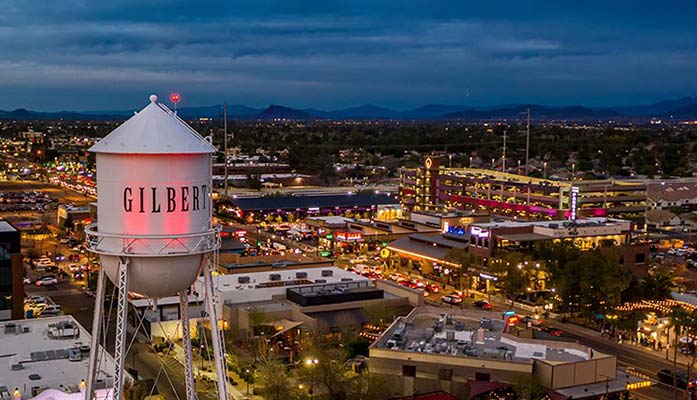
The citizens of Gilbert are bracing for a third water rate increase since 2024 on top of the 2025 sales tax increase that resulted in legal action against the town in January 2025. The new rate increase, following a 95% increase in the town’s utility wastewater rate, could see the town’s water rate jump up another 25%.
Gilbert Water Manager Rebecca Hamill revealed in a Town Council study session last week that the rate hike could be necessary based on Gilbert’s biannual utility rate analysis and adjustments, according to the Gilbert Sun News.
As previously reported by AZ Free News, there were no utility rate increases from 2019 to 2021, until a 29.6 percent jump in 2022, followed by a 48 percent increase in 2024 and a 25 percent increase in 2025, resulting in a staggering hike of 102.4 percent over 2021 rates.
“Arizona and Gilbert are facing uncertainty in water resources and providing a secure water supply is a top priority for our department,” Hamill told the council. “One of the main impacts on the budget is these increasing water resources costs, and we have seen since 2020 a 73% increase in the per acre-foot cost of CAP (Central Arizona Project) water, and we continue to see an increase in the percentage of the water resources as a component of the overall water budget,” she added.
Hamill explained that the Town of Gilbert’s water portfolio includes 40 percent of its potable water coming from the Salt and Verde Rivers, with 41 percent coming from the Colorado River via the CAP, 15 percent coming from the reclaimed recharge system water, and just four percent coming from groundwater. She described the town’s water sources as “diverse,” despite 81 percent of it being dependent on surface water and 41 percent subject to fluctuations in Colorado River water allocation.
As noted by the Gilbert Sun News, the town is in the early stages of reconstructing the North Water Treatment Plant to supply 70 percent of the town’s needs or approximately 60 million gallons per day, but it is only nearing the halfway point of its completion in October and is not expected to come online until 2028, according to the most current project update. This leaves the Town of Gilbert effectively at the mercy of a myriad of factors beyond the town’s control for at least the next two and a half years, with the town forced to defer $151 million in future water system improvements.
“The bill is typically made up of rates and fees for four lines of service, including water, sewer, solid waste, recycling and environmental compliance,” Hamill told the outlet. “We refer to each of these four lines of service as enterprise funds, which means that each fund operates as a self-sustaining business entity within the town. Revenue collected for each service is only used to fund that service.”
The increase is part and parcel to the cash/bond gradual approach the Town approved in February 2024.
“This is where we are now – we are working with our rate consultant to determine that 25% is the proper number for the fund,” Hamill told the council. “This option provided the (water) fund with sufficient revenue for critical capital projects, ongoing $5 million capacity in the operating fund, and an ongoing $66 million capacity in the repair and replacement fund starting in FY29.”
As a result of the delays in the Water Treatment Plant reconstruction, caused in part by an increase in the cost of chemical and electrical components, coupled with its dependence on sources susceptible to environmental and political factors, the Town government is turning to the public and conservation efforts in an attempt to stem the rising costs of the water system. Mayor Scott Anderson explained, “We have to remember it costs, and it’s going to cost more over time, to purchase the water, to transport the water, to treat the water, and to distribute the water. It’s going to cost more all the time – we can’t lose sight of that,” he emphasized. “Conservation is the key.”
A recent report has identified the five safest cities in Arizona and also noted a significant drop in violent crime experiences as well as a slight decrease in property crime experiences.
The report from Safewise found the ten safest cities in Arizona are (ranked order): Oro Valley, Queen Creek, Gilbert, Sahuarita, Surprise, Buckeye, Maricopa, Marana, Chandler, and Prescott Valley. Twenty-five cities in total were ranked.
The five lowest ranked were Apache Junction, Avondale, Casa Grande, Glendale, and Tempe. For comparison: the violent crime reported per 1,000 people in Oro Valley was 0.55 and property crimes per 1,000 people were 11.51. Tempe with over quadruple the population has 5.2 violent crimes per 1,000 people and 36.13 property crimes per 1,000 people.
Zeroing in on the reports findings, SafeWise found that the five safest cities collective violent crime rate is 1.0 incidents per 1,000 people while property crime was 10.4 incidents per 1,000 people. The report also found that the number of Arizonans surveyed who said they feel safe jumped up 5% from 36% to 41%.
SafeWise Managing Editor and Safety Expert, Rebecca Edwards said in a statement, “Violent crime experiences are trending down across Arizona, and mass shootings dropped by more than 60% year over year—from eight in 2023 to just three in 2024. Cities like Queen Creek and Surprise saw decreases in both violent and property crime, showing that safety is improving for many Arizona communities.”
According to the report, although 63% of Arizonans surveyed were concerned about property crime on a daily basis, personal experiences with property crime dropped year over year with just 26% of respondents reporting a personal experience with property crime in the past year.
Arizonans are also ranked third for adopting the use of security cameras for their homes, following Delaware and Louisiana. As a matter of preference most Arizonans surveyed, 59%, preferred security cameras or guard dogs, 44%.
Overall, Arizona respondents were most concerned over violent crime, although violent crime experiences fell from 19% to 11% year over year.
Approximately 14% of Arizonans polled reported carrying a firearm for personal protection and 33% reportedly own one for property protection. Incongruently, the number concerned about gun violence increased from 58% to 67% despite a decrease in mass-shootings.
According to SafeWise, the report was generated from “voluntary, self-reported information that cities and jurisdictions across the country report through the FBI Summary Reporting System (SRS) and National Incident-Based Reporting System (NIBRS). For our 2025 reporting year, the most recent FBI data was released in October 2024 for crimes reported in 2023.” The company’s full report and methodology is available here.
The Town of Gilbert is the target of a lawsuit by the Goldwater Institute on behalf of the Home Builders Association of Central Arizona and a local property owner, Jonathan Barth, for allegedly violating the Arizona Constitution which bans tax increases on “services.”
According to Goldwater, the tax increase imposed by the Town of Gilbert includes “many types of business that do not produce tangible goods, such as advertising, photography, utilities, hotel/lodging, and construction.”
Goldwater is challenging two of the tax increases in particular: on homebuilding and short-term rental properties.
Lawsuit Alert: The Goldwater Institute challenges Gilbert’s illegal pickleball tax.
Gilbert officials are hiking taxes to fund pickleball courts, splash pads, and even a ropes course—all in violation of the Arizona Constitution. Here’s what you need to know: 🧵
As noted in the text of the lawsuit, the Arizona Constitution prohibits “any county, city, town, municipal corporation, or other political subdivision of the state, or any district created by law” from creating any new or increasing any existing transaction-based taxes on the “privilege to engage in, or the gross receipts of sales or gross income derived from, any service performed in this state.”
The new tax ordinance in question, per the Town of Gilbert’s website, imposes a 0.5% increase in the existing sales tax and creates a “use tax” to be “paid for by residents and businesses when purchases are made online with out-of-state vendors who do less than $100K of sales in Arizona per year.”
The lawsuit explains that, “As a result of the Ordinance, individuals, businesses, and taxpayers, including Plaintiff Jonathan Barth, who engage in the rental or lease of real property, including for transient lodging, will pay a higher tax rate for the services they perform. Additionally, individuals, businesses, and taxpayers that engage in general contracting services, including the members of Plaintiff Home Builders Association of Central Arizona (“HBACA”), will pay a higher tax rate on the services they perform.”
Barth, an educator and father of five, will be impacted because he earns supplemental income by managing his detached bungalow as a rental for short-term tenants. He told Goldwater, “This tax hike makes it all the more difficult to make ends meet in Gilbert.”
Former Mayor Brigette Peterson and all of the members of the Town Council are named as defendants in addition to the town itself.
The town allegedly intends to use the projected $55 million yield of this new tax for “Critical Infrastructure Projects,” adding that “Time is of the essence as many of Gilbert’s services are over capacity and new infrastructure is needed.”
The Goldwater Institute has found however, that these “Critical Infrastructure Projects,” include pickleball courts, splash pads, a ropes course, and a “statement” bridge.
The Home Builders Association of Central Arizona (HBACA) told Goldwater that the new taxes will result in increased construction costs in the town as well. HBACA CEO Jackson Moll warned, “Gilbert officials are trampling on their own constituents’ rights with no regard for the consequences their illegal actions will have on taxpayers and homebuyers. The Arizona Constitution is clear: increasing taxes on services, including on construction contracting, is unlawful.”
As previously reported by AZ Free News, the Goldwater Institute pursued a similar action against the Town of Payson in September when the Town Council decided to incur a $70 million debt via a bond measure without a public referendum.
A prominent Hamas supporter and online influencer was arrested again this week, this time for trespassing.
Saiaf Abdallah — the Gilbert-area CEO of the Tempe-based Voyage Medical who goes by the username “Resistance is Beautiful” online — was arrested for trespassing after refusing to leave a Lifetime gym in Gilbert from which he was asked to leave.
In his recording of an interaction with Lifetime management and police, Abdallah wore a black t-shirt that read “Israel Kills Children… and we pay for it with taxes.” The management member informed Abdallah that he had trespassed because his membership wasn’t active. In response, Abdallah questioned whether the employee was motivated by bigotry or racism.
“Is the problem the shirt? Or the skin color?” asked Abdallah. “Are you offended by the shirt, or by the fact that you guys kill all of the Palestinians in the gyms over there?”
Abdallah then claimed to cops that the gym staff trespassed him for his shirt, not his inactive membership.
“They’ve always said, ‘Oh that shirt is offensive’ — typical Gilbert white supremacy stuff,” said Abdallah.
Following his latest arrest, Abdallah launched a GoFundMe fundraiser to cover the cost of court cases and his protesting across the state. As of this report, Abdallah’s GoFundMe has raised over $11,000 of its $12,000 goal from about 250 donors.
Abdallah has had frequent run-ins with law enforcement over his activism.
Earlier this week, Abdallah was detained for obstructing a public thoroughfare along a busy road. Like in his other videos, Abdallah wore his “Israel Kills Children” t-shirt, along with a keffiyeh headband. As he does in other videos frequently, Abdallah carried a Palestinian flag on a makeshift flagpole.
In 2023, Abdallah was arrested at a pro-Hamas protest led by Democratic Congresswoman Rashida Tlaib at Arizona State University following Hamas’ terrorist attack on Israel. In the months following that attack, Abdallah organized pro-Hamas protests at Arizona malls, including “die-ins” during Black Friday shopping, and helped coordinate a protest inside of Senator Mark Kelly’s office.
Although he was trespassed from ASU property in November 2023, Abdallah’s posted videos online show he participated in pro-Hamas protests on the public property abutting ASU campuses and around the Valley through the better half of last year.
Abdallah has been active with the Arizona chapter of CAIR. The national CAIR is an entity of the Muslim Brotherhood officially linked to Hamas activity.
Abdallah has been documented extensively by Canary Mission, an organization that profiles individuals and organizations promoting hatred of the U.S., Israel, and Jewish people.
Under the username “@Vingati2” on X, Abdallah expressed overt support for Hamas violence.
“Palestinians are going to take thousands more hostage. This is f*****g LIBERATION, and it isn’t pretty,” wrote Abdallah in one post.
“Hamas is eating your b***h a*s soldiers. They weak like you,” wrote Abdallah in another post. “Liberation is gonna get shoved down your f*****g throat.”
Abdallah’s father, Akram Abdallah, was sentenced to 18 months in prison in 2010 for making false statements to the FBI regarding his raising funds for the Holy Land Foundation for Relief & Development (HLF), a criminal organization that provided material support for Hamas. Character support letters submitted to the sentencing court identified Abdallah as the son of Akram Abdallah.
Abdallah maintained similar sentiments as his father around that time. While his father was facing trial for his ties to Hamas, Abdallah was active with Students For Justice in Palestine (SFJP) while attending Arizona State University. Abdallah filmed and edited multiple videos of SFJP activism.
AZ Free News is your #1 source for Arizona news and politics. You can send us news tips using this link.
Over Veteran’s Day weekend, personal-finance website WalletHub released a ranking of the Best and Worst Places for Veterans to live. And the state of Arizona was represented by seven of our cities.
According to WalletHub, the rankings were based on a series of “19 key indicators of livability, affordability and veteran-friendliness,” including the availability of jobs related to military skill-sets, records of veteran income growth over time, and the availability of VA Healthcare.
WalletHub Analyst Chip Lupo explained, “When veterans return home from serving our nation, it’s important for them to live in a place that provides good education and employment opportunities, along with access to quality care for their physical and mental health. The best cities for veterans have all these characteristics, plus added bonuses like large veteran populations for community support, plus many restaurants and entertainment venues that offer veteran discounts.”
All told, the seven Arizona cities ranked were, in order: Scottsdale, leading at #7; Gilbert at #15; Chandler at #16; Mesa at #29; Glendale at #44; Tucson at #62; and finally, Phoenix came in at #75.
Gilbert and Chandler ranked 2nd and 5th, respectively, for the lowest percentage of veterans in poverty. Otherwise the state failed to rank in the top 5 of the study’s focus areas.
Essentially, this places Arizona firmly in the middling range of neither the worst nor the best.
While cities like the top five: Austin, TX; Orlando, FL; Raleigh, NC; Tampa, FL; and Virginia Beach, VA, have cause to celebrate the ranking, the release could leave Arizonans asking questions.
As of late 2023, the U.S. Census Bureau, cited by ABC15, recorded that there were 454,620 veterans of the Armed Forces living in the state or approximately 62 of every 1,000 adults, ranking us at 13th in the nation statistically.
By concentration, most resided in Sun City and Sun City West, Sun Lakes, Carefree, Apache Junction, and Union Hills.
Over a third served during the Vietnam War, 43% served in either the Cold War period or Gulf War, with just 17% of the veterans in the youngest cohort: those who served in the Global War on Terror. The number who served in Korea and the Second World War are dwindling fast at just 3% and 1%, respectively.
Arizona plays home to defense contractors as Honeywell, Raytheon, General Dynamics, BAE Systems, and Northrup Grumman. However, the Bureau of Labor Statistics examined the unemployment figures as of March 20th, specifically targeting veterans, and found that only 47% of those surveyed were employed, while 2.9% were collecting unemployment and a staggering 51% were “not in labor force.” That means they were either on disability, retired, on other benefits, or simply stopped trying to find work. This gives a potential glimpse into why more young veterans aren’t making Arizona their home, and instead serves as a retirement destination.