Phoenix Mayor Kate Gallego continues to govern as a tyrant. Just look at item 37 on the next agenda she set for the November 1 Phoenix City Council meeting. The item calls for the City of Phoenix to accept a grant from a Rockefeller-sponsored entity headquartered in Copenhagen to implement meat consumption mitigation. But it’s not just the item alone that’s the problem.
In the dark behind closed doors, the Mayor of Phoenix told city staff to limit public comment to only 5 agenda items per person. By doing so, she possibly went against city code and violated state open meeting law and her loyalty oath to uphold and protect both the Arizona and U.S. Constitutions.
The Mayor suppressing voices of constituents was imposed without the other city council members being informed. Although this regulation was discovered at the September 6 meeting, city staff admitted at the October 18 meeting that the Mayor is the one who directed them to limit public comment to a maximum of 5 total agenda items per person.
During the Call to the Public at that October meeting, I called out Mayor Gallego for her policy.
Before we delve into the destruction to public opinion that the Mayor’s regulation causes, the Phoenix City Clerk’s site says, “Citizens may… express their views on any published agenda item.” Phoenix City guidelines on public comment say people have the ability to speak for two minutes on agenda items outside of the public comment section.
While the limitation of commenting on 5 agenda items may not sound like a big deal, city meetings can have anywhere between 20-200 agenda items plus a general public comment agenda item. To put that into context, 5 out of 200 items is only 2% of the meeting.
Furthermore, Mayor Kate’s restriction prevents the public from petitioning their elected officials if there are more than 5 agenda items that need public input.
Let’s say there are the following 7 items on the agenda for the next meeting:
Issue a $200 million bond that is backed by raising taxes
Road diets where the city reduces traffic lanes
Mitigation of meat consumption
Implementation of facial recognition technology
Solidifying the 15-minute city framework
Recommitting to red light surveillance cameras
Reducing parking around the city with the goal to get people to stop driving less
A person from the public is limited to speak on only 5 of those 7 items. Furthermore, that person cannot sign up to give public comment, which is protected in city code. Not only does this regulation restrict content from being brought forth by the public, but it also inhibits the ability of the people to petition their elected officials to let them know which way the people desire them to vote on specific policies.
Petitioning the government is protected under the First Amendment of the U.S. Constitution and Article 2, Section 5 of the Arizona Constitution. The First Amendment of the U.S. Constitution says, “Congress shall make no law respecting the right of the people to petition the Government.” The Arizona Constitution also states, “The right of petition, and of the people peaceably to assemble for the common good, shall never be abridged.” Restricting people’s right to petition their elected officials is a direct infringement on both constitutions.
Not only is petitioning the government protected, but content is also protected. The Arizona Attorney General states, “Public bodies may impose reasonable time, place, and manner restrictions on speakers, but any content-based restrictions must be narrowly tailored to effectuate a compelling state interest.” The Arizona Ombudsman Guidance further solidifies the opinion from the Attorney General. When discussing what could be a compelling state interest in court of law, the Military Leadership Diversity Commission of the United States Department of Defense states, “Only important, specific goals may satisfy this level of judicial scrutiny.”
As stated at the beginning of this article, the loyalty oath is swearing to protect and uphold both the U.S. and Arizona Constitutions. Because Mayor Kate has won multiple elections, she has sworn multiple times to the loyalty oath. If the oath is found to be violated, the maximum penalty is a class 4 felony and removal from office.
For public bodies and elected officials like those at the City of Phoenix to avoid possibly breaking the law, the Arizona Attorney General says, “The best practice is to decide [public comment changes] in advance [of the meeting] so that speakers have prior notice about the restrictions that the public body has set. In this way, the public body may be able to prevent allegations that it either treated speakers differently or used content-based restrictions.” Mayor Kate’s public comment limitation was not published, not written down, and staff has no idea where it came from other than her mouth.
While we have covered the possible content and petition limitations from the Mayor, another interesting issue stemming from the Attorney General’s recommendations is the potential targeting of specific voters. Since Mayor Kate’s regulation is not written down, it appears the Mayor decided to implement this policy after the June 28 Phoenix meeting. At this meeting, members of the public and Mayor Kate’s 2020 opponent showed up to speak against the Phoenix water rate hikes, water allotment reduction, and mismanagement of funds. It was at the next meeting, after summer break, that the public discovered the 5-agenda-item limitation. It looks like Mayor Kate may be targeting specific speakers and is treating members of the public differently.
Instead of allowing folks to freely express themselves, people like Kate Gallego will do anything to silence anyone in the mission to obtain all the power and control they possibly can. They are tyrants that use their power to implement radical policies and agendas to control others.
Limiting the number of items someone can speak on is way outside the bounds of Phoenix City Code, Phoenix’s public comment guidelines, the Attorney General’s opinion, Arizona state law, Ombudsman Guidance, the Arizona Constitution, and the U.S. Constitution. The Mayor of Phoenix crossed the line with her latest shenanigans by suppressing the voters of Phoenix, and in doing so, denied the city council members from considering their constituents’ views before voting. Kate Gallego has completely disgraced the sanctity of the institution and democracy. This public comment regulation is a violation of the bedrock of our Republic – consent of the governed. By limiting public comment content from her constituents, Mayor Kate exposes her true self. Her policy restricting free speech needs to be abolished.
Further, Arizona state law says, “A member of the public body may not knowingly direct a staff member to communicate in violation of [open meeting law].”
Elected officials and city staff work for us, not the globalist organizations. It’s why they swear an oath to protect and uphold the State and U.S. Constitutions. By restricting the ability to address officials through public comment, Mayor Kate is preventing the people from having the last say to stop bad policies. The Arizona State Legislature needs to take this up, review the open meeting laws, and codify public comment as a guaranteed First Amendment right to guarantee the public can petition their elected officials. In the meantime, we’ll see what happens at the next Phoenix City Council Meeting on November 1.
Jeff Caldwell currently helps with operations at EZAZ.org. He is also a Precinct Captain, State Committeeman, and Precinct Committeeman in Legislative District 2. Jeff is a huge baseball fan who enjoys camping and exploring new, tasty restaurants! You can follow him on X here.
The Arizona House Ad Hoc Committee on Oversight, Accountability and Big Tech convened on Tuesday to discuss the influence of Big Tech on free speech.
Chairing the committee was State Rep. Alex Kolodin (R-LD03); the two other members were State Reps. Neal Carter (R-LD15) and Cesar Aguilar (D-LD26). The committee heard testimony from Robert Epstein, a renowned psychologist and Big Tech data researcher, and James Kerwin, senior counsel for Mountain States Legal Foundation. More individuals were reportedly scheduled to testify, but Kolodin disclosed that they were unable to do so for fear of retribution by Google.
Kolodin opened the committee meeting with allegations of the “disturbing parallels” between modern society and the fictional world depicted in the book “1984” by George Orwell. Kolodin referenced the Orwellian concepts of “thoughtcrime” and “newspeak,” claiming further that they exist currently.
“That crime was thoughtcrime, and the crime was not merely that you said something wrong, the crime was that you thought wrong, that you weren’t purely of a mind that matched the party’s ideology,” said Kolodin. “There is a fear that is exactly what’s going on in our country today. There’s an attempt to redefine free speech as misinformation.”
Epstein was the first guest speaker. He summarized his ongoing, near-decade data collection of Google’s practice of creating “ephemeral experiences,” or persuasive search engine results, to influence voters. The term was discovered to be regularly used by Google internally via their company emails.
Epstein dubbed Google’s practice the “Search Engine Manipulation Effect” (SEME).
Based on multiple experiments on SEME conducted domestically and abroad, Epstein determined that the practice consistently influenced voters to shift their voting preferences anywhere from 20 to 80 percent.
“The most disturbing set of scientific findings that I’ve ever encountered in my life. The more we have learned, the more disturbed I have become at what I’m finding,” said Epstein.
AZ Free News reported last November that there was an apparent, consistent bias for two Democratic candidates — then-gubernatorial candidate Katie Hobbs and then-secretary of state candidate Adrian Fontes — over their respective Republican opponents, Kari Lake and Mark Finchem.
We reported that search results for “Katie Hobbs” brought up her campaign website first, followed by news reports that portrayed her favorably, her Twitter feed, her Wikipedia page, an endorsement by Emily’s List, her Ballotpedia, and her Facebook.
By contrast, a search for “Kari Lake” didn’t yield her campaign website on any of the first 11 search result pages, and didn’t appear even when omitted results were included. Her search results yielded a Wikipedia page first alongside unfavorable media coverage.
It wasn’t until after our report was published that search results for Kari Lake were modified. Epstein declared during Tuesday’s meeting that Google’s interference resulted in a race-determining advantage for Hobbs.
“If you took Google out of that picture, Kari Lake would’ve won,” said Epstein.
According to Epstein’s data collection, Google would also discriminately deploy voting reminder graphics to certain voters at certain times, with reported favoritism to Democratic voters. Some voters reportedly didn’t get a reminder to vote.
Epstein disclosed that he voted for both Hillary Clinton in 2016 and Joe Biden in 2020, but that he was concerned with Google’s influence over private decision-making.
“I object to the fact that a private company that is not accountable to the public in any way is messing with our elections,” said Epstein.
Epstein proposed implementing a monitoring system that would prevent manipulation from Google in the future.
After an hour break, Kerwin testified on the relationship between government and Big Tech concerning censorship. He explained that government wording in its communications determines whether a constitutional violation occurred. In most cases, Kerwin declared that the open relationship between government and social media companies to monitor speech exists in a “gray area” within the law.
Kerwin cited the ongoing case, Missouri v. Biden, as a “watershed” case on this gray area. The Biden administration was sued for coordinating with social media companies to flag and remove posts, and the federal judge in the case determined that the plaintiffs were likely to prevail based on preliminary evidence produced.
That’s when Kerwin broached the subject of Gov. Katie Hobbs. Kerwin reviewed several emails from Hobbs’ secretary of state staff requesting that Twitter remove certain tweets they classified as misinformation or disinformation.
“This suggests a troubling intention on part of a government official to stamp out speech they disagree with,” said Kerwin.
Corinne Murdock is a reporter for AZ Free News. Follow her latest on Twitter, or email tips to corinne@azfreenews.com.
Higher education, ideally a bastion of free thought and inquiry, should eagerly embrace a multitude of voices and perspectives—we usually call that thinking and learning. Yet, in practice, the ubiquitous doctrines of inclusion inscribed into university charters are not without exceptions. These exceptions materialize from the judgments of self-appointed arbiters of speech, who wield the authority to classify ideas and individuals as hateful and unsafe as they break from a general orthodoxy of perspective. Disguised as protections of students from pernicious notions, these arbiters diligently strive to condemn, censor, and chill speech they do not like – while university leadership does nothing.
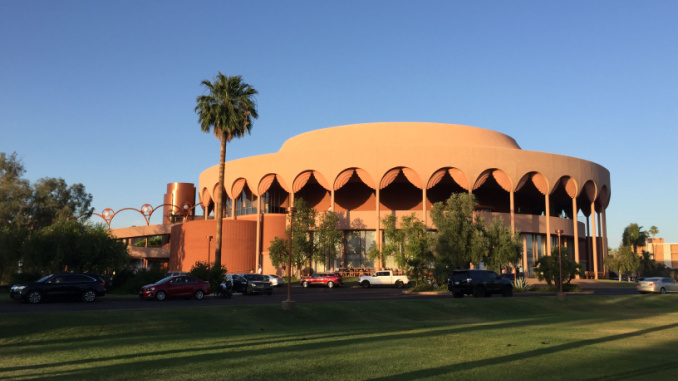
I experienced this exact condemnation when I orchestrated a university-sanctioned event in my capacity as the Executive Director of the T.W. Lewis Center for Personal Development at ASU’s Barrett Honors College. The event, titled “Health, Wealth, and Happiness,” took place at ASU Gammage Auditorium on February 8, 2023. Esteemed experts joined the panel, with Dr. Radha Gopalan, a distinguished heart transplant cardiologist, engaging on health; Robert Kiyosaki, expert on money and the acclaimed author of “Rich Dad Poor Dad,” delving into wealth; and Dennis Prager, co-founder of PragerU and, for over 40 years running, a nationally syndicated radio host, addressing happiness. Complementing the panelists were speakers Charlie Kirk, the visionary behind Turning Point USA, and Tom Lewis, a notable businessman, philanthropist, and namesake donor of the Lewis Center.
At Arizona State University (ASU), the culture of arbitration of speech has infiltrated deeply. This might come as a surprise given ASU’s acclaimed reputation for its free speech policies and its president’s commitment to this cause. In June, I published editorials in the Wall Street Journal“I Paid for Free Speech at Arizona State” and in the National Review, “Some Universities Care About Free Speech…Until They Don’t,” in which I revealed the free speech crisis at ASU’s Barrett Honors College while I also praised ASU for its free speech policies, at least as they state them on paper. I had hoped for a steadfast defense against blatant infringements on free speech that undermine ASU’s policies and declarations. Regrettably, my optimism faded. With each day, ASU’s actions, or lack thereof, erode my confidence in their stated defense of free speech.
It is imperative to grasp the suppression of speech in our academic institutions and to fully comprehend the essence of true freedom of thought which can only come from true freedom of speech. Only then can we embark on endeavors that genuinely promote the education and advancement of society.
ASU President Michael Crow may declare that “speakers speak at ASU,” but can we truly consider speech as free when over 80% of the faculty retaliates against speech they deem “wrong”? Do free speech ideals hold when deans prescribe limitations on speakers’ speech? Can we claim freedom of speech when marketing materials are removed due to faculty offense, while contrasting viewpoints bask in promotional spotlight? Is speech uninhibited when professors dedicate valuable class time to condemn the speech of other units? Does true free speech persist when professors discourage student participation in an event? And then stand vigilantly at the event entrance, watching attendees approach. Can we genuinely say that speech is free when college deans fire leaders and dismantle centers that uphold values no longer in harmony with the college’s leanings? The resounding answer is no. This is free speech under siege.
On August 3, 2023, a group of scholars who convened at Princeton established the “Princeton Principles for a Campus Culture of Free Inquiry.” This assembly distinctly underscores the pressing predicament faced by numerous higher education institutions that falter in upholding cultures of robust and uninhibited speech.
The Princeton Principles squarely confront this concern: “Some members of the university community argue that robust freedom of inquiry permits speech that can ‘harm’ students’ well-being or hinder institutional efforts to attain particular conceptions of social justice or ‘diversity, equity, and inclusion.’”
The case of the Lewis Center is illustrative, with 39 of the 47 Barrett Honors College faculty launching a nationwide condemnation campaign against the Health, Wealth, and Happiness program, speakers, donors, and staff. The Barrett deans actively endorsed this campaign and exercised censorship of speech the faculty found objectionable. The campaign led to intimidations and firings, which is to say prices to pay—sanctions—for exercising free inquiry and speech.
Having policies and ratings extolling free speech alone isn’t enough if university leadership doesn’t enforce their own standards. My experiences at ASU revealed a bureaucratic machinery that prioritizes safeguarding the institution’s interests over addressing free speech violations. I spent months reporting these violations internally and escalated the matter to ASU’s upper echelons and even testified in a legislative hearing. As of mid-August 2023, ASU and its board maintain that they have discovered “a series of examples of unfettered free speech,” aligning with the arbiters.
Self-governance alone proves inadequate in safeguarding our First Amendment rights on campus. The arbiters of speech are not likely to relinquish their control in the absence of decisive action by leadership. The responsibility rests upon parents, students, donors, the media, concerned citizens, and elected officials to unite and reestablish freedom of speech without fear of retribution, for there is no freedom of anything if it comes with a penalty for its exercise, including speech.
The Princeton Principles underscore that “If there is clear and convincing evidence that faculty members and administrators are not adequately fulfilling their responsibilities to foster and defend a culture of free inquiry on campus, other agents including regents, trustees, students, and alumni groups in the wider campus network may and indeed should become involved.”
Gratitude must be extended to parents, students, alumni, donors, lawmakers, and concerned citizens for following this story who rallied behind the cause of free speech. Special acknowledgment should be given to leaders like Arizona Senator Anthony Kern and State Representative Quang Nguyen for co-chairing the Joint Legislative Ad Hoc Committee on the Freedom of Expression at Arizona’s Public Universities. And sincere thanks should be extended to Arizona Speaker of the House Ben Toma and Arizona Senate President Warren Petersen for their unwavering support of free speech for all.
Despite receiving broad support, sustained vigilance is imperative. We must persist in recognizing speech suppression and holding university leadership accountable for defending the realm of free speech, even for ideas deemed offensive, such as, laughably, health, wealth, and happiness.
Ann Atkinson can be reached at her Twitter handle, @Ann_Atkinson_AZ.
A Pew Research poll released July 20 found that 70% of Democrats think the government should restrict what appears on social media, a dramatic change from five years ago when a majority of Democrats supported a free marketplace of ideas.
It’s no wonder, considering the drumbeat of warnings from leftist politicians and their liberal media allies about “disinformation” and “misinformation.”
But be warned: Democracy cannot survive for long if one of the nation’s two major political parties wants to put blinders on the public, limiting their access to information and canceling political opponents. That’s a rigged system. Ask the Iranians, Russians or Chinese.
A House hearing on July 20 held by the Select Subcommittee on the Weaponization of the Federal Government showed that the Biden administration is already censoring social media on a massive scale, putting blinders on all of us.
Hearing witness D. John Sauer, special assistant attorney general for Louisiana, described preliminary findings by a federal judge that Biden staff in the White House, the FBI, the Department of Health and Human Services, and almost every other executive department meet regularly with social media executives and pressure them to remove or demote criticisms of Biden economic and energy policies, Biden family members, and even items that depict the first lady in an unflattering way. According to Sauer, “millions of American voices” have been silenced in violation of the First Amendment.
Sauer cited some 18,000 communications from Team Biden to tech executives orchestrating a vast ongoing censorship operation.
Yet Democratic lawmakers were unfazed by this shocking evidence, and hardly questioned the witness. The U.S. Constitution and the future of our democracy be damned.
Rep. Stacey Plaskett laid out the Democratic Party’s distorted interpretation of the First Amendment, insisting that not all speech is constitutionally protected and offering hate speech as an example.
Plaskett and like-minded Dems need a refresher course on the Constitution and American history. The Supreme Court has ruled again and again that all speech, especially speech we like the least, is protected. That includes Nazi marches and cross burnings, as odious as these are. Who needs a constitutional amendment to protect speech everyone likes?
In 2017, the Court ruled unanimously in Matal v. Tam that the First Amendment requires “we protect the freedom to express ‘the thought that we hate,’” citing Justice Oliver Wendell Holmes Jr.’s dissent in the 1929 case United States v. Schwimmer.
Rep. Gerry Connolly aimed his wrath at witness Robert F. Kennedy Jr., whose views on vaccines and other pandemic policies were censored. Connolly said this censorship “was not big brother government trying to exercise its will on an innocent population. It was public health measures to protect lives.”
Connolly’s wrong. Censoring scientific debate was a lethal mistake. If competing scientific viewpoints, especially about masking and lockdowns, had been considered, harm to schoolchildren, business owners, and many others might have been prevented. Turns out, official government policy was based on “misinformation” and “disinformation.”
During the hearing, Rep. Debbie Wasserman Schultz, battered Kennedy with accusations of antisemitism and racism for his outrageous comments about the disparate impact of COVID on different ethnic groups. But when he tried to respond, she barked “reclaiming my time” and “ask the witness to stop talking.”
Whether you think RFK Jr. is loony or a viable presidential contender, as a witness he should have been treated with civility. Wasserman Schultz’s abuse is reminiscent of how Sen. Joseph McCarthy browbeat witnesses during the Army-McCarthy hearings in 1954. Those hearings ended abruptly when McCarthy was asked, “Have you no sense of decency?” Wasserman Schultz should have been confronted with the same question.
The attacks on RFK Jr. were a sideshow. The main event was the Democrats’ concocted defense of censorship. The Democrats’ own witness — civil rights attorney Maya Wiley — testified that “the ability of every person to have access to accurate and reliable information is a cornerstone of our democracy.”
Wiley’s slippery language is meant to evade the real issue: Who decides what is accurate and reliable?
Wiley was asked directly by Rep. Chris Stewart, “Do you trust the government to determine what facts and views the American people are exposed to?” She replied, “I think I’m struggling with the question.”
Tell Democrats the answer is a resounding “no.”
Trusting government to be your eyes and ears is crazy.
Betsy McCaughey is a contributor to The Daily Caller News Foundation and a former lieutenant governor of New York and chairman of the Committee to Reduce Infection Deaths. Follow her on Twitter @Betsy_McCaughey. To find out more about Betsy McCaughey and read features by other Creators Syndicate writers and cartoonists, visit the Creators Syndicate website at www.creators.com.
It looks like we struck a nerve at one of the largest universities in the United States. Last week, the Free Enterprise Club published an article on Arizona State University’s (ASU) failure to uphold free speech. The article came in the aftermath of an event held by the T.W. Lewis Center for personal development—a center of the Barrett Honors College—that featured prominent conservative speakers like Robert Kiyosaki, Dennis Prager, and Charlie Kirk.
While the event was allowed to proceed, it faced a campaign from 39 of the 47 faculty from the honors college who tried to shut it down. Then, in the months following the event, the center was not only dissolved, but two staff members lost their jobs. Now, ASU has offered a “fact check” of our article in a desperate attempt to save face. And as you might expect, it’s another swing and miss…