by Daniel Stefanski | Jun 20, 2023 | News
By Daniel Stefanski |
Arizona Governor Katie Hobbs’ historic veto streak has uncovered another disappointed legislator.
On Monday, Republican Senator Frank Carroll issued a press release to highlight Governor Hobbs’ veto of his bill, SB 1500, “which would have empowered (the) Arizona State Treasurer to eliminate environmental, social, and governance (ESG) consideration from all state investments by requiring investments be made in the sole interest of the taxpayer.”
Hobbs justified her reasoning for the veto in a customary letter to the Arizona Senate President, writing, “Politicizing decisions best made by the state’s investment professionals can harm our state’s long-term fiscal health.”
Senator Carroll was unhappy with the governor’s action on his proposal, saying, “My interest is in protecting taxpayer dollars and protecting pensions. I sponsored this bill to get politics out of the pensions of public employees and public officials who have earned the right to financial stability after dedicating their lives to public service. By definition, pecuniary means, ‘relating to or consisting of money.’ That is the criteria by which taxpayer dollars should be invested, not a social system used to push political agendas.”
The lawmaker’s release further explained why SB 1500 would have been so important for Arizona, stating, “An investment evaluation, conducted by the State Treasurer, must be based on financial and economic factors, and not to promote nonpecuniary benefits, other nonpecuniary social goals or take unnecessary investment risks. This bill aimed to protect government employees who pay into a retirement fund, where that money is then invested by the State Treasurer. The growing practice of ESG policies being imposed on companies is cause for concern, as it deviates from typical investing and business practices to consider non-financial information about a company, and ultimately prioritizes liberal ideology and goals over investor returns.”
SB 1500 was first passed by the Senate on February 28 with a 16-14 vote after clearing the Government Committee earlier in the month 5-3. When the bill was transmitted to the House of Representatives, it first obtained approval from the Government Committee before receiving the green light from the full chamber with a 31-27 vote (one member not voting and one seat vacant).
Senators Ken Bennett, David Gowan, Sine Kerr, Janae Shamp; and Representatives Michael Carbone, Neal Carter, Tim Dunn, Teresa Martinez, Quang Nguyen, Austin Smith, and Justin Wilmeth co-sponsored the legislation.
Representatives from the Climate Cabinet Action, Sierra Club – Grand Canyon Chapter, and the Arizona Association of Counties expressed opposition to the bill as it made its way through the legislative process.
The governor’s veto continues an abrupt shift in state policy over the ESG issue, which has largely devolved into a Republican versus Democrat fight. Prior to 2023, Arizona had two statewide officials, who were extremely active in fighting back against the ESG movement with former Attorney General Mark Brnovich and Treasurer Kimberly Yee.
However, the transition of power in the Arizona Attorney General’s Office halted Brnovich’s investigative efforts into this movement. Kris Mayes, Arizona’s new top prosecutor, stopped an ongoing investigation from her predecessor, saying, “corporations increasingly realize that investing in sustainability is both good for our country, our environment, and public health and good for their bottom lines. The state of Arizona is not going to stand in the way of corporations’ efforts to move in the right direction.”
But State Treasurer Kimberly Yee continues to be an active opponent of ESG. Her office took several positions and actions against ESG during her first term, including revising the Arizona State Treasurer’s Office Investment Policy Statement to ensure that the Office “investments are not subject to the subjective political whims of the ESG standards.” Yee stated, “This is about maintaining American free-market principles that our country was founded upon and not allowing environmental or social goals to dictate how taxpayer monies are managed.”
Daniel Stefanski is a reporter for AZ Free News. You can send him news tips using this link.
by Daniel Stefanski | May 31, 2023 | News
By Daniel Stefanski |
A west-valley lawmaker is speaking out after Democrat Governor Katie Hobbs vetoed his bill.
On Friday, Arizona Senator Frank Carroll issued a press release following the governor’s veto of his bill, SB 1100, which “would have increased the maximum weight of all-terrain vehicles or OHVs (Off-Highway Vehicles) subject to registration and vehicle license tax requirements from 2500 pounds to 3500 pounds as a way to update the state law definition to coincide with the evolution of safety features, electrification and other modernizations of these vehicles.”
Carroll included the following statement in his release, expressing his disappointment over the first-year governor’s action against his proposal: “It’s disappointing Governor Hobbs vetoed a bill that had strong bipartisan support, as well as support from the sponsor who established the Off-Highway Study Committee. This bill would have promoted small businesses in Arizona and supported electric alternatives to gas-powered OHVs, which would have helped reduce exhaust and noise emissions. A number of states who regulate weights of OHVs have already updated their statute to coincide with the industry’s technological advancements. Hobbs’ veto shows her lack of knowledge on the issue, which is a complete disservice to our state.”
In her veto letter to the Arizona Legislature, justifying her decision, Hobbs wrote: “I encourage the Legislature to work with my administration to explore current challenges with Off-Highway Vehicles (OHVs) and recommend mitigation strategies to minimize the impact and destruction of off-trails before increasing the weight limits. To accomplish this, I suggest working with the Off-Highway Vehicle Study Committee and/or the All-Terrain State Parks Advisory Group to study and propose administrative or legislative solutions.”
Senator Carroll, however, was not buying the governor’s reasoning, saying, “Governor Hobbs’ veto letter stated she believes the Off-Highway Study Committee established last session, instead of the Legislature, should determine whether OHVs with cab systems and electric powertrains can be legally operated in Arizona. However, this study committee was formed to address concerns stemming from improper use of OHVs and enforcement issues, not whether policymakers should amend the state’s OHV definition to allow new products to be available for our outdoor enthusiasts.”
The legislation first passed the Arizona Senate 19-10 (with one member not voting) on February 21. It then cleared the House of Representatives 43-15 (with one member not voting and one seat vacant).
During the legislative process, representatives from the Sierra Club – Grand Canyon Chapter and City of Sedona had opposed the bill.
Daniel Stefanski is a reporter for AZ Free News. You can send him news tips using this link.
by Pat Nolan | Apr 27, 2023 | Opinion
By Pat Nolan |
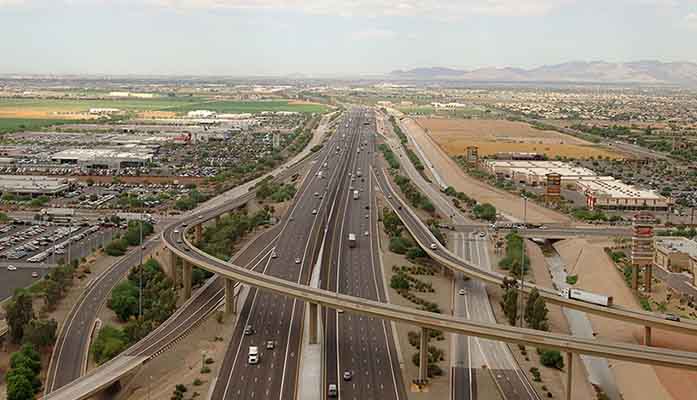
Arizona legislators will soon have to choose between two very different plans to spend funding from the highway sales tax originally passed in 1985. One plan, SB1246 by Senator Farnsworth, would keep faith with the promises made to voters that the sales tax would fund highways to relieve traffic congestion around Phoenix.
The alternative proposal, SB1102 by Senator Carroll, would siphon off money from road projects and instead fund “green energy” giveaways proposed by the bureaucrats at the Maricopa Association of Governments (MAG). SB1102 proposes to divert $2 billion from highway construction to fund bike lanes, walking trails, bus lanes, and other unspecified “special projects.” In other words, it establishes a slush fund comparable to the “Green New Deal” of the Biden Administration.
The Farnsworth bill, on the other hand, will fully fund the freeway expansions promised to the voters, and there will be no green slush fund. Also, none of the transportation money could be used to remove traffic lanes to make room for bike paths.
It also requires government-subsidized transit to operate efficiently and recover 25% of the cost from the riders, as they promised. In reality, the government-run system falls woefully short of that requirement, collecting a mere 7% currently. Senator Farnsworth’s bill will make public transit meet their revenue projections. If they fail to do so, private companies could bid to provide transit services and guarantee the revenue as promised to the voters.
The Left’s fixation with public transit has resulted in hundreds of millions pouring into the black hole of failing transit systems. Yet, despite the clear evidence that transit systems run by the government are a white elephant, they keep pumping more tax dollars into them. They cannot point to any city where the ridership has met their projections. The reason is simple. When pollsters ask the public, they say they want more public transit. However, when asked if they intend to use it, they say they have no intention of using it. They want other drivers to use transit to get those cars off the freeways.
SB1102 would help MAG pursue their far-Left agenda, which now includes imposing California-like restrictions on Arizonans, including banning the internal combustion engine and gas appliances. We must end such power grabs by the bureaucracy, and the Arizona Legislature can start by killing this bill and passing Senator Farnsworth’s SB1246.
The late, great conservative Senator Everett Dirksen famously explained the thinking of legislators when he said, “When I feel the heat, I see the light.” Taxpayers can hold legislators’ feet to the fire by telling them to vote NO on SB1102 and AYE for SB1246.
Pat Nolan is the Director Emeritus of the Nolan Center for Justice at the American Conservative Union and lives in Prescott.
by Daniel Stefanski | Apr 11, 2023 | News
By Daniel Stefanski |
A bill to protect children on the internet is nearing the finish line in the Arizona Legislature, though some partisan opposition puts its fate in jeopardy with Democrat Governor Katie Hobbs should it reach her desk.
SB 1503, sponsored by Senator Wendy Rogers, “directs a commercial entity to verify that any person attempting to access an internet website containing a substantial portion of material harmful to minors is at least 18 years old.” The bill “authorizes the age verification to be made through a commercially available database that is regularly used by businesses or governmental entities for the purposes of age and identity verification; or any other commercially reasonable method of age and identity verification.” It “subjects a commercial entity that violates the verification requirement to civil liability for damages, including attorney fees and costs, resulting from the minor’s access to the material.”
Rogers was joined on her bill by co-sponsors (and fellow Senators) Ken Bennett, Sonny Borrelli, Frank Carroll, David Farnsworth, Jake Hoffman, Steve Kaiser, John Kavanagh, Janae Shamp, T.J. Shope, and Justine Wadsack.
The bill first cleared the Arizona Senate Transportation and Technology Committee in February with a bipartisan vote of 5-2. Democrat Senator Christine Marsh joined four other Republicans to advance the legislation out of committee. After a Rogers’ amendment was adopted on the floor, the full chamber approved the bill with a bipartisan 19-11 vote, though Marsh did not vote in favor.
Senator Rogers cheered the passage of her proposal after the Senate vote, tweeting, “Need to be age 18 to view ‘content harmful to minors’ (pornography) on the internet. My SB 1503 passed the Arizona Senate. #ProtectChildInnocence”
SB 1503 was then transmitted to the Arizona House of Representatives where it was assigned to the Regulatory Committee. In March, the Committee took up and considered this bill, passing it with a party-line 4-3 vote. It awaits the green light from the House before it travels to the Governor’s Office for her final decision.
During the House Regulatory Committee hearing, Representative Nancy Gutierrez explained that she thought this legislation was “an infringement on our First Amendment rights,” and she found it “ridiculous” that anyone would suggest that a company would be at fault for a child looking at inappropriate websites. Gutierrez was baffled that anyone would also suggest that “there is a mechanism that would even be able to verify age.”
Her Democrat colleague, Representative Alma Hernandez, agreed with these sentiments. Before Hernandez voted against SB 1503, she first stated that she didn’t want children looking at pornography on the internet, but that this was “almost impossible to actually enforce.” She argued that the United States is “not North Korea, China, or Iran, where those countries have internet censorship,” and she challenged her Republican colleagues to return to their freedom-loving roots when coming up for solutions of problems that are perpetrated on the internet. Hernandez stated that she believes “it should be up to the parents to decide if they want to put screening mechanisms on their children’s phones.”
Daniel Stefanski is a reporter for AZ Free News. You can send him news tips using this link.
by Terri Jo Neff | Jan 22, 2022 | Economy, News
By Terri Jo Neff |
Several state lawmakers spent last Wednesday afternoon attending the 2022 Arizona Farm Bureau AgFest on the lawn of the House of Representatives.
The Arizona Farm Bureau is the state’s largest farm and ranch organization, and serves as the industry’s voice. The Jan. 19 event showcased the state’s $23.3 billion agriculture industry to legislators.
Among those attending was Sen. Sine Kerr, who chairs the Senate Committee on Natural Resources, Energy, and Water.
Kerr is no stranger to the Ag business. She grew up in rural Buckeye and with her husband now owns a large dairy farm.
“Agriculture is essential to Arizona’s prosperity,” Kerr said at the event. “We all depend on the work our ranchers and farmer are doing for our state and country, and I will do my absolute best to always advocate for them at the state legislature.”
Some of the other lawmakers who attended AgFest were House Speaker Pro Tempore Travis Grantham, as well as Reps. Leo Biasiucci, Frank Carroll, David Cook, and Joel John. Senate President Karen Fann was also on hand, as well as Sen. TJ Shope.
Members of the University of Arizona Collegiate Young Farmers and Ranchers, which has its own Arizona Farm Bureau chapter, also took part in the event.
In other Arizona Farm Bureau news, it was announced earlier this month that the organization earned the American Farm Bureau Federation’s New Horizon Award, which honors the most innovative new state Farm Bureau programs.
The New Horizon Award recognized the Arizona Farm Bureau’s partnership with the USDA’s Natural Resources Conservation Service last year to launch a conservation agriculture mentoring program. Stefanie Smallhouse, president of Arizona Farm Bureau, accepted the award during the Federation’s annual convention in Georgia.
Arizona Farm Bureau also won in all four Awards of Excellence categories for demonstrating outstanding achievements in Advocacy, Coalitions & Partnerships, Engagement & Outreach, and Leadership & Business Development.