Arizona lawmakers are continuing efforts to prepare the state for advanced air mobility, hosting Joby Aviation at Phoenix Deer Valley Airport this week for a demonstration of the company’s autonomous flight technology.
Senate Majority Whip Frank Carroll (R-LD28) and Sen. David Farnsworth (R-LD10) attended the event, which featured Joby’s autonomous J208 aircraft and marked the beginning of the company’s nationwide Electric Skies tour.
🚨FOR IMMEDIATE RELEASE: Arizona Senate Republicans Help Prepare State for the Future of Advanced Air Mobility
The J208 is a Cessna 208 Caravan equipped with autonomous aviation technology developed by Xwing, an autonomy division acquired by Joby Aviation in 2024. The aircraft is separate from Joby’s electric vertical takeoff and landing air taxi, which the company is developing for commercial passenger service.
Joby said the J208 departed Concord, California, on September 8 for its 2026 Electric Skies tour, which is intended to demonstrate autonomous aviation technology during a cross-country flight.
Joby reported that the aircraft completed its eastbound cross-country journey under remote supervision, with an onboard safety pilot who made no control inputs.
September is shaping up to be a huge month for our J208 program and the future of autonomous flight.
Former fighter pilot @maxabusa spent his career flying with a stick and a rudder.
The pilot commanding the J208 uses a keyboard, a mouse, and a microphone.
The Phoenix event continued a series of demonstrations and legislative initiatives aimed at expanding Arizona’s advanced air mobility sector.
In March, Farnsworth hosted representatives from Pivotal Aviation at the Arizona Capitol for discussions about potential uses of electric vertical takeoff and landing aircraft in communities including Superior and Globe.
Those discussions focused on rural transportation, emergency response, public safety, and connections between communities that have limited access to traditional transportation infrastructure. Pivotal Aviation markets the Helix, a single-seat electric vertical takeoff and landing aircraft.
Later that month, legislation sponsored by Farnsworth had advanced through the House Technology and Infrastructure Committee.
One measure, SB 1826, would appropriate $2 million from the Advanced Air Mobility Fund to the Arizona Office of Defense Innovation and require a public-private partnership supporting autonomous systems, advanced aviation, and related defense and aerospace development.
A second measure, SB 1549, would add ultralight vehicles to Arizona’s statutory definition of advanced air mobility.
The legislative work builds upon SB 1307, sponsored by Carroll and signed into law in 2025. The law directs the Arizona Department of Transportation to incorporate advanced air mobility into state aviation planning and consider infrastructure including vertiports, charging facilities, emergency-response applications, and integration with existing transportation systems.
Arizona’s fiscal year 2025-2026 transportation budget also deposited $2 million into the Advanced Air Mobility Fund. State law allows the fund to support planning, infrastructure development, research, workforce development, public education, and local transportation projects connected with advanced air mobility.
Carroll said Arizona has an opportunity to lead the next major development in transportation by creating a regulatory and infrastructure environment that encourages aviation investment.
“We’ve been laying the groundwork at the legislature so companies developing the future of aviation know Arizona is open for innovation and ready for investment,” Carroll said. “Advanced Air Mobility can improve connectivity between our communities, strengthen emergency response and public safety, support our defense industry, connect communities, and create tremendous economic opportunities.”
“Arizona has the opportunity to lead the next revolution in transportation,” he continued.
Farnsworth said technological development in the sector is accelerating and that lawmakers must ensure state policy keeps pace.
“Our responsibility as lawmakers is to remove unnecessary barriers and ensure that the infrastructure and policies are in place to translate innovation into real-world transportation.” He added, “This is about more than new aircraft. It’s about jobs, economic growth, stronger communities, and giving Arizonans entirely new ways to move around our state.”
“The technology is here, the momentum is building, and Arizona has every ingredient necessary to become the national leader in Advanced Air Mobility,” Farnsworth continued.
Joby also demonstrated its autonomous technology during the U.S. military’s 2025 Resolute Force Pacific exercise, testing capabilities for cargo delivery and military logistics. According to Joby’s account, the campaign logged more than 7,000 autonomous miles, including round-trip ferry flights across the Pacific; six exercise sorties accounted for 2,416 miles. Ground stations supervised the flights, with a safety pilot aboard to monitor system performance.
Carroll and Farnsworth said they are continuing to consult aviation companies and other stakeholders as they prepare for the 2027 legislative session. The Senate Republican announcement did not identify specific legislation planned for the session.
Correction:An earlier version incorrectly described the 2025 military demonstration as transporting personnel and attributed its total flight mileage to operations between Hawaiian locations. The article has been corrected to describe the cargo-logistics demonstration, distinguish exercise mileage from ferry flights, and include the presence of an onboard safety pilot.
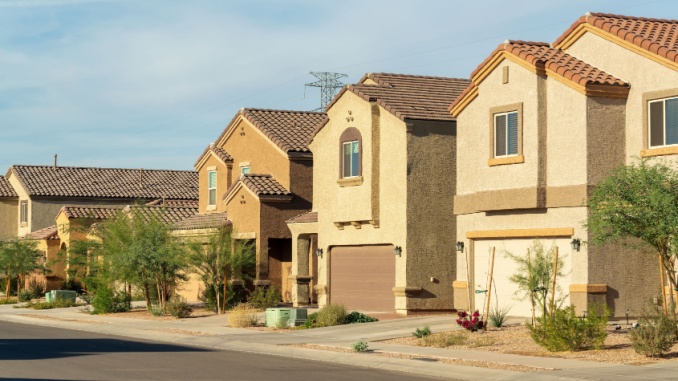
Arizona homeowners will receive expanded protection against deed and title fraud under Senate Bill 1479, which Gov. Katie Hobbs signed into law last week after it received unanimous support in the Arizona Senate.
The bipartisan legislation was sponsored by Arizona Senate Majority Whip Frank Carroll (R-LD28) and co-sponsored by Reps. Selina Bliss (R-LD1) and Patricia Contreras (D-LD12). The bill was also backed by Maricopa County Assessor Eddie Cook, Gov. Katie Hobbs, and Attorney General Kris Mayes.
SB 1479 establishes new requirements for recording property documents, creates a statewide alert system for property owners, increases criminal penalties for fraudulent filings, and repeals an Arizona law that critics said could allow forged deeds to become legally valid if left uncontested for five years.
🚨BILL SIGNED INTO LAW Your home is your biggest investment… and criminals are finding ways to steal it on paper.
According to Maricopa County officials, deed fraud is a growing concern nationwide. Fraudsters can use forged signatures and fraudulent documents to transfer property ownership or attempt to secure a loan against a home they do not own, sometimes before the actual owner becomes aware of the transfer.
In a February statement, Carroll said, “Property ownership is the cornerstone of financial security for families, seniors, and small businesses in Arizona. When criminals are able to forge documents, record false claims, or quietly transfer property without the rightful owner’s knowledge, it erodes trust in our entire system.”
According to the Phoenix Business Journal, a 2025 survey by the National Association of Realtors found that Arizonans lost nearly $50 million to real estate fraud in 2024.
“A home is often a family’s most important investment, both financially and emotionally,” Cook said in a statement. “Deed fraud robs people of far more than property; it steals their sense of security.”
Under the new law, anyone recording a document in person at a county recorder’s office will be required to provide photo identification, with exemptions for certain professionals, including escrow officers, attorneys, and financial institutions.
The legislation also requires county assessors to create an opt-in property alert system by Jan. 1, 2027. The system will notify homeowners whenever the ownership status of their property changes or when the mailing address associated with the property is changed.
SB 1479 also expands the information required on an Affidavit of Legal Value. Buyers and sellers will now be required to provide mailing addresses and phone numbers, while email addresses will remain optional.
The measure also increases the penalty for filing false property documents from a Class 1 misdemeanor to a Class 5 felony to reflect “the severity and financial harm caused by deed fraud,” according to a release from the County Assessor’s Office.
The bill also repeals Arizona Revised Statute §12-524, the law at issue in the Arizona Supreme Court case Dominguez v. Dominguez, a prominent forged deed dispute. Critics argued the law created a loophole under which a forged deed could become legally valid if it was not challenged within five years.
In addition, notaries will now be required to obtain a thumbprint in their journal for most deeds and real estate documents. Remote notarizations are exempt if video recordings verifying the signer’s identity are retained for at least seven years.
Cook said the Maricopa County Assessor’s Office began prioritizing deed fraud prevention in 2024 and hosted a seminar last year with county officials, industry representatives, and lawmakers to discuss the issue and develop legislative solutions.
Cook said the new law provides “the early alerts, verification safeguards, and legal teeth we need to stop criminals before harm is done.”
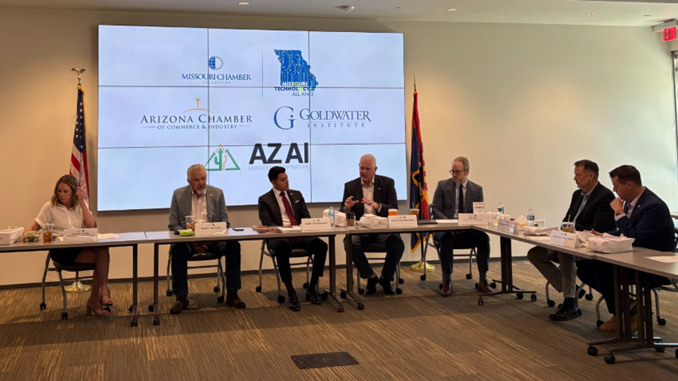
The Arizona Chamber of Commerce & Industry and the Goldwater Institute hosted a delegation of Missouri policymakers in Phoenix to discuss economic competitiveness, innovation, and pro-growth policy, according to a joint release.
The meeting focused on Arizona’s approach to building a competitive environment for emerging industries and long-term economic growth.
The discussion followed the Chamber’s recent launch of its AZ AI Leadership Initiative, which aims to strengthen Arizona’s position in emerging technologies and the broader digital economy.
Arizona has seen rapid expansion in AI and data center infrastructure, driven by growing demand for computing power and cloud services. Major investments from companies such as Taiwan Semiconductor Manufacturing Company (TSMC), which is constructing advanced semiconductor fabrication facilities in Phoenix, along with large-scale data center developments by Google and Meta Platforms in Mesa, and Amazon Web Services in Goodyear, have helped position the state as an emerging hub for both semiconductor production and AI-related computing capacity.
Participants included legislative leaders, policy experts, and representatives from the Arizona Commerce Authority, who shared insights into the state’s policy framework and economic development strategies.
A big part of the conversation: how states are thinking about AI and the broader digital economy.
“Arizona’s growth didn’t happen by accident,” said Courtney Coolidge, executive vice president of the Arizona Chamber of Commerce & Industry. “It reflects deliberate policy choices that prioritize certainty, competitiveness, and a regulatory environment where businesses can invest, innovate, and scale.”
Arizona lawmakers participating in the meeting included House Speaker Steve Montenegro (R-LD29), Majority Leader Michael Carbone (R-LD25), Rep. Jeff Weninger (R-LD13), Rep. Justin Wilmeth (R-LD2), chair of the House Artificial Intelligence and Innovation Committee, Senate President Pro Tempore T.J. Shope (R-LD16), and Senate Majority Whip Frank Carroll (R-LD28).
“Arizona has made a conscious decision to lead on innovation rather than wait for other states to set the pace,” Montenegro said. “That kind of alignment and forward-looking policy environment allows industries to grow and scale here.”
Lawmakers and policy leaders highlighted sectors including advanced manufacturing, semiconductors, aerospace, autonomous systems, and emerging technologies as areas where Arizona has seen sustained growth.
“Arizona’s success in attracting major investment is tied directly to our focus on advanced manufacturing, infrastructure, and supply chain strength,” Carbone said.
Weninger pointed to Arizona’s regulatory and tax structure as a factor in business investment.
“Companies are looking for certainty,” Weninger said. “Arizona’s predictable regulatory environment and competitive tax structure give businesses the confidence to invest and expand.”
Participants also discussed the role of infrastructure, water policy, and land use in supporting statewide growth. “We’ve been intentional about making sure economic development isn’t concentrated in one region,” Shope said.
Carroll said Arizona’s approach to economic development has positioned the state for continued expansion, particularly in emerging industries.
Wilmeth emphasized the importance of flexibility in regulating new technologies. “We’ve taken a thoughtful approach to emerging technologies by avoiding premature regulation,” he said.
Victor Riches, president and CEO of the Goldwater Institute, said policy certainty and deregulation remain key factors in supporting innovation.
“As emerging technologies continue to reshape industries, policy certainty and deregulation matter more than ever,” Riches said. “Arizona needs to ensure an environment where innovation can move forward.”
The Missouri delegation included state senators and policy advisors, including Sen. Travis Fitzwater, Sen. Maggie Nurrenbern, Sen. Karla May, Sen. Barbara Anne Washington, Sen. Jamie Burger, policy advisor to Gov. Mike Kehoe, Johnathan Shifflett, and representatives from the Missouri Chamber of Commerce, Karen Buschmann, and Jared Hankinson.
The meeting explored how elements of Arizona’s economic policy framework could be adapted in other states and how interstate collaboration could support broader economic growth.
In a move to protect Arizona’s land, critical infrastructure, and national security, Senate Republicans have passed legislation tightening restrictions on foreign adversaries seeking to acquire interests in state real property or install surveillance-related equipment. SB 1683, sponsored by Majority Whip Frank Carroll (R-LD28), advanced through the Senate on a narrow 18-12 vote last week.
The bill heads to the House for further consideration.
The bill amends ARS § 33-443 to close loopholes that could allow foreign adversary nations or their agents to indirectly control Arizona land or infrastructure through complex ownership structures.
“National security doesn’t stop at our borders; it includes our networks, infrastructure, land, and the systems Arizonans rely on every day,” stated Carroll. “Hostile threats are growing more advanced, more aggressive, and more dangerous – ignoring that reality would be irresponsible.”
Key provisions of SB 1683 include:
Lowering the threshold for a “substantial interest” in real property from 30% to 15%, calculated as if any contingent interests held by foreign adversaries are exercised, to prevent hidden ownership stakes.
Prohibiting foreign adversary nations or agents from directly or indirectly purchasing, owning, leasing, acquiring concessions, or obtaining substantial interests in Arizona real property. This covers transactions granting physical access, exclusion rights, development capabilities, or the ability to attach fixed structures.
Banning the installation, maintenance, data access, or operation of equipment such as uncrewed/autonomous systems, antennas, communications systems, surveillance devices, or high-sensitivity sensors on Arizona property—whether permanent, temporary, physical, or embedded.
Prohibiting evasion tactics, including the use of shell companies, intermediaries, partnerships, trusts, or restricting to obscure beneficial ownership or maintain functional control.
Requiring public utilities, telecommunications providers, critical infrastructure owners, and government agencies to report suspected leases, licenses, or colocation agreements that may allow prohibited equipment installation to the Attorney General and Corporation Commission.
Classifying violations involving prohibited equipment as a Class 5 felony for foreign adversary agents.
Aligning with federal processes, including violations of Committee on Foreign Investment in the United States mitigation agreements or presidential divestment orders, and allowing the Attorney General to seek injunctions, forfeiture, removal of devices at the violator’s expense, or automatic stays during federal reviews.
Applying to new transactions and renewals/extensions/modifications of existing interests on or after the effective date, with emergency provisions to preserve public peace, health, and safety.
“This legislation strategically ensures Arizona is prepared, not reactive, in protecting critical infrastructure. Protecting public safety is a core function of government, and that means addressing security gaps,” added Carroll. “Arizona farmland, properties near military bases, airports, utilities, and critical infrastructure must not be used for foreign espionage or as leverage by hostile regimes. It’s a priority for me to put the safety of Arizona and its citizens above all else.”
Ethan Faverino is a reporter for AZ Free News. You can send him news tips using this link.
In a display of strong bipartisan support, the Arizona Senate unanimously advanced legislation designed to crack down on deed fraud and better protect property owners statewide.
On Tuesday, the Senate passed SB 1479, sponsored by Majority Whip Frank Carroll (R-LD28), and sent the measure to the House for further consideration.
With deed fraud schemes growing more complex and repeatedly targeting vulnerable homeowners, lawmakers are acting to close dangerous loopholes in Arizona’s real estate recording system.
The bill updates statutes to improve identity verification, increase transparency, and impose stricter penalties on those who exploit the system for fraudulent purposes.
SB 1479 requires individuals submitting deeds or related documents in person at a county recorder’s office to present valid photo identification, with exemptions provided for trusted entities such as escrow officers, title insurance agents, banks, credit unions, active members of the State Bar of Arizona, and governmental entities. Recorders may note identification details in the system, but are prohibited from retaining copies of the identification, and this information remains non-public and exempt from disclosure.
“Property ownership is one of the most basic rights Arizonans have, and protecting that right should never be controversial,” stated Carroll. “When criminals can forge documents, quietly transfer property, or exploit weak safeguards, it puts families, seniors, and small businesses at real risk of losing what they worked their entire lives to build.”
The legislation also directs county assessors to establish a voluntary notification system by January 1, 2027, enabling property owners to opt in for prompt alerts—via email, text message, or similar means—whenever changes are made to ownership or mailing address information.
Additionally, the bill strengthens affidavit requirements for deeds and contracts transferring title by requiring the inclusion of mailing addresses, telephone numbers, and optional contact details such as email addresses for buyers and sellers.
For high-risk real property documents—including deeds, quitclaim deeds, deeds of trust, and power of attorney affecting real property—notaries must obtain a thumbprint in their journal, with exceptions for foreclosure-related trustee’s deeds, releases, and certain compliant remote notarizations that include retained audiovisual recordings for at least seven years.
The measure repeals outdated provisions, increases penalties for recording forged documents, and makes clear that property fraud carries serious criminal consequences.
“This legislation restores trust in our system by strengthening identity verification, improving transparency, and holding bad actors accountable,” added Carroll. “The unanimous vote shows that protecting property owners isn’t partisan—it’s common sense. Arizona is sending a clear message that we will stand with rightful owners and will not allow fraudsters to game the system.”
As concerns over property scams continue to rise across the state, SB 1479 represents a proactive effort to ensure Arizona’s recording processes prioritize legitimate owners and deter fraud at every stage.
Ethan Faverino is a reporter for AZ Free News. You can send him news tips using this link.