The Fountain Hills Town Council adopted its tentative budget plan for the upcoming fiscal year on a 6-1 vote May 7.
The council decided to set the budget at the maximum expenditure amount allowed under law, $45.1 million.
“Fountain Hills need to save some money and do more road repairs,” Councilman Allen Skillicorn said. “Last night the Liberal Ladies majority of council refused to cut just $1 from their ‘spend to max’ 2025 budget.”
Skillicorn, a Republican, suggested cutting 3% or $1.35 million from that budget to fund road repairs. The motion failed to receive a second. Skillicorn made a follow-up motion to cut the budget by just $1. This motion was seconded but failed three votes to four.
Voting to cut the budget were council members Gerry Freidel, Hannah Toth, and Skillicorn.
Mayor Ginny Dickey and council members Peggy McMahon, Sharron Grzybowski, and Brenda Kalivianakis voted against cutting just $1 from the budget.
“Four big spending Liberal Ladies voted for the maximum under law budget and could not cut just $1,” Skillicorn said. “If we cannot cut the budget by just $1 to fix roads, one wonders how Dickey, McMahon, Grzybowski, and Kalivianakis plan to fix our roads.”
Fountain Hills is a town in Maricopa County, Arizona with a population of roughly 24,000.
Elizabeth Troutman is a reporter for AZ Free News. You can send her news tips using this link.
The town council of Fountain Hills tabled a proposal for a policy prohibiting Diversity, Equity, and Inclusion (DEI) discrimination during its meeting on Tuesday.
The council overwhelmingly voted to table the proposal, 6-1, with Councilman Allen Skillicorn, the introducer of the policy item, being the sole vote for it. Vice Mayor Brenda Kalivianakis led a motion to suspend the proposal awaiting further guidance from the state legislature, who has similar legislation in the works currently.
Kalivianakis’ motion occurred after Hannah Toth expressed confusion over town members’ opposition to the policy, because it accomplished the main objective of DEI: preventing discrimination based on race, color, and ethnicity. Toth suggested tabling the policy to allow the state legislature to act on a similar bill.
Skillicorn warned that the state legislature was deadlocked due to Governor Katie Hobbs vetoing nearly all legislation containing Republican or conservative substance.
The policy would prohibit the town from hiring or contracting a DEI officer, as well as prohibit preferential treatment or discrimination against an individual on the basis of race or ethnicity as a condition of hiring, promoting, or contracting.
Further, the policy would prevent DEI teachings on affirming concepts like unconscious or implicit bias, cultural appropriation, allyship, transgender ideology, microaggressions, group marginalization, antiracism, systemic oppression, social justice, intersectionality, neopronouns, heteronormativity, disparate impact, gender theory, and racial or sexual privilege.
In the agenda item for the policy, town staff clarified that the town had no plans to create an office of DEI administration, and that the town adheres to all state and federal nondiscrimination laws for hiring, promoting, disciplinary measure, and terminations.
The town further noted that it would be required to collect and report race or ethnicity and gender demographics to the federal Equal Employment Opportunity Commission (EEOC) since the number of town employees has exceeded 100.
Those who spoke against the policy included town council candidate Clayton Corey. Corey claimed DEI was “the right thing to do morally” that would contribute to the town’s financial and social well-being.
Among those who spoke in favor of the policy was Goldwater Institute’s Austin VanDerHeyden, who cautioned against DEI policies by citing the controversial Digital Government team within the town of Gilbert. The Goldwater Institute assisted in drafting the policy.
In a press release, Skillicorn condemned the tabling as opposition to DEI discrimination. Skillicorn described his fellow council members and those supportive of DEI discrimination as “cultural marxists.”
“Last night the cultural marxists won. We had the opportunity to prevent DEI discrimination,” said Skillicorn. “We had the opportunity to protect the taxpayers from woke bureaucrats. We let down the people of Arizona and Fountain Hills.”
Kalivianakis is a longtime Republican — a member of the Fountain Hills Republican Club and former Republican National Committee legal team member — and has generally been supportive of right-leaning policies on issues like free speech and support for Israel. Kalivianakis voted in favor of banning future mask and vaccine mandates last year.
So glad Tucker Carlson is back on Twitter. Infact, I'm very happy I'm on Twitter, I just set up an account with free speech on the horizon.
On Thursday, former Maricopa County Sheriff Joe Arpaio qualified to run for the 2024 Fountain Hills mayoral race. This would be his second time running for the position.
At 91 years old — 92 next June — and following his unseating as the longest-serving sheriff for the state’s largest county, Arpaio has run a series of unsuccessful campaigns. He ran for Senate in 2018 and then ran to reclaim his sheriff seat in 2020, before launching a bid in 2022 to become the Fountain Hills mayor.
In a press release, Arpaio announced that he’d obtained just shy of 600 signatures, the maximum number required to qualify for the ballot. Arpaio remarked that his mayoral bid sparked interest from at least one national news outlet, the Washington Post, who allegedly was unable to obtain negative commentary on Arpaio from Fountain Hills residents.
“A Washington Post reporter followed Arpaio around town on the campaign trail, and had difficulty finding anyone who would say anything negative about him,” said the press release. “I am thankful and honored for the citizens of Fountain Hills recognizing my wisdom, principles, and leadership. Never surrender!
I have obtained the maximum number of nominating petition signatures for my campaign for Fountain Hills, AZ mayor 2024. I am thankful & honored for the citizens of Fountain Hills recognizing my wisdom, principles, and leadership.
Signatures to qualify for the ballot aren’t due for another few months: candidates must turn in signatures between March 9 and April 8 by 5:00 pm.
The Washington Post coverage of Arpaio’s campaign, published early last month, focused on former President Donald Trump’s 2017 pardon of Arpaio over his continued practice of profiling and detaining Hispanic individuals as illegal immigrants despite a court order against it. The Post portrayed the pardon as one of a series from the former president, allegedly issued with the expectation that the beneficiaries would supply political favors down the road. This year, that would be securing the presidential nomination.
Arpaio gained mass media attention, and both praise and scrutiny for his “Tent City”: his outdoor jail facility established in 1993 outside of downtown Phoenix. In a 2018 documentary, Arpaio said that his contrived system was just and fair.
“I did it to make it tough, and when anybody complains I have one thing to say, and it shuts everybody’s mouth: [the] men and women fighting for our country, they live in tents. What’s wrong with the prisoners that violated the law living in tents?” said Arpaio. “If [you, the prisoner] don’t like it, when you get out, be good, be a good citizen.”
In the place of Tent City, Arpaio’s successor, Paul Penzone, established a substance abuse counseling program for repeat offenders.
Arpaio lost the last mayoral race in Fountain Hills to incumbent Ginny Dickey. She hasn’t filed a statement of interest to run again. Apart from Arpaio, only two others have filed statements of interest: Fountain Hills councilman Gerry Friedel and local psychologist Robyn Marian.
Another councilman Allen Skillicorn — a former Illinois state representative who, last summer, had signaled interest in running for mayor — congratulated Arpaio on his obtaining enough signatures to qualify for the ballot.
— Allen Skillicorn ™ 🌵 🇺🇸 (@allenskillicorn) January 4, 2024
Skillicorn endorsed Arpaio last August.
“Joe Arpaio has been serving our town, state, and nation for years. I encourage all conservatives to join together and support the leader we know and trust.” – Allen Skillicorn Former sheriff Joe Arpaio announces run for Fountain Hills Mayor https://t.co/3G3cRH1HJK
— Allen Skillicorn ™ 🌵 🇺🇸 (@allenskillicorn) August 31, 2023
Corinne Murdock is a reporter for AZ Free News. Follow her latest on Twitter, or email tips to corinne@azfreenews.com.
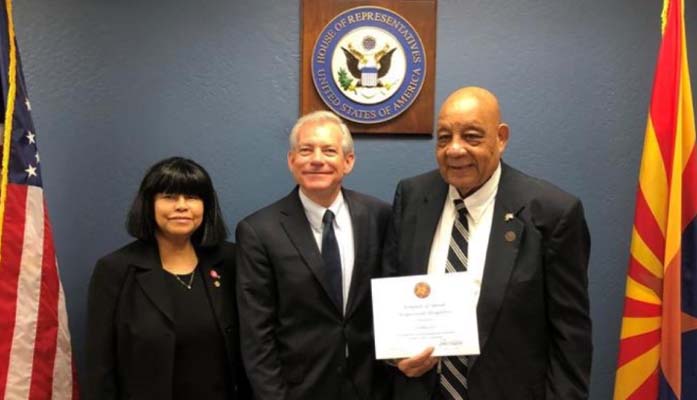
If the U.S. Senate agrees, the post office in Fountain Hills will be designated the Dr. C.T. Wright Post Office Building.
The U.S. House of Representatives unanimously passed H.R. 5650 this month. The bill introduced by Rep. David Schweikert to honor the life of Dr. Wright was co-sponsored by the other eight members of Arizona’s Congressional House delegation.
“The legacy of Dr. C.T. Wright is one that should never be forgotten,” Schweikert said in announcing the House vote. “With the House passage of my bill, we are one step closer to seeing his passion for family, faith, and freedom immortalized in our community.”
When Wright died in 2020, a state biography described his “diverse life experiences” which included being a day laborer in Georgia cotton fields, becoming an elementary school teacher, moving on to college professor and administrator, and being named a university president. He spent much of his education career working at many of America’s historically black colleges.
Wright, who was also a faith leader, later turned his focus to human rights and justice issues. He became a criminal justice expert who developed and supervised several training programs for law enforcement officers as well as an education program for inmates.
Around 1999 Wright moved to Arizona where he went on to serve as a member of the Arizona Electoral College and was appointed to the Arizona Board of Executive Clemency which he later chaired. He also served as a delegate to three national political conventions, was involved with the Fountain Hills Unified School District Governing Board and Fountain Hills Kiwanis Club, and was President of the Arizona African Society.
In 2019, Schweikert presented Wright with the Congressional Lifetime Achievement Award.
“Dr. C.T. Wright’s contributions to Arizona are unparalleled,” Schweikert said after the recent House vote. “I look forward to seeing this important piece of legislation advance in the Senate.”
Restaurants across Arizona won a majority legal victory Thursday that protects those who give jobs to minors under age 16 even if the job requires the minor to walk into or pass through the restaurant’s kitchen on occasion.
The issue arose after the popular Sofrita Restaurant in Fountain Hills was accused by the Industrial Commission of Arizona in 2018 of several violations related to its hiring of three hostesses who were under the age of 16. The Spanish-Latin restaurant was also hit with a $1,000 civil penalty.
Sofrita cooperated with the investigation, which confirmed the hostesses are tasked at times to take dirty dishes into the kitchen and sometimes used the restaurant’s rear entrance when reporting to work. This required the hostesses to walk through the kitchen to get to the hostess stand.
The ICA investigator cited Sofrita for three alleged violations of Arizona Revised Statute 23-232 for having employees under age 16 engage in activities “in, about, or in connection with” the kitchen. A fourth violation stemmed from the restaurant’s alleged failure to keep proper records to ensure the young employees did not violate ARS 23-233 in regard to how many hours a minor can work.
Sofrita challenged the violations and requested a hearing before an Administrative Law Judge. At the hearing, the state investigator testified that the child labor statute means employees under the age of 16 “cannot be in the kitchen” for any reason, not even simply to clock in for their shift.
Judge Jonathan Hauer rejected the Industrial Commission’s position, finding that Arizona’s child labor laws do not regulate “casual encounters” between minor employees and a restaurant’s kitchen space. The findings also concluded there was an “inadequate factual basis” for the ICA to impose the $1,000 penalty.
The State of Arizona appealed Hauer’s findings last year.
On June 16, the Arizona Court of Appeals affirmed Hauer’s rejection of ICA’s interpretation of Arizona Revised Statute 23-232 which prohibits restaurant employees under the age of 16 from working “in, about, or in connection with…cooking and baking.” The appellate opinion also affirmed Hauer’s finding which vacated the $1,000 civil penalty against the restaurant.
In a unanimous appellate decision, Presiding Judge David D. Weinzweig wrote that the statute the ICA relied on never mentions the word kitchen, and nothing supports the ICA’s reading that employers like Sofrita must prevent minors under age 16 from entering the kitchen.
The opinion also pushes back on the ICA investigator’s focus on the words “in, about or in connection with” the kitchen without tethering them to the statute’s specific prohibited activities of cooking and baking.
“It does not forbid employees under 16 years old from walking in the kitchen,” Weinzweig wrote, adding that federal regulations also undermine the ICA’s broad interpretation of a kitchen prohibition.
Weinzweig pointed to the Fair Labor Standards Act which permits minors under 16 to do kitchen work such as some food preparation, cleaning of some kitchen equipment, and even entering freezers to retrieve items.