by Matthew Holloway | Aug 1, 2025 | Education, News
By Matthew Holloway |
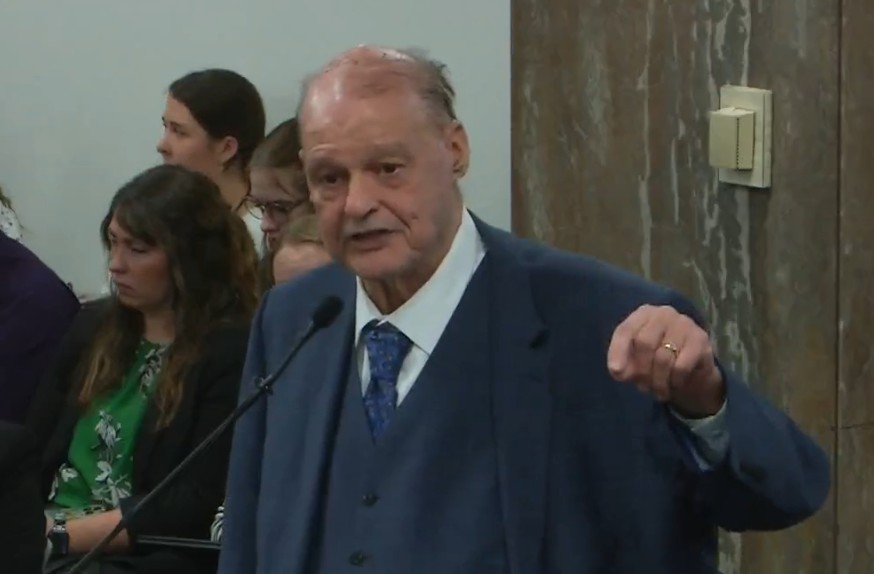
Arizona Superintendent of Public Instruction Tom Horne followed the U.S. Department of Education’s release of its pause on grant funding with a public commitment to disburse the funding as soon as possible.
The Arizona Department of Education announced that $124 million, or approximately one percent of the state’s overall education funding, was under review by the federal government.
The funding was due to be released in early July, but the approximate $6 billion in nationwide funding, including the $124 million allocated for Arizona, was placed under review by the agency on July 1st.
“The department will not be issuing grant award notifications obligating funds for these programs on July 1 prior to completing that review,” a memo from the Department’s Office of Legislation and Congressional Affairs said at the time. “The department remains committed to ensuring taxpayer resources are spent in accordance with the president’s priorities and the department’s statutory responsibilities.”
In an interview with the outlet, Secretary of Education Linda McMahon assured the public, “We want to make sure that we have the right focus on what we’re trying to do with our students.”
Superintendent Horne said in a statement, “The release of federal funds that were being reviewed by the Trump administration is good news and no surprise to me. When the review was announced I noted that the federal government is merely ensuring that the funds are being used appropriately and not for ideological purposes. People need to be assured that their education tax dollars are being used to advance academic goals and not social indoctrination.”
He added, “When the pause occurred, a lot of people panicked thinking the money would go away entirely. I said at the time that this was merely a pause for review and that is exactly what happened. The Arizona Department of Education staff will work very hard to disburse these funds as soon as possible.”
Horne shared a video clip on Friday from President Trump, coinciding with the release in which the President said, “We are moving education back to the states….when they do it, you are going to have the BEST education in the world.”
In a previous statement, Horne observed, “They’ve (federal government) seen instances of far-left ideology being taught to students. And I would agree that that should not be. People obviously have a right to be far left if they want, but they don’t have a right to impose it on students in the classroom. So, if there’s any of that in Arizona, I would cooperate enthusiastically with the federal government to get rid of it.”
Matthew Holloway is a senior reporter for AZ Free News. Follow him on X for his latest stories, or email tips to Matthew@azfreenews.com.
by Matthew Holloway | Apr 15, 2025 | Education, News
By Matthew Holloway |
Arizona Superintendent of Public Instruction Tom Horne issued a stern warning to Arizona school districts late last week. The warning came after Phoenix’s Kyrene School District voted to adopt a policy that further embeds Diversity, Equity, and Inclusion (DEI) into the district’s day-to-day operations in defiance of policy guidance issued by President Donald Trump.
Horne warned, “Kyrene and any district or charter that is not taking the federal DEI guidance will lose their federal dollars. The U.S. Department of Education has been abundantly clear with its most recent guidance against the use of DEI language in schools. Federal law and the 14th amendment to the U.S. Constitution are clear that no person shall be discriminated because of race, skin color or ethnicity, and this guidance aligns completely with my philosophy. By contrast, the use of DEI programs does just the opposite and promotes racial discrimination. Schools ignore the federal guidance at their own peril. This is not an empty threat, and districts and charter schools need to treat it seriously.”
In its meeting on April 8th, the Kyrene School District voted unanimously to defy policy guidance from both the U.S. Department of Education (DOE) and the Arizona Department of Education (AZDOE). The move will cause the district to lose access to over $1.5 million in federal funding in favor of its “Staff Social Emotional Wellness Policy” in which it purports to “provide welcoming, inclusive learning environments in which every student is honored, valued, and feels a strong sense of belonging and purpose.”
Guidance from the DOE issued in February explicitly states that, “Institutions that fail to comply with federal civil rights law may, consistent with applicable law, face potential loss of federal funding.” It noted that “DEI programs, for example, frequently preference certain racial groups and teach students that certain racial groups bear unique moral burdens that others do not. Such programs stigmatize students who belong to particular racial groups based on crude racial stereotypes. Consequently, they deny students the ability to participate fully in the life of a school.”
The federal policy explains, “Although some programs may appear neutral on their face, a closer look reveals that they are, in fact, motivated by racial considerations. And race-based decision-making, no matter the form, remains impermissible.” The DOE also cited the U.S. Supreme Court’s 2023 decision in Students for Fair Admissions v. Harvard, which ruled that “[c]lassifying and assigning students based on their race” is an unlawful practice unless it satisfies a firm legal standard of ‘strict scrutiny,’ under two narrowly tailored instances:
(1) remediating specific, identified instances of past discrimination that violated the Constitution or a statute;
(2) avoiding imminent and serious risks to human safety in prisons, such as a race riot.”
The high court added, “An individual’s race may never be used against him” and “may not operate as a stereotype,” used to justify government polices.
In his remarks, Horne concluded, “The most interesting philosophical divide in our country right now is between those like me who believe in individual merit, and those who want to substitute racial entitlement. DEI is all about racial entitlement. The problem with racial entitlement is that it does nothing to promote hard work, conscientiousness, or creativity. If those advocating for it succeed in having it replace individual merit, we will become a mediocre, third world country. China will become the dominant power.”
Earlier this month, Horne signed an attestation letter to the DOE stating that “Arizona will not have anything to do with race-based programs, DEI, etc.”
Horne shared a handwritten missive to Secretary McMahon from the margins of the letter that AZDOE called “uplifting” which stated, “Sec. McMahon- Thank you for fighting for our Constitution and laws!”
Matthew Holloway is a senior reporter for AZ Free News. Follow him on X for his latest stories, or email tips to Matthew@azfreenews.com.
by Staff Reporter | Feb 1, 2025 | News
By Staff Reporter |
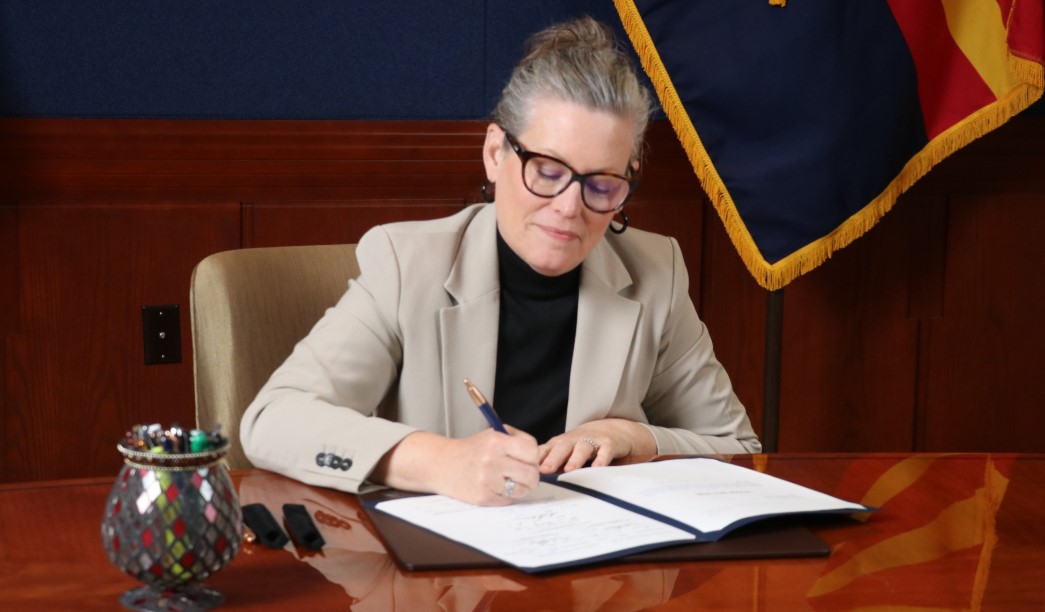
After Tuesday’s blunder from Arizona’s chief executive, those across the state are again questioning the competency of Governor Katie Hobbs and her staffers.
Hobbs submitted an error-ridden letter to the Arizona Congressional Delegation on Tuesday afternoon requesting their assistance in resisting the Trump administration’s federal funding freeze.
Hobbs’ letter failed to include two of Arizona’s congress members: Congressmen Abraham Hamadeh and Paul Gosar. Her letter also incorrectly claimed Trump’s federal funding freeze extended to federal assistance programs providing individuals with healthcare, public safety, veterans’ services, and financial assistance.
“Without these programs, Arizonans will be denied healthcare, families will struggle to stay housed, and communities will become less safe. The effects of this funding freeze will have impacts across the state, and weaken Arizona’s ability to care for its residents,” said Hobbs. “Congress must act. These actions directly violate the Constitution’s delegation of power of the purse to Congress and the Impoundment Control Act of 1974. Courts, including the Supreme Court, have made it clear that presidents cannot unilaterally withhold the funding appropriated by Congress for these services.”
Hobbs also threatened to sue the Trump administration over its funding freeze.
As the White House and the Office of Management and Budget (OMB) clarified in a memo and other public statements preceding Hobbs’ letter, the federal funding freeze doesn’t affect programs providing direct benefits to individuals. The OMB supplemented its memo with a Q&A on the guidance.
“This is not a blanket pause on federal assistance and grant programs from the Trump Administration. Individual assistance that includes […] Social Security benefits, Medicare benefits, food stamps, welfare benefits […] will not be impacted by this pause,” said Press Secretary Karoline Leavitt during Tuesday morning’s White House press briefing.
The following executive orders pertain to the federal funding freeze: “Protecting the American People Against Invasion,” “Reevaluating and Realigning United States Foreign Aid,” “Putting America First in International Environmental Agreements,” “Unleashing American Energy,” “Ending Radical and Wasteful Government DEI Programs and Preferencing,” “Defending Women from Gender Ideology Extremism and Restoring Biological Truth to the Federal Government,” and “Enforcing the Hyde Amendment.”
An OMB memorandum meant to offer guidance on those executive orders, M-25-13, prompted an eleventh-hour federal court injunction on Tuesday. The federal funding freeze was scheduled to take place at 5 pm on Tuesday.
On Wednesday, Leavitt confirmed that the OMB rescinded its memo to “end any confusion” created by the injunction. In effect, this provided the administration with a workaround to the court order. A follow-up OMB memo advising of its rescission directed agencies to contact their general counsel for implementation of Trump’s executive orders.
“The President’s [Executive Orders] on federal funding remain in full force and effect, and will be rigorously implemented,” said Leavitt.
As first reported by the Arizona Daily Independent, other leaders took the effort to clarify the scope of the federal funding freeze — among them, Virginia Governor Glenn Youngkin.
“I’ve spoken to senior officials at the White House and confirmed the temporary pause by OMB does not impact individual assistance and will not interrupt disaster recovery efforts, school and childcare funding, healthcare for seniors or low-income families, funding for our roads, meals and lunches, or any of the other misinformation that has spread,” said Youngkin. “The partisan stunt to disseminate knowingly misleading information is dangerous fearmongering and completely wrong.”
AZ Free News is your #1 source for Arizona news and politics. You can send us news tips using this link.
by Corinne Murdock | Jul 28, 2023 | News
By Corinne Murdock |
The Arizona desert’s classic dry heat should now qualify as an “extreme heat,” according to Democratic lawmakers and leadership.
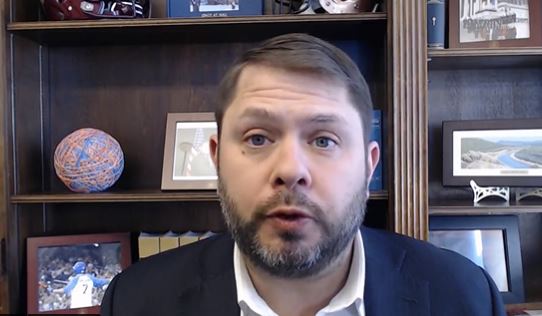
Rep. Ruben Gallego (D-AZ-03) is lobbying for more federal funding to counter the desert heat. Democrats at all levels have recharacterized summer temperatures as “extreme heat” in an attempt to pull more funding for a variety of progressive initiatives ranging from climate change to social justice. Trending usage of the word “extreme heat” has increased dramatically over the past 20 years, spiking with increased regularity every summer.
In a press release, Gallego commended President Joe Biden for increasing heat-related worker protections on Thursday. As part of the changes, Biden met with Phoenix Mayor Kate Gallego, the congressman’s ex-wife, and San Antonio, Texas Mayor Ron Nirenberg. Yet, those changes fell short of Rep. Gallego’s ultimate goal: he urged the Biden administration to go one step further by classifying heat as an emergency.
“Far too many people are dying or falling ill from these extreme temperatures,” said Rep. Gallego. “[M]ore must be done. We need a swift, immediate deployment of resources, and that requires FEMA declaring extreme heat as an emergency. I will continue pushing the administration and Congress to get that done.”
Both Gallegos have worked together to lobby the federal government to declare summer heat as an emergency.
During her annual state of the city address in April, Mayor Gallego petitioned the Federal Emergency Management Agency (FEMA) to qualify extreme heat as a disaster by adding the regular seasonal occurrence to its national emergency declarations categorization.
A FEMA recognition would bring in more federal funding. The city has a number of heat mitigation projects that would likely benefit from such funding, like the manufactured shade and drinking water access areas known as “cool corridors,” which are determined on an equity basis, and the special sunlight reflective streets known as “cool pavement.” (Which, as AZ Free News reported, actually makes people hotter). Those initiatives were unique creations under Mayor Gallego’s administration.
Mayor Gallego was also responsible for the creation of one of the first heat mitigation offices within city government: the Office of Heat Response and Mitigation (OHRM). The city established the office with $2.8 million in 2021, with the explicit attempt to combat urban heat: the theory that urbanization causes higher temperatures.
Presently, the OHRM doles out COVID-19 relief federal funding provided by the American Rescue Plan Act (ARPA) for annual heat relief grants. These grants are earmarked for nonprofit, charitable, small business, and faith-based organizations existing within the city-recognized Maricopa Association of Governments Heat Relief Network that claim negative impacts from the COVID-19 pandemic. OHRM will give out a maximum of $450,000 total, with each recipient receiving anywhere from $10,000 to $25,000.
A major focus of the OHRM is providing heat respite for the homeless. The latest update from OHRM, issued last summer, announced initiatives costing millions to increase the comfort of the homeless residing within the infamous mass homeless encampment known as the Zone: the creation of seven new shade structures; distribution of insulated and reusable water bottles, hats, sunscreen, personal misters, towels, ice chests with water; and 475 shelter beds for 24/7 heat respite.
The first and current OHRM director is Arizona State University (ASU) professor David Hondula, who teaches within the Global Institute of Sustainability. ASU worked with the city of Phoenix on the trial run and report ahead of the full launch of the cool pavement program.
After the mayor, Rep. Gallego introduced the Extreme Heat Emergency Act last month. Rep. Gallego said that extreme cold weather warrants federal disaster relief and contended that the same should be the case for the opposite of extreme heat.
“If you’re in Chicago and you have two weeks of extreme cold weather and snow and 400 people die, and Chicago calls the federal government, they will get money from the federal government,” said Gallego.
As AZ Free News reported this week, a majority of heat deaths in Maricopa County last year were due to meth.
Rep. Gallego also introduced similar legislation last year alongside Rep. Bonnie Watson Coleman (D-NJ-12). Last year’s version, the Excess Urban Heat Mitigation Act of 2022, would establish a grant program through the Department of Housing and Urban Development. It never made it past introduction.
In this latest announcement from Biden on Thursday, the president directed the Department of Labor (DOL) to issue a Hazard Alert for heat and ramp up workplace heat-safety violation enforcement, allocated $7 million in Inflation Reduction Act (IRA) funding to the National Oceanic and Atmospheric Administration (NOAA) for weather prediction improvements, and allocated $152 million in Bipartisan Infrastructure Law (BIL) funding to expand water storage and equity-based climate resilience efforts in California, Colorado, and Washington.
The Biden administration has invested over $50 billion so far to address climate issues like heat waves. They have also established a website providing information on federal funding opportunities to mitigate health risks from heat, the #SummerReady awareness campaign, established the new Office of Climate Change and Health Equity, funded 10 community groups and localities for equitable heat relief, and launched heat mapping campaigns in 154 communities across 14 states.
Earlier this month, the Biden administration announced other heat mitigation initiatives: $5 million to NOAA for two virtual research centers providing technical assistance and information to historically marginalized and underserved communities, a National Heat Strategy focused on equity and environmental justice developed by the White House Interagency Working Group (IWG) on Extreme Heat, meetings with local and tribal leadership to offer federal support for summer heat, and affordable housing opportunities using IRA and BIL funding.
Corinne Murdock is a reporter for AZ Free News. Follow her latest on Twitter, or email tips to corinne@azfreenews.com.
by Corinne Murdock | Jun 27, 2023 | News
By Corinne Murdock |
The city of Phoenix received $10 million in federal funding to establish an equitable “Cultural Corridor” near Phoenix Sky Harbor Airport.
The city announced the funding over the weekend, which originated from the Rebuilding American Infrastructure with Sustainability and Equity (RAISE) program. The $10 million came from $1.5 billion in a discretionary fund through the RAISE program opened up in December.
With these recent RAISE funds, the city of Phoenix will develop vacant lots west of the airport. In a press release, the city identified neighborhood stability, identity creation, and economic expansion as their primary goals.
Although the $10 million came this month, final drafting for the Cultural Corridor was published in April 2020. According to these draft plans, the corridor will serve as a multicultural heritage trail navigable via public transit.
Seven individuals were proposed as those to be featured on the trail: Father Albert Braun, Cesar Chavez, Sister Mary Luca Junk, Silvestre Herrera, Wing Ong, Calvin & Georgie Goode, and John Lewis. Each individual will receive their own themed “zone” within the Cultural Corridor: the Goode-Luca-Ong Community Champion Zone, the Silvestre Herrera Heroism Zone, the Cesar Chavez Labor & Civil Rights Zone, the Father Albert Braun O.F.M. & Medallion of Honor Zone, and the Anne Ott Education Zone.
Additionally, seven landmarks were selected: Historic Sacred Heart Church, Santa Rita Center, Ann Ott School, Silvestre Herrera School, Tanner Church and other churches in the area, Austin Market, and neighborhood parks.
The draft plan also identified 65 properties that were either currently listed as or eligible to be enlisted as historic at the national or local level.
The final draft for the corridor also identified seven areas as historic neighborhoods: the Eastlake Park Neighborhood, El Campito Barrio, Golden Gate Barrio, Cuatro Milpas Barrio, Ann Ott Neighborhood, Green Valley Neighborhood, and Rio Salado San Juan Bautista Neighborhood.
This is the latest round of federal funding for the project. The city received a Federal Aviation Administration (FAA) grant for its implementation phase from 2017 to 2019.
Mayor Kate Gallego said in the weekend press release that the grant would issue warranted recognition to communities surrounding the airport.
“This grant will enable us to honor the legacies, histories, and identities of existing communities while also improving safety and mobility in the region,” said Gallego.
The Cultural Corridor arose from the airport’s Land Reuse Strategy that first began in early 2016. Developments on the vacant land include a workforce training center, mixed-use residential properties, commercial lots abutting mixed-use office spaces, and a public park adjacent to a commercial recreation facility. The Cultural Corridor would run from the light rail terminal near East Washington and South 7th streets, down South 16th Street, along East Buckeye Road, along East Pima Street, and southbound past the I-17 until it hits the Rio Salado River.
Several private developments will be established near the light rail terminal where the Cultural Corridor begins: apartments, mixed-use residential, condominiums, commercial spaces, and a hotel.
RAISE grants aren’t the only source of DOT funding for infrastructure. In March, Tucson received another $900,000 from the DOT’s Reconnecting Communities Program to build another biking and pedestrian bridge, covering about 56 percent of the total project cost of $1.6 million. They were approved while 10 other Arizona cities, counties, and one nonprofit were denied funding. The DOT revealed that it prioritized projects engaged in equity and environmental justice work.
The debut of the Biden administration’s RAISE grants saw one award in Arizona: over $10.6 million to the city of Yuma to convert a historic building into a multimodal public transit center. Project costs totaled over $17.7 million.
RAISE is a continuation of its predecessors dating back to 2009, former President Obama’s first year in office: formerly Better Utilizing Investments to Leverage Development (BUILD) and initially Transportation Investment Generating Economic Recovery (TIGER). Through 2022, all three programs have issued over $12.1 billion in grants for 934 projects, 18 of which were Arizona-based projects. RAISE alone has issued over $3.2 billion in grants to 255 projects since launching in 2021.
Last year, the RAISE program gave over $75 million to four projects in Arizona: $261,000 to Navajo County for a regional multimodal planning study of 16 miles of pedestrian and bicycle pathway (total project cost: $290,000); $25 million to Phoenix to build a bicycle and pedestrian bridge over the Rio Salado River (total project cost: $34.5 million); $25 million to Tucson to rebuild a bridge less than a mile in length, expand a street from four to six lanes, and build a new bicycle and pedestrian bridge (total project cost: $95.4 million); and nearly $25 million to the Colorado Indian River Tribes to reconstruct 10 miles of road.
Corinne Murdock is a reporter for AZ Free News. Follow her latest on Twitter, or email tips to corinne@azfreenews.com.