The Phoenix Union High School District (PXU) is preparing for significant budget reductions and potential staff layoffs as enrollment continues to drop, according to a letter sent to district employees on October 24th by Superintendent Thea Andrade.
In a letter to PXU colleagues posted to X by Phoenix Union Governing Board Member Jeremiah Cota, Andrade cites a decline of approximately 1,800 students in the 2025-2026 school year, following a drop of about 1,200 students the previous year. This represents a total loss of roughly 3,000 students, or about 10% of the district’s overall population, since its high point in 2022.
The superintendent attributes the budget cuts to “a significant decline in student enrollment.” In her letter, she explains that “the reasons for declining enrollment are complex,” and pivots to what she says are contributing factors: “the largest expansion of Empowerment Scholarship Accounts (ESA) in our state’s history,” the continued growth of charter schools, local demographic challenges such as gentrification and low birth rates, and the expiration of several federal Elementary and Secondary School Emergency Relief (ESSER) funds.
Today, Phoenix Union High School District announced an untold number of possible job cuts due to declining enrollment.
It's unfortunate, this district has chosen to blame ESA families, charter schools, and the GOP legislature for their budget shortfalls.
The announcement drew immediate response from Governing Board Member Jeremiah Cota, who slammed the district for casting blame on ESA families, charter schools, and Arizona’s Republican-led legislature.
In his post, Cota said that as a board member, he has repeatedly requested improvements in school safety and has been “all but ignored.” He also expressed concern that parents are hesitant to send children to district schools due to safety issues and “woke identity politics” in classrooms.
Cota wrote in full:
“Today, Phoenix Union High School District announced an untold number of possible job cuts due to declining enrollment.
It’s unfortunate, this district has chosen to blame ESA families, charter schools, and the GOP legislature for their budget shortfalls.
As a board member for @PhoenixUnion, from day one I’ve asked to make our schools safer and have all but been ignored on EVERY single request.
Parents, don’t feel safe sending their kids to one of our schools and are tired of the woke identity politics being injected in the classroom.
Yet, here we are, big enrollment drops and possibly even bigger job cuts coming.
TRUTHFULLY, I am concerned the present board will not take any corrective action to stem this decline.”
To address the financial strain, the district has already implemented cuts. In the 2023-2024 school year, it reduced district office budgets by $8.6 million and reorganized the executive team, eliminating several administrative positions to shield campus roles. For the 2024-2025 school year, per AZ Family, an additional $5.8 million was cut through district office reductions, unfilled vacancies, and natural attrition.
As previously reported by AZ Free News, the Phoenix Union High School District (PXU) faced major controversy going into a vote to approve a Memorandum of Understanding (MOU) with Chicanos Por La Causa (CPLC) to provide substance abuse prevention and mental health services at three high schools. The MOU outlines CPLC’s role as a subgrantee of the Arizona Health Care Cost Containment System (AHCCCS) under the federal Substance Abuse Prevention and Treatment Block Grant (SABG).
The MOU would also permit CPLC to offer “Health Masculinity Services for Self-Identified Males.”
Good morning. Tomorrow at @PhoenixUnion school board meeting, we'll be voting on contracts with leftist activist group Chicanos Por La Causa.
Reason: to help self identified males and likely abortion services as part of "wrap around" services to students.
Looking ahead, the district projects it will need to cut another $15 million in the 2025-2026 school year and $20 million in the 2026-2027 school year to maintain solvency. Approximately 90% of the district’s annual budget goes toward employee salaries and benefits, Andrade noted.
Since becoming President of the Scottsdale Unified School District (SUSD) Governing Board, Dr. Libby Hart-Wells has increasingly displayed hostility toward her fellow Board Members Amy Carney and Carine Werner.
At nearly every board meeting, Hart-Wells repeatedly interrupts and reprimands Members Carney and Werner, stifling any discussion or differing viewpoints, and repeatedly insists they stay on topic by saying “not on the agenda” whenever they attempt to ask a foundational question concerning an agenda item. This effectively curtails any potential for meaningful dialogue before it can begin.
Hart-Wells’ response to criticism is notably defensive, as evident in numerous board meetings throughout the year. Her authoritative and viewpoint-intolerant leadership style was particularly evident at the June 25th board meeting, where, knowing that Member Lindsay would not be present—a reliable progressive vote—she declined to include agenda items requested by Member Carney, despite a board policy that gives each board member an equal right to include agenda items for discussion.
Furthermore, during a public hearing at that meeting on the fiscal year 2024-2025 expenditure budget, Hart-Wells not only cut off Member Carney but also interrupted my public comments as well.
The agenda for the meeting specified that the board would hold a public hearing on the adoption of the SUSD proposed fiscal year 2024-2025 expenditure budget, in accordance with A.R.S. §38-431.02 and A.R.S. §15-905(D)(E).
A.R.S. §38-431.02 is often referred to as Arizona’s open meeting law (OML) and, as Dr. Hart- Wells should know because the former Attorney General successfully sued SUSD on this very issue just two years ago over the mask mandate debacle, the OML applies to “public hearings” just like any other board meeting.
A.R.S. §15-905 pertains to school district budgets, and subsection (D) mandates that the governing board must conduct a public hearing to present the proposed budget and explain it upon request of any person.
SUSD is a large district. The budget is not insignificant. The proposed fiscal year 2024-2025 expenditure budget totals $437,700,168 and before the board approved it, they were obligated to explain it to the public.
In line with Arizona law, I chose to address the board and seek clarification on the budget. However, just as she does with board members who bring up uncomfortable topics (for her), Dr. Hart-Wells repeatedly interrupted me during my discussion with staff who were explaining the budget, as required by law. At one point, she even turned off my microphone, effectively halting my comments. Under the OML, board members cannot simply interject and interrupt speakers during public comment. But as usual that doesn’t stop this district from doing things their own way and gaslighting parents if they object.
Dr. Hart-Wells, after breaking off my comments, insisted that discussions should focus strictly on “the proposed M&O budget for next school year” despite the public notice stating the purpose of the hearing was the adoption of the entire fiscal year 2024-2025 expenditure budget, not solely the M&O section of the budget.
Furthermore, the expenditure budget summary, as presented, explicitly mentions the ESSER funds. Therefore, discussing ESSER funding during the hearing, as I was trying to do, is directly relevant to the budget and “on topic.”
Dr. Hart-Wells had the audacity (and lack of self-awareness) to say publicly that she would “appreciate it” if I followed the state laws, yet her actions appear to violate both Arizona’s open meeting law and A.R.S. §15-905(D). Restricting meaningful discussion on pertinent budgetary matters outlined in the public notice and summary provided by the District is a clear violation of state law. By statute, the board is obligated to explain the budget – to the people who pay the taxes to support that budget. In this mandatory duty, she failed.
If you share my frustration with the way the Governing Board has been operating, continuously violating OML, disrespecting the rights of the public, preventing meaningful discussions on critical topics, and rubber-stamping Superintendent Menzel’s failing agenda, and if you believe our children deserve better, I urge you to vote for change this November.
Mike Bengert is a husband, father, grandfather, and Scottsdale resident advocating for quality education in SUSD for over 30 years.
In September 2023, four DUSD high schools were named 2023-2024 Best High Schools by U.S. News & World Report. Three of the four were also named A+ Schools of Excellence by the Arizona Educational Foundation. Although DUSD has a lot of work to do, school board members across the Valley now have a model for governing with sense and sensibility.
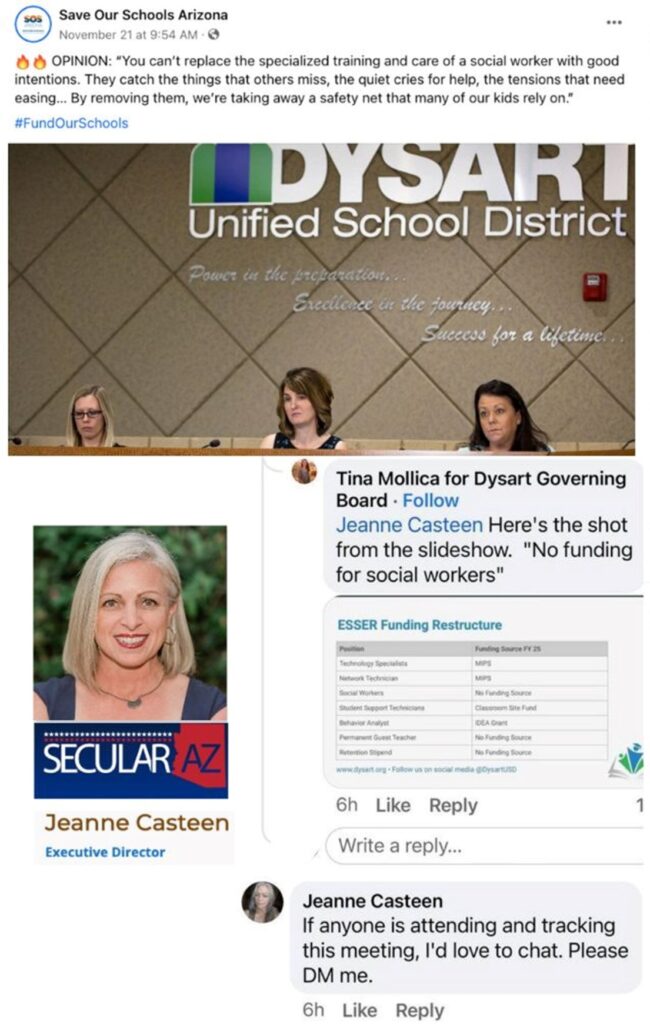
Of course, every free-thinking, constitutional, conservative board member will have progressive dogs nipping at their heels. Such is the case with the uprising of emotional activists after DUSD opted to not renew Elementary and Secondary School Emergency Relief (ESSER) funds.
Save Our Schools Arizona—a leftist group that identifies as a “nonpartisan community based organization”—led the campaign of oppression by posting a hack opinion editorial on social media. Anxiety-ridden constituents (including the director of an anti-God organization) manifested in the comment section with cries of outrage. Wow. I didn’t know saving Arizona schools meant converting every campus into psychiatric medical facilities!
With sensational clarity, Arizona’s Family reported that DUSD’s decision came amid “a fiery exchange after [board] members voted to eliminate the role of social workers within their school district.” Did anybody in the bullpen even watch the November 16 board meeting? I did. Of course, I don’t have a predisposition to rage, so I viewed it as a thoughtful discussion with differing opinions. Board Member Jo Grant blessed me with her deliberate and persistent, social-emotional vantage point. She got outvoted. Where’s the fire?
Board Members Dawn Densmore and Jennifer Drake personally assured me that because ESSER funds were drying up, it was in the district’s best interest not to renew without a financial plan to supplement looming deficiencies. They also confirmed the district would retain numerous student support positions, including psychologists, counselors, and behavior interventionists.
Densmore said, “For me…it’s not a slam on the profession of social workers. I genuinely don’t think all of them [have a leftist agenda]. But at the same time…places of education should not be healthcare institutions. If parents have children who go through issues where they need additional support—and I [personally] had one child who needed it—take them out of school and get them into counseling. I would have never expected the school to take care of that and replace me as a parent in that situation.”
Drake agreed, “It is the parent’s responsibility [to take care] of the health and wellbeing of their child—not the school. When a child is at school, their priority is safety and education. If your child needs mental health or medical services, then as a parent, it is your responsibility to provide that. The school can get outside resources, but having these services inside the school is unacceptable. Taxpayers should not be paying for this.”
Densmore and Drake also emphasized that educators should not bear the consequences of attendance deficits and low test scores when emotional needs become disruptive to learning environments.
In response to the small faction of obnoxious critics who branded DUSD “cruel” and “irresponsible,” Densmore and Drake said, “Parents need to start parenting. Stop using schools as a crutch—for vaccinations, for dental work, etc.…If your kid is sick, whether it’s physical or mental, take them to the doctor. If your kid is suffering mentally, why would you rely on a school [district] for something like that?”
I’ll wrap this up by pointing out that 2020 was America’s Enlightenment period where we discovered a supposed new and improved job function for social workers. According to the National Association of Social Workers, these mental health warriors are now equipped to practice a more inclusive, equitable, anti-racist approach. And they want us to rest assured that no matter what issues students face inside or outside the classroom, affirming their gender-identity and empathizing with their skin color is sure to be the cure.
Seriously, parents, why haven’t you pulled your kids out of Arizona public schools?
For nearly two decades, Tiffany Benson’s creative writing pursuits have surpassed all other interests. When she’s not investigating Kennedy Assassination conspiracy theories, she enjoys journaling and contributing to her blogBigviewsmallwindow.com. She encourages average citizens to take on an active role in the grassroots fight for future generations.
Mesa Public Schools (MPS) ignored additional requests from our reporters to obtain data on how $32.3 million in federal COVID-19 relief funds were spent. In March, MPS toldAZ Free News that no records existed detailing how exactly those funds were spent.
Over a month ago, AZ Free News inquired about records for the chart of accounts related to Elementary and Secondary School Emergency Relief (ESSER) funding. There were three separate COVID-19 federal relief grants administered: ESSER I, coded under 326; ESSER II, coded under 336; and ESSER III, coded under 346.
We requested those records because the public ESSER report given by MPS in December didn’t offer an in-depth explanation. MPS attributed those tens of millions spent to a variety of ambiguous explanations: “other,” “etc,” “indirect costs,” and “COVID relief positions.”
When we asked for further information about the $32.3 million, MPS told us they couldn’t offer further explanation of those expenditures because they weren’t required by law to create records.
Of the over $4 billion Arizona received in ESSER funding, MPS received the second-largest allotment: around $229.2 million. Tucson Unified School District (TUSD) received the most in the state.
Last October, MPS reported that they had nearly $40 million remaining in their maintenance and operation funds.
Corinne Murdock is a reporter for AZ Free News. Follow her latest on Twitter, or email tips to corinne@azfreenews.com.
Mesa Public Schools (MPS) won’t explain where over $32.3 million of their federal emergency funds slated for COVID-related expenditures went. The lack of transparency calls into question the amount of funds funneled into undisclosed areas potentially unrelated to education while teachers struggle for increased salaries and school supply funding.
AZ Free News inquired with MPS about their COVID-19 expenditures after readers requested we look into reports that teachers were asking parents to donate basic supplies like paper because they were running out — and apparently their district wouldn’t cover it. In its annual financial report submitted last October, MPS reported nearly $40 million remaining in their maintenance and operation funds
That led AZ Free News to look into MPS expenditures. The millions we inquired about came from their latest public Elementary and Secondary School Emergency Relief (ESSER) report. Specifically, we inquired about what was behind the repeated listings of “indirect costs,” “other,” and “etc” expenditures that MPS allocated millions of dollars toward. AZ Free News focused on these expenditures:
Page 8: the “other (includes indirect costs)” totaling over $16 million
Page 9: the “etc” expenditures under PPE totaling nearly $1.7 million
Page 9: the “other” and “indirect costs” together totaling over $554,000
Page 10: the “COVID relief positions” totaling over $122,000
Page 10: the “indirect costs” totaling nearly $4.3 million
Page 12: the “indirect costs” totaling over $9.6 million
With each public records request, MPS officials would refer us back to the public ESSER report. After several follow-ups, MPS General Counsel Kacey King informed AZ Free News that MPS could not fulfill the request further because explanation of those additional expenditures in full would require MPS to “create records.” Under Arizona law, government entities aren’t required to create records that they don’t have.
In all, Arizona has received over $4 billion in ESSER funding. MPS received some of the largest bulk of that funding, coming in second for most ESSER funds received: around $229.2 million, coming in second only to Tucson Unified School District (TUSD).
Corinne Murdock is a reporter for AZ Free News. Follow her latest on Twitter, or email tips to corinne@azfreenews.com.