In a recent opinion piece, Scottsdale Unified School District (SUSD) Superintendent Scott Menzel highlights what he considers a long list of accomplishments. According to Superintendent Menzel, the “2023-2024 school year has been marked by significant progress and achievements as we continue to implement initiatives aligned with our Strategic Plan to improve academic achievement and outcomes and prepare students for real-world opportunities in an ever-evolving landscape.”
Let’s delve into the statistics.
Nearly 1,800 seniors graduated from SUSD on May 23rd. During the May 14th Governing Board meeting, 11 seniors were recognized for their academic excellence. In his column, Dr. Menzel highlighted that 51 graduates had received math and science diplomas. While these acknowledged students have rightfully earned praise for their hard work and accomplishments, including receiving various scholarships, what about the remaining 1,800 graduates? How have they fared after receiving a purportedly “world-class, future-focused” education from SUSD?
According to the Arizona Department of Education’s comprehensive school report card system, the overall performance isn’t encouraging. In 2023, when these graduating seniors were juniors, their proficiency levels were assessed, yielding the following results:
Only 63% demonstrated proficiency in English Language Arts (ELA), leaving 37% (or 666) lacking proficiency.
Math proficiency was even lower at 55%, indicating that 45% (or 810) were not proficient.
Science proficiency was the lowest, with a mere 25% demonstrating proficiency, leaving 75% (or 1,350) lacking in this area.
On average, only 48% (or 858 students) of the 1,800 graduates were proficient across all three academic subjects.
Given these outcomes, it seems apt to reconsider the SUSD slogan “Because kids,” as it appears the district may not adequately prioritize the needs of all students. Perhaps it should be restated as “Because some kids.” A school district’s quality should be judged by how well it supports its lowest-performing students.
Yet, despite this concerning academic record, three outgoing members of the current governing board decided, without public input or feedback from district stakeholders, to extend Superintendent Menzel’s contract by two years and grant him a 4% raise.
Dr. Menzel’s emphasis on using class time for destructive “Social Emotional Learning,” “Diversity, Equity & Inclusion,” and gender identity at the expense of teaching academics appears to be falling short for SUSD students, parents, and taxpayers. It’s perhaps unsurprising that parents are increasingly withdrawing their children from SUSD, and staff turnover, including principals, is at an all-time high.
If you share my frustration with the Governing Board’s apparent rubber-stamping of Dr. Menzel’s failing agenda and believe our children deserve better, I urge you to vote for change this November.
Mike Bengert is a husband, father, grandfather, and Scottsdale resident advocating for quality education in SUSD for over 30 years.
Any sensible person can see that there is something seriously wrong with many American universities.
For several decades many of our most prestigious seats of learning have become hostile to free speech and genuine inquiry. Speech codes have been introduced to prevent so-called ‘microaggressions.’
Speakers that do not subscribe to ‘woke’ orthodoxies have been ‘de-platformed.’ Those that do get invited on to campus risk being mobbed, as recently happened to a federal judge at Stanford and Riley Gaines at San Francisco State.
Intellectual inquiry, too, has narrowed. Anyone presenting ideas outside the approved parameters risks having their career terminated. (See what happened to Harvard’s then-president, Larry Summers, in 2006 when he suggested that genetics might help explain why there are more male than female scientists.)
Then on October 7th, Hamas slaughtered over a thousand Israelis, most of them civilians. Far from condemning the massacre, student groups at Harvard, Cornell and other universities rushed to issue statements attacking Israel.
Anti-Israel protesters on campus made statements and chanted slogans that went beyond being merely rude or unpleasant. Some seemed antisemitic. Others sounded like they were calling for a Jewish genocide.
How come those campus speech codes suddenly no longer applied? Having spent years policing what could be said to avoid ‘microaggressions,’ where were the university authorities when Jewish students faced actual aggression?
Giving evidence before a Congressional committee the other week, Claudine Gay of Harvard appeared to suggest that however unpalatable the protesters might be, it was all part of their right to freedom of speech. “Our university embraces a commitment to free expression” she said. Both she, and Liz Magill of Penn, failed to confirm that calls for genocide of Jews violated the university’s code of conduct.
Free speech appears to apply at these universities when you want to call for genocide, but not if you want to talk about genetics.
Watching both Gay and Magill give evidence, they both appeared out of their depth. I may not have been the only person left wondering how either of them was appointed to their respective roles in the first place. (Some have unkindly suggested it may have something to do with ‘woke’ hiring practices.)
The problems at US universities run deeper than just a handful of poor appointments.
Many US universities, including some right here in Mississippi, have DEI, or Diversity, Equity & Inclusion, programs. This needs to stop. Now.
DEI can sound entirely harmless. Who could possibly be against supporting different groups of individuals, including people of different races, ethnicities, religions, abilities, genders, and sexual orientations? Pretty soon, however, DEI proves to be something much more sinister.
In the name of diversity, some US universities have been systematically discriminating against some Americans on the basis of their race, limiting admissions to ‘overrepresented’ groups. In the name of equity, US universities have set out to address structural inequalities – historic and current – that advantage some and disadvantage others. In the name of inclusion, those with the wrong views are excluded.
DEI is flawed because it demands we think in terms of groups of individuals, rather than just individuals. Universities that apply DEI no longer treat everyone on campus equally, but on the basis of their immutable characteristics. DEI is a fundamentally un-American ideal.
DEI is also a formula almost guaranteed to produce institutional incompetence. Imagine, for a moment, that your favorite football or basketball team was to be run on the basis of DEI. If they recruited players on the basis of something other than their ability to play the game, they would lose. It makes no sense to run a public university that way.
What is to be done?
Last week, the Governor of Oklahoma, Kevin Stitt, showed the way. He issued an executive order banning DEI programs in public universities. Mississippi needs to do something similar.
An executive order in Mississippi could prohibit public universities from using state funds, property or resources for DEI initiatives.
To be sure, if the Governor was to do this in Mississippi there would be howls of protests. Various pundits would whine. It is what pundits do. Some will scream “supremacist!” There is nothing supremacist about insisting every American is treated equally. Others will warn that unless we continue to pay DEI staff six figure salaries Mississippi will somehow regress.
I suspect most Mississippi parents wanting the best for their children would breathe a sigh of relief knowing that the sort of scenes we witnessed at some of those so-called ‘elite’ institutions never happen here.
If we want to stop the ‘woke’ takeover of our institutions, we need to act now.
Northern Arizona University (NAU) will play a key role in an effort to validate indigenous knowledge as scientific knowledge using millions in federal funding.
Ora Marek-Martinez, NAU’s associate vice president of the Office for Native American Initiatives and assistant professor of anthropology, will be part of the University of Massachussetts’ newly-established Center for Braiding Indigenous Knowledges and Science (CBIKS). Marek-Martinez will serve as the CBIKS Diversity, Equity, and Inclusion (DEI) & Ethics Co-Lead for the center’s Southwest Hub.
Biden’s National Science Foundation (NSF) gave $30 million to CBIKS, a grant lasting five years. CBIKS may qualify for additional federal funding come 2028.
CBIKS researchers will focus initially on collaborating with indigenous Nanwalek Alaskans to study their traditional methods of salmon population preservation, indigenous Hawaiians to study their agricultural and food waste practices, and indigenous Australians to study environmental signs of climate change. Sonya Atalay, CBIKS Director and UMass Amherst Provost Professor of Anthropology, said that current scientific approaches were limited.
“CBIKS is about recognizing that Indigenous knowledge systems carry tremendous information and value, and it’s shortsighted to think that current research practices founded on Western knowledge systems are the only or ‘right’ approach,” said Atalay.
In one of CBIK’s initial postings, Atalay gave credence to the belief that rocks are alive, per indigenous knowledge.
Atalay criticized Michigan archaeologists for “disregard[ing] Native understanding of the rock as an animate being.” The rock in question bears Native American petroglyphs.
The rock wasn’t available for comment.
In order to obtain more indigenous knowledge beyond the consciousness of rocks, CPIKS will interact with 57 indigenous communities through its eight regional hubs across the country and in Canada, New Zealand, and Australia.
The initiative is part of a larger effort by the Biden administration to prioritize “indigenous knowledge” into “research, policies, and decision making,” as noted in a memo from the Office of Science and Technology Policy issued last November. The office, newly assigned cabinet-level status by the Biden administration, further declared indigenous knowledge to be “an aspect of the best available science” and directed its inclusion in “Highly Influential Scientific Assessments.” Those assessments directly shape costly federal policies.
The Biden administration wasn’t the first to attempt to assign parity to indigenous knowledge in scientific inquiry: as Washington Free Beacon reported, Canadian researchers reported adverse results after their country incorporated indigenous knowledge into policymaking, ranging from counterproductive at best to dangerous at worst.
“[T]he acceptance of spiritual beliefs as ‘knowledge’ by governments was dangerous because it could be used to justify any activity, including actions that were environmentally destructive,” stated a 2006 academic assessment.
One apparent outcome of catering to indigenous knowledge occurred when Hawaii’s Department of Land and Natural Resources (DLNR) deputy director M. Kaleo Manuel, a Native Hawaiian cultural practitioner, delayed the release of water to combat the Maui fires because he insisted that officials obtain permission from a local taro farm. Taro is integral to Native Hawaiian agriculture and tradition.
Washington Free Beacon also reported some of the early fruits of the Biden administration’s indigenous knowledge labors: reinterpreting time as cyclical rather than sequential, entertaining proposals to pay tribal elders to assist in federal rulemaking, scrapping peer review processes, acknowledging alleged interdimensional relations between animals and humans,
NAU’s involvement in the Biden initiative aligns with the university’s policy of prioritizing Native American individuals in admissions and employment.
In February, NAU established a program providing free tuition regardless of income to Native Americans while requiring a financial threshold for students of all other races. They also pledged $10 million to “indigenous,” or prioritize indigenous people, in their curriculum. The equitable treatment of Native Americans resulted in a boost to the university’s enrollment.
The Office for Native American Initiatives, which Marek-Martinez helps lead, played an integral role in these equity efforts.
Corinne Murdock is a reporter for AZ Free News. Follow her latest on Twitter, or email tips to corinne@azfreenews.com.
The city of Phoenix rolled out a new, equity-focused internet subsidy program this week using federal funding.
The Federal Communications Commission (FCC) issued a $700,000 grant through the $14 billion Affordable Connectivity Program (ACP). The funds will provide discounted internet of up to $30 off per month for most households but up to $75 off per month for tribal land households. Eligible households must be at or below 200 percent of federal poverty guidelines.
Phoenix Mayor Kate Gallego announced that 80,000 households were enrolled in the program, with an estimated additional 100,000 who could qualify.
The federal program also qualifies certain households for a one-time discount of up to $100 for a laptop, desktop computer, or tablet if they contribute anywhere between $10 to $15 toward the purchase.
Thank you for coming to Phoenix to help promote the Affordable Connectivity Program, @JRosenworcel! Every Phoenician deserves access to high-speed internet, regardless of zip code.
Those who qualify for other forms of federal welfare programs may also qualify for ACP.
Did you know? If you qualify for SNAP, Medicaid, WIC, Supplemental Security Income or other federal benefit programs you may be eligible to receive a monthly discount on your #broadband internet bill through the Affordable Connectivity Program. Learn more: https://t.co/0aTBbdST9L
The Biden administration launched the ACP through the $1.2 trillion Bipartisan Infrastructure Law in November 2021. The administration brokered a deal with 20 of the nation’s main internet providers to offer ACP-eligible households internet plans for no more than $30 per month.
We're throwing it back to last year when our President @ALLO_Brad visited the White House to support the Affordable Connectivity Program.
Flash forward – we've provided more than 3,500 customers with no cost or discounted internet this year! 🤩 pic.twitter.com/vd9TAQKc6S
Effectively, ACP-eligible households get free internet initially if they sign onto the 20 internet providers that worked with the Biden administration. The providers are Allo Communications, altaFiber (Hawaiian Telecom), Altice (Optimum), Astound, AT&T, Breezeline, Comcast, Comporium, Cox Communications, Frontier, IdeaTek, Jackson Energy Authority, Mediacom Cable, MLGC, Spectrum, Starry, Verizon, Vermont Telephone Company, Vexus Fiber, and Wow! Internet, Cable and TV.
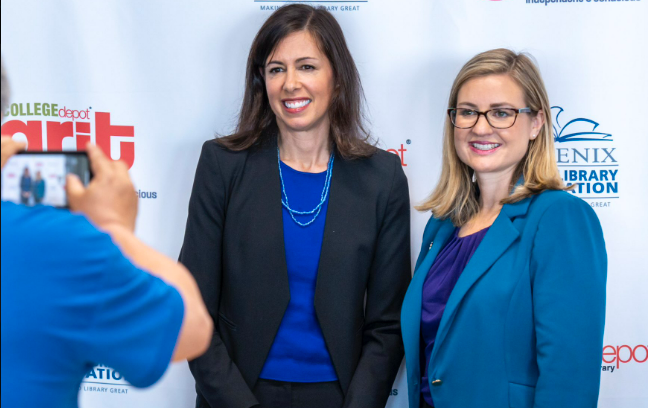
FCC Commissioner Jessica Rosenworcel presented the ACP grant in Phoenix on Wednesday.
Rosenworcel served as commissioner under both the Obama and Trump administrations. In a 2018 profile, the Washingtonian noted that Rosenworcel had continued her equity-oriented efforts through the Trump administration.
With the apparent lobbying efforts by these main internet providers to make ACP funding permanent, it appears that Biden’s arrangement for free internet is a limited-time offer. Nearly 18 million households have signed up for ACP.
On Tuesday, Verizon Senior Vice President Kathy Grillo warned that ACP funding was projected to run out as early as the first quarter of next year. Grillo urged for a more permanent subsidy structure for internet access.
Most internet providers set their contracts to last for a mandatory minimum of two years. The ACP subsidies will only last as long as funding is afforded to it.
Corinne Murdock is a reporter for AZ Free News. Follow her latest on Twitter, or email tips to corinne@azfreenews.com.
The University of Arizona Global Campus (UAGC) convinced a cop to take a social justice approach in his career, based on their online programming.
UAGC featured this police officer, Michael Ander, in an article praising his commitment to social justice. As UAGC noted, Ander was unfamiliar with the concept of social justice until he began taking university classes. UAGC initially described social justice as equality and fairness for all in their article, but then described equity-oriented implementation.
Equity proposes disparate treatment in order to achieve purportedly equal outcomes, unlike equality which proposes equal treatment that may result in unequal outcomes. Ander echoed that difference when defining social justice.
“Social justice seeks to understand the why,” said Ander. “Why people don’t have the same opportunities and why some people need more humanity than others.”
— UAGC – The University of Arizona Global Campus (@UAZGlobalCampus) April 28, 2023
As Britannica notes, “social justice” is comparative to an equity-oriented concept known as “distributive justice” — “the fair and equitable distribution of social, political, and economic benefits and burdens.”
Ander initially left community college in 2011 when he was accepted in the police academy. It wasn’t until recent years that he returned to finish his degree — not out of an unprompted desire to do so, but rather because he couldn’t advance any further in his career field without one. In order to rise above sergeant to become a lieutenant, Ander was required to obtain a bachelor’s degree.
UAGC gave Ander a full-ride scholarship in partnership with his former community college, Rio Salado College.
Ander received an online degree in UAGC’s Social and Criminal Justice program. As part of the program, students review the application of select social justice principles — equality, solidarity, and human rights — as well as apply knowledge of cultural sensitivity and diversity awareness to social and criminal justice.
One of the program chairs, Shari Schwartz, has tweeted in support of social justice policies such as gun control, Black Lives Matter, ending the death penalty, and allowing gender transitions for minors.
Narcissism at its worst: her daughter was suicidal for three years and it was inconvenient for her. Listen to her talk about herself and derogate her own daughter. https://t.co/K8uaCAaCH4
Worth watching. @RepTonyGonzales position on women’s reproductive rights irritates me but he supports gun control. Got censured by @GOP for it. @DanaBashCNN asked pointed questions and unlike many politicians, he answered directly. https://t.co/GK8jRDEpQ0
UAGC focuses heavily on expanding social justice perspectives. The university frequently hosts diversity, equity, and inclusion (DEI) events.
Forbes interviewed the UAGC chair of Forbes School of Business & Technology, Misty Resendez, about how social justice ideologies such as DEI are necessary components of education and leadership.
“My goal, my aspiration is to help educate leaders so they don’t fall to that dark side of leadership and to be aware, right, to help develop that self-awareness, that purpose-driven value leadership,” said Resendez.
Corinne Murdock is a reporter for AZ Free News. Follow her latest on Twitter, or email tips to corinne@azfreenews.com.