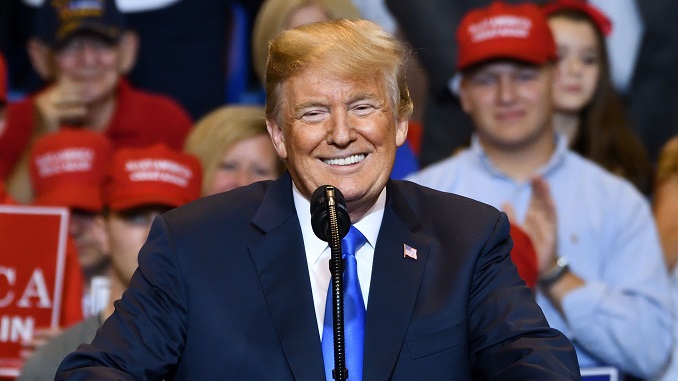
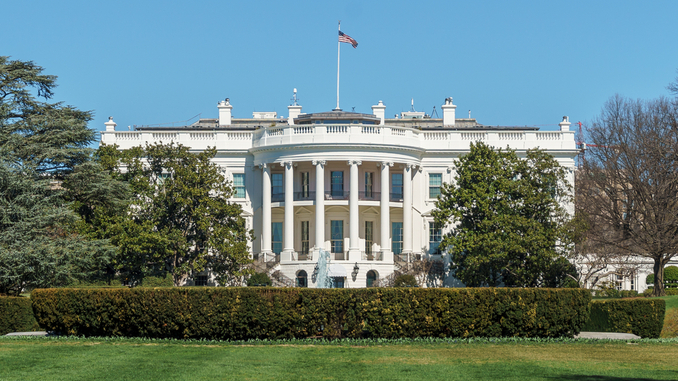
Members of the Arizona GOP Caucus, Reps. Abe Hamadeh (R-AZ08) and Eli Crane (R-AZ02), marked the 100th day of President Donald Trump’s second administration with statements and social media posts praising the accomplishments of the 47th President and the Republican-led Congress.
President Trump has worked tirelessly over the last 100 days to Make America Great Again, and the best is yet to come! 🇺🇸 pic.twitter.com/XG9hAxvcar
Congressman Crane offered a series of posts to X pointing to the President’s achievements in border security, the economy, energy, forest health, and draining the swamp.
Thank you, President Trump, for ending the premeditated border invasion.
In full he wrote, “Thank you, President Trump, for ending the premeditated border invasion. We didn’t need new legislation. We just needed a new President.”
The Democrats left President Trump a broken economy with record inflation and skyrocketing costs.
Thankfully, we now have a President who prioritizes Americans, not globalists. pic.twitter.com/tPeBNG1ZKE
“The Democrats left President Trump a broken economy with record inflation and skyrocketing costs. Thankfully, we now have a President who prioritizes Americans, not globalists.”
Under President Trump's leadership, American Energy Dominance will prevail.
“Under President Trump’s leadership, American Energy Dominance will prevail. The days of sidelining our vast resources are over.”
Thank you, President Trump, for revamping our approach to forest health.#AZ02 welcomes these proactive wins that provide long-term stability. pic.twitter.com/Hzrt8JPZ5G
“Despite formidable opposition, President Trump continues to take on the administrative state and entrenched establishment. We appreciate the President’s commitment to tackling waste, fraud, and abuse.”
Congressman Hamadeh offered his own congratulatory post with a note: “Promises Made. Promises Kept. Congratulations to @POTUS on an incredibly successful First 100 Days!”
Hamadeh cited as accomplishments: 70+ Terrorists killed, $5 Trillion in secured domestic investment, $57 Billion in canceled foreign aid, $935 Billion in saved tax dollars, along with 139,000 illegal immigrants deported to date.
The White House posted on X, “Under President Trump’s leadership, we have the most secure border in the history of this nation. President Trump was able to do in 100 days what the Biden administration couldn’t — or wouldn’t — do in four years.” In a subsequent post the White House added, “100 days of President Trump—and we’re nowhere near tired of winning. To the haters: we’re just getting started. AMERICA FIRST FOREVER!”
Just 100 days in, President Trump’s economic policy is driving down inflation, gas, and grocery costs, while jobs boom, investments pour in, and America First proves it’s not just a slogan — it’s a winning formula.
In a statement, President Trump said, “Every single day I will be fighting for you with every breath in my body. I will not rest until we have delivered the strong, safe and prosperous America that our children deserve and that you deserve. This will truly be the golden age of America.”
Australia-based energy firm Woodside announced Monday plans to invest $17 billion in a new liquefied natural gas export facility to be sited in south Louisiana. Company CEO and Managing Director Meg O’Neill said the Louisiana LNG facility represents the single largest greenfield energy project investment, and the largest foreign direct investment in the state’s history.
In a release, the company said the project will support 15,000 jobs during the construction phase and, when completed, will sport a total export capacity of more than 27 million tons per annum of LNG. Originally named the Driftwood LNG project by previous owner Tellurian, Woodside acquired the project in 2024 for just $900 million.
The timing of Woodside’s announcement on Monday, which represented the 99th day of President Donald Trump’s second administration, serves to symbolize the impressive success the President and his senior appointees have had in completely changing the energy and climate policy debate in the U.S. across their first 100 days. Nowhere has this sea change in policy been more obvious than as it relates to the LNG export industry.
When Trump was sworn into office on January 20, America’s LNG sector had spent the previous 358 days as a target of demonization by former President Joe Biden and his senior officials. That stemmed from the decision by the White House to implement a so-called “pause” in permitting of new LNG facilities like Louisiana LNG on January 27 last year. Prior to last November’s election, that pause appeared destined to become a permanent feature of federal policy had Kamala Harris won the presidency.
President Trump canceled the Biden pause with a Day 1 executive order, and the industry has since resumed the pace of rapid expansion that had made it one of America’s great growth industries prior to Biden’s irrational move last year.
The resumption of the LNG industry’s rapid growth path is just one of many success stories which Trump’s energy team of Interior Secretary Doug Burgum, Energy Secretary Chris Wright, and EPA Administrator Lee Zeldin can point to at the end of this first 100 days time period.
At Interior, Secretary Burgum can point to his efforts to return the federal oil and gas leasing program to normal order both onshore and offshore after four years of its being held hostage by Biden’s Interior Secretary Deb Haaland. He can also highlight last week’s announcement detailing efforts to speed up permitting approvals related requirements under the Endangered Species Act, the National Environmental Policy Act, and the National Historic Preservation Act.
Zeldin is able to point to his effort to freeze $20 billion in highly questionable grants awarded by his predecessor, Michael Regan, during the final days of the Biden presidency, and claw them back a major savings. He has also embarked on a study focused on the potential reversal of the Obama EPA’s endangerment finding on greenhouse gases, a finding that classifies carbon dioxide, the fundamental building block for all life on Planet Earth, as a pollutant which can be regulated under the Clean Air Act. A successful reversal of that finding could lead to the restoration of honesty in air quality regulation and a focus on elimination of real pollution, which was the intent of the law as it was passed by congress.
Secretary Wright has less ability to directly impact regulatory polices to the nature of his job, but he has become the most effective spokesman for commonsense energy policies to ever hold the Energy Secretary position. He has not shied away from taking on controversial topics, like the need to revitalize the nation’s coal industry to take advantage of America’s enormous wealth of that resource. Wright has also been very blunt and effective in highlighting the role the wind industry has played in forcing consumer utility costs up to all-time highs under the Biden administration.
Taken as a whole, it is hard to imagine a more impactful 100 days related to energy and climate policy than this administration has achieved. Trump’s legion of critics won’t agree with the direction he and his appointees have taken, but they can’t honestly claim they aren’t producing major results. For Trump and his team, it is a simple case of promises made, promises kept.
David Blackmon is a contributor to The Daily Caller News Foundation, an energy writer, and consultant based in Texas. He spent 40 years in the oil and gas business, where he specialized in public policy and communications.
For the past decade, our organization has been fighting the Green New Deal agenda in Arizona, working to score a decisive victory for reliable and affordable energy. Thanks to President Trump, that decisive victory now appears within reach.
Earlier this month, President Trump released three new executive orders and one proclamation, all aimed at unleashing American energy abundance. These executive actions are all part of a coordinated White House effort to initiate a tidal shift in the ever-steady march toward the Net Zero nightmare being pursued by radical environmentalists, the green industrial complex, and public utilities across the nation.
For years, energy regulators have forewarned of the impending grid crisis due to the overreliance on costly renewable energy, yet the previous administration only accelerated the catastrophe. The new Trump Executive Orders, coupled with his declaration of a National Energy Emergency, will directly address this crisis by ending the regulatory discrimination against coal, empowering the domestic mining of coal resources, encouraging the development of coal energy generation, and allowing for these activities to take place on federal lands.
Reigniting the American coal industry couldn’t happen soon enough. While China and India are building new coal plants at unprecedented rates to power their economic growth, we have been aggressively shutting our plants down…
News broke last week that the Biden Department of Energy (DOE), led by former Secretary Jennifer Granholm, was so dedicated to the Biden White House’s efforts to damage the dynamic U.S. LNG export industry that it resorted to covering up a 2023 DOE study which found that growth in exports provide net benefits to the environment and economy.
“The Energy Department has learned that former Secretary Granholm and the Biden White House intentionally buried a lot of data and released a skewed study to discredit the benefits of American LNG,” one DOE source told Nick Pope of the Daily Caller News Foundation.. “[T]he administration intentionally deceived the American public to advance an agenda that harmed American energy security, the environment and American lives.”
And “deceived” is the best word to describe what happened here. When the White House issued an order signed by the administration’s very busy autopen to invoke what was supposed to be a temporary “pause” in permitting of LNG infrastructure, it was done at the behest of far-left climate czar John Podesta, with Granholm’s full buy-in. As I’ve cataloged here in past stories, this cynical “pause” was based on the flimsiest possible rationale, and the “science” supposedly underlying it was easily debunked and fell completely apart over time.
But the ploy moved ahead anyway, with Granholm and her DOE staff ordered to conduct their own study related to the advisability of allowing further growth of the domestic LNG industry. We know now that study already existed but hadn’t reached the hoped-for conclusions.
The two unfounded fears at hand were concerns that rising exports of U.S. LNG would a) cause domestic prices to rise for consumers, and b) would result in higher emissions than alternative energy sources. As the Wall Street Journal notes, a draft of that 2023 study “shows that increased U.S. LNG exports would have negligible effects on domestic prices while modestly reducing global greenhouse gas emissions. The latter is largely because U.S. LNG exports would displace coal in power production and gas exports from other countries such as Russia.”
An energy secretary and climate advisor interested in seeking truth based on science would have made that 2023 study public, and the “pause” would have been a short-lived, temporary thing. Instead, the Biden officials decided to try to bury this inconvenient truth, causing the “pause” to endure right through the final day of the Biden regime with a clear intention of turning it into permanent policy had Kamala Harris and her “summer of joy” campaign managed to prevail on Nov. 5.
Fortunately for the country, voters chose more wisely, and President Trump included ending this deceitful “pause” exercise as part of his Day One agenda. No autopen was involved.
So, the thing is resolved in favor of truth and common sense now, but it is important to understand exactly what was at stake here, exactly how important an industry these Biden officials were trying to freeze in place.
In an interview on Fox News Monday, current Energy Secretary Chris Wright did just that, pointing out that, fifteen years ago, America was “the largest importer of natural gas in the world. Today, we’re the largest exporter.”
He went onto add that, “the Biden administration put a pause on LNG exports 14 months ago, January of 2024, sending a message to the world that maybe the US isn’t going to continue to grow our exports. Think of the extra leverage that gives Russia, the extra fear that gives the Europeans or the Asians that are dying for more American energy.”
Then, Wright supplied the kicker: “They did this in spite of their own study that showed increasing LNG exports would reduce greenhouse gas emissions and have a negligible impact on price.” It was an effort, Wright concludes, to kill what he says is “America’s greatest energy advantage.”
This incident is a stain on the Biden administration and its senior leaders. The stain becomes more indelible when we remember that, when asked by Speaker Mike Johnson why he had signed that order, Joe Biden himself had no memory of doing so, telling Johnson, “I didn’t do that.”
Sadly, we know now there’s a good chance Mr. Biden was telling the speaker the truth. But someone did it, and it’s a travesty.
David Blackmon is a contributor to The Daily Caller News Foundation, an energy writer, and consultant based in Texas. He spent 40 years in the oil and gas business, where he specialized in public policy and communications.
Arizona Governor Katie Hobbs has vetoed SB1119, a piece of bipartisan legislation aimed at prioritizing affordable and reliable utility services for Arizonans. The bill, sponsored by Senator Tim Dunn (R-LD25), sought to direct the Residential Utility Consumer Office (RUCO) to focus exclusively on minimizing utility rates rather than considering environmental policies that could contribute to higher costs.
In a press release following the veto, Senator Dunn criticized the decision, arguing that it would negatively impact consumers already struggling with rising costs. “SB 1119 would have required the Residential Utility Consumer Office to focus its efforts on fighting for the safest and most reliable utility service achievable at the lowest retail rate possible, instead of prioritizing any costly radical environmentalist agendas,” Dunn stated. He went on to say that the veto was “short-sighted” and would ultimately burden Arizona residents.
Utility costs have been a growing concern for Arizona residents, particularly in the wake of inflation and increased energy demand. The state’s energy policies have often been a point of contention, with debates centering around balancing affordability with sustainability. RUCO, an independent agency that represents residential utility customers, currently considers multiple factors when making policy recommendations.
Supporters of SB 1119 argued that the bill would have strengthened consumer protections by ensuring that RUCO prioritized affordability above all else. The veto is expected to spark further discussions among lawmakers and stakeholders on how to bring more affordable utility rates to Arizonans. As the state continues to grapple with rising utility costs, future legislative efforts may seek to address the concerns raised by both proponents and critics of SB 1119.
Jonathan Eberle is a reporter for AZ Free News. You can send him news tips using this link.