Something is missing from the Democratic Party’s 2026 message, and its absence speaks louder than any speech. Climate change, the issue party leaders once called an existential emergency, has gone quiet. Journalists even have a name for it: climate hushing.
An analysis of congressional press releases by Inside Climate News found that Democratic mentions of climate change have plummeted since 2025, while talk of energy affordability has surged. Democratic New York Gov. Kathy Hochul, once a green energy champion, now sells herself as a fighter against high utility bills, and her pivot is being called a blueprint for the party.
Behind closed doors, the shift is even starker. At a recent Senate Democratic strategy retreat, the polling presentation did not ask a single question about climate change. One attendee, Democratic Rhode Island Sen. Whitehouse, called it a massive blind spot.
Give the strategists credit. They read the same election returns everyone else did. The party’s own review of the 2024 loss reportedly found that green transition messaging frightened workers in traditional industries who feared for their jobs. Voters punished Democrats for the high cost of living, and nothing raised that cost more visibly than energy.
But notice what the party retreated toward. They did not change the subject to something safe and unrelated. They ran straight at affordability, the exact ground where their climate record is weakest. You do not flee toward your own weakness. You flee toward it only when you have no choice, because the voters are already holding their ever-increasing electric bills.
And those bills tell the story. The average American residential electricity rate has climbed about 25% in four years, from just over 15 cents per kilowatt hour in 2022 to nearly 19 cents this spring. In the last year alone, rates jumped more than 7%.
Federal forecasters expect another increase in 2026, with the sharpest pain along the East Coast, where climate mandates are most aggressive. These are not acts of nature. They are the predictable result of policies that shut down reliable power plants and force expensive, weather-dependent replacements onto the grid. Like adding an undependable car to your family’s budget. It just increases your costs if you want reliability.
The price tag reaches well beyond the monthly bill. When Congress passed the ill-named Inflation Reduction Act, budget scorekeepers pegged its energy subsidies at around 370 billion dollars over ten years. The real number keeps climbing.
The Congressional Budget Office now estimates the clean energy tax credits alone will add 825 billion dollars to the deficit, and the Cato Institute puts the full range as high as nearly 2 trillion dollars over the same window. That is a wealth transfer from ordinary ratepayers and taxpayers to well-connected developers, and it buys higher prices, not lower ones.
Here is the admission hiding inside the silence. If the green transition were actually making energy cheaper, climate and affordability would be the same message, and there would be nothing to hush. The party could brag about both in the same breath. The fact that its own strategists had to choose between them, and chose to bury climate, is a confession that the two pull in opposite directions.
Some Democrats insist this is a recast, not a retreat. They argue that cheap solar and wind are the affordability answer, and that voters can be won by promising climate policy will lower bills.
But that claim collapses on contact with its own logic. If renewables were truly the cheapest power, they would not need mandates, subsidies, and regulatory waivers to force utilities to buy them. You do not have to compel people to choose the cheaper option. The mandates exist precisely because the market, left alone, would choose otherwise.
The honest lesson is one conservatives have argued for years. Reliable, affordable energy and heavy-handed climate central planning cannot coexist. Americans want to keep the lights on and the bills low, and they have figured out which policies deliver that and which do not.
Democratic strategists have figured it out too. That is why they have stopped talking. The quiet is not a change of heart. It is a change of subject, and it amounts to an admission that the policies were too expensive and too restrictive to defend out loud. The rest of us should say plainly that we do not want less reliable and more expensive electricity.
As we celebrate America’s 250th birthday, one of the finest blessings our Founders gave our nation stands out with particular clarity: the system of free enterprise. That system did not merely enable liberty and prosperity in the abstract.
It unleashed the human ingenuity, risk-taking, and capital allocation that turned America into the world’s unrivaled energy superpower.
From the coal age that fueled the Industrial Revolution, through the oil age that powered the 20th century, to the LNG age we now dominate, American free enterprise has repeatedly delivered technological leadership and abundance. No central planner designed these revolutions.
Entrepreneurs, engineers, and investors did, operating in a system that rewards results above political connections.
Today that legacy is unmistakable. The United States leads the world by a wide margin in the production of both oil and natural gas. We have also become the world’s largest exporter of liquefied natural gas, shipping reliable energy to allies across Europe and Asia who once relied on less friendly suppliers.
While some critics like to call this an accident of geology, they’re wrong. America’s LNG dominance is the direct result of the shale revolution, advanced drilling techniques, and a policy environment that, when properly structured, lets markets work.
America once held a similar commanding position in nuclear power. We built the world’s first commercial reactor and led in reactor technology for decades. Then came the 1979 Three Mile Island incident. Irrational fears, amplified by media and activists, led to a bureaucratic paralysis in the Nuclear Regulatory Commission which stalled new construction for two generations. Promising projects died in paperwork as existing plants faced endless regulatory hurdles. America fell behind while other nations pressed forward.
Today, that era is ending. The Trump administration is delivering a major push to revitalize America’s nuclear power industry. Energy Secretary Chris Wright and Interior Secretary Doug Burgum have announced major project milestones in recent weeks, including new loan programs to support large-scale reactors and breakthroughs on advanced designs such as microreactors that have already achieved criticality.
These steps signal a return to regulatory sanity and a recognition that abundant, reliable, carbon-free baseload power is essential for both economic growth and national security.
Wind and solar have also established a robust presence on every major U.S. regional grid. These intermittent sources now deliver meaningful power to homes and businesses when the weather cooperates. American companies and workers have built real expertise and infrastructure in these sectors. Yet the United States remains far behind China in manufacturing scale and deployment speed, and subservient to the Chinese Communist Party for the raw materials that make them work.
As Secretary Wright posted on X this week, the massive Biden-era subsidies that distorted markets and enriched foreign supply chains begin phasing out this month. That transition will test the true competitiveness of these technologies without artificial support. Their future contribution will depend on genuine cost reductions and technological improvement, not ever-rising subsidies from taxpayers and ratepayers.
America’s dominant position across fossil fuels, its returning strength in nuclear power, and its established role in renewables together form an unmatched energy portfolio. This abundance has been no small factor in making the United States the world’s dominant geopolitical power. Reliable, affordable energy underpins manufacturing resurgence, data-center growth, and an enduring military edge that deters adversaries. It keeps our economy the envy of the world, with lower energy costs than most competitors and the flexibility to adapt to new demands.
Most importantly, energy dominance sustains the God-endowed freedoms our Founders secured. Cheap, reliable power frees families from energy poverty. It powers the innovations that improve daily life. It supports the industries that create the jobs and wealth that let individuals and communities flourish according to their own lights rather than government dictates.
On this 250th anniversary, we should give thanks not only for the Declaration of Independence and the visionaries who created it, but for the practical system of ordered liberty that turned a resource-rich continent into the engine of global progress.
Free enterprise did not merely discover America’s energy wealth. It developed it, refined it, and continues to expand it. That is a blessing worth celebrating not just this weekend, but every day.
David Blackmon is a contributor to The Daily Caller News Foundation, an energy writer, and consultant based in Texas. He spent 40 years in the oil and gas business, where he specialized in public policy and communications.
I have to admit that I laughed out loud – almost spewing coffee on my keyboard – Friday morning when I read this headline from a competing platform’s energy-related newsletter: “SOLAR DOESN’T USE MUCH FARMLAND: Solar occupies less than 1% of farmland in the U.S., according to the Solar Energy Industries Association.”
To paraphrase from former President Bill Clinton’s grand jury testimony, that depends on what the meaning of “much” is. Curious about the subject, I decided to research the question, accessing a wealth of public information easily available to anyone, including those in the solar industry. The answer I found might surprise the folks at the Solar Energy Industries Association. Or maybe it wouldn’t, which might explain why they choose to couch the answer in such a misleading way.
The salient question: How many acres make up 1% of U.S. farmlands?
According to the USDA’s most recent data, the 2025 total land in farms is 873.95 million acres (down slightly from prior years). Earlier years were a bit higher (e.g., ~900 million in 2017), but the total has been gradually declining. One percent of 873.95 million acres = 8.74 million acres.
Farmland here generally refers to “land in farms” per USDA definitions (including cropland, pasture, woodland, etc., on farms). Figures can vary slightly by source or definition (e.g., cropland-only vs. all agricultural land), but the ~874 million acre range is the standard benchmark from official USDA reports.
Now, for some context. The King Ranch in South Texas is arguably the largest and most celebrated big farming and ranching operation in U.S. history. Established in 1854 by pioneering rancher Richard King, the ranch at its peak consisted of 1.2 million acres.
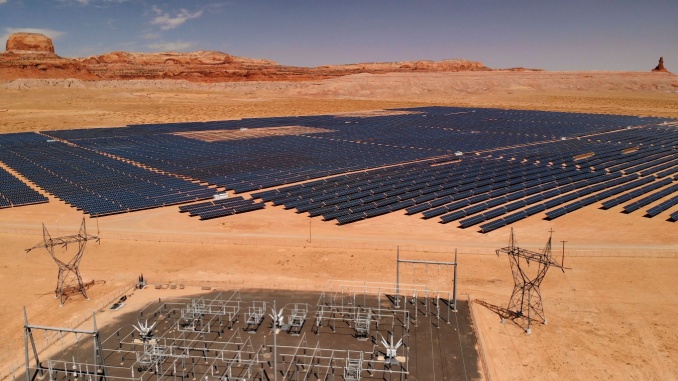
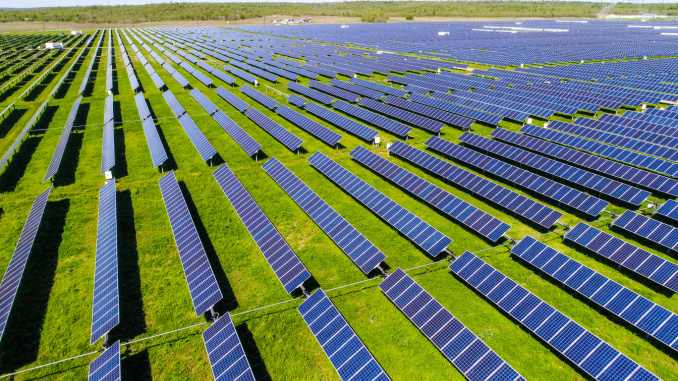
Thus, the solar power industry itself admits that its wind arrays currently occupy an area of fertile farmlands that is roughly 8 times the size of the biggest farming and ranching operation in United States history. That is a stunning number, yet the authors of that referenced newsletter characterize it as being “not much.”
Being a guy who grew up in a farming and ranching family, that sure seems like “much” to me. It also most likely seems like “much” to experts whose own studies find that placing solar arrays atop farmlands robs the land of crucial nutrients and renders it more vulnerable to erosion. Disturbingly, unless radical changes are quickly made, the industry plans to cover up many more King Ranch-sized swaths of fertile land in the coming years.
A 2024 report by the Institute for Energy Research finds that, despite these warnings by experts in the field, the vast majority of new solar projects are targeting farmland to house their industrial projects in the coming years. “The target for solar operations is increasingly in the Midwest, where government handouts to solar allow them to pay more to rent land than the farmers providing food for the nation,” the report says, adding, “Farmland preservation groups believe 83 percent of new solar installations will come from farm and ranch lands with half of these installations on the richest land for food and crops.”
Fortunately, the big federal subsidies which drove the recent huge solar expansion are scheduled to begin expiring in July. But with hundreds of new solar projects already in the queue, millions more acres of fertile farmlands will be removed from the food system in the years to come even as a fertilizer shortage threatens to disrupt global food supplies. All to create unreliable, unpredictable, intermittent electricity for a few hours a day that could be provided by an array of more reliable power sources which occupy a fraction of the land, none of which intentionally target farmlands as their homes.
It’s a completely irrational misallocation of hundreds of billions of dollars in capital brought to us directly by the Biden autopen presidency and its Orwellian Inflation Reduction Act. You could never make this stuff up if it weren’t already happening before your very eyes. Watch it and weep.
David Blackmon is a contributor to The Daily Caller News Foundation, an energy writer, and consultant based in Texas. He spent 40 years in the oil and gas business, where he specialized in public policy and communications.
Now, Arizona’s largest monopoly utility, APS, is asking the Arizona Corporation Commission for yet another rate hike. Their double-digit 14% request is bad enough on its own. But buried within APS’ ask is something even worse: automatic rate hikes for the next five years (something the Corporation Commission voted in favor of just a year and a half ago).
It isn’t just APS. At the same time, the Commission is also considering a double-digit (also 14%) rate hike for TEP, along with automatic rate increases. Arizona ratepayers are now seeing the consequences of years of bad energy policy, costly clean energy commitments, and a Commission that has not stopped any of it.
Before APS’ rate request becomes a real rate hike on your bill, the Commission still has to vote on it. Right now, the case is before an administrative law judge, with hearings expected to continue through June and July. After the hearing concludes, the judge will issue a recommended order, and then the Corporation Commission will make the final decision.
So, the question now is simple: will the Commission finally say no, or will it force ratepayers to pay for the Green New Scam?
This Rate Hike Is Not Because of AI or Data Centers
APS, Kris Mayes, and the Corporation Commission would like ratepayers to believe this rate hike is about AI, data centers, and explosive load growth. It isn’t…
An Arizona coal-fired power plant will receive federal funding for modernization efforts under a U.S. Department of Energy (DOE) initiative aimed at strengthening grid reliability and preserving dispatchable power generation.
According to the DOE, project selections announced under its Defense Production Act (DPA) Title III Coal Fleet Projects program, Arizona Electric Power Cooperative’s (AEPCO) Apache Generating Station will receive approximately $21 million in DOE funding along with $32 million in non-DOE funding. The project is one of several selected nationwide as part of the Trump administration’s effort to support coal-fired generation infrastructure.
The Apache project, known as RECOAL — Revitalizing Energy Capacity with Optimized Assets and Long-Life Infrastructure — is intended to modernize the facility’s coal generation assets, improve operational efficiency, and extend the useful life of existing infrastructure.
Arizona Corporation Commissioner Nick Myers highlighted the project in a statement following the federal announcement.
“In the recent announcement from the administration, Arizona is benefiting from the money designated to keep coal plants open,” Myers wrote. “The Apache Generating Station is getting about $21M in DOE funding and $32M in non-DOE funding. This will help modernize the plant to increase efficiency and retain that dispatchable energy for years to come.”
In the recent announcement from the administration, Arizona is benefiting from the money designated to keep coal plants open. The Apache Generating Station is getting about $21M in DOE funding and $32M in non-DOE funding. This will help modernize the plant to increase…
— Nick Myers – Arizona Corporation Commissioner (@votenickmyers) June 5, 2026
The funding was announced as part of a broader DOE initiative described in a department fact sheet titled “The Energy Department is Unleashing Beautiful Clean Coal.” According to the agency, the initiative supports projects to build, recommission, upgrade, and modernize coal-related energy infrastructure in order to strengthen electric grid reliability and maintain generation resources capable of providing power on demand.
The DOE stated that it has now “saved or supported” 45 coal plants and more than 40 gigawatts of coal-powered generation through actions taken since President Donald Trump declared a National Energy Emergency. The department said its latest actions include support for 17 additional coal plants and one coal export facility.
According to the DOE fact sheet, the coal fleet projects are intended to strengthen domestic energy production, improve power system resilience, and ensure sufficient dispatchable generation capacity as electricity demand increases. The agency cited growing power needs for artificial intelligence, data centers, manufacturing, and national security as factors driving the initiative.
“American coal miners remain essential to American energy dominance,” U.S. Secretary of Energy Chris Wright said.”Unfortunately, previous leaders launched relentless attacks on U.S. coal workers and industry, threatening grid reliability and driving energy prices higher for the American people. Thanks to President Trump, we are not only stopping the premature closure of our coal plants, but also taking steps to expand and modernize existing coal infrastructure. These actions will help ensure affordable, reliable, and secure energy access for decades to come.”
The Apache Generating Station is located in Cochise County and supplies power to rural electric cooperatives and other customers in Arizona and the surrounding region. Under the DOE-supported project, modernization efforts are expected to improve efficiency and support continued operation of the facility’s existing generation assets.
The Trump administration also intervened in Arizona’s coal-powered energy sector in 2025, using emergency authorities to support continued operations at the Cholla Power Plant in Navajo County.