by Matthew Holloway | Jul 12, 2024 | News
By Matthew Holloway |
With voter confidence at an all-time low, state and county elections officials have their work cut out for them to run the 2024 polls effectively and restore the faith. However in Pinal County, with just weeks left before the Arizona primary, a small mistake could have large repercussions and does not build voter confidence.
As reported by SanTanValley.com, early ballots sent out July 3 for the 2024 primary election taking place July 30 were mailed, missing a “critical update regarding the return instructions.” The outlet reported that the county, in an effort to alleviate confusion between neighboring Maricopa County’s ballots and its own, switched from using green ballot return envelopes to “buff-colored” envelopes… without altering the instructions to the voter. So the written instructions that accompanied the ballot instruct the voter to use an envelope they weren’t sent.
In a statement reported by The Apache Junction/Gold Canyon Independent, the county said, “Unfortunately, the directions did not update the change from green to buff. Postcards with updated instructions will be mailed to all voters who received an early ballot. A notice will also be placed on the Pinal County Recorder’s website. The Republican and Democrat Party Chairs have been notified as has the Secretary of State’s office.”
The Pinal County Elections Department and the Pinal County Recorder’s Office provided the corrected instructions via a shared X account, which should have read:
- Step 3: Place the WHITE affidavit envelope into the BUFF return envelope addressed to the Recorder and seal.
The Arizona Republican Party posted an update regarding the error to X writing, “PINAL COUNTY VOTERS See Message from Recorder’s Office Error on Early Voting Ballot Printed Envelopes. The instructions call for a ‘GREEN’ return envelope but the color of the return envelope is ‘BUFF’ color. Follow these guidelines so that your ballot is processed timely: 1. Place your ballot into the WHITE affidavit envelope. 2. Sign and seal the WHITE affidavit envelope. 3. Place the WHITE affidavit envelope into the BUFF return envelope addressed to the Recorder and seal.”
Comments on the post revealed expressions of concern, dismay, and even dubiousness with one X user noting, “These mistakes don’t help anyone.” Another X user added, “Oh gee, who’d have guessed Pinal County messed up again?”
Paz Phillips an “AZ, Precinct & State Committeeman,” according to her bio asked, “Didn’t Pinal County just go through election problems and had to replace people?”
As noted by the commenters on X, and the AJ/GC independent, in the widely criticized 2022 primary election cycle, Pinal County suffered multiple printing errors on its early ballots and critical shortages of ballots at voting precincts on election day which contributed to massive erosion in voter confidence. As a result, the county elections department underwent a very public and costly revamp. However, this 2024 error is clearly not building voter confidence.
Matthew Holloway is a senior reporter for AZ Free News. Follow him on X for his latest stories, or email tips to Matthew@azfreenews.com.
by Corinne Murdock | Mar 6, 2024 | News
By Corinne Murdock |
On Monday, GOP leaders for both legislative chambers’ elections committees announced additional election transparency measures in an agreement with the Phoenix-based ballot production and distribution company, Runbeck Election Services (RES).
State Rep. Alexander Kolodin (R-LD03), vice chair of the House Elections Committee, and State Sen. Wendy Rogers (R-LD07), chair of the Senate Elections Committee, shared in a press release that RES entered into a memorandum of understanding (MOU) guaranteeing an observation program, software audits, an election workflow report from RES, and access to 2022 election data.
Kolodin further revealed in the press release that RES also agreed to cage the ballot sorters, contingent on legislative appropriation. The MOU dates back to last Wednesday.
“This agreement represents a significant advancement in our ongoing efforts to ensure the security and integrity of Arizona’s elections,” said Kolodin. “I appreciate the cooperation of Runbeck’s new ownership and their willingness to provide greater transparency — the foundation of public trust and confidence.”
By “new ownership,” Kolodin was likely referring to the company whose president and CEO is Mihai Toma, brother to House Speaker and congressional candidate Ben Toma (R-LD08). Last August, RES sold a majority stake in the company to Lincoln Shields, a subsidiary of Black Mountain Investment Company (BMIC), whose president and CEO is Mihai Toma.
RES said in a statement that the speaker has no stake in RES and was unaware of the purchase until shortly prior to its occurrence. The speaker pledged to divest his financial interest in BMIC, reported to be over $100,000, around the time of the sale.
The RES CEO is Jeff Ellington, appointed to the position in 2021 after serving for about a decade in various executive capacities. Under Ellington, RES reported significant growth in its ballot mailing operations: from 3.5 million in 2016 to 16 million in 2020. According to the company, at least 45 percent of registered voters in the nation “touch[ed]” one of their products in 2020.
Under the MOU, RES agreed to allow up to three observers each from the state’s Republican and Democratic parties onsite during the primary and general election days to watch in-bound mail packet sorting activity via the loading dock and the camera feeds viewing the loading dock, sorting areas, and ballot storage room entrances; a House-led audit of signature verification and ballot duplication software licensed to Maricopa County, which will be completed this year and made public; a RES report published prior to the upcoming August primary outlining its scope of work and election workflow with Maricopa County and other state election agencies, complete with chain of custody documents, as well as RES documents completed and returned to Maricopa County; and onsite access to up to two legislative observers to view RES’ general election night loading dock video footage from 2022.
Corinne Murdock is a reporter for AZ Free News. Follow her latest on Twitter, or email tips to corinne@azfreenews.com.
by John R. Ammon | Feb 27, 2024 | Opinion
By John R. Ammon |
The United States and Arizona election systems are broken. The last several election cycles have demonstrated the defects in the electoral system and defined the Democrat project to increase large numbers of favorable and questionable ballots and not actual, legitimate votes by citizens of our state and our nation.
Increasing numbers of illegal aliens vote across the country, especially after the last three years of intentional destruction of our borders by the current Administration. Without restating all the proofs and data indicating what has gone wrong with election integrity across America, what can the Arizona voting citizen do to not lose his or her ballot being honestly counted and expressing each legitimate citizen’s choice of how we are to be governed? Project this critical question to millions of votes cast in primary and general elections and the question of election integrity becomes very clear.
Until the state of Arizona once again becomes red in future election cycles, i.e., governed by those who strive to conserve (as in ‘conservatism’) the Founders’ foundational vision of representative government with honest elections, we must use the existing election system to win elections and thwart the dangerous leftist intention of Obama’s “fundamental transformation of America” with a permanent ruling elite and evolution of a Marxist-like governing class.
How do we do this?
For brevity, the following recommendations hopefully will block or reduce the dangerous election manipulations that have occurred in the past three Arizona (and U.S.) election cycles.
- 80% of Arizona ballots are cast by Mail-In-Voting. In Maricopa County, that figure is 90%. The Democrat focus is on the number of ballots cast and how they are counted rather than legitimate votes cast. They have rallied their voters to cast their votes by mailing in ballots early after receipt. By election day, Democrats can be 700,000 votes ahead in Arizona elections. ‘Proud’ Republicans who insist on voting on ‘Election Day’ in person are far behind already in state and national races. Witnessing the terrible performance of polling stations and incompetent voting mechanics in Maricopa County and elsewhere in Arizona in 2022, confidence for in-person voting on Election Day in Arizona should be zero, nada. Until the traditional voting methods are reestablished someday when political and Legislative power is capable of doing so, you should vote by mail in Arizona. If not already a mail-in voter, see the instructions below to get on the Active Mail-In Voting List (AEVL) and do so ASAP.
- Voting by mail in Arizona means filling our your ballot early within days of receiving it at your address, ascertaining that the envelope is properly signed and then delivering it to your post office. Do not wait – fill it out, sign it and mail it at your post office. Proof of the ballot being received, your signature being verified, and your vote actually counted is your responsibility as a citizen of Arizona and America. Remember – you can be and You Are Your Own Poll Watcher.
- DON’T BE A STUPID VOTER – what does this mean? DO NOT BRING YOUR GREEN MAIL-IN BALLOT ENVELOPE TO A POLLING STATION ON ELECTION DAY TO DROP OFF IN A BOX FOR FUTURE (YES, FUTURE) COUNTING. Hundreds of thousands of Arizona voters do this and it feeds corruption of the ballot counting throughout Arizona, especially in Maricopa County. Since the 2018 Arizona election, we have seen election reversals of Republican winners in the days and weeks after the announced results on the night of the actual election date. If you ‘drop off your mail-in ballot’ on election day at the polling station your vote will not be included in the evening results of the general election on November 5th or on the March 19th primary. THAT IS STUPID. When or if it is honestly counted for the final election results cannot be relied on. Ballot manipulation is the Democrat game. Don’t play it. Even better, don’t vote on election day in Arizona – vote by mail early and follow your ballot until you know that it is received, your signature verified and your vote counted. To follow your mail-in ballot and ascertain that your vote is counted after submitting it, see below.
How to be on the Active Early Voting List (AEVL) in Arizona if you are not on it already:
For a registered voter to move on to the AEVL, use this site to change your registration to the Active Early Voting List online or to obtain the form to submit a written AEVL request. Sign the document that you filled out, then mail, fax, or email a scanned copy or photo of your handwritten request to your County Recorder’s Office.
How to follow your Mail-In Ballot in Arizona to ascertain receipt by your County Recorder election center, your signature verification, and the counting of your vote:
After you have mailed in your Early Ballot (very soon after you receive it), follow your ballot at the following link: https://my.arizona.vote/AbsenteeTracker.aspx. This site gives each Arizona voter throughout the state the ability to follow his or her ballot and to ascertain that the vote you have cast has been legitimately counted. Information about your early mail-in ballot should be available within days of mailing it in.
Voters can also sign up for text messages and email alerts as part of the ballot-by-mail/early ballot tracking service. To sign up, visit trackmyballot.azsos.gov.
The Arizona citizen voter is strongly encouraged to use these two links and the services provided. As a responsible citizen, don’t forget – You Are Your Own Poll Watcher. You want an honest election? IT STARTS WITH YOU using the existing system smartly and consistently until we can reform the system for real confidence in future elections.
A version of this opinion article originally appeared in The Prickly Pear.
John R. Ammon is the Executive Editor of The Prickly Pear.
by Daniel Stefanski | Feb 14, 2024 | News
By Daniel Stefanski |
A bipartisan effort to pass election reforms in Arizona succeeded last week.
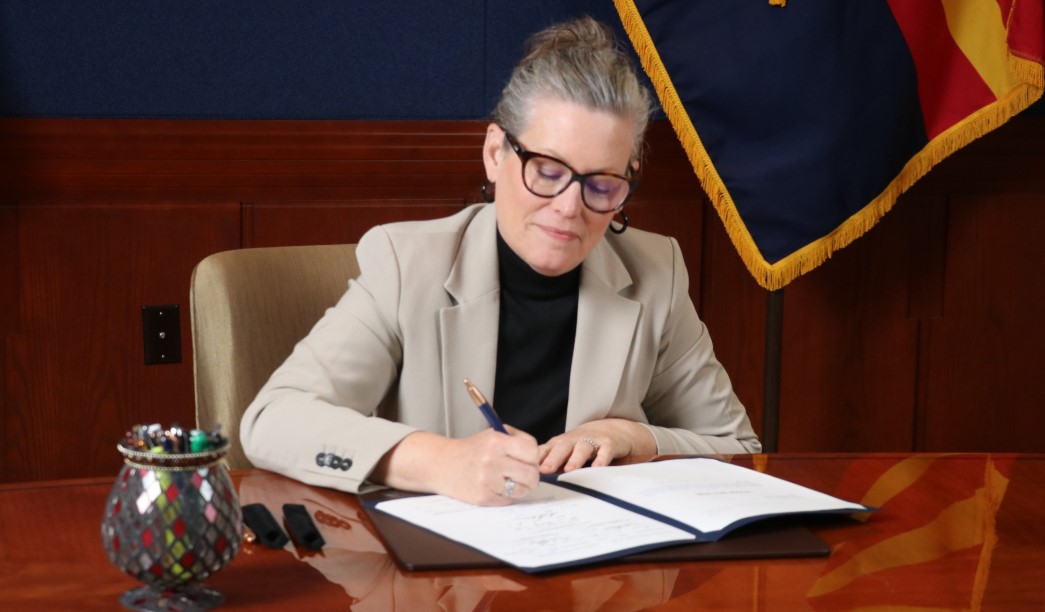
After many failed times of attempting to approve election reform measures in Arizona under a divided government since the start of 2023, the Republican-led legislature and Democrat Governor Katie Hobbs came to an agreement on a crucial package. Late last week, the state house and senate passed HB 2785, and then the governor signed the legislation.
According to an overview provided by the Arizona House of Representatives, the bill is “an emergency measure that modifies certain procedures and deadlines related to the conduct of elections.” The significant provisions of the legislation, per the press release from the Arizona House, are as follows:
- Robust legally binding signature verification standards in law for first time in Arizona.
- Puts political parties on an equal playing field when curing ballots.
- Promotes greater use of ID when voting early.
- Ensures that Arizona’s overseas military will be able to vote, and Arizona’s electors will be delivered on time.
With the bipartisan agreement, Arizona’s primary election date will be moved up to July 30.
“Politics is the art of the possible, and when Republicans stick together, we can achieve the impossible, like getting Katie Hobbs to sign real election reforms into law,” said Representative Alexander Kolodin, sponsor of HB 2785. “Arizona’s voters can rest assured that the 2024 election will be more secure, free, and fair than those that have gone before.”
The Senate Elections Committee Chair, Senator Wendy Rogers, added, “”This legislation is a major win for Arizona voters and important in restoring voter confidence in election Integrity. After months of painstaking discussions among lawmakers, election experts, administrators, county officials, and the executive branch, I’m proud we were able to craft a commonsense solution that all 15 Arizona counties support. It will ensure our service members abroad will have their votes counted on election day, and moreover, it will enable us to accurately determine the winner sooner rather than later.”
Governor Hobbs also struck a triumphant tone in her statement when she signed the bill, saying, “With this bill, we are making sure every eligible Arizonan can have their voice heard at the ballot box. We protected voters’ rights, we kept the partisan priorities out, and we demonstrated to the country that democracy in our state is strong. Thank you to Republicans and Democrats in the legislature who put partisan politics aside to deliver this important victory for the people of Arizona.”
Arizona Secretary of State Adrian Fontes, also a Democrat, chimed in with his support of the package. Fontes said, “I am pleased to see Arizona’s bipartisan effort to pass House Bill 2785, keeping on-time ballot delivery for military and overseas voters and securing the state’s electoral votes for the 2024 presidential election. This legislation received overwhelming support across party lines and demonstrates Arizona’s commitment to fair and secure elections.”
The bill passed the state house with a 56-2 vote (with two vacant seats), and the senate with a 24-2 vote (with four members not voting).
Ironically, the consensus on these election reforms between legislative Republicans and statewide Democrats comes as both parties prepare to wage a legal fight in the courts over the Elections Procedures Manual that was produced by Secretary Fontes and greenlighted by Governor Hobbs and Attorney General Kris Mayes.
Daniel Stefanski is a reporter for AZ Free News. You can send him news tips using this link.
by AZ Free Enterprise Club | Nov 29, 2023 | Opinion
By the Arizona Free Enterprise Club |
We’re less than a year away from our next election, and if Arizona Secretary of State Adrian Fontes is serious about doing his job, his primary focus should be on ensuring a process where it is easy to vote and hard to cheat. Instead, Fontes has been attempting to implement an Elections Procedures Manual (EPM) that is ripe with unlawful provisions all while ignoring a giant (and growing) elephant in the room.
In its last two quarterly reports to the Arizona state legislature, the Secretary of State’s office reported that over 78,000 individuals have been identified on our state’s voter rolls as noncitizens or nonresidents. This number includes:
- Over 53,200 individuals who were reported to have been issued a driver’s license or the equivalent of an Arizona nonoperating license ID in another state.
- Over 1,300 individuals who admitted to not being a U.S. citizen on a jury questionnaire.
- Over 23,600 individuals who admitted to not being a resident of a county on a jury questionnaire.
These numbers should be great cause for alarm—especially when you consider how close some of our state’s races were in 2022—and these individuals should be immediately removed from our state’s voter rolls. So, what did Fontes do in response to this news?
>>> CONTINUE READING >>>