While the White House touts the success of “Bidenomics,” American families are drowning in debt, especially on credit cards. The latest data from the Federal Reserve Bank of New York show Americans ended the first half of this year with over a trillion dollars of credit card debt for the first time ever. At the same time, credit card interest rates are at record highs, pushing many Americans to the financial brink.
How we got here is a lesson in basic economics, something the Biden administration has willfully ignored.
Contrary to the White House talking points, President Joe Biden did not inherit a “reeling” economy and inflation was not “already there.” When he entered the Oval Office, the economy was growing at a $1.5 trillion annualized rate and inflation was 1.4 percent, comfortably below the Federal Reserve’s target inflation rate. But Bidenomics changed all that.
In just a year and a half, Mr. Biden managed to deliver two consecutive quarters of negative economic growth (a recession). Moreover, inflation reached 40-year highs, with prices rising in a single month about as fast as they rose in the entire year before Biden took office.
This is the bitter fruit of the Bidenomics tree. The seed was trillions of dollars in excessive government spending; it was watered with trillions of borrowed dollars and fertilized by the Fed’s printing trillions of dollars. The results are fast-growing prices, a sluggish economy, and family budgets getting squeezed.
Since Mr. Biden took office, prices have risen about 16 percent, but average hourly wages have risen less than 13 percent, and average weekly hours have been cut back. That has left the average American with an effective pay cut of about 5 percent, and families have been using credit cards to make up for that lost purchasing power.
In just two and a half years, outstanding credit card balances have exploded 34 percent, but it gets worse—much worse. The Fed has been steadily raising interest rates to combat the very inflation which it helped cause. That has pushed up borrowing costs, especially on credit cards; their average interest rate is now at an all-time high.
The combination of large balances and high interest rates is a financial death spiral for many American families. When the financing charges on your credit card bill are equal to or greater than what you can afford to pay each month, it becomes impossible to pay down your balance. You are effectively trapped in debt. On top of the higher cost of living, you’re now paying higher financing charges too.
And it’s not just credit card debt that has exploded during Bidenomics. Consumer spending during the last two years has been partly fueled by higher balances for auto loans and mortgages, the latter of which has grown almost $2 trillion in just two and a half years.
Mr. Biden’s false promises of a student loan bailout along with a moratorium on student loan payments have also encouraged young people to take on additional debt for schooling and not pay those loans back. In fact, instead of using the savings from the moratorium to responsibly pay down their debt, most borrowers have been further increasing consumer spending.
American families going deeper into debt is a hallmark of Bidenomics, so much so that even members of Mr. Biden’s administration are beginning to say the quiet part out loud. Vice President Kamala Harris recently claimed that most Americans would go “bankrupt” if they had a $400 emergency expense.
While there is no evidence to support Ms. Harris’ claim, her statement is an indictment of the administration’s economic agenda. For most Americans, a much more likely scenario than bankruptcy is that they would have to put that emergency expense on a credit card—which many families have already had to do.
The squeeze on Americans’ family budgets will continue until we clean up the federal budget. If Washington doesn’t cut trillions of dollars in spending, the bills will keep piling up, both at the Treasury, and in your mailbox.
E.J. Antoni is a contributor to The Daily Caller News Foundation, a public finance economist at The Heritage Foundation, and a senior fellow at Committee to Unleash Prosperity.
American school children are instructed that the late 19th century, the Gilded Age, was dominated by “robber barons” who made great fortunes creating monopolies that exploited the poor and middle classes.
Howard Zinn‘s best-selling textbook, which introduced generations of Americans to their own history, informed them that “ordinary people who lived through the Gilded Age… experienced tremendous hardships and losses… While they got poor, the rich were getting richer.” Another noted economist concurred that “the poor grew helpless, the middle class got swept away.”
But let’s look again. In fact, by the numbers, it was a golden age for American workers.
As Phil Gramm and Amity Shlaes documented in the Wall Street Journal, between 1870 and 1900, the national GNP rose 233%, per capita GNP surged by 90%, and wages increased 53%, all inflation adjusted. Meanwhile, food costs and other necessities fell by 70%. Better yet, the illiteracy rate fell by 46%, life expectancy rose12.5%, and infant mortality declined by 17%. The people did OK when government stayed on the sidelines.
But Americans, then as now, misread their history and so were doomed to repeat it. Modern progressivism was born in response to the purported outrages of the plutocrats. Government controls stifled economic growth and innovation. Later, big government was credited by many with pulling us out of the depression.
By the 1970s, the damaging effects of the dead hand of government were so obvious that Ted Kennedy and Jimmy Carter led a massive deregulation movement – airlines, communications, energy, and other sectors – that ushered in the tech revolution and renewed prosperity.
But the tendency to regard socialistic policies as inherently good is so ingrained in human nature that once again we have already forgotten the lessons learned. Now the Biden administration is creating a new industrial policy in which government handouts are lavishly dispensed but conditioned on compliance with progressive mandates.
For example, America’s semiconductor chip producers scored a $280 billion subsidy recently, on the grounds that their sector was ailing financially, and its health was so important to the economy generally, that it was, you know, too big to fail. Commerce secretary Gina Raimondo was very explicit about the strings attached, “if Congress wasn’t going to do what they should’ve done [in the Build Back Better bill], we’re going to do it in the implementation.”
She meant it. For starters, chipmakers receiving $150 million or more in federal aid will be required to provide childcare to their employees and construction workers that has been crafted in “tandem with community stakeholders including…local groups with expertise in administering childcare” (i.e., lefty nonprofits).
Chipmakers will also have to pay construction workers prevailing wages set by unions and abide by “project labor agreements” which allow unions to mandate conditions and benefits for all workers, union members or not.
That’s not all. The “lucky” chipmakers must also provide “paid leave and caregiving support” to employees as well as wraparound services such as adult care, transportation, and housing assistance to the disadvantaged or underserved.
Centralized economic planning is once again butting up against economic reality. Chip manufacturers have already been transferring production overseas because costs are 40% higher stateside. Any benefit from the subsidies will be so offset by the increased costs that the net profit may be questionable.
Still, other industries are eagerly lining up for their government handouts. In their ceaseless efforts to socialize their losses while retaining profits to themselves, banks lobbied the FDIC to guarantee uninsured deposits without limit after the recent midsize bank collapses. Broadband providers received tens of billions in grants from states to build high-speed broadband to subsidize low-income purchases of Internet service plans.
Years ago, EV producers received temporary subsidies as start-up inducers, which, of course, aren’t going away at all. They just keep expanding, like $523 billion over 10 years for vehicle consumer and battery production tax credits.
As the chipmakers are discovering, the effect of all this free stuff from government is to make big businesses the compliant wards of the state. Thus, the administration imposes a cradle-to- grave welfare system through centralized industrial policy, while unconstitutionally usurping congressional authority in the bargain.
It’s the path to nowhere – again.
Dr. Thomas Patterson, former Chairman of the Goldwater Institute, is a retired emergency physician. He served as an Arizona State senator for 10 years in the 1990s, and as Majority Leader from 93-96. He is the author of Arizona’s original charter schools bill.
Last year, Arizona was the most popular state for people to relocate to. Those new arrivals helped boost our economy and put the state’s budget in the black. That’s the good news. But the bad news is that the state is falling behind in building homes to meet the needs of current families as well as newcomers.
Some may say that is just fine because they liked the Grand Canyon State before those people moved here. But they likely haven’t considered the consequences when the government restricts new housing.
The demand for housing goes up as families have children, residents get pay raises, and workers bring their skills and talents to our state. We celebrate these events, and to make sure it continues, we must allow the supply of housing to meet this increased demand.
When governments restrict the supply of new housing, it reduces the choices available to buyers, which drives up the cost of their new homes. It is the buyers who bear the cost of these restrictive policies. This year Arizona has a shortfall of 270,000 housing units, and that deficit in housing will continue for years to come.
This shortage of housing is quickly putting our state beyond the reach of many qualified young workers. If businesses can’t attract capable workers, the owners will think long and hard before moving their business here or expanding their current operations. And that’s bad news for all Arizonans because businesses pay the lion’s share of our taxes. Without a healthy economy, the state budget will slide into deficits again. And that means cutbacks for schools and roads.
If Arizona is to remain prosperous, we must be attractive and affordable for new businesses and new residents. As The Wall Street Journal wrote, “The shortfall of affordable housing hurts America’s businesses and the broader economy by preventing workers from living in areas with economic opportunities but high housing costs. Employers are forced to operate below their potential because they can’t attract or retain workers.”
Local land use restrictions bear most of the blame for the housing shortage. In many areas, it is hard or impossible to add a casita for an aging parent or young renter. Local regulations often prohibit empty nesters from renting a single bedroom to a senior. And cities often dictate design elements such as floor plans, styles, and materials for homes. Such restrictions do not protect public safety or health. They merely impose the preferences of politicians and bureaucrats and limit the choices for property owners.
Navigating through the planning bureaucracy is difficult and there are frequent delays. Not long ago, it took about six months to complete the planning process. Now, it often drags on for a year or more. The clerks handling the applications do not have to pay the price for those delays. It is the new buyer who bears the added costs. But these huge added costs are not obvious to home buyers.
One way to inform consumers would be to have a sticker price for each home, much like we see when buying a car. The sticker would list the actual costs of the land and construction. Then, the sticker would lay out the costs of the myriad government requirements, then list the multiple fees for the city, the county, and all special districts, and finally the costs for connections for electricity, gas, sewer, etc. The sticker would make it clear how much the land and construction actually cost, and what was added on by government regulations and processing.
The Legislature had the opportunity to deal with the shortage this year but dropped the ball. Speaker Ben Toma’s HB 2536 proposed allowing property owners to build casitas attached to or in the backyard of their home, and would have allowed owners to rent a single bedroom to seniors. The bill would have also prevented cities from dictating design elements and aesthetics. Arizonans should have the right to choose the style and layout of their homes, and not have their aesthetics dictated by the bureaucracy.
After passing the House unanimously, the Senate killed it under pressure from local politicians. Those politicos want to protect their monopoly on housing decisions, even if their decisions cause young families and seniors to be priced out of their city. I was surprised that ten Senate Republicans voted against this important bill: Bennett, Borrelli, Carroll, Hoffman, Kavanagh, Kern, Kerr, Mesnard, Rogers, and Wadsack.
They claim they voted to kill the bill to protect the prerogatives of local government. While I agree that most decisions are better left up to officials closest to the people, I strongly dispute that local governments have unfettered power to ignore the rights of their residents. Local governments do not have the authority to dictate the color and floor plan for new homes. That goes far beyond the proper scope of their duties and interferes with the basic rights of property owners.
I am particularly troubled that several members of the Freedom Caucus helped kill this bill. I don’t understand how they can believe that their votes to allow local politicians to excessively interfere with the rights of property owners doesn’t infringe on our basic rights. The members of the Freedom Caucus would do well to re-read Alexis de Tocqueville’s warning about the terrible impact imposed on the people by bureaucratic rules:
“It covers the surface of society with a network of small, complicated rules, minute and uniform, through which the most original minds and the most energetic characters cannot penetrate, to rise above the crowd. The will of man is not shattered, but softened, bent, guided; men are seldom forced by it to act, but they are constantly restrained from acting: such a power does not destroy, but it prevents existence; it does not tyrannize, but it compresses, extinguishes, and stupefies a people, till each nation is reduced to be nothing better than a flock of timid and industrious animals, of which the government is the shepherd.”
It is the duty of our state representatives to forestall efforts to make us sheep under the care of government bureaucrats. Our legislators are not elected by local governments; they are elected directly by the people. They should not think of themselves as protectors of local governments’ prerogatives; rather, they should be vigilant guardians of our freedoms no matter which level of the government tries to violate them. I would remind our legislators that our Constitution does not begin with the words “We the state and local governments” but “We the people.”
Pat Nolan is the Director Emeritus of the Nolan Center for Justice at the American Conservative Union Foundation. He and his wife live in Prescott.
America’s response to the COVID-19 pandemic was possibly the most consequential public policy blunder in our history.
The enormous costs included $5 trillion or so in unproductive federal spending, inflation, reduction in our standard of living, and permanent economic damage that will be felt for generations to come.
There was massive learning loss and the specter of loved ones dying alone. The incidence of depression and drug addiction skyrocketed. Businesses were shuttered while many Americans seemingly lost their work ethic.
What happened? The short answer is that we panicked and listen to “experts” who vowed we could halt this virus if we were willing to sacrifice enough.
At first, with imperfect information around a deadly new phenomenon, projecting a worst-case scenario and drastic measures to prevent it made sense. However, more data and experience with the virus soon tended to support a strategy of containment (“stop the spread”).
Still the decision makers at the World Health Organization (WHO) and the National Institutes of Health (NIH), doubled down on their zero-COVID based recommendations. Lockdowns ensued. We scoffed at cost-benefit analysis. “If only one life…” and “in an abundance of caution…” became the guiding standards of policymaking.
The American people mostly went along with it. Why wouldn’t they? They were provided little awareness of alternate approaches.
Once the narrative had been established that eradication was the only permissible strategy, opposing viewpoints were excluded to a degree any Third World dictator would have envied.
Dissenters were shamed and censored. Professional reputations were attacked. Dr. Fauci informed us that “I am the science” and thus all who disagreed were “science deniers.”
Consider the case of Dr. Jay Bhattacharya, a Professor of Health Policy at Stanford. He also directs Stanford’s Center for Demography and Economics of Health and Aging and is a research associate at the National Bureau of Economics Research. So, the doc isn’t exactly an empty suit. He was also a co-author of the Great Barrington Declaration (GBD), signed now by thousands of medical scientists and practitioners, which advocated for “focused protection” against COVID.
Since COVID is dangerous only to a relatively small proportion of the population, it was argued that the greatest efforts should be in protecting people most at risk, the chronically ill and elderly. This would focus resources where they do the most good, saving lives and money.
Agree or not, there is nothing looney about this notion that one-size-fits-all doesn’t make sense for COVID-19. It was mainstream common sense, advocated by highly qualified, non-political scientists.
Yet the blogosphere and leading scientific opinion channels exploded with vitriolic denunciations. The authors were accused of promoting infections among the young to achieve a cruel herd immunity strategy. The claimed the GBD was promoting a wholesale return to our pre-pandemic lives—that they were encouraging fringe groups who distrust health officials and prioritizing individual preference above public good.
None of it was true, but to the social media tyrants, that didn’t mean that Dr. Bhattacharya should be vigorously debated. It meant that he must be threatened and silenced.
We just recently learned that he was indeed censored and intentionally shadowbanned by Twitter. His account was tagged with a label of “Trends Blacklist.” He was censored before he tweeted a single message.
He had violated no rules. He spread no “misinformation.” He only defied the approved consensus. He was silenced by the mob at Twitter, none of whom had anything like his knowledge or experience.
The GBD authors were right, of course. None of the isolations, lockdowns, or school closures affected the eventual course of the virus. We received virtually no benefit from the massive self-inflicted harm.
It’s ironic in our supposedly modern, enlightened age that dogma won out over science. That is, we based our societal decisions on knowledge rooted in deemed authority, not the open inquiry of the scientific method.
We paid a big price for listening to the Fauci’s of the world with their refusal to balance benefit with cost. Dr. Fauci bragged of not caring about the cost of his demands.
They convinced our leaders to spend money we don’t have in a vain attempt to achieve the impossible.
Bad idea. We can’t afford to let it happen again.
Dr. Thomas Patterson, former Chairman of the Goldwater Institute, is a retired emergency physician. He served as an Arizona State senator for 10 years in the 1990s, and as Majority Leader from 93-96. He is the author of Arizona’s original charter schools bill.
America’s political class can no longer put off the inevitable. They soon will have to pay for their insanely reckless fiscal practices.
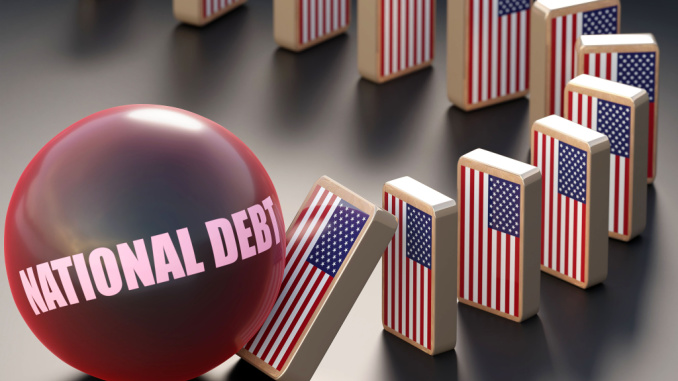
It’s not going to be pretty. America’s debt has reached an appalling $31 trillion. Annual interest payments will exceed $1 trillion this year. Debt service is well on its way to crowding out other priorities, a trend which will only accelerate.
Unfortunately, a steep rise in interest rates occurred near the end of the biggest spending binge ever. Economists are warning we are nearing the dreaded “doom loop” in which interest costs can be covered only by more borrowing which further drives up interest expense, creating a vicious cycle.
There is a weird, almost preternatural calm about our dire fiscal future during this campaign season. We’ve seen much consternation about inflation, public safety, the border, and other critical issues. Yet politicians and the media hardly mentioned the debt crisis, so the public seems to assume everything is under control.
It isn’t, not by a long shot. Uncle Sam issued $7 trillion in new debt to finance the recovery from the COVID pandemic and our panicked overreaction to the disease. It’s too bad we can’t take back that $7 trillion.
Much of it was stolen by fraud and bureaucratic bumbling. Funds went to school districts, that haven’t spent them so far, to finance the indolence of those who preferred not to work and to Democrat pet projects like “climate change.” Millions of voters in no distress whatsoever got checks, as did some illegal immigrants.
Many economists predicted that injecting that much cash into the economy would cause inflation, especially since supply was limited by weakness in the labor market, fuel shortages, and supply chain problems. They were mostly ignored but turned out to be absolutely correct. After decades of relative price stability, we are now experiencing 8% inflation with no end in sight.
Millions of non-economists are experiencing what that does to your standard of living. Suddenly, food, fuel, and shelter have become existential concerns to millions of Americans, and the economic future looks dim.
Inflation also increases government spending. Social Security benefits are inflation-adjusted, resulting in an 8%, $100 billion increase. Total government healthcare costs will grow from $710 billion last year to $915 billion.
Financial markets cannot ignore the cloud of government debt hanging over our economy. A serious recession will almost certainly soon be upon us. Already, declining stock and bond values over the past nine months assure a steep decline in capital gains tax revenue, another contributing factor to the deficit.
The Federal Reserve board is doing the only thing it can to address inflation, which is to raise core interest rates. That also directly adds to the national deficit, increasing the interest cost and driving up the balance, since no other source of funds is available.
So, to summarize, unnecessary COVID-related spending of $7 trillion has combined with chronic overspending, which caused inflation, which increased borrowing costs, which drove up the deficit, thus precipitating a recession which will deprive the government of revenues to pay down the surging debt load. Way to go, guys.
The principle response of the Biden administration has been denial. Our president claims the economy is thriving. A monthly .1% drop in the inflation rate was the pretext for claiming inflation was in decline. The national debt is never mentioned, nor are the untold trillions in future promises we have made to senior citizens and others.
Instead, Biden issued a probably unconstitutional executive order “canceling” unpaid college loans – i.e., transferring the liability to taxpayers. It was terrible public policy, penalizing those who had behaved responsibly and incentivizing student indebtedness in the future. It spent yet more money in a desperate attempt to bribe some votes for the midterm elections.
Yet there seems to be little taxpayer resentment. Why should they care? Their taxes aren’t going to increase. The obligation will be added to the great river of debt passed on to future generations—you know, those little people who don’t vote yet.
They will inherit an America feeble and impoverished, that will have forfeited its greatness because of our greed and selfishness. STOP THE SPENDING!
Dr. Thomas Patterson, former Chairman of the Goldwater Institute, is a retired emergency physician. He served as an Arizona State senator for 10 years in the 1990s, and as Majority Leader from 93-96. He is the author of Arizona’s original charter schools bill.