For months, we have documented the pattern of errors, distortions, and outright fabrications that characterize the coverage of Arizona’s Empowerment Scholarship Account program by Channel 12’s political reporter Craig Harris. Each new episode—the fabricated 20% fraud claim, the defiance in the face of correction by the Arizona Department of Education itself, the constant shifting of goalposts as each of his claims is debunked—seemed like it might result in Channel 12 taking appropriate corrective action.
But they never did.
Last week, at the Arizona Legislature’s final stretch of its 2026 session, the mask came off entirely.
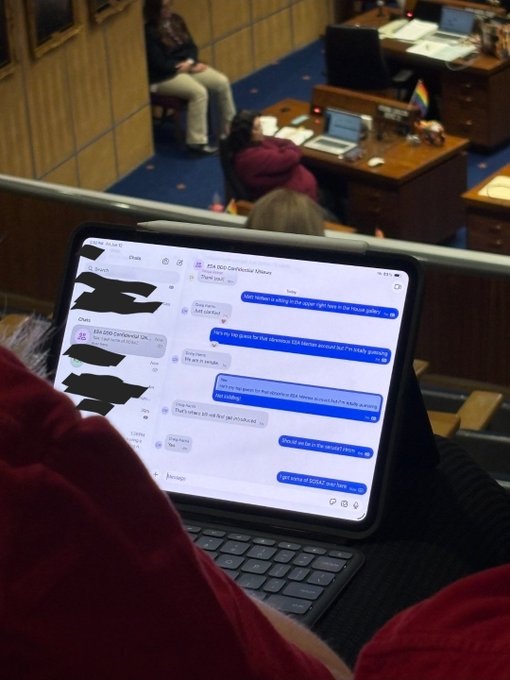
While lawmakers debated a series of consequential ESA-related bills and resolutions on Thursday and Friday—including a constitutional amendment to protect military family scholarships—Harris was captured on camera doing something that no journalist who takes the job title seriously can explain away: coordinating, via text message, with members of Save Our Schools Arizona, the anti-school-choice advocacy group that is a principal sponsor of the Protect Education Now ballot initiative, about where they should position themselves inside the Capitol building for maximum political impact.
Text message conversation between Channel 12’s Craig Harris and anti-school choice activists.
Let that sink in. A reporter on the education beat, covering legislation in real time, was not observing the advocacy groups in the building. He was directing them.
The text exchange was visible on the screen of a Save Our Schools activist—readable thanks to a conspicuously large font and no privacy screen—and was flagged by our Heritage Foundation colleague Corey DeAngelis, who shared images of the messages on social media after receiving them from a local activist. Harris subsequently confirmed on X that the images of the group chat, named “ESA DDD Confidential 12News,” were real.
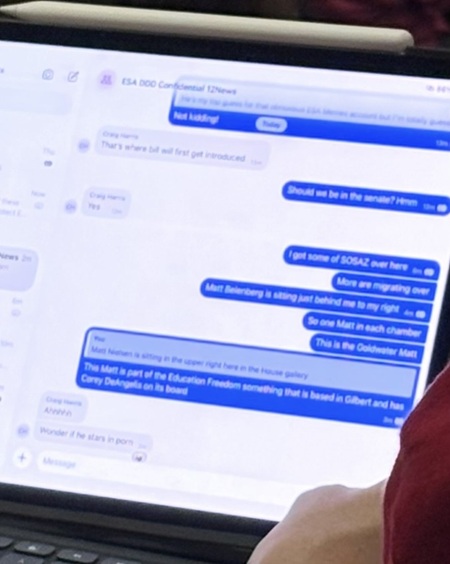
After Harris told the activist that he was in the state senate chamber as that is “where [the] bill will first get introduced,” Save Our Schools board member Kathy Boltz asked Harris for advice regarding where their team of activists should place themselves in the capitol building. “Should we be in the senate? Hmm,” she asked. Within a minute, Harris answered in the affirmative.
This is not ambiguous. This is not a misunderstanding. This is a journalist using his knowledge of the Arizona Legislature’s political process to provide tactical advice to an advocacy group that has a direct political stake in the legislation he is supposed to be covering neutrally.
Harris was no longer covering the news. He was helping to manufacture it.
But that wasn’t the worst of it.
The same captured text conversation revealed Harris mocking a local school choice supporter, asking whether the individual “stars in porn.”
This derision was not just a lapse in professionalism. This was contempt—contempt for the families, advocates, and ordinary citizens who show up at the Capitol to make the case for educational freedom, expressed in a private conversation with advocates on the other side of the issue.
Text message conversation between Channel 12’s Craig Harris and anti-school choice activists.
Multiple Arizona politicos were quick to call out the behavior publicly. State Senator Jake Hoffman called for Channel 12 to fire Harris and called on the station to “open an investigation into every story he was involved in and retract any instance of undisclosed coordination.” Hoffman observed that this coordination with activists is “precisely the kind of unethical behavior that has caused the majority of Americans to deeply distrust the media.”
Arizona Republic columnist and former State Senator Paul Boyer called it “a really bad look” for Channel 12 to have their reporter, “who is also reporting on these same groups” to be discovered “coordinating with them at the legislature to defeat the same type of legislation he’s myopically focused on.” Similarly, J.P. Twist, executive director of Citizens for Free Enterprise, called out Harris for “literally strategizing with a partisan union to undermine parents’ rights.”
The parent company of Channel 12 publishes a “Principles of Ethical Journalism” statement committing its journalists to the values of truth, independence, public interest, fair play, and integrity. It’s hard to see how coordinating with one group of political activists and crudely mocking the other side comports with those standards.
Sadly, Harris’s breach of journalistic ethics does not end there.
Later that night, in a hearing on legislation to protect military family scholarships, Harris took to social media to characterize two of the three supporting witnesses who testified as people “making money off ESAs,” implying their support was financially motivated rather than principled.
One of those witnesses was Kevin Biesty, spokesperson for the Arizona Christian Education Coalition. As Biesty detailed on X, he reached out to Harris privately and asked him to correct or remove the post. Harris declined. As Biesty observed, the logic Harris applied to him — that representing clients who are affected by ESA policy makes one a financially conflicted advocate — is never applied to the other side. The staff and lobbyists of Save Our Schools Arizona and the teachers unions, who are paid to oppose the ESA program, are never characterized by Harris as people “making money off” the issue.
Harris also claimed that no military family spoke at the hearing. That too was false. Biesty had personally presented a written statement from a military mother who could not remain for the late-night session, and referenced letters from other military families — all of this while Harris was in the room. At no point did Harris ask Biesty for that mother’s contact information or seek to include her perspective in his coverage. He was, however, apparently attentive enough to the gallery to communicate with his Save Our Schools contact — the same ESA mother and SOS board member who, Biesty observed, is never identified as such in Harris’s stories — while sitting at the press desk on the floor.
Indeed, when ESA students and their families share their stories, Harris is quick to dismiss them. Recently, a young ESA student with disabilities named Jordan Visser shared on video about the ways the Protect Education Now initiative would harm students like himself. Harris went on social media to dispute his account, claiming that the initiative would not affect students with special needs—effectively accusing a student with disabilities of lying about the impact of a ballot measure on his own situation.
He was wrong. As the student’s mother, Kathy Visser, and others documented, the text of the initiative itself bore out what the student had said—the ESA funds that the family had saved to continue providing him with services would be seized by the state if the Save Our Schools ballot initiative were adopted.
The irony of Harris’s posture—aggressively checking the credibility of a disabled student while coordinating inside the Capitol with the very advocacy group sponsoring the initiative in question—encapsulates the problem. It is not that Harris is a journalist who occasionally makes mistakes. It is that the mistakes run in one direction, consistently, and that when corrected, he doubles down rather than acknowledging any error. And it is now documented, on camera, that he was coordinating tactics with one side of the debate he was purportedly covering.
Arizona families with children in the ESA program deserve better than a reporter who coordinates with the opposition at the very hearings he is assigned to cover. Arizona viewers deserve better than a news organization that has allowed this pattern to continue unchecked. And the thousands of children—including those with disabilities—who rely on these scholarships deserve a press corps willing to represent their stories honestly.
Channel 12 has not issued a correction or a retraction of the false fraud statistics. It has not yet acknowledged Harris’s coordination with activists or the mockery of a school choice supporter.
Channel 12’s parent company should answer a simple question: Is the behavior documented at the Capitol last week consistent with its Principles of Ethical Journalism? If not, what will it do about it?
Jason Bedrick is a Senior Research Fellow and Matthew Ladner is aSenior Advisor for education policy implementation at The Heritage Foundation’s Center for Education Policy.
An Arizona State University faculty member, who also serves as an associate director, was captured on video acknowledging that diversity, equity, and inclusion (DEI) programming continues at ASU despite Executive Orders and U.S. Department of Education (DOE) policies directing the elimination of the programs.
In footage from Accuracy in Media (AIM) circulating online, an ASU official identified as Rebecca Loftus, Associate Teaching Professor and Associate Director of the School of Criminology & Criminal Justice, is shown discussing how DEI efforts persist at the university, saying the programming is now “just not as broadcast as it was before,” according to posts and videos shared on social media platforms.
In January 2025, the DOE announced it was dismantling DEI-related offices, removing DEI references from public-facing materials, and directing staff to eliminate related programs as part of a department-wide policy shift under the Trump administration. The department said the move was intended to end what it described as discriminatory or non-merit-based practices tied to DEI frameworks. It warned that institutions continuing such efforts could face scrutiny over federal funding.
The video, originally posted to YouTube, was later shared on X by Corey A. DeAngelis and circulated more broadly as Instagram Reels and X posts. In the footage, Loftus can be heard making statements that ASU’s diversity initiatives are still in effect, albeit with less public emphasis than in earlier years.
BREAKING: An Arizona State University professor was just caught bragging about secretly pushing DEI.
She said they're just "careful with the language" because "it's really tied to funding."
A journalist confronted her and she looked like a deer in the headlights.
— Corey A. DeAngelis, school choice evangelist (@DeAngelisCorey) January 5, 2026
According to AIM, Loftus, speaking with an undercover investigator, was recorded stating that, “Most of our faculty do tend to be a little more on the liberal side. You have to be careful with the language that you use. We’re doing pretty much what we were doing before.”
The outlet reported that she went on to describe a body known as “the idea office,” an internal group responsible for “designing” criminology classes for a “majority-minority student body,” with AIM characterizing such groups as “how DEI-related instruction is being concealed through new internal structures.”
Loftus is later seen telling the investigator: “You’re not going to find very many programs that are going to broadcast it as before because the federal funding for universities, especially state-run universities like ASU… If you have federal funds that are withheld, it really makes a big impact.” She reportedly added that entire classes are still being devoted to race, ethnicity, and gender, and said that ASU has been bringing in outside figures to present these classes.
In a later clip, when confronted about the undercover video, she can be seen telling Adam Guillette, President of Accuracy in Media, that she has “no idea” what he’s talking about and urged him to “talk to our Director” before requesting he leave her office.
ASU’s use of diversity training and DEI programming has been the subject of a legal challenge in recent years.
In March 2024, the Goldwater Institute filed a lawsuit on behalf of an ASU faculty member challenging ASU’s “Inclusive Communities” training requirement as violating Arizona law prohibiting certain diversity trainings funded with public money. That lawsuit, Anderson v. Arizona Board of Regents, remains active in the state court system.
The Goldwater Institute’s online materials describe the training as covering systemic bias, privilege, and related concepts.
At the time of this report, ASU administrators had not issued a public response to the video clips widely circulated on social media, nor had the university clarified whether the recording was conducted with consent or in a sanctioned setting.
The footage has been reposted and commented on by multiple users, including calls for questions about the university’s DEI direction. One user suggested contacting the ASU Board of Trustees regarding the issue; however, no official response from the board has been posted publicly as of this report.
Arizona AG Kris Mayes’ Communications Director Richie Taylor deleted his X, Bluesky, and LinkedIn accounts after screenshots of his alleged posts surfaced on “groypers” and “violence on the right.”
Corey A. DeAngelis, a Senior Advisor with Americans For Fair Treatment, shared a screenshot allegedly taken from Taylor’s X account, which read, “Lots of people learning about groyper’s tonight because of violence on the right in this country.”
The post appeared to advance the unsubstantiated theory that Charlie Kirk’s assassin, Tyler Robinson, is a member of online commentator Nick Fuentes’ fan base, known as “groypers,” who have rhetorically feuded with Kirk and Turning Point USA over the years.
— Corey A. DeAngelis, school choice evangelist (@DeAngelisCorey) September 17, 2025
As reported by the Associated Press, Utah County Attorney Jeff Gray revealed Tuesday that evidence, including a text confession and a note, shows the suspect targeted Charlie Kirk, stating, “I had enough of his hatred. Some hate can’t be negotiated out,” and “I had the opportunity to take out Charlie Kirk and I’m going to take it.”
The comments would seem to preclude the assassin from views that could be “on the right,” as Taylor’s alleged post suggested. Gray declined to address whether Kirk was targeted due to his views on transgenderism on Tuesday, telling reporters, “That is for a jury to decide.”
Last month, Taylor came under public scrutiny for “vicious ad hominem attacks” against Jenny Clark, founder of Love Your School, a nonprofit that advocates for parental rights, school choice, and resources for Empowerment Scholarship Accounts (ESA) and special education students.
🚨Update: the Head of Communications for @AZAGMayes , @richietaylor – has deleted posts against me which were extremely aggressive, untrue, unprovoked and vicious ad hominem attacks.
I make policy arguments supported by available facts, they prefer to personally attack people. pic.twitter.com/qkeXlqG9KU
Following the incident, Clark posted an update saying, “Update: the Head of Communications for @AZAGMayes, @richietaylor – has deleted posts against me which were extremely aggressive, untrue, unprovoked and vicious ad hominem attacks. I make policy arguments supported by available facts, they prefer to personally attack people.”
Americans’ support for school choice is on the rise.
A recent poll from Real Clear Opinion Research showed that school choice has the support of 71% of the 1,000 registered voters who participated in that survey. This number was a seven-point increase from an April 2020 poll.
— Christine Accurso (@ArizonaCatholic) July 12, 2023
In this June 27-30 poll, support for school choice came from 80% of Republican voters, 66% of Democrat voters, and 69% of Independent voters. Though the Republican and Democrat support was up from April 2020, the 9% increase in favor from Independents was the most among the political parties.
NEW POLL: 71% of Americans support school choice.
April 2020: 64% —> June 2023: 71%
7 percentage point jump in support since April 2020.
IT'S HAPPENING.
— Corey A. DeAngelis, school choice evangelist (@DeAngelisCorey) July 11, 2023
The question presented to voters on the survey was as follows: “School choices gives parents the right to use the tax dollars designated for their child’s education to send their child to the public or private school which best serves their needs. Generally speaking, would you say you support or oppose the concept of school choice?”
The CEO of American Federation for Children, Tommy Schultz, lauded the news about the growing support for school choice around the country, saying, “School choice support is here to stay, and politicians who ignore this reality do so at their own peril. Parents are the new interest group in town, and legislators would be wise to keep responding to their needs. The days of the old one-size-fits-all model are numbered, welcome news for the countless students who need something different to learn and thrive. AFC is thrilled to continue standing behind parents as they gain more options for their children’s education.”
Arizona has been at the front lines of the surge in school choice support. Last year, the Republican-led Legislature passed a historic expansion of the state’s Empowerment Scholarship Account (ESA) Program, allowing any child in K-12 to apply. According to a June 30 update from the Executive Director of the ESA Program, Christine Accurso, 62,005 Arizona students have now been enrolled.
That same update also showed that the program, under the direction of Republican Superintendent of Public Instruction Tom Horne, had largely caught up with the backlog and influx of reimbursements to ESA account holders. As of June 30, the ESA Program only had 1,195 Reimbursement Orders in the queue – down from 24,409 on February 8.
When asked about the increasing support for school choice in Arizona and around the nation, Superintendent Horne told AZ Free News, “We have a lot of excellent public schools in Arizona. But no matter how good a public school is, it may not be able to meet the needs of all students. Rich parents have always had the ability to choose the best school to meet the needs of each of their children and people at all economic levels should have the same ability. In addition, competition improves public schools. The United States has been prosperous, and the Soviet Union was poor, because we had competition which drives people to do their best, while they were a government monopoly. As they used to say in Poland, ‘We pretend to work, and they pretend to pay us.’ The same applies in education. Competition causes everyone to do better.”
Daniel Stefanski is a reporter for AZ Free News. You can send him news tips using this link.
Advocates of Arizona’s Empowerment Scholarship Accounts (ESA) are responding to recent attacks on the program.
Last week, Democrat Governor Katie Hobbs launched a political assault on ESAs, reacting to a recent memo from the Arizona Department of Education, which detailed the expected cost for the upcoming fiscal year. Hobbs tweeted, “the school voucher program in its current form is not sustainable, and Republican legislators need to explain why they are forcing this runaway spending on Arizona taxpayers. We need to bring an end to this out of control and unaccountable spending, and I will work tirelessly to make that happen.”
The first-year governor has been working tirelessly to assuage angry members of her own party since she agreed to a negotiated state budget last month with Republican leaders of the Arizona House and Senate. Though she railed against ESAs on the campaign trail and leading up to the budget compromise, Hobbs signed the package that left the historic school choice expansion untouched and uncapped, leaving Democrats and interest groups opposed to ESAs to question her commitment to adhere to such a prominent platform of her administration.
Proponents of Arizona’s ESA program were ready for Hobbs’ – and other Democrats’ – attack, publishing national and local opinion pieces to assure people of the facts. Jason Bedrick and Corey DeAngelis, two national leaders of the school choice movement, wrote a commentary for the Wall Street Journal, entitled “School Choice Saves Arizona Money.” The advocates clarified the cost for ESAs in Fiscal Year 2024 ($900 million) “is barely 2% of total Arizona state spending of $80.5 billion in 2022. Arizona public schools spend about $14,000 per pupil, or $1.4 billion for 100,000 students. If the department’s enrollment projection is reached, school choice would serve roughly 8% of Arizona’s students for 6% of the $15 billion that Arizona will spend on public schools.”
— Wall Street Journal Opinion (@WSJopinion) June 7, 2023
They pointed to a report published by the Common Sense Institute, which found that “current enrollment in Arizona public district and charter schools combined is over 80,000 students below pre-pandemic projections,” saving Arizona $639 million.
A new report by the Common Sense Institute finds that “current enrollment in Arizona public district and charter schools combined is over 80,000 students below pre-pandemic projections,” producing a savings of $639 million.https://t.co/UaLbA7J6cw
Another opinion piece, written by Jon Gabriel for the Arizona Republic, stressed that “the critics of Arizona’s Empowerment Scholarship Accounts keep claiming the program is too expensive. At the same time, they insist the state spend far, far more on education.” Gabriel highlights that “an ESA student is only allowed 90% what that student would receive in a traditional public school,” arguing that Democrats “are galled to see education funding going directly to students and parents instead of to bloated public school administrations and teachers’ unions.”
No, ESA's won't "bankrupt" the state. Democrats are just mad that education dollars aren't going to their political allies. https://t.co/Hv3WLYrSYF
Matthew Ladner took his defense of ESAs to Twitter to make a comparison with the Mesa Unified School Direct. He posted, “Mesa Unified was budgeted for $1.3 billion last year to educate 54,000 students. I’m having a hard time getting too excited about less money for 100,000 students. Let’s call ESA ‘a bargain for taxpayers.’”
Mesa Unified was budgeted for $1.3 billion last year to educate 54,000 students. I'm having a hard time getting too excited about less money for 100,000 students. Let's call ESA "a bargain for taxpayers."/3 pic.twitter.com/LwkXV6qVvm