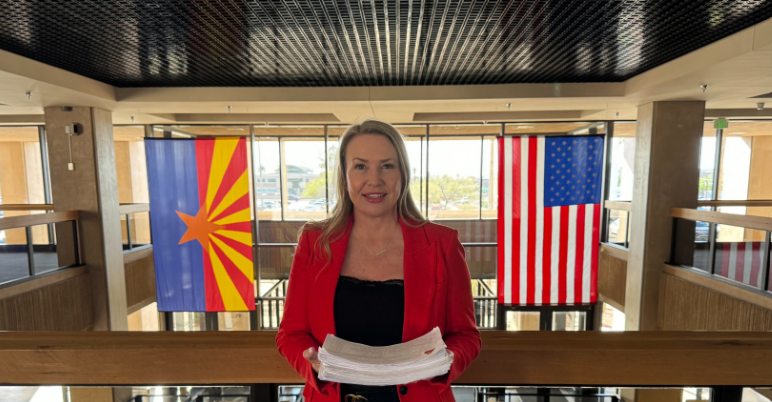
The Scottsdale Unified School District (SUSD) Governing Board approved a bonus of nearly $16,000 to its superintendent during an August board meeting, despite lower test scores. And during last week’s meeting, it approved another performance pay plan for the 2024-2025 school year.
Superintendent Scott Menzel will receive a bonus of over $15,700, despite not achieving any of the academic achievement goals for the 2023-2024 school year. Menzel has a base salary of $225,000, a $16,000 stipend, and opportunity for a 20 percent bonus (around $43,200).
That full 20 percent bonus hinged on accomplishing the 11 key performance indicators the board set for the 2023-2024 school year. Menzel accomplished five of the 11 goals, none of which were academic: increased attendance rate to 92.5 percent or better, increased percent of students participating in extracurricular and cocurricular activities by four percent; increased certified staff retention; established a baseline for work-based learning opportunities and hours completed using Major Clarity; and produced decision-making matrix and at least one proposal for action by June 30.
The academic-based performance pay goals that Menzel didn’t meet concerned increasing scores for third-grade English-Language Arts (ELA) students to 68 percent passing, eighth-grade math students to 53 percent passing, and ninth-grade science students to 41 percent passing. During the 2023-2024 school year, only 60 percent of third-grade ELA students passed, 46 percent of eighth-grade math students passed, and 34 percent of ninth-grade science students passed.
The governing board was divided over the new performance pay plan. Board President Libby Hart-Wells and members Zach Lindsay and Julie Cieniawski voted in favor, while members Amy Carney and Carine Werner abstained.
During the meeting, Carney questioned why there was no board discussion prior to Menzel’s proposed performance plan pay raise being included as an action item on last week’s agenda.
“Last [year] we had a lengthy discussion [and] came to a collaborative result, and then we had an action item later,” said Carney.
Hart-Wells didn’t deny that the procedure for proposing a superintendent pay raise plan had changed from last year, but said that Carney and other members were free to discuss the action item and propose changes.
“It has always been the case that the superintendent has drafted the goals based on the information provided by the board and the goals that were set related to the key performance indicators for the district, then that comes forward to the governing board for review,” said Menzel.
During that same meeting last week, the board’s budget presentation revealed that SUSD spending on classrooms and teachers would hit a historical low again for the 2024-2025 school year: 54 percent versus nearly 64 percent exactly 20 years ago per the auditor general. That is one percent away from the lowest fiscal year: 53 percent in 2017.
As the parent watchdog group Scottsdale Unites For Education Integrity said in a recent press release, “This 9.2 percent decrease means that, out of a $438 million budget, over $40 million has been redirected away from supporting students’ academic achievement.”
Correction: A previous version of this story said thatMenzel’s bonus was approved last week. It was approved in August while the performance pay plan was approved last week. The story has been corrected.
AZ Free News is your #1 source for Arizona news and politics. You can send us news tips using this link.
A Scottsdale-area mom is hoping that her success and positions on a local school district governing board will convince voters to elect her to the Arizona State Senate.
Carine Werner is currently running to represent Arizona Legislative District 4 in the state senate. She is an immigrant and small business owner, looking “to address the problems we face and help us protect the community we love together.”
Currently, Werner serves on the Scottsdale Unified School District Governing Board, where she has gained valuable experience for a potential move to the state Senate. In 2022, Werner gave an interview to the Scottsdale Progress Newspaper to outline her motivations for running for the position she would later assume, and to preview her action items and priorities for office.
She told the paper that she was running for the board because, “having experienced the past few tumultuous years with children in Scottsdale schools, I know the frustration and pain our students, families, and community experienced. I bring common-sense leadership, an enduring passion for securing our children’s future, respect for parents and teachers, and a skill for building consensus without compromising values.”
Werner then presented six promises to voters and parents of children within the Scottsdale Unified School District. The first was that she would “address parents’ rejection of SUSD.” She made this commitment because “A recent exit survey reveals that parents are concerned about failing academics, politically-charged classrooms, the promotion of ideological and anti-American rhetoric, and that they lack faith in the SUSD administration and the board.”
The Scottsdale mom added, “When I’m on the board, parental input will guide decisions made. I plan to partner with parents to curate the best educational experience for our children.”
The second promise was that she would “reverse enrollment decline and loss of funding.” Werner made this commitment because, “We cannot market our way out of this problem, nor should taxpayers’ foot the bill. We must restore academic excellence, close the achievement gap, and create a culture students will thrive in.”
The third promise was that she would “pay teachers first.” She made this commitment because “Although enrollment is down, SUSD increased administrative staff overhead. The Arizona legislature approved an additional $1 billion in year-over-year education spending, bringing the total K-12 spending for this year to $8.45 billion. In addition, federal funding and property taxes brings that total to $14.88 billion. Governor Ducey called on school board members to ensure these funds are directed to teachers. I commit to using my vote to prioritize those funds for teachers’ salaries and funding our classrooms first.”
The fourth promise was that she would “improve academic performance. Werner made this commitment because “With less than 37% of SUSD 10th graders proficient in math and ELA, a strategy to improve academic scores must be clearly stated, aggressive, and measurable. Yet, SUSD’s strategic development plan treats academics as an afterthought. We must get back to focusing on the basics. My commitment is to ensure that achievement programs will improve student proficiency and mastery of academic standards.”
The fifth promise was that she would “improve student safety.” She made this commitment because, “We must ensure the safety of our schools through support of our valued School Resource Officers, partnerships with the Scottsdale Police Department, and continuous review and improvement of our safety procedures.”
Werner also noted that, “The Arizona Legislature has approved $50 million in ongoing funding for school safety, supporting school resource officer salaries, and $20 million for the school safety interoperability program, which provides funding to county sheriffs for real-time communication solutions between schools and public safety agencies in the event of an emergency.”
The final promise was that she would “remove politics from the classroom.” Werner made this commitment because, “We must develop students’ interests, not identities. Politics and ideological rhetoric should have no place in our classrooms. I will work to remove the divisive curriculum that has been swept into our schools, restoring our education of revered American principles and ensure every student has the opportunity to thrive.”
It was this promise from Werner that led to the most controversy over her efforts to keep her commitments to constituents. Last year, Werner was unafraid to stand with Arizona Superintendent of Public Instruction Tom Horne when he addressed educational curriculum that may have been in violation of state law. Her appearance led to accusations against her from the president of the Scottsdale Unified School District Governing Board, Julie Cieniawski, claiming that Werner and another member of the board “showcased their inability to honor policy [duties and obligations] and the principles of democracy at an ‘emergency press conference,’ held by the State Superintendent of Instruction, to further complain about the outcome of the collective board decision.”
Cieniawski shared her opinion that “their public commentary contained inaccuracies, disparaged a minority population, and asserted erroneous judgments regarding the benefits SUSD students receive from a comprehensive and multi-faceted education.”
Yet, others saw this episode differently and appreciated Werner’s stand for the children and constituents of her school district. In an op-ed for the Scottsdale Progress, a retired public-school teacher, Susan Winder, defended Werner and called Cieniawski’s earlier piece “divisive, misleading, and frankly, embarrassing for our great city.”
Winder wrote, “Here’s my beef: Cieniawski has attempted to silence her fellow board members – the ones voters elected to represent them. And, while Carney and Werner attacked the content of the curriculum, Cieniawski has stooped to a new low by making personal attacks on Carney and Werner. As an SUSD stakeholder, I do not want the minority board members to be silenced by the majority members. I am grateful that we now have board members who care about the quality of curriculum SUSD offers to our students, as well as the legality of the lessons… and that they are willing to speak up.”
The promises and subsequent actions on the governing board from Werner earned her the support of several women who appeared in a campaign ad on her behalf this summer for her run for the state legislature. In that ad, the women announce their support for Werner, in large part, because of her trustworthiness to keep her commitments to her constituents.
The women say, “I’m not political. I don’t go to rallies. I don’t usually donate to candidates. But this election isn’t about politics to me. This election is about protecting our family and our community. I know Carine Werner. She’s a mom, a school board member, and most importantly she’s a fighter. She stands up for what’s right and not what is politically easy. Politicians say one thing and do another, which is why I trust Carine Werner. She’s not a politician. She’s a mom like me. Carine will fight for our families and help make our neighborhoods safe. It’s time to change who we send to the state Senate. Vote Carine Werner for state Senate. I trust Carine to stand up for us.”
This election isn’t about politics; it’s about standing up and doing the right thing for our families and communities.
The Republican candidate isn’t done making promises she intends to keep in office. She’s made more commitments to the voters in her new district should they send her to the state Senate. On her campaign website, the first of those promises is that she will fight to “increase teacher pay and reduce wasteful spending.” The second is that she will work to “empower parents.” The third is that she will strive to “empower and fund law enforcement.” The fourth is that she will vote to “secure the border.” The fifth is that she will attempt to “address homelessness with compassion and accountability.” The sixth is that she will work to “champion low-tax, business friendly environment.” The seventh is that Werner promises to advocate for policies that “generate job growth.” And finally, she vows to support efforts to “improve cost of living.”
Legislative District 4 is one of the most competitive in the state. According to the Arizona Independent Redistricting Commission, it has a 3.4% vote spread over the past nine statewide elections within its boundaries, with Republicans winning five of those contests.
Werner emerged from the Republican primary election in July and is facing off against incumbent Democrat state senator Christine Marsh for the right to represent Arizona Legislative District 4.
AZ Free News is your #1 source for Arizona news and politics. You can send us news tips using this link.
One Arizona mom is hoping to make a difference over the next two years for her family in the state legislature.
Carine Werner is currently running to represent Arizona Legislative District 4 in the state senate. She notes on her website that her history as an immigrant, who arrived in the United States when she was eleven years old, has given her a great appreciation for this nation and helps drive her spirit to give back to the community around her through public service.
On March 29, Werner posted to her “X” account that she “turned in more than 3x the amount of signatures needed to get on the ballot for State Senate in LD-4.”
I’m excited to announce that just this week I turned in more than 3x the amount of signatures needed to get on the ballot for State Senate in LD-4
I am incredibly grateful for every one of you who helped get us on the ballot – thank you all! ❤️🇺🇸 pic.twitter.com/LCswfQ8aJF
“Mom” is the first descriptor on Werner’s biography, which speaks volumes to onlookers about “who” and “what” is inspiring her to serve. Carine has three children, all with her husband of almost 30 years. She reflects on the motivation for her campaign for the state legislature, saying, “We face a flailing economy with out-of-control prices, a broken border, rising crime, homelessness, and challenges within our education system. As a result of these issues, we worry that our children and grandchildren won’t have the chance to enjoy the same opportunities and lifestyle that we have.”
Werner now serves on the Scottsdale Unified School District Governing Board. She lists her goals for this position as “improving the quality of education offered to Scottsdale students and ensuring their safety on all SUSD campuses.”
On her biography for SUSD, Werner reveals that “highlights of her [business] career include facilitating more than $100 million of commercial and residential loans, hiring, developing, and training more than 150 lenders, and creating the most six-figure income earners in her organization.”
Though Werner is already involved in public service, she sees an opportunity in the state legislature to secure a better future for her children. On her website, Werner writes that she is running for state senator “because our school boards are only one front in the battle for our children’s future, and we need fighters in the state legislature who will fight for their future too. Those of us who call this area home are truly fortunate because we’ve worked hard for the life we’ve built here. But we aren’t immune to the problems happening in the world that are beginning to hit close to home.”
The District 4 candidate has three priorities on her website to give voters a taste of what she would pursue if given the chance to represent them at the state legislature. The first is education, where Carine promises to help “increase teacher pay and reduce wasteful spending [and] empower parents.” She states, “Parents are the experts in their children’s lives, education, and health. They’re the ones who should drive children’s education inside and outside of the classroom. In the State Senate, Carine will ensure transparency in classrooms so parents are informed and involved in their child’s education.”
In her second priority for the state legislature, Werner highlights “safe and secure communities,” vowing to “empower and fund law enforcement, secure the border [and] address homelessness with compassion and accountability.” Giving her thoughts on the border, she writes, “We’ve all seen far too many Arizonans die of drug overdoses as a result of the crisis at our border. In the State Senate, Carine will work with local, state, federal, and law enforcement officials on solutions to secure our border, stop the rise in crime, and stop the flow of drugs coming into Arizona.”
Finally, Werner includes “economic growth and opportunities” for her priorities. Under this umbrella, she commits to “champion low-tax, business friendly environment, generate job growth, and improve cost of living.” Werner says that she “will promote legislation to advance economic growth and opportunities for prosperity through low taxes and legislation that will benefit Arizonans and Arizona businesses, while standing firmly against legislation that attempts to increase the burden on families and businesses.”
Werner was recently endorsed by the Maricopa County Colleges Police Officers Association. In announcing the support, Werner said, “It is critical that we fund police and stand alongside the men and women who risk their lives to keep us safe. At the Capitol, I will champion funding for law enforcement and more investment in a secure border. Together we can keep our communities and neighborhoods safe!”
Proud to stand with law enforcement and grateful for the endorsement from Maricopa County Colleges Police Officers Association – Mccpoa.
It is critical that we fund police and stand alongside the men and women who risk their lives to keep us safe. At the Capitol, I will… pic.twitter.com/BLFz6kddYh
Legislative District 4 is one of the most competitive in the state. According to the Arizona Independent Redistricting Commission, it has a 3.4% vote spread over the past nine statewide elections within its boundaries, with Republicans winning five of those contests.
The Scottsdale mother is running in the Republican primary against Kenneth R. Bowers, Jr. The winner on July 30 will face off against incumbent Democrat state senator Christine Marsh for the right to represent Arizona Legislative District 4.
AZ Free News is your #1 source for Arizona news and politics. You can send us news tips using this link.
Since becoming President of the Scottsdale Unified School District (SUSD) Governing Board, Dr. Libby Hart-Wells has increasingly displayed hostility toward her fellow Board Members Amy Carney and Carine Werner.
At nearly every board meeting, Hart-Wells repeatedly interrupts and reprimands Members Carney and Werner, stifling any discussion or differing viewpoints, and repeatedly insists they stay on topic by saying “not on the agenda” whenever they attempt to ask a foundational question concerning an agenda item. This effectively curtails any potential for meaningful dialogue before it can begin.
Hart-Wells’ response to criticism is notably defensive, as evident in numerous board meetings throughout the year. Her authoritative and viewpoint-intolerant leadership style was particularly evident at the June 25th board meeting, where, knowing that Member Lindsay would not be present—a reliable progressive vote—she declined to include agenda items requested by Member Carney, despite a board policy that gives each board member an equal right to include agenda items for discussion.
Furthermore, during a public hearing at that meeting on the fiscal year 2024-2025 expenditure budget, Hart-Wells not only cut off Member Carney but also interrupted my public comments as well.
The agenda for the meeting specified that the board would hold a public hearing on the adoption of the SUSD proposed fiscal year 2024-2025 expenditure budget, in accordance with A.R.S. §38-431.02 and A.R.S. §15-905(D)(E).
A.R.S. §38-431.02 is often referred to as Arizona’s open meeting law (OML) and, as Dr. Hart- Wells should know because the former Attorney General successfully sued SUSD on this very issue just two years ago over the mask mandate debacle, the OML applies to “public hearings” just like any other board meeting.
A.R.S. §15-905 pertains to school district budgets, and subsection (D) mandates that the governing board must conduct a public hearing to present the proposed budget and explain it upon request of any person.
SUSD is a large district. The budget is not insignificant. The proposed fiscal year 2024-2025 expenditure budget totals $437,700,168 and before the board approved it, they were obligated to explain it to the public.
In line with Arizona law, I chose to address the board and seek clarification on the budget. However, just as she does with board members who bring up uncomfortable topics (for her), Dr. Hart-Wells repeatedly interrupted me during my discussion with staff who were explaining the budget, as required by law. At one point, she even turned off my microphone, effectively halting my comments. Under the OML, board members cannot simply interject and interrupt speakers during public comment. But as usual that doesn’t stop this district from doing things their own way and gaslighting parents if they object.
Dr. Hart-Wells, after breaking off my comments, insisted that discussions should focus strictly on “the proposed M&O budget for next school year” despite the public notice stating the purpose of the hearing was the adoption of the entire fiscal year 2024-2025 expenditure budget, not solely the M&O section of the budget.
Furthermore, the expenditure budget summary, as presented, explicitly mentions the ESSER funds. Therefore, discussing ESSER funding during the hearing, as I was trying to do, is directly relevant to the budget and “on topic.”
Dr. Hart-Wells had the audacity (and lack of self-awareness) to say publicly that she would “appreciate it” if I followed the state laws, yet her actions appear to violate both Arizona’s open meeting law and A.R.S. §15-905(D). Restricting meaningful discussion on pertinent budgetary matters outlined in the public notice and summary provided by the District is a clear violation of state law. By statute, the board is obligated to explain the budget – to the people who pay the taxes to support that budget. In this mandatory duty, she failed.
If you share my frustration with the way the Governing Board has been operating, continuously violating OML, disrespecting the rights of the public, preventing meaningful discussions on critical topics, and rubber-stamping Superintendent Menzel’s failing agenda, and if you believe our children deserve better, I urge you to vote for change this November.
Mike Bengert is a husband, father, grandfather, and Scottsdale resident advocating for quality education in SUSD for over 30 years.
Scottsdale Unified School District (SUSD) failed to pass a gender-neutral bathroom policy during its special meeting on Tuesday night.
The board tied 2-2 in their vote on the policy, which would have established single-stall, gender-neutral bathrooms or provided designated employee restrooms for students unwilling or unable to use a multi-occupancy restroom. The bathroom policy came about after allegations that some SUSD schools were allowing restroom access based on gender identity and not biological gender.
Board member Amy Carney and Vice President Carine Werner voted for the policy, while board members Libby Hart-Wells and Zach Lindsay voted against it. Board President Julie Cieniawski wasn’t present at the meeting, so she didn’t vote.
Hart-Wells said that the “how” and “why” of the policy were problematic: the cost and the implementation. Hart-Wells said that available district data proved that site administrators were already handling the .001 percent of student requests for bathroom accommodations.
In closing, Hart-Wells indicated that some parents were the greater danger to children, but didn’t expand further.
“The proposal puts forth a bastardization of parent’s rights at the very expense of the very students’ rights that this proposal purports to support. The operational reality of this proposal can — whether intended or not — put some children in harm’s way. And yes, tragically, that harm can come from the home,” said Hart-Wells. “This proposal, in my view, does not represent healthy governance.”
Werner responded that supportive parents have indicated to her that it was about the children, not about the adults.
Werner requested the new policy. The proposed financial impact would’ve been about $70,000 total: five restrooms per school, with each restroom estimated to cost $500 each.
“I’m certain that kids’ academic achievement is affected when they feel like they can’t use the restroom,” said Werner.
Some parent and community activists expressed grievance over the rejection of the policy.
The SUSD bathroom accommodation policy failed in a 2-2 vote last night, with Hart-Wells claiming that involving parents hurts students' rights and puts children in harm's way. https://t.co/WcALn8dCfvpic.twitter.com/bMQiIWvNJY
— Scottsdale Unites for Educational Integrity (@ScottsdaleUnite) October 25, 2023
Over the summer, Gov. Katie Hobbs vetoed legislation similar to SUSD’s failed policy. The bill, SB1040, would have required students to have the option to access a single-occupancy or employee restroom or changing facility.
Hobbs declared that such accommodations were discrimination against LGBTQ+-identifying minors.
“SB 1040 is yet another discriminatory act against LGBTQ+ youth passed by the majority at the state legislature. [I] will veto every bill that aims to attack and harm children,” said Hobbs.
Corinne Murdock is a reporter for AZ Free News. Follow her latest on Twitter, or email tips to corinne@azfreenews.com.