by Ethan Faverino | Dec 13, 2025 | News
By Ethan Faverino |
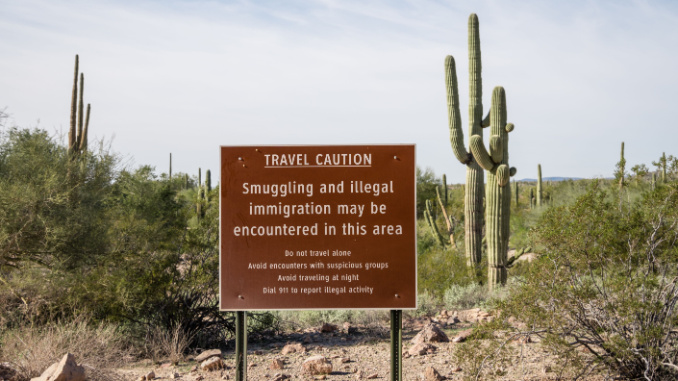
The Department of Homeland Security (DHS), through U.S. Customs and Border Protection (CBP), has achieved unprecedented border security milestones, with illegal border crossings reaching the lowest levels ever recorded at the start of a fiscal year.
Preliminary data for October and November 2025 show a continued historic decline in apprehensions and encounters, reflecting the effectiveness of President Trump’s policies and leadership.
Since President Trump took office on January 20, 2025, total enforcement encounters along the southwest border through the end of November stand at 117,105—37% below the monthly average of 185,625 recorded during the Biden administration.
U.S. Border Patrol apprehensions have averaged under 10,000 per month, described by DHS as “a level of deterrence unmatched in modern border history”.
Daily apprehensions along the southwest border now average just 245—fewer than 11 per hour—and a stunning 95% reduction from the Biden-era daily average of 5,110 (February 2021-December 2024). For comparison, December 2023 saw 336 illegal crossers apprehended every hour during the height of the prior administration’s border crisis—more than today’s entire daily total.
In October 2025, nationwide Border Patrol encounters and apprehensions totaled 30,573, distinctively down from 142,742 in October 2024, 309,605 in October 2023, and 278,317 in October 2022.
Preliminary data for November 2025 show 30,367 encounters, slightly lower than October’s record low. Combined, October and November recorded just 60,940 encounters—the lowest two-month start to any fiscal year on record and 28% below the previous low of 84,293 set in FY2012.
“Once again, we have a record low number of encounters at the border and the 7th straight month of zero releases. Month after month, we are delivering results that were once thought impossible: the most secure border in history and unmatched enforcement successes,” said Secretary Kristi Noem. “Thanks to President Trump’s leadership and the dedication of DHS law enforcement, America’s borders are safer than ever before.”
Every individual apprehended is processed for removal in accordance with the law, reversing Biden-era policies that pulled agents from the field to facilitate mass releases, leaving hundreds of miles of border unpatrolled for extended periods.
Ethan Faverino is a reporter for AZ Free News. You can send him news tips using this link.
by Matthew Holloway | Nov 18, 2025 | News
By Matthew Holloway |
The Arizona Department of Homeland Security (AZDHS) has joined a lawsuit brought by 12 states that challenges the terms set by the Trump administration and FEMA for two federal grants that impact the prevention and response to terrorist attacks, securing the southern border, and bolstering emergency management capabilities.
The lawsuit, filed on November 4th was touted by Democrat Attorney General Kris Mayes as “the 30th lawsuit the Attorney General of Arizona has joined to stop the Trump administration’s federal overreach.” It argues that the grant terms in the Emergency Management Performance Grant (EMPG) and Homeland Security Grant Program (HSPG) depart from past practices, essentially making it more difficult for state, local, and Tribal partners to obtain and use the federal grant funds.
Mayes complained at the time, “The Trump administration is trying to claw back money we use to protect the border, including for protective equipment and vehicles for law enforcement on the ground, and to support emergency preparedness and terrorism response preparation. They are also trying to withhold 50% of the funds we use to respond to emergencies in Arizona.”
“Local, state, and Tribal public safety agencies rely on funding from the Homeland Security Grant Program to effectively protect Arizonans from vulnerabilities bad actors may wish to exploit,” AZDHS Director, Dr. Kim O’Connor said in a statement. “This funding is absolutely essential in keeping our citizens and communities safe.”
The lawsuit points to two of the imposed terms as “at issue”:
- “A hold on EMPG funding until the State provides FEMA with ‘a certification of the recipient state’s population as of September 30, 2025,’ including an explanation of ‘the methodology it used to determine its population and certify that its reported population does not include individuals that have been removed from the State pursuant to the immigration laws of the United States.’”
- “A reduction of the period of performance, i.e., the period in which grant recipients must complete all activities to be reimbursed, from three years to one year.”
The state attorney’s general argue that the accurate determination of a state’s population of lawful inhabitants “exceeds” the federal government’s “statutory authority, as no statute permits Defendants to impose such a hold,” “is contrary to law because 13 U.S.C. § 183 requires federal agencies to use U.S. Census Bureau data to allocate federal grant funding,” and “is arbitrary and capricious in violation of the Administrative Procedure Act (“APA”) because it is unexplained, does not reflect reasoned decision making, and ignores the States’ reliance interests on receipt of the EMPG funds unimpeded.” Finally, they argue that the action was issued without following procedural requirements.
Reasoning for these requirements is, however, provided in the FY 2025 DHS Standard Terms and Conditions, which states “compliance with this term is material to the Government’s decision to make or continue with this award and that the Department of Homeland Security may terminate this grant, or take any other allowable enforcement action.”
Mayes also appears aware of another facet of the administration’s reasoning, as stated in her November 4th statement: “the Trump administration has attempted to reduce FEMA’s role and shift the burden of emergency management to the States.”
President Trump noted during a June announcement in the Oval Office that his administration “want(s) to wean off of FEMA and we want to bring it down to the state level.” He added that states should be equipped to handle disasters directly, noting that he wants to “give out less money,” and to “give it out directly,” according to the Associated Press. He further placed the onus for disaster response onto state governors saying, “The governor should be able to handle it and frankly if they can’t handle the aftermath, then maybe they shouldn’t be governor.”
Matthew Holloway is a senior reporter for AZ Free News. Follow him on X for his latest stories, or email tips to Matthew@azfreenews.com.
by Jonathan Eberle | Oct 15, 2025 | News
By Jonathan Eberle |
Arizona Senate President Warren Petersen hailed a “victory for Arizona” on Monday after Maricopa County Superior Court Judge Michael Valenzuela dismissed all challenges to the Secure the Border Act — a voter-approved initiative known as Proposition 314.
The ruling, issued October 10 and electronically filed October 13, upheld the will of voters who passed the measure in November 2024. In a statement on X , Petersen said the decision upheld “the will of voters who passed Prop 314 to protect our communities from illegal crossings and fentanyl,” calling border security “non-negotiable.”
“President Donald Trump truly delivered the most secure border in U.S. history,” Petersen wrote. “If our nation ever sees a repeat of lawlessness from an administration like we witnessed with Biden-Harris, Arizona will be ready to uphold the rule of law.”
The lawsuit, Living United for Change in Arizona et al. v. State of Arizona, challenged several provisions of Proposition 314, arguing the law violated Arizona’s constitution. Plaintiffs included Living United for Change in Arizona (LUCHA), the Arizona Center for Empowerment, and two individual plaintiffs.
According to court documents, the Secure the Border Act — approved by voters and enacted in November 2024 — created new state laws addressing immigration enforcement and public benefits eligibility.
Judge Valenzuela’s 10-page ruling rejected all three counts brought by the plaintiffs, determining that counts 1 and 2 were not “ripe” for review, as the challenged provisions are not currently enforceable; plaintiffs lacked standing to bring certain claims, particularly regarding separation of powers and legislative delegation arguments; and the SAVE Provision did not violate Arizona’s Revenue Source Rule, because participation in the federal verification program does not impose costs on state or local agencies.
The court concluded that the plaintiffs’ complaint “fails to state a claim on which relief can be granted” and dismissed it with prejudice, making the decision final under Arizona civil procedure rules.
The ruling allows Proposition 314 to stand as enacted by voters, although parts of the law will remain unenforceable until triggered by developments in Texas or another state with similar legislation. The decision represents a significant victory for Arizona lawmakers who championed the measure, including Petersen and House Speaker Steve Montenegro, both of whom intervened in defense of the law.
Supporters say the ruling reinforces Arizona’s right to protect its borders and uphold voter-approved laws. For now, however, the court’s dismissal marks a legal and political win for backers of Proposition 314 — and for state leaders pushing for stricter border enforcement at the state level.
Jonathan Eberle is a reporter for AZ Free News. You can send him news tips using this link.
by Matthew Holloway | Sep 19, 2025 | News
By Matthew Holloway |
Last week, Congressman Abe Hamadeh joined his fellow Republicans in passing the FY26 National Defense Authorization Act (NDAA) with a bipartisan vote of 231-196 in the U.S. House of Representatives.
The landmark legislation delivers critical support for Arizona’s military communities, service members, and defense industry. Hamadeh’s vote reflects his commitment to strengthening national security and prioritizing the needs of his constituents in Arizona’s 8th Congressional District.
“I am proud of the work we have done on the FY26 National Defense Authorization Act to support military families through a pay raise, restore America’s fighting forces, and secure our border,” said Congressman Hamadeh. “This legislation will get our service members what they need, when they need it, while supporting America’s manufacturers and workers.”
In a post to X, Hamadeh’s office wrote, “Congressman Hamadeh understands that Border Security is National Security, which is why he supports the FY26 NDAA to secure America’s borders. This means it fully funds the deployment of troops to the border and authorizes nearly $1 billion to combat drug traffickers.”
The FY26 NDAA, shaped through bipartisan collaboration, streamlines military procurement processes, delivering over $20 billion in savings while ensuring critical investments in Arizona’s military installations and defense innovation. Congressman Hamadeh’s leadership secured several key provisions that directly benefit Arizona’s service members, military bases, and defense industry.
Hamadeh’s office emphasized the key wins for Arizona in the FY26 NDAA. They highlighted two provisions impacting Luke Air Force Base in particular. The first is a provision requiring the Secretary of the Air Force to produce a detailed report on the operational impacts, workforce demands, and costs before any downgrade of leadership at major bases like Luke Air Force Base. This will ensure the base, a critical hub for training and operations, retains its one-star general leadership. The second provision addresses HVAC issues at the West Valley Air Force Base.
In broader moves for his district, Hamadeh worked with Rep. Don Davis (D-NC) to secure a provision eliminating burdensome regulations that required license holders to “babysit” machine guns during fitment and testing. This change will save Arizona’s defense industry, particularly in Congressional District 8, significant costs while boosting efficiency.
Hamadeh added additional provisions as well to invest in cutting-edge gyroscopes produced in Congressional District 8, enhancing intelligence, surveillance, and reconnaissance satellite imagery, fast-tracking the customization of jet engine production in Phoenix for use in collaborative combat aircraft, and increasing the acquisition of dump trucks for the Arizona Army National Guard.
Working in bipartisan cooperation alongside Reps. Andy Biggs (R-AZ-05) and Greg Stanton (D-AZ-04), Hamadeh also secured an order for three additional conversions of AH-64D to AH-64E Apache helicopters, saving jobs at Mesa’s remanufactured Apache production line, which had been at risk of shutting down. In collaboration with Sen. Mark Kelly (D-AZ), Hamadeh included a provision requiring the Secretary of Defense to report on suicide prevention resources under The Brandon Act, named after Congressional District 8 service member Brandon Caserta, who tragically died by suicide.
Hamadeh emphasized the collaborative nature of the NDAA, stating, “I am grateful to my colleagues for their bipartisan support of Arizona’s military installations and innovators.”
Matthew Holloway is a senior reporter for AZ Free News. Follow him on X for his latest stories, or email tips to Matthew@azfreenews.com.
by Jonathan Eberle | Sep 13, 2025 | News
By Jonathan Eberle |
Arizona’s top Republican lawmakers are asking the Trump administration to reimburse the state for more than $700 million spent on border security initiatives over the past several years.
Senate President Warren Petersen and House Speaker Steve Montenegro sent a letter this week to U.S. Secretary of Homeland Security Kristi Noem, requesting repayment under the recently passed One Big Beautiful Bill, which provides $10 billion for states to recover border-related expenses incurred during the Biden administration.
According to the letter, Arizona appropriated $599 million in 2021 and 2022 through the Border Security Fund, in addition to $145 million over five years for law enforcement and other enforcement efforts tied to the southern border. The funds were used to support sheriffs, the Department of Public Safety, and construction tied to border barriers.
“For four years, the Biden Administration failed to defend our border, leaving Arizona to shoulder the burden,” Petersen said in a statement. He argued that the investments made by the Legislature were necessary to protect residents and that taxpayers deserve reimbursement.
Earlier this year, Petersen joined a group of attorneys general on a border tour reviewing state and federal enforcement operations. He praised former President Donald Trump’s policies, calling them effective in reducing illegal crossings without additional legislation.
Montenegro also underscored the legislature’s commitment to border security, contrasting it with the approach taken by Democratic Gov. Katie Hobbs. He pointed to the voter-approved Secure the Border Act as evidence of public support for stricter enforcement.
“Arizona voters made their voices clear when they overwhelmingly passed the Secure the Border Act that Democrats tried to block,” Montenegro said. “Thanks to President Trump and his administration, Washington is finally treating border security as a priority again, and Arizona taxpayers deserve to be reimbursed.”
If the state receives federal funds, legislative leaders said the money will be directed into Arizona’s General Fund and overseen by the legislature to ensure proper use.
Jonathan Eberle is a reporter for AZ Free News. You can send him news tips using this link.