by Matthew Holloway | Oct 16, 2024 | News
By Matthew Holloway |
This week, the Arizona Republican Party reported that the AZGOP’s fundraising efforts “crushed” the party’s goals for the third quarter of 2024, raising a total of $9.22 million.
According to a press release from the party, the Republicans credited the success with Arizonans being “FED UP with the radical Harris/Walz agenda and the dangerous, California-style policies like Prop 140,” adding that they are “threatening” the state.
Chairwoman Gina Swoboda said in a statement, “This $9.22 million haul shows just how serious Arizonans are about WINNING this fight. Our supporters are fueling a movement that will stop the disastrous radical Left policies and ensure Arizona NEVER becomes California. We’re ready to turn out voters in November and WIN.”
The AZGOP noted that the fundraising effort will “supercharge” the party’s war chest going into the endgame of the 2024 election adding the funding is for “crucial efforts to protect Arizona from the Left’s overreach, defend our elections, and mobilize voters across the state.”
In its monthly newsletter, the AZGOP reported that the fundraising efforts are working to fund the Arizona Republican Coordinated Campaign (AZRCC) which it described as “the driving force behind securing Republican victories in November. Unlike traditional independent expenditures, the AZRCC works directly with candidates in critical swing districts, deploying targeted voter contact campaigns to ensure success at the ballot box.”
The party is currently engaged in 18 legislative races and is campaigning heavily to defeat the controversial, California-esque Propositions 140 and 139. As reported by The Hill earlier this month, the Republican party on a national level has lagged on spending in Arizona with only $17 million in aired ad spending in the state.
In a January interview with Steve Bannon’s Warroom, Swoboda told the host that the AZGOP came into the year with “no money,” as State Affairs noted the party ended 2023 with approximately $160,000 cash on hand. Republican consultant Chuck Coughlin told the outlet that the decision to move the party’s headquarters and sell the existing location near Park Central was “prudent.” He told State Affairs, “It seems Ms. Swoboda is making the best of a bad situation.”
Matthew Holloway is a senior reporter for AZ Free News. Follow him on X for his latest stories, or email tips to Matthew@azfreenews.com.
by Daniel Stefanski | Oct 9, 2024 | News
By Daniel Stefanski |
After a lengthy court battle, a ballot measure involving a major change to Arizona’s elections system will be considered by voters in the upcoming November General Election.
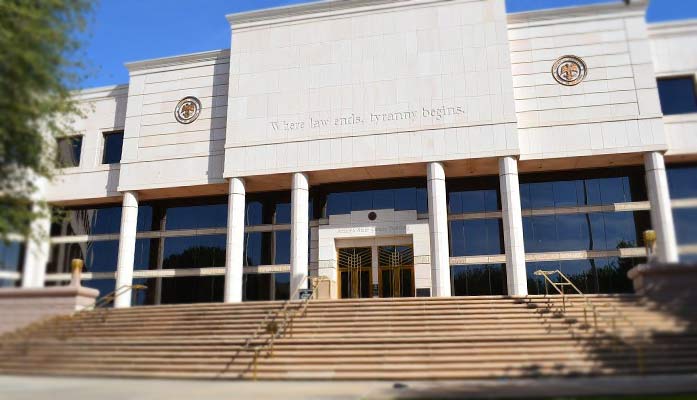
Late last week, the Arizona Supreme Court finally dismissed the challenge to Proposition 140, the Make Elections Fair Arizona Act. The court simply released its decision order, promising an explanation later. All the justices on the court supported the ruling.
The Arizona Free Enterprise Club, which spearheaded the challenge to the legal validity of the proposition, was disappointed in the result from the court. Scot Mussi, the President of the conservative organization, said, “We are disappointed in the ruling of the court on this matter. Our organization proved that the special interest groups attempting to hijack Arizona’s elections systems lacked the minimum number to qualify for the ballot to even be considered by voters in November. The special master in this case also ruled that 99% of the signatures in question should be disqualified. The committee behind the measure was aware of the duplicates, yet they obstructed and delayed the review of the duplicate signatures for over a month.”
Sarah Smallhouse, Chairperson of the Make Elections Fair Committee, said, “The Make Elections Fair Committee is thrilled with our latest victory for Prop. 140 before the Supreme Court. 32 days from now we will celebrate again when all Arizonans are liberated from the grip of partisan primary elections. It’s time to move forward. It’s time for open primaries in Arizona.”
“Our opponents engaged in blatant attempts to manipulate the system, undermining the democratic process with misleading tactics. This deliberate misconduct was rightfully rejected by the courts, ensuring that Arizona voters were not disenfranchised. The court’s decision upheld the integrity of our elections and protected the right of every voter to have a fair and transparent choice,” said Chuck Coughlin the campaign treasurer.
According to the Make Elections Fair PAC, Prop 140 would do the following if it is approved by Arizona voters: “Eliminates taxpayer funding for partisan elections; All candidates can run and will appear on the same ballot; Same signature requirements for all candidates; No funding for Partisan Presidential Primary unless unaffiliated voters are included; Every voter can participate in every election.”
The Arizona Free Enterprise Club has a different perspective on the ballot measure. In a press release, the Club stated that Prop 140 would do the following if enacted:
- “Allows one politician, the Arizona Secretary of State, to decide how many candidates qualify for the general election ballot for every single contest, including his or her own race
- Would result in some races where candidates from only one political party appear on the general election ballot
- Would force voters to navigate two completely different voting systems on the same ballot, with some races requiring voters to rank candidates and others that do not
- Will increase tabulation errors, create longer lines at the polls, and significantly delay election results.”
A couple of Arizona political parties weighed in on the official inclusion of Proposition 140 for voter consideration. The Republican Party of Arizona posted, “ACTION ALERT The awful California style Ranked Choice Voting measure DISGUISED as an ‘open primary’ will appear on AZ ballots. We need EVERYONE to join us on the NO ON PROP 140 campaign to Save Arizona.”
The Arizona Libertarian Party agreed, writing, “The AZLP approves this message. Prop 140 could effectively kill third-party and independent candidates. Vote no!”
Daniel Stefanski is a reporter for AZ Free News. You can send him news tips using this link.
by Matthew Holloway | Jul 12, 2024 | News
By Matthew Holloway |
With voter confidence at an all-time low, state and county elections officials have their work cut out for them to run the 2024 polls effectively and restore the faith. However in Pinal County, with just weeks left before the Arizona primary, a small mistake could have large repercussions and does not build voter confidence.
As reported by SanTanValley.com, early ballots sent out July 3 for the 2024 primary election taking place July 30 were mailed, missing a “critical update regarding the return instructions.” The outlet reported that the county, in an effort to alleviate confusion between neighboring Maricopa County’s ballots and its own, switched from using green ballot return envelopes to “buff-colored” envelopes… without altering the instructions to the voter. So the written instructions that accompanied the ballot instruct the voter to use an envelope they weren’t sent.
In a statement reported by The Apache Junction/Gold Canyon Independent, the county said, “Unfortunately, the directions did not update the change from green to buff. Postcards with updated instructions will be mailed to all voters who received an early ballot. A notice will also be placed on the Pinal County Recorder’s website. The Republican and Democrat Party Chairs have been notified as has the Secretary of State’s office.”
The Pinal County Elections Department and the Pinal County Recorder’s Office provided the corrected instructions via a shared X account, which should have read:
- Step 3: Place the WHITE affidavit envelope into the BUFF return envelope addressed to the Recorder and seal.
The Arizona Republican Party posted an update regarding the error to X writing, “PINAL COUNTY VOTERS See Message from Recorder’s Office Error on Early Voting Ballot Printed Envelopes. The instructions call for a ‘GREEN’ return envelope but the color of the return envelope is ‘BUFF’ color. Follow these guidelines so that your ballot is processed timely: 1. Place your ballot into the WHITE affidavit envelope. 2. Sign and seal the WHITE affidavit envelope. 3. Place the WHITE affidavit envelope into the BUFF return envelope addressed to the Recorder and seal.”
Comments on the post revealed expressions of concern, dismay, and even dubiousness with one X user noting, “These mistakes don’t help anyone.” Another X user added, “Oh gee, who’d have guessed Pinal County messed up again?”
Paz Phillips an “AZ, Precinct & State Committeeman,” according to her bio asked, “Didn’t Pinal County just go through election problems and had to replace people?”
As noted by the commenters on X, and the AJ/GC independent, in the widely criticized 2022 primary election cycle, Pinal County suffered multiple printing errors on its early ballots and critical shortages of ballots at voting precincts on election day which contributed to massive erosion in voter confidence. As a result, the county elections department underwent a very public and costly revamp. However, this 2024 error is clearly not building voter confidence.
Matthew Holloway is a senior reporter for AZ Free News. Follow him on X for his latest stories, or email tips to Matthew@azfreenews.com.
by AZ Free Enterprise Club | Feb 19, 2024 | Opinion
By the Arizona Free Enterprise Club |
If Adrian Fontes likes spending time in court, he’s going to have a fun time in 2024. In case you’ve lost count, Arizona’s Secretary of State has been sued three times over his Elections Procedures Manual (EPM) in just the last two weeks. That’s what happens when you produce one of the most radical EPMs in Arizona’s history.
At the end of January, Senate President Warren Petersen and House Speaker Ben Toma filed a lawsuit against Fontes over a variety of provisions in his EPM that violate or conflict with current election laws in our state. But the party was just getting started.
Last week, the Arizona Republican Party, the Republican National Committee, and the Yavapai County GOP also sued Fontes for his blatant attempt to rewrite election law through his EPM. And on the same day, we filed our own lawsuit against Fontes over the promulgation of certain unlawful rules set forth in his EPM.
The reality is that, in his role as Secretary of State, Adrian Fontes is supposed to provide an EPM that gives impartial direction to county recorders to ensure uniform and correct implementation of election law. Instead, he prescribed certain rules without the power to do so and moved forward with an EPM that contains several “rules” that are unconstitutional.
>>> CONTINUE READING >>>
by Corinne Murdock | Feb 13, 2024 | News
By Corinne Murdock |
Arizona Secretary of State Adrian Fontes is facing another lawsuit over his Elections Procedures Manual (EPM), the state’s rulebook for administering federal and state elections updated biennially.
On Friday, the Arizona Republican Party (AZGOP), the Republican National Committee (RNC), and Yavapai County GOP sued Fontes over the 2023 EPM. Newly-elected AZGOP Chairwoman Gina Swoboda stated in a press release that Fontes had far surpassed his limited rulemaking authority through the EPM.
“Fontes and his allies are not legislators — they have no right to insert their preferred far-left policies into the guidance for Arizona elections,” said Swoboda. “This is a blatant attempt to rewrite election law and hollow out basic safeguards that are designed to preserve election integrity in our state’s elections.”
State law limits Fontes’ rulemaking authority to supporting existing laws on early and regular voting, and the handling of ballots and other election materials. The GOP groups stated in their lawsuit that these limitations were necessarily “specific and exhaustive” because the EPM carries the force of law upon approval by the governor and attorney general: a violation of any EPM provision is a class two misdemeanor, which carries a maximum four-month jail sentence.
Nine provisions set forth in Fontes’ EPM conflict with state election law, according to the GOP groups. These provisions concern registered voters who are declared noncitizens or have not provided Documentary Proof Of Citizenship (DPOC), signature verification, challenges to early ballots, out-of-state mailed ballots, and out-of-precinct voters.
One contested EPM provision requires county recorders to not cancel the voter registrations of individuals who declared themselves noncitizens on juror questionnaires if they have previously provided DPOC or have been registered to vote since 2004. The GOP groups contend that A.R.S. § 16-165(A)(10) requires county recorders to cancel those types of voter registrations, should the individual in question not respond to a mailed request for DPOC within 35 days.
A second contested EPM provision allows for those who don’t submit DPOC or whose DPOC can’t be verified to be registered as federal-only voters: individuals who may only cast votes for federal offices. The GOP groups contend that A.R.S. § 16-127(1) prohibits those without DPOC from voting in presidential elections.
A third contested EPM provision allows first-time, federal-only voters to provide only an ID and not DPOC in order to vote by mail. The GOP groups contend that A.R.S. § 16-127(2) prohibits anyone who hasn’t provided DPOC from voting by mail.
Fourth and fifth contested EPM provisions declare that county recorders aren’t required to check federal databases for citizenship review purposes. The GOP groups contend that A.R.S. §§ 16-165 and 161-121.01 require county recorders to compare voter registrations to a specific and inclusive list of state and national databases.
A sixth contested EPM provision precludes public review of voter signatures on mail ballots, limiting review to documents pertaining to a candidate, initiative, referendum, recall, new party, or petition. The GOP groups contend that A.R.S. § 16-168(F) allows public review of voter signatures for all election purposes.
A seventh contested EPM provision allows Active Early Voting List (AEVL) voters to make one-time requests for their ballots to be mailed to an address outside the state for certain elections. The GOP groups contend that A.R.S. § 16-544(B) prohibits AEVL voters from using a mailing address outside the state unless they are Uniformed and Overseas Citizens Absentee Voting Act (UOCAVA) voters.
An eighth contested EPM provision requires the denial of early ballot challenges received prior to the “return” of an early ballot or after the opening of an early ballot affidavit envelope. The GOP groups contend that A.R.S. § 16-552(D) allows for challenges to be placed before early ballots are placed in the ballot box specifically.
A ninth contested EPM provision allows out-of-precinct voters to cast provisional ballots. The GOP groups contend that A.R.S. § 16-122 prohibits out-of-precinct voters from voting at all.
Their lawsuit also accuses Fontes of ignoring statutory requirements for public and stakeholder review of the EPM, namely by withholding disclosure of “critical portions” of the rulebook until its final release last December.
GOP leadership also objected to Fontes only granting 15 days for initial public comment on the draft EPM from last July to mid-August and then allowed for no public comment period prior to the publishing of the final EPM in December. The Administrative Procedure Act (APA) requires agencies — defined as boards, commissions, departments, officers, or other administrative units — to allow for at least 30 days of public comment. The GOP groups argue that the secretary of state’s office falls under APA’s definition of agency.
Both the AZGOP and RNC raised objections to the brevity of public comment for the draft EPM around the time of its release, which Fontes ignored.
At the end of last month, Arizona’s GOP legislative leadership sued Fontes over the EPM. Their lawsuit contested some of the same provisions as this latest lawsuit from the GOP groups, but also contested other provisions, such as an AEVL provision delaying voter roll cleanup until 2027 and a canvassing provision circumventing court-based relief for when boards of supervisors fail to certify an election.
Corinne Murdock is a reporter for AZ Free News. Follow her latest on Twitter, or email tips to corinne@azfreenews.com.