by Terri Jo Neff | Sep 17, 2022 | News
By Terri Jo Neff |
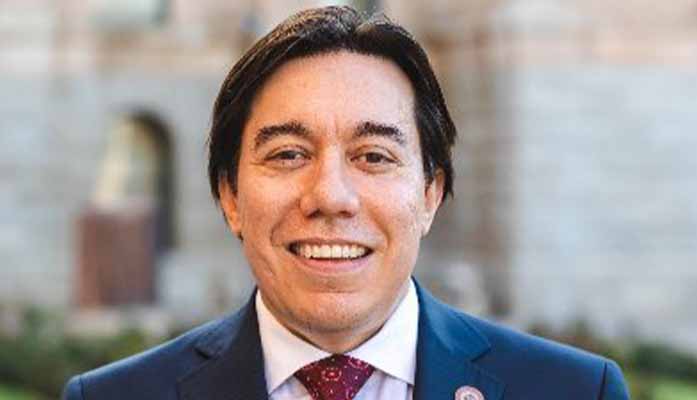
State Rep. Brian S. Fernandez (D-Yuma) has reportedly lost a key labor endorsement in the upcoming election after being accused by a fellow Democratic lawmaker of calling her a “Fat Fu**” to other elected officials and lobbyists.
Arizona Rep. Alma Hernandez tweeted Friday that SMART—the International Association of Sheet Metal, Air, Rail and Transportation Workers—Local 359 pulled its support for Fernandez as a result of his alleged comments about Hernandez, who represents parts of the greater Tucson area.
Fernandez, who is also accused of telling people he “hates” Hernandez, is running against Republican nominee Gary Snyder in the upcoming Nov. 8 General Election to represent Legislative District 23 in southwest Arizona.
On Friday morning Hernandez released a letter calling on Fernandez to take part in sensitivity training and to apologize “to every single woman” in the Democratic Party. She also wants party leadership to “seek a punishment” against Fernandez, who was appointed to the Legislature last year to fill the seat his mother Charlene vacated after several years.
Hernandez has also demanded the entire Democratic Legislative Caucus “take a pledge to not engage in this type of behavior against women.” Minority Leader Rep. Reginald Bolding issued a response Friday which noted the leadership team “is aware” of Hernandez’s letter.
“The House of Representatives has a clear policy on Workplace Harassment that gives zero tolerance to this type of behavior,” Bolding noted. “Pursuant to this policy, these allegations will be taken seriously, properly investigated and have been referred to the Rules Office.”
Very few other Democratic state lawmakers weighed in on the controversy. One is Rep. Cesar Chavez (Phoenix), who lost in the August primary election to Anna Hernandez, sister of Alma.
by Corinne Murdock | May 17, 2022 | News
By Corinne Murdock |
Republican legislators expressed displeasure with a bill brought forth by State Senator Paul Boyer (R-Glendale) to require county recorders to publicize the total number of early ballots returned to voting locations on election day — 14 of 31 Republicans voting against it. Effectively, House Republicans were divided in half on the issue.
One of the first legislators to express their disapproval of the bill was State Representative John Fillmore (R-Apache Junction). He said that Arizona had passed three historic election integrity bills and failed 14 others, 13 of which he blamed on Boyer. Fillmore said the bill was an insult to Arizona voters.
“This bill doesn’t do a darn thing but insult our caucus, the state of Arizona, and the Republic,” said Fillmore. “This is a bill that should’ve never been brought to the floor.”
The bill, SB1329, passed with some bipartisanship. 15 Republicans joined 22 Democrats to pass the bill. In addition to Fillmore, State Representatives Brenda Barton (R-Payson), Leo Biasiucci (R-Lake Havasu City), Walt Blackman (R-Snowflake), Judy Burges (R-Skull Valley), Neal Carter (R-Queen Creek), Joseph Chaplik (R-Scottsdale), Mark Finchem (R-Oro Valley), Teresa Martinez (R-Oro Valley), Kevin Payne (R-Peoria), Beverly Pingerelli (R-Peoria), and Justin Wilmeth (R-Phoenix) voted against the bill.
Democrats expressed wholehearted support for the bill. State Senator Lorenzo Sierra (D-Avondale) claimed that belief that the 2020 election was rigged in favor of President Joe Biden was the biggest lie of all time. Sierra’s assertion elicited groans from those around him, provoking him to insist that Fillmore instigated him.
“I support this bill because it attacks the greatest lie ever told in the course of human history,” said Sierra. “[Fillmore] started it, it’s going, I vote yes!”
State Senator John Kavanagh (R-Fountain Hills) made light of Fillmore’s ire, remarking that his colleague’s vote against the bill seemed to inspire all Democrats to support it. His comment stoked laughter around the room.
“I wanted to thank Representative Fillmore for discovering a new, secret weapon for the Republicans. Apparently if he votes against an election integrity bill, every Democrat votes for it, which is absolutely amazing,” said Kavanagh with a laugh.
As an explanation of her “no” vote, Martinez simply referenced the recent documentary on widespread mail-in ballot fraud in the 2020 election, “2000 Mules” from conservative commentator Dinesh D’Souza.
“2000 Mules. And with that, I vote no,” stated Martinez.
Minority Leader Reginald Bolding (D-Laveen) insisted that the bill was a common-sense policy that offered transparency to voters concerning the number of ballots cast and counted in real time.
“This gives many of the unfounded issues that we saw during the 2020 election when people asserted that there were somehow additional ballots that were out there, floating, that were being added to support candidates or another,” said Bolding.
SB1329 now heads to Governor Doug Ducey for approval.
Corinne Murdock is a reporter for AZ Free News. Follow her latest on Twitter, or email tips to corinne@azfreenews.com.
by Corinne Murdock | Mar 18, 2022 | News
By Corinne Murdock |
A bill to tighten up mail-in voting, SB1260, passed the House Government and Elections Committee along a party-line vote on Wednesday, 7-6.
SB1260, introduced by State Senator J.D. Mesnard (R-Chandler), would make it a class 5 felony for someone to knowingly help another to vote who’s registered in another state. If made law, people would be required to write “not at this address” on an early ballot sent to their home but not addressed to them. There’s no penalty for not writing the phrase on the ballot. In return, county recorders would have to cancel that individual’s registration and remove their name from the Active Early Voting List (AEVL).
Mesnard explained during the committee hearing that Arizona law doesn’t currently have standards for handling those who’ve moved, such as duplicate registrations.
Minority Leader Reginald Bolding (D-Laveen) inquired how a prosecutor would determine that an individual knew they were helping another vote fraudulently, giving an example of a parent forwarding an absentee ballot to their college student who’d established residency and registered to vote in another state. Mesnard admitted that determining that someone “knowingly” facilitated fraudulent voting was difficult to prove, emphasizing that the burden to prove that would fall on the prosecutor.
“I don’t think it should be someone caught up in an innocent mistake,” said Mesnard.
State Representative Kevin Payne (R-Peoria) pointed out that the college student given in Bolding’s example would have to vote on the ballot for the parent’s mistake to be made apparent, and that the college student would be knowingly submitting a fraudulent vote.
State Representative Sarah Liguori (D-Phoenix) asked whether this was a real issue that occurred. Mesnard confirmed that he’d received reports of people submitting ballots to others registered in other counties.
“What does the statute say? Is the statute silent on it or does it address that? And it was silent on the issue,” said Mesnard.
Constituents in favor of the bill included Arizona Free Enterprise Club Deputy Director Greg Blackie, agreeing with Mesnard that current statute doesn’t address this problem that mailed ballots present.
Bolding claimed that counties already have a mechanism in place to address ballots sent to the wrong address, and he argued that the ignorant might be punished for unintentionally committing a crime.
“If they are somehow convicted by a rogue prosecutor, whether they’re at the local level or state level who’s looking to make a political point or score points,” said Bolding. “In this political environment right now, I think we need to be judicious in the laws that we’re making. We need to make sure we’re taking the politics out of it, especially when it comes to the electoral process.”
Liguori concurred with Bolding’s assessment, arguing that the legislation addressed a nonexistent problem.
Corinne Murdock is a reporter for AZ Free News. Follow her latest on Twitter, or email tips to corinne@azfreenews.com.
by Corinne Murdock | Mar 1, 2022 | News
By Corinne Murdock |
The Arizona House passed a bill to prevent illegal immigrants from voting, HB2492, along party lines on Monday, 31-26. The bill would impact federal-only voters heavily because that class of voters isn’t required by federal law to provide proof of citizenship. Federal-only voters had a significant impact in the 2020 election. The main exception made in this legislation would be for those who submit forms produced by the U.S. Election Assistance Commission.
The bill would require county recorders to rely on local, federal, and state databases to discern whether the applicant is a citizen. Refusal to comply would qualify officials for a class six felony. In the event that an applicant is discovered to be here illegally, officials must notify applicants of their rejection and refer the case to both the county attorney and attorney general for further investigation. Lack of citizenship proof, however, would only require election officials to notify the applicant of their rejection and offer them time to respond with proof of citizenship. A floor amendment removed the 30-day deadline applicants would’ve had to abide by to provide proof of citizenship.
Valid, unexpired driver’s licenses or nonoperating ID numbers would suffice for proof of location requirements to establish residency.
County recorders must also work with the secretary of state to present a list of all individuals who registered to vote and haven’t provided satisfactory evidence of citizenship by Halloween of this year. At that point, the attorney general would have until the end of next March to determine each applicant’s citizenship status and submit a report to the secretary of state, senate president, and house speaker.
As AZ Free News reported, the sponsor of the bill, State Representative Jake Hoffman (R-Queen Creek), explained in the House Government and Elections Committee last month that there were over 11,000 individuals who didn’t provide a Documentary Proof of Citizenship (DPOC) to vote in the 2020 election. By contrast, there were about 1,700 individuals who didn’t provide proof of citizenship in 2018.
HB2492 received significant opposition from the illegal immigrant activist community. Those who harassed and stalked Senator Kyrsten Sinema (D-AZ) into an Arizona State University (ASU) bathroom over her refusal to support President Joe Biden’s reconciliation bill.
The bill now heads to the Senate for consideration.
Corinne Murdock is a reporter for AZ Free News. Follow her latest on Twitter, or email tips to corinne@azfreenews.com.
by Terri Jo Neff | Feb 23, 2022 | News
By Terri Jo Neff |
Two bills designed to tweak Arizona’s voter registration laws had third readings in the House on Tuesday, resulting in party line votes of 31 to 28.
House Bill 2237 stipulates that a department, division, agency, or political subdivision of Arizona—or any person acting on behalf of one—may not register a person to vote on an election day and then deem that person eligible to vote in the same election. Doing so would be a Class 6 felony which carries a presumptive one-year prison sentence.
Under current law, someone seeking to register to vote must meet several criteria, such as being U.S. resident, being a resident of Arizona for 29 days before the election, and being at least 18 years of ago on or before the next election following registration.
There is also a deadline in Arizona for registering to vote – 29 days before the election.
However, some people are allowed to cast a provisional ballot on Election Day. The provisional ballot includes information for registering the person to vote going forward if it is determined the person is not already registered.
Rep. Jake Hoffman (R-LD12) introduced by HB2237 to ensure the information included with the provisional ballot is not used to register the voter until after election day. Otherwise, Arizona’s 29-day registration deadline could be circumvented.
A second bill introduced by Hoffman, HB2243 would add a simple advisory statement to all new voter registration forms. The advisory informs the person registering to vote that if they permanently move to another state after being registered in Arizona, then their Arizona voter registration will be cancelled.
Supporters of HB2243 say it will help keep Arizona’s voter database up-to-date. In addition, it would reduce the opportunity for fraud if the moved voter was on the early balloting list or lives in a community with vote-by-mail elections.
Hoffman had 11 co-sponsors on each of the two bills.