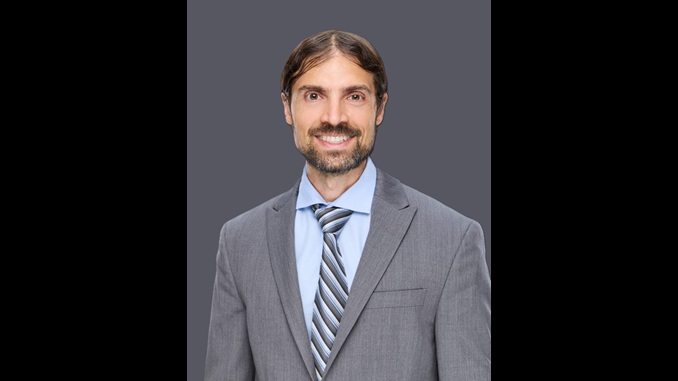
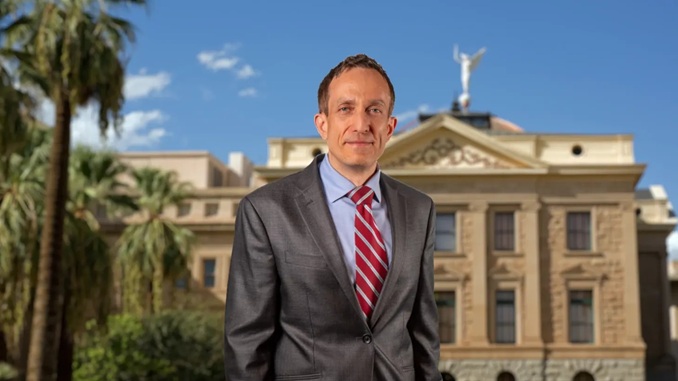
State Rep. Walt Blackman (R-LD7) has endorsed Republican Bradley “Brad” Bettencourt in the three-candidate race for two Arizona House seats in Legislative District 9.
Blackman is a retired U.S. Army combat veteran who served for 21 years and received the Bronze Star Medal for combat actions in Iraq. He currently serves as chairman of the House Government Committee.
“I’m proud to endorse Brad Bettencourt for the Arizona House in Legislative District 9,” Blackman said. “Brad is a businessman and community leader who has already shown he can step up, fix real problems, and get the numbers to add up. That is the kind of common-sense leadership Arizona families need. He will work hard, respect taxpayers, and be a strong voice for Mesa and Tempe. I encourage LD9 voters to support him.”
Blackman, a 21-year U.S. Army combat veteran and chairman of the House Government Committee, had the following to say.
“I’m proud to endorse Brad Bettencourt for the Arizona House in Legislative District 9,” Blackman said. “Brad is a businessman and community leader who has… pic.twitter.com/HhYahtjhwi
Bettencourt welcomed the endorsement and cited Blackman’s military and legislative service.
“Rep. Blackman’s endorsement means a great deal,” Bettencourt said. “He has served this country in uniform and this state in the Legislature. He knows the difference between talk and results. I will take that same standard to the House: fiscal responsibility, safe communities, parents in charge of their children’s education, and a state budget that works for the people who live here.”
Bettencourt will face Democratic Rep. Lorena Austin and Democratic candidate Jacob Martinez in the general election.
The official statewide primary canvass recorded 10,441 votes for Bettencourt in the Republican primary. Austin received 11,252 votes, and Martinez received 9,290 votes in the Democratic primary.
Austin currently represents LD9 alongside Democratic Rep. Seth Blattman. Blattman announced in December that he would not seek reelection in 2026.
Bettencourt is president of the Dobson Association, the homeowners’ association serving Dobson Ranch in Mesa. His campaign biography says he earned bachelor’s and master’s degrees from Arizona State University, previously worked as a credit analyst and credit officer, and operates a real estate investment business.
Bettencourt has cited his work at Dobson Ranch as evidence of his approach to government finances. His campaign says the community, which includes approximately 5,000 homes and condominiums, uncovered more than $1.5 million in budget errors before he helped bring its finances back into order.
Bettencourt has made fiscal responsibility, housing affordability, water security, public safety, school choice, and government spending central issues in his campaign.
The Legislative District 9 Republican Committee endorsed Bettencourt in February. The committee’s resolution cited his service as an elected Republican precinct committeeman, his Dobson Ranch leadership, and his business experience.
An attorney with America First Legal (AFL), the nonprofit created by President Donald Trump’s policy chief Stephen Miller, is running for a seat in the Arizona House.
AFL senior counsel James Rogers is gunning to represent LD10. For the past five years he has been in court challenging faulty election processes and other red-meat Republican issues. With that history heavily promoted, Rogers campaigns as one with the potential to be the foremost election integrity expert in the legislature.
Rogers’ platform also focuses on what he calls “straightforward” conservative issues: affordability to encourage family growth, election integrity, purging gender ideology from schools, protecting the unborn, stopping illegal immigration, and defending gun ownership rights.
Since Republican State Rep. Ralph Heap won’t be returning to represent LD10 — he’s running for the Arizona Corporation Commission — Rogers and State Rep. Justin Olson are running together as a slate.
There’s a third Republican candidate in the mix: Ciara Anderson, who moved to Arizona in 2021 from Washington state. Anderson has served as a Republican precinct committeeman and LD10 executive board member, and founded a mothers-focused coalition through Turning Point Action.
Two are running on the Democratic side: Brian Calaway and Helen Hunter. The No Labels party has one candidate: David Scott.
Rogers, a sixth-generation Arizonan, takes credit for drafting key Republican-led legislation like Proposition 314, the Secure the Border Act approved by voters in the 2024 election. The law criminalized illegal migration into the state and gave the state authority to act on immigration matters: state and local law enforcement may arrest illegal aliens, and state judges may order deportations.
A similar law in Texas, Senate Bill 4, has been challenged in federal court and would determine the fate of Arizona’s law. So far, Texas’s law has withstood legal challenges.
Rogers was senior litigation counsel at the solicitor general’s office for former Attorney General Mark Brnovich during the COVID-19 pandemic, 2021 to 2022. In that time, Rogers led on lawsuits against former President Joe Biden’s COVID-19 vaccine mandates and border policies.
Prior to serving under Brnovich, Rogers was a foreign service officer with the State Department from 2015 to 2021. According to his April 2025 testimony before the House Foreign Affairs Committee Subcommittee on Oversight and Intelligence, Rogers endured retaliation for whistleblowing.
Rogers alleged that State Department leadership ignored Trump on policy to more thoroughly vet visa applicants during his first term, but that he complied and was punished for it through a denial of tenure. Rogers also reported that his rate of problematic visa issuances, such as overstays, was more than 50% lower than his colleagues’ while following the directive of Trump rather than his supervisors.
Rogers estimated that the number of visa overstays was two to four times higher than it would have been had State Department leadership complied with Trump’s orders.
“[T]he malfeasance of State Department consular managers during that time likely caused 900,000 to 1.4 million extra overstays that were easily avoidable. Most foreigners who overstay their visas do so with the intent of illegally immigrating and remaining in the United States long-term,” said Rogers. “To put that in perspective, ten U.S. states have populations of 1.4 million or less. In other words, consular managers working to subvert President Trump’s policies managed to add an entire state population’s worth of illegal aliens in just four years.”
Since joining AFL in 2022, Rogers has led on cases challenging the Biden administration, such as the alleged diversity, equity, inclusion, and accessibility (DEIA) discrimination that occurred within the federal government.
Rogers also testified before the House Judiciary Committee last March to discuss court-ordered immigration policy made through the landmark Supreme Court case Plyler v. Doe (1982), which determined that states must permit children of illegal aliens to attend public school. Rogers argued that the decision was wrong, and that the legal framework used by the Supreme Court to overrule Roe v. Wade through Dobbs v. Jackson could be applied to overrule Plyler v. Doe.
“The Court’s role is to interpret the Constitution, not to serve as a policymaking body filling in the gaps left by legislative inaction,” said Rogers. “Where the Constitution’s text, history, and precedent all point in the same direction — and where the Court’s own analytical concessions compel application of a standard under which the challenged law would clearly survive — the Court must follow the law, not its own policy preferences.”
AZ Free News is your #1 source for Arizona news and politics. You can send us news tips using this link.
Legislative District 13 candidate Debra Schinke is looking to get into government to reduce its footprint, and ensure it further prioritizes faith, law, and families.
Schinke, a Chandler Citizens Police Review Board member, also wants to apply her 17 years as a fraud prosecutor to cutting down on waste within the presently struggling state budget.
The former president of Chandler Republican Women (2020-2023) told the Gilbert Chamber of Commerce in a candidate interview last month that she experienced the injustice of bureaucratic bloat during her upbringing in a California farming community.
During her youth, Schinke said she helped around her father’s gas station in addition to taking up customer service and accounting for his propane company. The former Grace Community Christian School board member attested to the struggles imposed by copious regulations on her father’s small businesses.
Schinke said freedom can’t exist without freedoms in the marketplace.
“Some of us need to stand up and defend the small businesses in our communities,” said Schinke. “Small businesses are the backbone of our economy.”
Schinke decided to run for public office because of her son, a member of the Air Force stationed in Japan. During her time as a precinct committeewoman, Republican state committeewoman, and Arizona Federation of Republican Women leadership team, she has spent years working campaigns for candidates running for city councils, school boards, the legislature, and Congress.
“It just spoke to my heart again, that if our sons and daughters are over fighting for us and our freedom and liberty, then I need to be here on the frontlines, too,” said Schinke.
Schinke’s platform consists of historically standard perspectives like: encouragement of public faith in God, protection for parental rights, resistance to bureaucratic growth, a strict view of borders, implicit trust for law enforcement, and an open mind for school choice.
While Schinke generally opposes a larger government presence, she has taken exception to the ongoing issue of water. Schinke indicated that the state ought to lead on conservation measures, but without creating additional burdens on residents.
On this and other pressing issues in the Valley, like public transit and housing, Schinke said she needed to conduct more research. In all cases, Schinke said her litmus would be the impact on Arizona families.
Per her latest campaign finance report, Schinke has raised nearly $40,400.
Other candidates in the LD13 race are Democratic candidate Racquel “Rockee” Armstrong and Republican candidates Kevin Hartke, Chandler mayor, and Janet Weninger, wife of State Rep. Jeff Weninger (R-LD13).
Armstrong’s platform encourages increased government spending to deflate costs by expanding affordable housing and public transportation.
Both Weninger and Harktes’ platforms appeared similar to Schinke’s, but with more openness to select government spending to improve social outcomes.
AZ Free News is your #1 source for Arizona news and politics. You can send us news tips using this link.
Last week, the Arizona House of Representatives passed an Arizona First budget focused on increasing take-home pay, lowering costs, and protecting core services. The Arizona Senate is on track to approve it today. Governor Hobbs should sign it.
The fastest way to address an affordability crisis is simple: let people keep more of what they earn.
This budget returns $1.45 billion to taxpayers over the next three years. When government takes less, families keep more through bigger paychecks, larger refunds, and lower overall tax burdens.
Our plan raises the standard deduction so workers can keep more from each paycheck. It exempts tips and overtime pay so frontline workers see meaningful relief at tax time. It reduces the cost of raising a family by exempting childcare expenses from state taxes and increasing the per-child tax refund by 25%. And it supports seniors on fixed incomes by exempting retirement income for Arizonans age 60 and older.
The goal is straightforward: you keep more, and government takes less.
At a time when families are tightening their belts, government should do the same. Yet the governor’s proposal increased spending to $18.7 billion. The House budget spends $800 million less without compromising the core services Arizonans rely on. It reflects the same discipline families practice every day.
This plan shows that responsible leadership is still possible in divided government. It prioritizes stability, protects taxpayers, and delivers a balanced approach ahead of the new fiscal year.
It fully funds K-12 education with an inflation increase, provides $200 million for public school facility repairs, gives additional support to low-income students, and eliminates co-pays for reduced-price school meals. It protects the most vulnerable by funding congregate care within the Department of Child Safety, addressing rising costs for high-need individuals with developmental disabilities, and strengthening foster care support through community providers.
This is what responsible governing looks like: targeted tax relief, controlled spending, and a commitment to core priorities. It recognizes that affordability is not just a talking point. It is the defining issue for Arizona families.
Governor Hobbs now has a clear choice. She can embrace a balanced, responsible budget that lowers costs and delivers real relief. Or she can reject a plan that reflects the will of a divided government working in good faith.
The House has done its job. We cut taxes. We protected essential services. We kept spending in check.
For Arizona families feeling the strain of rising costs, this budget deserves the governor’s signature.
Steve Montenegro is the Speaker of the Arizona House of Representatives and serves Legislative District 29 in the West Valley, Goodyear, and Surprise. Follow him on X at @SteveMontenegro.
State Rep. Gail Griffin (R-LD19) was recognized for achieving the longest active streak of “Above Expectations” performance among members of the Arizona House of Representatives, according to a new report from the Center for Effective Lawmaking.
The recognition was announced in a press release from Arizona House Republicans, which cited the Center’s State Legislative Effectiveness Scores for the 56th Arizona Legislature. The report found that Griffin maintained a three-session streak of “Above Expectations” ratings, the longest currently recorded in the Arizona House.
The Center for Effective Lawmaking is a nonpartisan research initiative operated jointly by Vanderbilt University and the University of Virginia.
According to the report, Griffin received an effectiveness score of 5.50 for the 2023–2024 legislative session. That score ranked second-highest in the Arizona House and exceeded the scores of all members of the Arizona Senate during the same period. Griffin’s score was exceeded only by Rep. David Livingston (R-LD28), with 7.23.
The effectiveness scores evaluate lawmakers based on factors including bill sponsorship, legislative progress, and the ability to advance policy through the legislative process.
Griffin has focused her legislative work on areas including water policy, land use, natural resources, energy, job creation, and economic development.
In a statement, Griffin said, “I’m honored to be recognized for a record that reflects years of hard work on behalf of the people I represent. Southern Arizona expects results, not excuses. I come to the Capitol to protect our water, defend private property rights, support agriculture and mining, stand up for rural communities, and fight for the constitutional freedoms that matter to Arizona families. Good policy only matters if you can move it, pass it, and put it into law.”
✅Representative Gail Griffin Earns #1 Ranking for Longest Streak of Excellence in Arizona House Center for Effective Lawmaking highlights Griffin’s three-session “Above Expectations” streak
“I’m honored to be recognized for a record that reflects years of hard work on behalf of… pic.twitter.com/YAjIaHQEpM
— Arizona House Republicans (@AZHouseGOP) April 6, 2026