Sexual Groomers In Schools Should Be Punished When Related Law Goes Into Effect Next Month

Sexual Groomers In Schools Should Be Punished When Related Law Goes Into Effect Next Month

By Tamra Farah |

The author of this opinion piece would like to clarify that the title refers to individuals like Aaron Dunton and does not apply to any other individuals named in this article. In addition, the reference to sexually grooming kids concerns encouraging LGBTQIA gender identity considerations. Further, the mention of sexualizing kids refers specifically to encouraging kids to access the specific library books indicated and not to anything else.

Concerns over sexual grooming in Arizona schools and inappropriate educational agendas have intensified. The use of grooming materials and activities by teachers, the Arizona Education Association (AEA) agenda, and the damning Department of Education’s Enforcement Action report on sexual misconduct in schools are telling.

Not in Our Schools recently outlined concerns over reported misconduct and the promotion of LGBTQ and social justice agendas in Arizona schools. There are also concerns about the growing influence of LGBTQ and social justice agendas in Mesa Public Schools (MPS) through the actions of teachers and organizations like GLSEN (Gay, Lesbian & Straight Education Network).

Some Mesa teachers reportedly use their roles to promote LGBTQ-related content and activities in the face of new district policies restricting teacher involvement in non-academic clubs. Activities cited by Not in Our Schools also reveal that Mrs. Tami Staas engages in “grooming” students for sexual behaviors and gender transitioning without parental knowledge, using platforms like Synergy to hide information from parents. Mrs. Staas is said to introduce pronouns and LGBTQ+ symbols in her classroom, causing concern among parents.

Not in Our Schools also reports that the AEA prioritizes social agendas over academic achievement and influences school board elections to further these goals. Allegations are made about the AEA’s involvement in supporting abortion access and pushing for laws that promote gender transitioning in schools. Parents must be cautious about the school system and the influence of organizations like the AEA, and should thoroughly research candidates before voting in the upcoming school board elections.

Another concern involves the social-emotional learning (SEL) framework, which is used to push LGBTQ agendas. Programs like “Everybody Matters” indoctrinate students into LGBTQ lifestyles, further eroding parents’ influence in the education system. Additionally, the involvement of organizations like GLSEN and the Arizona School Board Association (ASBA) promotes LGBTQ content and obscures it from parents. Finally, the Mesa Public Schools Governing Board has been called out for supporting programs that weaken family structures and increase LGBTQ influence in schools.

Not only are teachers identified as using sexualizing materials in school, but just a few years ago a flurry of news called out Aaron Dunton, a former teacher at Higley High School in Gilbert, Arizona, who was arrested after a months-long investigation revealed his alleged inappropriate relationship with a 14-year-old student. Dunton resigned after the allegations surfaced, having taught at the school since July 2021. During the investigation, another victim accused Dunton of inappropriate incidents in 2019 when he was a teacher at Power Ranch Elementary. The second victim was 11 years old at the time. Dunton was facing multiple charges, including aggravated assault, witness tampering, and contributing to delinquency and dependency, until the Maricopa County District Attorney dropped the charges. Speculation is that there was no law to convict Dunton at the time. Now, there is hope that the anti-grooming law will be implemented soon.

Dunton is just one teacher among many seeking to mistreat students sexually. The Arizona Department of Education 2023 Enforcement Action Report indicates an 184% increase in sexual teacher discipline-related cases from 2012 to 2023. Those are cases that were recognized and resulted in the discipline of perpetrators. Imagine how many more teachers, coaches, and other school officials may go unrecognized as sexual predators of students.

Some consider HB2310, referred to as the Child Enticement Bill or the anti-grooming bill introduced by Representative Travis Grantham, as a tool to prosecute sexual predators like Dunton. HB2310, which will go into effect next month, strengthens protections for children against enticement and grooming. Going into effect next month, the bill makes it a fourth or fifth-degree felony to intentionally lure, solicit, or entice a minor into committing illegal sexual acts or actions that could lead to sexual exploitation or abuse. It also includes provisions for offenses committed through electronic communications. The legislation increases penalties for these crimes, providing better legal protection for children in Arizona.

Beyond respect for this prosecutorial law, the governing boards in Arizona school districts and the Arizona Department of Education are responsible for ensuring guardrails and accountability in schools to protect children. But it doesn’t stop there. Parents are vital in guiding their children to make safe and responsible decisions at school and online. Parents can encourage their children to protect themselves and others, understand harmful behaviors, and report incidents to parents and school officials immediately.

Here are suggested steps parents can advise their kids to take at school:

1. Understand Consent and Boundaries: Encourage your child to be aware of the power they have not to consent and the legal consequences of inappropriate sexual conduct by an adult. Ensure your kids understand that boundaries matter in physical and digital communication. Reinforce this by having regular conversations about consent and why respecting their personal space and boundaries is essential.

2. Be Mindful of Online Behavior: Advise your child to think critically about how they interact online, particularly with social media or text messaging. Teach them never to share personal or explicit content with others and to be cautious when interacting with people they do not know well. They should also understand that even consensual acts, such as sharing inappropriate images, can have severe legal consequences. Parents can support this by discussing the real risks of digital communication and the importance of privacy.

3. Report Suspicious Behavior: Make sure your child knows that if they encounter inappropriate behavior, such as an adult or peer asking them to send inappropriate images or engage in risky sexual acts, they should report it immediately to a trusted adult at school, such as a counselor or teacher, or use an anonymous reporting tool if available. Reinforce that reporting these incidents is crucial for their safety and protecting others from potential harm.

4. Stay Informed About Friendships and Relationships: Parents should encourage their children to surround themselves with friends who respect boundaries and engage in safe, responsible behavior. Advise them to avoid risky situations or peer pressure and to feel confident in saying “no” to uncomfortable requests, whether in person or online. By fostering open communication with your child, you can help them navigate complex social situations and ensure they understand their rights and responsibilities in relationships.

5. Learn About the Law: Encourage your child to become familiar with the legal consequences outlined in the amended Arizona statutes, particularly regarding age differences in relationships and digital safety. Understanding the law can empower them to make responsible choices. Parents can help by discussing the specific legal consequences of child enticement, age proximity laws, and what qualifies as inappropriate behavior.

6. Practice Digital Safety: Advise your child never to share personal passwords, account details, or private information online. Reinforce that they should never engage with unknown people online, especially if the conversation turns inappropriate or uncomfortable.

By teaching children about consent, online safety, reporting suspicious behavior, and advocating for themselves, parents can help them align their actions with appropriate behavior and relationships and create a secure school environment that is in accordance with Arizona’s laws to protect minors.

Tamra Farah has twenty years of experience in public policy and politics, focusing on protecting individual liberty and promoting limited government. She has worked at the senior director and advisor level for Americans for Prosperity, FreedomWorks, Moms for America, and pregnancy centers. Tamra currently directs SMART Families Network at Arizona Women of Action.
Hobbs’ Ten Commandments Veto Draws Outrage

Hobbs’ Ten Commandments Veto Draws Outrage

By Daniel Stefanski |

A Republican State Senator is speaking out against the Arizona governor’s decision to veto one of his education-related bills.

Last week, Governor Katie Hobbs vetoed SB 1151, which would have allowed state teachers or administrators in all schools to “read or post copies or excerpts of the Ten Commandments.”

Hobbs, in a veto letter to Senate President Warren Petersen, explained that she had “serious concerns about the constitutionality of this legislation,” adding that she also felt it “is also unnecessary.”

The sponsor of the bill, Senator Anthony Kern, expressed his outrage over the governor’s action, writing, “I’m appalled the state’s top elected official is abandoning God and the very foundation our country was built upon by not allowing teachers to expose their students to the morals and ethics outlined in the Ten Commandments. When you look at some of the garbage being forced on our children in the classroom, it’s no wonder rates of depression, anxiety, and suicide among youth are at their highest levels ever recorded. When children are exposed to good, noble, honest, and righteous ideas, they are more prone to being better human beings with sound character, able to navigate life’s problems with grace, and have a greater chance of treating each other with respect and dignity throughout life. Sadly, Katie Hobbs’ veto is a prime example of Democrats’ efforts to push state-sponsored atheism while robbing Arizona’s children of the opportunity to flourish with a healthy moral compass.”

On the Arizona Legislature’s Request to Speak system, the proposal drew a significant amount of opposition, including representatives from the Arizona Association of County School Superintendents, Arizona Education Association, American Civil Liberties Union of Arizona, Save Our Schools Arizona, Arizona School Boards Association, and Americans United for Separation of Church and State.

SB 1151 had first passed the State Senate in February with a 16-12 vote (with two members not voting), before being approved in the State House earlier this month with a 31-28 tally (with one member not voting).

Daniel Stefanski is a reporter for AZ Free News. You can send him news tips using this link.

Teachers Union Protests Parent Hotline For Reporting Inappropriate Materials

Teachers Union Protests Parent Hotline For Reporting Inappropriate Materials

By Corinne Murdock |

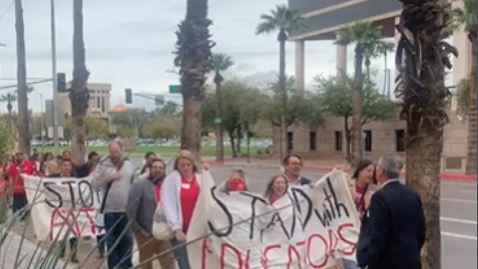
On Wednesday, the state’s teachers union protested against the Arizona Department of Education’s newly-launched hotline for parents to report inappropriate class materials.

The Arizona Education Association (AEA) had educators and activists march around the state capitol and ADE building, holding signs and chanting. Some signs read, “Stand with Educators,” and “Stop the Attacks.”

AEA also issued a letter on Wednesday to ADE Superintendent Tom Horne. The activists delivered a copy of the letter to the ADE office following a short speech outside the building. The AEA characterized the hotline as another political game.

The body of the letter is reproduced below:

Consider this an open invitation to visit Arizona schools and meet with educators. Come see for yourself the hard work, expertise and passion that go into each day. The constant attacks, along with low wages and underfunded classrooms, are causing far too many of our colleagues to leave the profession and the state. Our students and our schools deserve better. Take down the ‘hotline.’ Stop the attacks and stand with us.

Horne told Fox News on Wednesday that he was aware of the hotline’s unpopularity with certain groups, and criticized the teachers that participated in the protest. The superintendent implied that those teachers protesting were opposed to transparency and accountability.

“I served 24 years on a school board, and our rule was anybody could come in and watch the teaching, and the teachers never complained because they were proud of what they were doing, so those who are protesting, maybe they are not so proud of what they’re doing,” said Horne.

ADE launched the hotline last Tuesday. The department clarified in a corresponding press release what qualified as inappropriate school lessons: those focused on race or ethnicity, rather than individuals or merit; promoting gender ideology; social-emotional learning (SEL); or sexual content. ADE cited our reporting as an example of those committed to teaching inappropriate materials, in which AZ Free News documented over 200 educators who signed onto a statement proclaiming that they would teach outlawed materials like Critical Race Theory (CRT) even if banned.

ADE stated that the hotline represented their administration’s commitment to transparency and empowering parents.

Under former Superintendent Kathy Hoffman, ADE’s commitment to transparency looked slightly different. As AZ Free News reported in January, the former administration neglected the state’s school choice program: it had less than one-third of the staff designed to run the program and nearly 171,600 unfulfilled expense requests, despite receiving millions in additional funding for hiring and operation expansions.

AEA President Marisol Garcia claimed that the hotline would invite harassment of educators, and allow for accusations to be vulnerable to open records requests.

“Inviting the harassment of educators, without due process at their local level, with the ability of these ‘accusations’ to be FOIA’d?” asked Garcia. “As if nothing bad is going to happen here?”

Teachers union members and supporters filled the Capitol following the march.

Corinne Murdock is a reporter for AZ Free News. Follow her latest on Twitter, or email tips to corinne@azfreenews.com.

Gov. Katie Hobbs Keeps Inauguration Donations Secret

Gov. Katie Hobbs Keeps Inauguration Donations Secret

By Corinne Murdock |

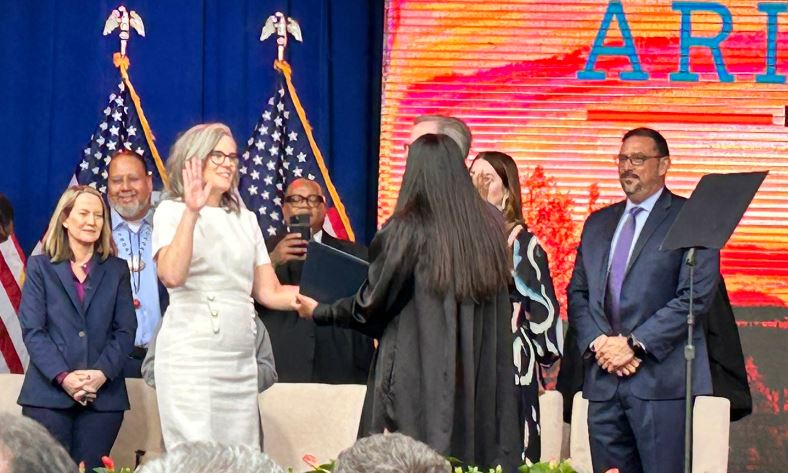
Gov. Katie Hobbs won’t disclose how much her inauguration ceremony will cost, or how much donors paid for it. Hobbs’ decision to withhold the donors’ identities not only contradicts her campaign promises but past administrations’ transparency on the subject.

Hobbs listed 137 sponsors for the event, but didn’t disclose how much they paid. 

Sponsors include the Arizona Education Association, APS, Arizona Coyotes, Banner Health, BlueCross BlueShield, Boeing, Cigna, Cox, CVS, Deloitte, Gila River Indian Community, Greater Phoenix Leadership, Healthcare Rising Arizona, Horizon Strategies, Human Rights Campaign, Intel, Motorola, Pepsico, Phoenix Suns, PhRMA, Southwest Gas, SRP, Comcast, Amazon, Anheusesr-Busch, CoreCivic, Lockheed Martin, Paypal, and Safelite. 

Tickets were $150 for the public to attend. Following widespread reporting on the lack of transparency around the event, ticket registration was listed as free.

In a statement to Arizona Capitol Times, Hobbs’ press aide Murphy Hebert said the event is a private one not paid for with public funds.

The secretive nature of Hobbs’ first days in office may be a lasting trait throughout her administration. The governor barred reporters from attending a swearing-in ceremony on Monday. 

Hobbs’ first promise when she announced her candidacy for governor was to “deliver transparency.” 

Hobbs continued that promise throughout her campaign, right up to the election.

Hobbs’ bio on the newly revamped governor’s website also promises transparency from this new administration.

“A fearless advocate for Arizona, Katie will bring transparency and accountability to the governor’s office and deliver real results for all of us,” reads the bio. “Katie knows firsthand that government only works well if it’s led well. For Katie, that means transparency and accountability.”

Those interested in watching the inauguration ceremony may do so here:

Corinne Murdock is a reporter for AZ Free News. Follow her latest on Twitter, or email tips to corinne@azfreenews.com.

Prop 208 Is Dead but the Fight Against Red4ED Is Not Over Yet

Prop 208 Is Dead but the Fight Against Red4ED Is Not Over Yet

By the Arizona Free Enterprise Club |

The State of Arizona has great reason to celebrate. In a case that the Club joined as a plaintiff, Maricopa County Superior Court Judge John Hannah ruled against Prop 208, determining that the money raised from the tax would exceed the constitutional spending limit for education. This decision followed the Arizona Supreme Court’s ruling last August that Prop 208 was unconstitutional. And now, it officially puts the nail in the coffin of the largest tax hike in Arizona history.

This is great news for taxpayers throughout our state, except if you’re House Democrat Minority Leader Reginald Bolding apparently. But while Prop 208 may be dead, the fight is not quite over yet.

>>> CONTINUE READING >>>