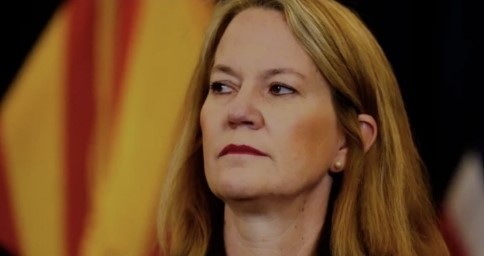
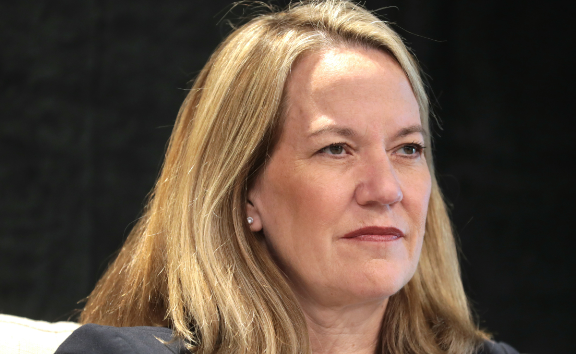
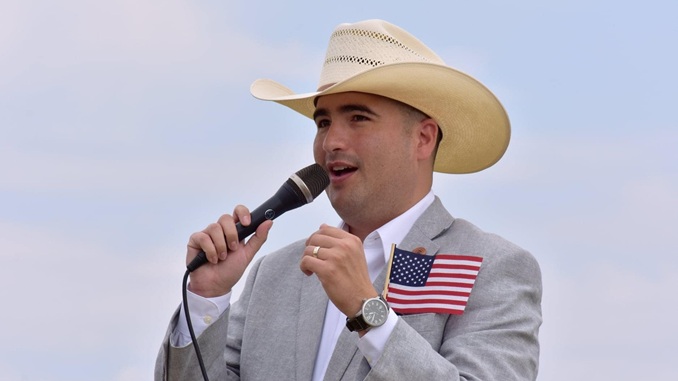
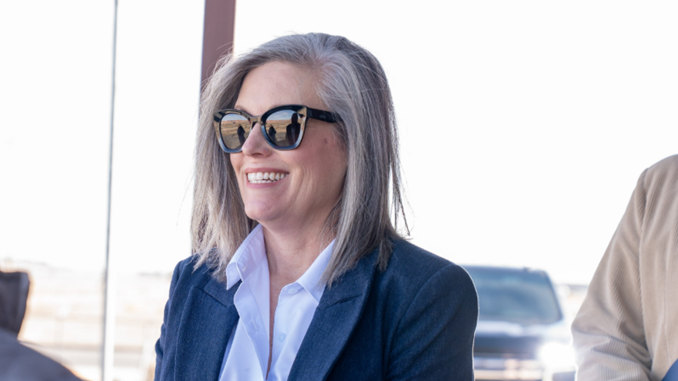
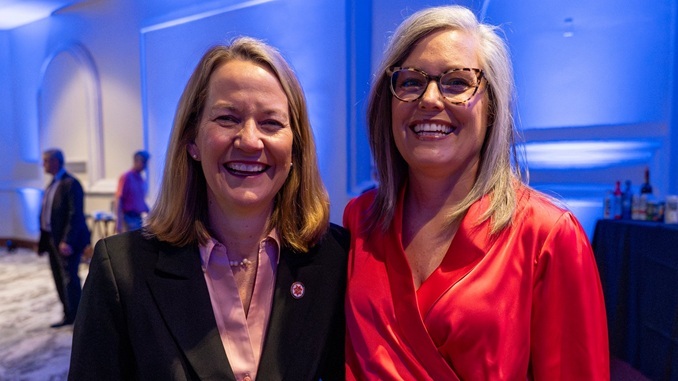
The head of the Arizona Republican Party is predicting that Attorney General Kris Mayes will face an investigation of her own for her alleged lack of investigation into Gov. Katie Hobbs.
Sergio Arellano stated in an interview with the “Conservative Circus” on Monday that Arizona Democrats should be “terrified” over the continued inquiries into Mayes.
“Kris Mayes didn’t just make Sunshine Residential Homes disappear; she may have just moved the spotlight directly onto herself,” said Arellano.
The Arizona Republican Party issued a statement accusing Hobbs of leading a “culture of corruption,” and endorsing the Republican nominee for governor, Rep. Andy Biggs (AZ-05).
Arizonans deserve better than Katie Hobbs’s Culture of Corruption.
Arellano also urged Republicans to issue the transcripts from their investigation into Mayes and Hobbs.
More than two years after launching an investigation based on media reports connecting Hobbs with an unusual rate increase for one of her major donors, Mayes released a short memorandum clearing Hobbs of pay-to-play corruption.
Sunshine Residential Homes, a major group home operator in the state, and its CEO, Simon Kottoor, are among the top donors to Hobbs’ campaign, legal fund, and inaugural fund. The company received substantial rate increases in 2023 and 2024 following years of denials before Hobbs took office.
The most recent denial occurred a month after Hobbs was sworn in. Several months later, following a dinner attended by Hobbs and her campaign chief at Kottoor’s residence, Sunshine Residential Homes received the rate increase it had sought — while other group home operators were denied increases or had their contracts cut entirely.
Mayes’ seven-page memorandum clearing Hobbs was criticized across the board not only for its length but for it allegedly revealing oversights concerning apparent evidence that some corruption had occurred.
Mayes maintained that the scope of her investigation was thorough; it included more than 100,000 documents. The attorney general suggested that the legislature was to blame for the perceived pay-to-play issues, and advocated for improved transparency laws.
Earlier this summer, Hobbs vetoed the sort of legislation Mayes suggested to ensure greater transparency. Hobbs claimed that because the legislation would also bring transparency to the Sunshine Residential Homes debacle, it was a “political stunt.”
Most recently, House Speaker Steve Montenegro (R-LD29) sent Mayes a letter demanding she provide answers to five questions indicating key contradictions and omissions in her investigation. Montenegro cited evidence from Department of Child Safety employee testimonies and contracting requirements as support for the scope of questioning.
“The Memorandum suggests your Office failed to pursue critical issues and reached conclusions that directly conflict with reliable evidence — including information provided by the very witnesses your Office claims to have interviewed,” said Montenegro. “Those failures raise the specter that your Memorandum was intended to influence the November election by attempting to inoculate the Governor from a perceived political vulnerability.”
Montenegro gave Mayes until Friday, September 4, to answer.
Senate President Warren Petersen (R-LD14) — who is the Republican nominee for attorney general — has also called on Mayes to release the records that informed her decision to clear Hobbs of wrongdoing. Petersen called Mayes’ memorandum a “cliffs notes report” that withheld critical information from the public.
An Arizona House special advisory team and the Maricopa County Attorney’s Office are still investigating the pay-to-play allegations against Hobbs, despite an initial order from Mayes to stand down as her office conducted its investigation.
AZ Free News is your #1 source for Arizona news and politics. You can send us news tips using this link.
Republican Rep. Abraham Hamadeh (AZ-08) said Arizona has a “captured government” after Democratic Attorney General Kris Mayes declined to prosecute Gov. Katie Hobbs over allegations involving political contributions connected to Sunshine Residential Homes and rate increases the company received from the Arizona Department of Child Safety (DCS).
Hamadeh made the remarks during an appearance on James T. Harris’ “The Conservative Circus,” calling Mayes’ two-year criminal investigation “a sham” that he said was intended to clear Hobbs before the November election.
“Arizona has a captured government right now,” Hamadeh said.
Congressman Hamadeh is not surprised that @KrisMayes dropped the investigation into crooked @KatieHobbs.
Mayes is the illegitimate attorney general BECAUSE Hobbs withheld evidence when she was Secretary of State. They are in cahoots. This was a sham released sixty days before… pic.twitter.com/OJwDggjUKw
— Office of Congressman Abe Hamadeh (@RepAbeHamadeh) August 25, 2026
“The most important thing we have to do this November is get rid of both Kris Mayes and Katie Hobbs.” Hamadeh said. Hamadeh accused Mayes and Hobbs of protecting one another and said the state’s news media had failed to hold either official accountable.
“The attorney general is not going to hold the governor accountable,” Hamadeh said. “This is what you call a captured government. So it is up to We the People to show them accountability by voting them out of office.”
The congressman also tied the decision to his continuing claim that Mayes is an “illegitimate attorney general,” arguing that Hobbs withheld evidence while serving as secretary of state during Hamadeh’s unsuccessful challenge to the 2022 attorney general election. Mayes defeated Hamadeh by 280 votes after a recount, a result later recounted in an Arizona Court of Appeals decision rejecting Hamadeh’s request for a new trial.
Mayes announced earlier this month that her office found no evidence of a quid pro quo connecting Sunshine’s political contributions to the company’s DCS rate increases.
“After two years of investigation, consisting of multiple interviews, reviews of campaign-finance records, procurement records, bank documents, and State emails and chats, totaling over one terabyte of data, including more than 100,000 documents, the investigation has not uncovered any evidence of the necessary quid pro quo to support a bribery charge,” Mayes said.
The attorney general’s seven-page legal memorandum said investigators conducted 12 interviews and reviewed campaign-finance records, procurement documents, bank records, and state communications. The memorandum concluded that prosecutors lacked evidence establishing a reasonable likelihood of conviction for bribery or related offenses.
Hobbs declined an in-person interview and submitted two written statements through her attorneys on Aug. 17, according to the memorandum. She stated that she had never discussed Sunshine’s rates or DCS contracting decisions with Sunshine founder and CEO Simon Kottoor or anyone affiliated with the company. Hobbs also denied directing anyone to intervene and said Sunshine’s political contributions did not influence state agency decisions.
Sunshine gave $200,000 to the Arizona Democratic Party before Hobbs’ 2022 election, $100,000 to her inaugural fund and another $100,000 to the state party in August 2023. Kottoor and his wife, Elizabeth, also made contributions to Hobbs’ gubernatorial campaigns.
The company received a mid-contract rate increase in May 2023 that raised its payment to $195 per bed, followed by an increase to $234 per bed during an April 2024 contract renewal. The AG memorandum said Sunshine’s rate increased 56% between 2019 and 2024. Two other providers received larger percentage increases over that period while retaining lower daily rates.
Mayes’ Investigation found that DCS officials knew about Sunshine’s political contributions as they considered its request. Then-DCS official Robert Navarro told colleagues during a February 2023 meeting that Sunshine was likely to seek an increase and was a donor to Hobbs, according to the memorandum. Navarro told investigators that the donations created perceived pressure. The Attorney General’s Office concluded that any perceived pressure resulted from Navarro’s own knowledge of the contributions and found no evidence that Hobbs or her office directed DCS to increase Sunshine’s rate.
The memorandum concluded that Sunshine’s rate increases resulted from its leverage as one of Arizona’s largest congregate-care providers. Sunshine accounted for approximately 20% to 25% of the state’s non-Division of Developmental Disabilities group-home beds. DCS officials told investigators that the company had threatened to move beds to the federal Office of Refugee Resettlement, which paid higher rates to house unaccompanied migrant children. Officials said losing Sunshine’s capacity would have strained the foster-care system and reduced beds available to keep siblings together.
Mayes called for legislation increasing transparency around political contributions from state contractors when she announced the decision. Hobbs previously vetoed two bills sponsored by Republican Senate President Pro Tempore T.J. Shope (R-LD16) that would have required certain companies seeking state contracts or grants to disclose political contributions and required agencies to retain procurement records.
Mayes’ criminal division recommended closing its pay-to-play investigation while keeping the matter open for the limited purpose of assisting the Arizona Auditor General. A separate review involving the Auditor General and Maricopa County Attorney Rachel Mitchell remains ongoing. The Arizona House has also commissioned an independent investigation.
Arizona Senate President Pro Tempore T.J. Shope (R-LD16) is accusing Attorney General Kris Mayes of providing political cover for Governor Katie Hobbs after Mayes declined to prosecute the governor following a two-year investigation into alleged pay-to-play activity involving Sunshine Residential Homes.
Shope is also challenging Mayes to publicly support legislation aimed at increasing transparency around political contributions and state contracts, measures he said her office has previously declined to support.
Last week, Mayes announced that her office found insufficient evidence to establish that political contributions made by Sunshine Residential Homes and individuals connected to the company were exchanged for rate increases approved by the Arizona Department of Child Safety (DCS).
The attorney general’s decision does not close the matter entirely. A separate investigation being led by the Arizona Auditor General, with assistance from the Maricopa County Attorney’s Office, remains ongoing.
The Arizona House of Representatives has also commissioned an independent investigation into the allegations.
Shope originally requested the investigation in 2024 after Sunshine Residential Homes and individuals associated with the company made combined political contributions of $580,840 benefitting Hobbs, her inaugural fund, her legal defense fund, and the Arizona Democratic Party, according to the senator’s office.
🚨FOR IMMEDIATE RELEASE: President Pro Tem Shope Condemns AG Mayes' Election-Year Cover for Governor Hobbs' Pay-to-Play Scandal
Sunshine founder Simon Kottoor and his wife Elizabeth also contributed to Hobbs’ campaigns. Kottoor even served on Hobbs’ inaugural committee and became a gold-level sponsor of her inauguration.
Sunshine initially sought a DCS rate increase in December 2022 but was denied in February 2023. The company reapplied several months later and received a mid-contract increase in May 2023. Its rate was subsequently increased again during its April 2024 contract renewal, making it the state’s highest paid group-home provider per child.
Internal DCS communications that surfaced during the controversy also acknowledged Sunshine’s political connections and discussed keeping the company’s special rate increase from competitors.
Despite the scrutiny, Hobbs did not agree to an interview with investigators. Instead she provided two written statements through her attorneys.
Shope said Mayes’ decision is particularly concerning because he previously introduced legislation intended to address the types of conflicts raised by the Sunshine investigation.
“For two years, Kris Mayes had every opportunity to support meaningful pay-to-play reforms, and she chose silence,” Shope said. “She allowed Hobbs to avoid questioning, ignored the growing trail of political contributions, and then cleared her fellow Democrat after a two-year investigation. Only after the Legislature adjourned did Mayes suddenly discover that reform was necessary. That’s not leadership. It’s political damage control.”
Shope sponsored SB 1612 in 2025, legislation that would have required companies seeking state contracts or certain grants to disclose political contributions and other items of value connected to the governor, political committees, and affiliated organizations.
The bill also included requirements for state agencies to retain records used in evaluating contract proposals.
Hobbs vetoed the bill.
Shope introduced similar legislation again this year through SB 1186. The bill retained requirements for companies seeking state contracts or grants to disclose political contributions and for state agencies to preserve records used to evaluate contract proposals.
Hobbs again vetoed the measure in June, amid the continuing investigation into Sunshine Residential Homes.
“Katie Hobbs took the political money, her administration approved the rate increases, she refused to answer investigators’ questions, and then she vetoed the reforms designed to prevent this from happening again,” added Shope. “Now her political ally wants Arizonans to believe the matter is closed. It isn’t.”
Mayes has called for legislative action following her decision not to prosecute Hobbs, saying changes to state law are needed to address potential conflicts involving political contributions and government contracting.
Shope said he plans to bring his legislation back during the next legislative session and intends to challenge Mayes to publicly testify in support of the reforms she is now calling for.
“If Mayes is sincere, she can endorse the legislation, appear before lawmakers, and demand that Hobbs sign it,” continued Shope. “If she refuses, Arizonans will know her call for reform was nothing more than election-year cover for the governor. The other investigations must continue without interference, and their complete findings must be made public,” Shope concluded.
Ethan Faverino is a reporter for AZ Free News. You can send him news tips using this link.
“I’m Katie Hobbs, and the rules don’t apply to me.” That might as well run at the end of the next campaign ad featuring Arizona’s governor. Since taking office in 2023, Hobbs has been building a rap sheet of scandals that would make Minnesota Governor Tim Walz blush.
From one of the largest Medicaid fraud scandals in Arizona history to a pay-to-play scheme that has put her administration under active criminal investigation, Hobbs has taken corruption to new heights in our state. But now, her latest campaign-finance reports are raising even more troubling questions: How did more than $1 million in small-dollar contributions disappear? And why are over 46,000 of her contributors listed as unemployed?
A Million-Dollar Campaign-Finance Mystery
How many times can a campaign-finance report be amended before it starts to raise red flags? For the 2026 Quarter 2 report, the Hobbs campaign has managed to amend it 10 times so far. But why? Were there some typos or decimals in the wrong spot? Nope. Many of these amendments repeatedly changed the amount of money the Hobbs campaign reported receiving.
The biggest mystery involves more than $1.4 million in small-dollar contributions. In its original filing, Elect Katie Hobbs reported $1.426 million in exempt small contributions—donations under $100 that can be reported in aggregate. The campaign reported the same amount in its first amended filing.
But something happened in its second and third amended filings. All of a sudden, that $1.426 million dropped to $0. And then, in the fourth amended filing, nearly $400,000 suddenly reappeared.
The campaign’s total receipts also followed a similarly bizarre path, jumping from $2.64 million to $3.1 million, falling below $1.7 million, and then climbing back above $2.6 million through various amendments.
So, where did the money go?
That’s a great question. And Hobbs has yet to answer. But it’s not the only anomaly in her campaign-finance reports…
Arizona Attorney General Kris Mayes declined to prosecute Gov. Katie Hobbs on Friday over allegations of a pay-to-play arrangement involving Sunshine Residential Homes. The decision prompted Senate President Warren Petersen (R-LD14), Mayes’ Republican opponent in the November election, to accuse the attorney general of protecting a political ally.
Mayes announced that her office found no evidence establishing that political contributions from Sunshine were exchanged for rate increases granted by the Arizona Department of Child Safety (DCS).
“The investigation has not uncovered any evidence of the necessary quid pro quo to support a bribery charge,” Mayes said.
The decision followed a two-year criminal investigation that included 12 interviews and reviews of campaign-finance records, procurement records, bank documents, and state communications comprising more than one terabyte of data and more than 100,000 documents.
The investigation began in June 2024 after Republican Sen. T.J. Shope (R-LD16) requested reviews by both Mayes’ office and the Maricopa County Attorney’s Office following reporting about Sunshine’s political contributions and subsequent rate increases.
Sunshine gave $200,000 to the Arizona Democratic Party before Hobbs’ 2022 election, $100,000 to her inaugural fund, and another $100,000 to the party in August 2023. Sunshine founder Simon Kottoor and his wife, Elizabeth, also contributed to Hobbs’ gubernatorial campaigns. Arizona campaign-finance records showed Hobbs was the only Arizona candidate to receive contributions from either Kottoor during the 2022 and 2024 election cycles.
Sunshine received a mid-contract increase in May 2023 that raised its rate to $195 per bed, followed by an increase to $234 per bed during its April 2024 contract renewal. The Attorney General’s memorandum said the company’s rate increased 56% from 2019 to 2024, although two other providers received larger percentage increases over that period while maintaining lower daily rates.
Investigators found that DCS officials were aware of Sunshine’s political contributions while considering its request. According to the memorandum, then-DCS official Robert Navarro told agency officials during a February 2023 meeting that Sunshine was likely to request an increase and added that the company was a donor to the governor. Internal teams messages also included discussions of Sunshine’s contributions.
Navarro told investigators that the donations created perceived pressure, but the Attorney General’s Office concluded that the pressure resulted from his knowledge of the contributions and found no evidence that Hobbs or her office directed DCS to raise Sunshine’s rate.
The investigation instead concluded that Sunshine’s rate increases “appear as the result of its outsized leverage” over the state’s congregate-care system. The company has been one of Arizona’s largest group-home providers and accounted for approximately 20% to 25% of the state’s non-Division of Developmental Disabilities congregate-care beds, according to the AG memorandum.
DCS officials told investigators that Sunshine had indicated it could shift beds to the federal Office of Refugee Resettlement, which was paying substantially higher rates to house unaccompanied migrant children. Officials expressed concern that losing Sunshine’s capacity would make it more difficult to keep siblings in foster care together. Two other providers had already left state contracts in favor of federal work.
Mayes would not say whether Hobbs would ultimately sit for questioning, while saying the investigation was nearing completion. The memorandum released Friday says Hobbs declined to sit for an in-person interview with investigators but submitted two written statements through her attorneys on Aug. 17, one in her capacity as governor and another as a candidate.
Hobbs wrote that she “has never discussed DCS contract rates, Sunshine’s rates, or any DCS procurement decision” with Kottoor or anyone affiliated with Sunshine. She also denied directing anyone else to have such discussions and said neither Sunshine’s contributions nor other financial support influenced state decisions concerning the company.
Petersen criticized Mayes’ decision in a statement released through Arizona Senate Republicans Friday.
“Mayes’ decision was predictable in an election season,” Petersen said. He accused Mayes of having “shamefully shifted accountability and protected her political ally, turning a blind eye to Hobbs’ misconduct” and said she had placed politics ahead of law enforcement.
Petersen’s office said Sunshine made three $100,000 contributions to the Arizona Democratic Party during Mayes’ investigation. However, AZ Free News previously reported that Sunshine gave the party $200,000 in September and October 2022 and another $100,000 in August 2023, before Mayes opened her investigation in June 2024. The Attorney General’s findings released Friday do not identify any additional Sunshine contributions made during the investigation.
Petersen won the Republican nomination for attorney general in July and will face Mayes in the general election.
Mayes called for new state contracting transparency laws while announcing the decision, saying the absence of evidence sufficient for prosecution did not eliminate concerns about disclosure requirements surrounding state contractors and political donations.
The Legislature has previously sent Hobbs two bills sponsored by Shope addressing those issues. SB 1612 in 2025 would have required companies responding to state requests for proposals or seeking grants to disclose items of value provided during the previous five years to the governor, gubernatorial political committees, inaugural funds, and related entities. It also included procurement-record retention requirements and removed an Arizona Health Care Cost Containment System (AHCCCS) exemption from state procurement laws. Hobbs vetoed the measure.
Shope returned this year with SB 1186, which retained the political-contribution disclosures and record-retention provisions without the AHCCCS provision. Hobbs vetoed the bill in June after lawmakers sent it to her amid the continuing Sunshine investigation.
Hobbs separately proposed her own procurement and campaign-finance changes earlier this year, including limits on political giving while companies were bidding for state contracts and a searchable database of state contractors. The competing proposals did not produce legislation acceptable to both the governor and Legislature before lawmakers adjourned.
Mayes’ criminal division recommended closing its investigation into the alleged pay-to-play arrangement involving Hobbs and Sunshine. The memorandum said the office would keep its investigation open for the limited purpose of assisting the Arizona Auditor General if requested. A separate investigation involving Maricopa County Attorney Rachel Mitchell and the Arizona Auditor General also remains ongoing.