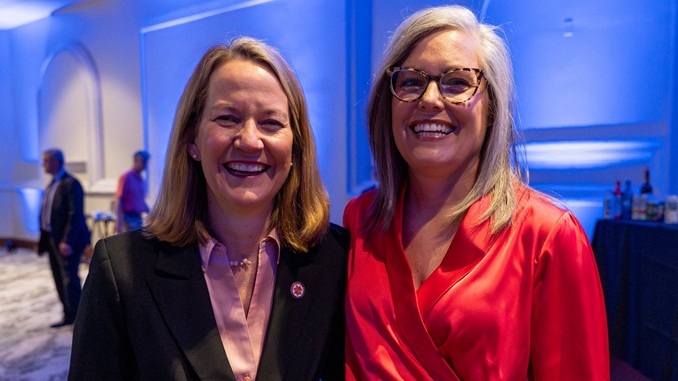
Attorney General Kris Mayes wouldn’t confirm whether Gov. Katie Hobbs will be questioned as part of the investigation into the governor’s alleged pay-to-play scandal, which has been ongoing for more than two years.
Mayes was asked during a press conference announcing her lawsuit against the Trump administration’s tariffs on Monday whether it was possible that Hobbs would never sit for questioning.
“I’m going to decline to answer that question right now,” said Mayes.
Mayes’ office has asked Hobbs publicly to sit for questioning for months.
Despite needing a sit-down interview to proceed with the investigation, Mayes did promise to release the results of the investigation sometime before the general election in November. Left unsaid was the possibility that voters may not have those results until their ballots have already been cast in the highly competitive governor’s race between incumbent Hobbs and Republican Andy Biggs.
Mayes disagreed that Hobbs was shirking questioning and denied that the prolonged lack of communication between her and the governor on the matter had to do with Hobbs leaning on her power and status as the state’s chief executive, and their shared party affiliation.
“You cannot blow off the attorney general’s office. Full stop. No one can, regardless of who they are,” said Mayes. “When we have a result in this investigation, we will make an announcement. And we are near the end of the investigation.”
The investigation concerns an allegation that Hobbs directed a unique rate increase of 30% for Sunshine Residential Homes, a group home operator, as thanks for the company’s sizable 2024 election cycle donations totaling more than $400,000 to Hobbs and the Arizona Democratic Party. Hobbs was the only candidate to receive contributions from Simon Kottoor, founder and CEO of Sunshine Residential Homes.
While Sunshine Residential Homes received a rate increase, the Arizona Department of Child Safety (DCS) denied rate increases for other home operators and dropped more than a dozen providers. DCS has since stated that the rate increase occurred because Sunshine Residential Homes threatened to prioritize intake of migrant children over Arizona’s foster children.
Mayes began her investigation more than two years ago, in the summer of 2024, after others began investigating following reporting by the Arizona Republic that broke the pay-to-play scandal.
Certain officials had begun to investigate the allegations, but Mayes stepped in to stop them. Mayes sent letters to Maricopa County Attorney Rachel Mitchell and Auditor General Lindsey Perry, ordering both officials to stop seeking answers.
“It would not be appropriate or in the best interest of the state to conduct parallel investigations into the same matter,” said Mayes in the letter to Mitchell. “[A] separate process conducted by the MCAO could jeopardize the integrity of the criminal investigation that my office will now proceed with.”
Mitchell’s response urged Mayes to reconsider her position on being the sole investigator into the allegations.
“I want to be clear: This is not an accusation against you or the many fine employees in your office,” said Mitchell. “We are in a time when people are increasingly distrustful of government. Your insistence on being the sole investigator in this matter will greatly contribute to people’s […] belief that nothing can change.”
Leadership within the Republican-led legislature announced their own investigatory efforts earlier this year. The House advisory team obtained outside counsel to investigate the alleged pay-to-play scandal. No findings have been made public as a result of that effort to date.
Earlier this summer, the governor vetoed legislation establishing financial transparency requirements tied to the alleged pay-to-play scandal.
Hobbs has denied any wrongdoing throughout the years-long investigation.
AZ Free News is your #1 source for Arizona news and politics. You can send us news tips using this link.
Gov. Katie Hobbs has signed a package of child welfare bills sponsored by Sen. Carine Werner (R-LD4) aimed at strengthening Arizona’s response to abuse reports, improving Department of Child Safety (DCS) case review procedures, and increasing protections for children in dependency proceedings and state care.
Werner said the measures followed months of legislative oversight and investigation into Arizona’s child welfare system.
The Senate Republican Caucus said the hearings examined weaknesses in how abuse reports are reviewed, how allegations are investigated, and how children already known to DCS are protected. The hearings were launched after multiple high-profile child deaths exposed breakdowns in the state’s child safety system, including the deaths of Emily Pike, Rebekah Baptiste, and Zariah Dodd.
🚨FOR IMMEDIATE RELEASE: Senator Werner Strengthens Child Welfare System with Package of Bipartisan Reforms Signed Into Law
All together, Arizona enacted 13 new child welfare laws this year.
SB 1127 amends Arizona’s mandatory reporting statute for child abuse and neglect. The bill requires a person who has a duty to report and who has direct knowledge that a minor is or has been the victim of abuse or neglect to immediately report it to DCS and bars that person from delegating the report to someone else.
Under existing statute amended by the bill, mandatory reporters include physicians, physician assistants, optometrists, dentists, osteopathic physicians, chiropractors, podiatrists, behavioral health professionals, nurses, psychologists, counselors, social workers, peace officers, child welfare investigators, child safety workers, school personnel, domestic violence victim advocates, sexual assault victim advocates, clergy, parents, stepparents, guardians, and others with responsibility for the care or treatment of a minor.
SB 1174 requires the DCS centralized intake hotline to take steps to identify and locate prior communications and DCS reports related to a current abuse or neglect communication using the department’s data system and the state’s central registry system.
The bill requires the hotline to quickly and efficiently show in a single report the entire history of a child and the child’s siblings who have been the subject of prior hotline calls or DCS investigations. The hotline worker must review the narrative of every call received for that child from the previous 90 days.
SB 1174 also allows a hotline worker to review hotline calls received in the previous 90 days that did not meet the criteria for a DCS report and use information contained in prior calls when deciding whether a new allegation meets the criteria for a DCS report. The law takes effect after Dec. 31, 2026.
SB 1496 makes broader changes to DCS policies and procedures involving children in dependency cases, federal benefits for children in DCS care, kinship placement searches, missing or runaway children, and central registry hearings.
The bill requires courts to appoint an attorney for a child in dependency and termination of parental rights proceedings before the first hearing. It also directs the attorney to determine whether the child has diminished capacity that would affect the child’s ability to express an opinion or make decisions.
The measure requires DCS to determine within 60 days after a child enters care whether the child is receiving or may be eligible for benefits administered by the Social Security Administration or Veterans Administration. If DCS is appointed as the child’s representative payee, the department may not use the child’s federal benefits, other benefits, savings, or assets to pay for or reimburse the state for the child’s care.
The bill requires DCS to use due diligence to identify and notify adult relatives and persons with a significant relationship to a child within 30 days after the child is taken into temporary custody. The search must include interviews with the child’s parent, the child, identified adult relatives, and others likely to have information about possible relatives or significant contacts.
For missing, abducted, or runaway children in state care, SB 1496 requires DCS to notify law enforcement immediately or within 24 hours, request that law enforcement enter the child into state and national missing-person systems, and report the child to the National Center for Missing and Exploited Children within 24 hours.
The bill also requires DCS to provide local law enforcement with identifying information within 48 hours, including a physical description, last known location, clothing description, vehicle information if applicable, current photos, a law enforcement phone number, and information about any offered rewards. Law enforcement must provide that information to local media outlets and post it to social media platforms.
SB 1631 requires that when a child alleges sexual abuse, or when a report of abuse or neglect includes an allegation of sexual abuse, a person trained in forensic interviewing must conduct a forensic interview with the child immediately or within 72 hours.
The 72-hour requirement does not apply if DCS shows good cause for the delay. The bill lists several examples of good cause, including when the child is receiving inpatient physical or mental health care, is not physically present in Arizona, has not been located by the department, or is unavailable because a parent or guardian who is not the subject of the allegation is unresponsive or unable or unwilling to make the child available for the interview.
The bill defines sexual abuse for the purposes of the requirement to include sexual abuse, sexual conduct with a minor, sexual assault, molestation of a child, commercial sexual exploitation of a minor, sexual exploitation of a minor, incest, and child sex trafficking.
“Protecting vulnerable children is one of government’s most important responsibilities, and there have been far too many cases where that responsibility was not met,” Werner said. “These new laws address real problems we uncovered through legislative oversight, and they strengthen the safeguards that exist to protect children from abuse, neglect, and exploitation. Arizona families deserve confidence that when warning signs appear, the system will respond appropriately and children will not be forgotten.”
The latest signed bills follow two other Werner-sponsored DCS measures Hobbs signed earlier this year. SB 1125 requires DCS to make annual efforts to enter into memorandums of understanding with Arizona tribes that do not already have current agreements with the department. The agreements must address information sharing, training materials, operational standards, tribal liaisons, and access to regulatory and enforcement information involving DCS-licensed group homes where tribal children are placed.
SB 1126 requires schools, upon request by a DCS caseworker, to identify any school that has requested a pupil’s educational records and any person who has withdrawn the pupil from school. The law also requires schools to provide other requested information or records related to a pupil who is or was enrolled at the school and bars public and private schools from prohibiting employees, contractors, or volunteers from speaking with a DCS caseworker investigating abuse or neglect allegations.
The Governor’s Office listed SB 1127, SB 1174, SB 1496, and SB 1631 among the bills Hobbs signed in a June 19 legislative action update.
A separate Werner measure, SB 1175, was vetoed by Hobbs. The proposal would have required DCS caseworkers to photograph children during abuse and neglect investigations and review the photographs when assessing a child’s safety. DCS Director Kathryn Ptak said the department would adopt the requirement administratively.
The Arizona Department of Child Safety (DCS) will implement a new child safety reform set to be codified until Gov. Katie Hobbs’ office intervened.
Sen. Carine Werner (R-LD4) had championed the legislation that prompted the new policy, SB 1175. It passed the legislature with bipartisan support earlier this month.
The legislation would have required DCS caseworkers to photograph children during abuse and neglect investigations, followed by a review of those images when evaluating the safety and well-being of those children. Specifically, the legislation would have required caseworkers to consider any decline in a child’s appearance or health.
DCS leadership announced it would voluntarily adopt the requirements as policy.
SB 1175 was part of a legislative package of bipartisan reform bills to improve DCS handling of reports of abuse. The reforms were prompted by high-profile child abuse cases in which prior DCS involvement failed to prevent deaths, including 10-year-old Rebekah Baptiste, 14-year-old Emily Pike, and 16-year-old Zariah Dodd.
At Werner’s urging early last year following Pike’s death in 2024, Arizona lawmakers launched an investigation into DCS for systemic failure. The subsequent deaths of Baptiste and Dodd further compelled lawmakers to take expedited action.
At the time, Werner said the failures of the state had too great of consequences to be ignored.
“These tragedies make it painfully clear that when our child protection systems — both state and tribal — fail, the consequences can be horrific,” said Werner.
Werner said in a press release issued last week that Hobbs’ office attempted to require SB 1175 to have legislative appropriation. Werner and legislative staff disagreed with the assessment from Hobbs’ office, citing an estimated implementation cost low enough to be absorbed within the existing DCS budget: $50,000. Hobbs’ office refused to relent on their request, and the House opted to recall the statutory route and instead relied on DCS to implement it through policy.
Summaries of SB 1175 noted that the new DCS requirements would have no anticipated fiscal impact to the state general fund.
DCS Director Kathryn Ptak said the legislation-turned-policy was a “commonsense solution” for keeping children safe while in DCS care.
“I will be issuing a directive to our staff to guarantee each child in our care has an updated photograph to help us maintain accurate records and respond quickly in any situation where a child’s safety or whereabouts need to be confirmed, while continuing conversations around this topic,” said Ptak. “We are grateful to Senator Werner for her partnership in advancing bills that help keep children safe, while also balancing the privacy needs of families.”
Werner said the legislation was a fulfillment of government responsibility to respond to those tragedies that occur despite oversight, especially when it comes to children entrusted to a state system.
“Children cannot afford for warning signs to be missed. If something as simple as maintaining and reviewing photographs helps a caseworker recognize a child is deteriorating and intervene sooner, then it is absolutely worth doing,” said Werner. “I’m grateful to Director Ptak and the Department for their partnership in moving these reforms forward right away through administrative action. This ensures Arizona’s most vulnerable children benefit from improved documentation and earlier recognition of warning signs without delay.”
AZ Free News is your #1 source for Arizona news and politics. You can send us news tips using this link.
As Sunshine Residential Homes remains at the center of an ongoing investigation into alleged “pay-to-play” conduct involving Gov. Katie Hobbs, public records link founder and CEO Simon Kottoor to a Paradise Valley residence that Zillow estimates is worth nearly $10 million. The property has drawn renewed attention amid scrutiny of Sunshine’s political donations and subsequent state-approved rate increases.
Arizona campaign finance records reviewed by AZ Free News show that Gov. Katie Hobbs was the only Arizona candidate to receive contributions from Simon and Elizabeth Kottoor during the 2022 and 2024 election cycles. Simon Kottoor’s only other recorded contribution to a political candidate was a 2023 donation to New York Democratic congressional candidate Kevin Thomas.
Simon Kottoor founded Sunshine Residential Homes (formerly Sunshine Group Homes) in 1996, according to the company’s website. Sunshine says it provides congregate foster placements for Arizona children, has served more than 25,000 children since its founding, and currently has more than 300 children in care with approximately 200 employees.
Maricopa County property records reviewed by AZ Free News list the residence under the Kottoor Family Trust, with Simon M. Kottoor and Elizabeth Kottoor named as trustees. AZ Free News has withheld the street address from publication.
Zillow describes the property as a 7,719-square-foot, five-bedroom, six-bathroom home on 1.08 acres and estimates its value at approximately $9.53 million. Realtor.com estimates the property’s value at about $8.71 million and reports it last sold for $1.55 million in 2020.
Sunshine Residential Homes and Kottoor have faced scrutiny over political donations connected to Hobbs and subsequent state-approved rate increases. The Arizona Republic reported in June 2024 that Sunshine Residential Homes received a large rate hike from the Arizona Department of Child Safety (DCS) after making six-figure contributions to Hobbs’ inauguration fund and the Arizona Democratic Party. The outlet reported that Sunshine applied for a rate increase in December 2022, was denied in February 2023, then applied again in May 2023 and was approved, citing DCS records.
The Republicreported in July 2024 that both the Kottoors’ and Sunshine Residential Homes’ donations to Hobbs and the Arizona Democratic Party amounted to approximately $420,000 from 2022-2024.
According to the Arizona Capitol Times, Sunshine Residential Homes gave $100,000 to Hobbs’ inaugural fund and separately gave $300,000 to the Arizona Democratic Party. The outlet also reported that the Arizona Republic found Hobbs personally called Kottoor shortly after winning the 2022 election and asked him to serve as a gold-level sponsor of her inauguration. The same report said the Department of Child Safety later increased payments to Sunshine in 2023 to nearly 40 percent above the average for other group homes.
Kottoor was also on Hobbs’ inaugural committee, and he and his wife made maximum contributions to Hobbs’ campaign, according to reporting cited by Governing. That report also noted that Hobbs attended a private event at the Kottoor’s Paradise Valley residence.
Calls for investigation from Arizona lawmakers followed within days of the initial reporting.
From @GovernorHobbs spokesperson: "Like every other 'investigation' launched by this chaotic and radical legislature, this is another desperate, partisan stunt. It will do nothing but show the administration put the best interest of Arizona first." https://t.co/taQAZTmb52
The Arizona Attorney General’s Office opened an investigation into the Sunshine Residential matter in June 2024. The office’s public records archive lists communications and records related to the Sunshine Residential Homes investigation, including correspondence with Maricopa County Attorney Rachel Mitchell and Auditor General Lindsey Perry, as well as a criminal referral.
I requested an investigation by the Maricopa County Attorney into Governor Hobbs' alleged "pay to play" scheme. Arizona taxpayers deserve financial accountability. Giving state dollars to political donors is a grave misuse of public funds.
— Arizona Treasurer Kimberly Yee (@AZTreasurerYee) June 10, 2024
Hobbs’ office has denied wrongdoing. Axios reported that Hobbs spokesman Christian Slater said the administration would be “cleared of wrongdoing” and called the allegations partisan. Slater and DCS spokesman Darren DaRonco told Axios that Hobbs and her office had no involvement in agency decisions regarding Sunshine Residential Homes. Sunshine told the Arizona Republic that it remained committed to cooperating with any inquiry, Axios reported.
The investigation remains a prominent political issue in Arizona well into 2026. In April, KJZZ reported that Mayes’ team had asked Hobbs for an interview as part of the investigation and that Hobbs would not publicly commit to sitting for one. KJZZ reported that Hobbs continued to deny wrongdoing.
Republican lawmakers have cited the Sunshine controversy as they advance legislation requiring more disclosure from companies seeking state contracts. The Arizona Senate Republican Caucus announced last week that SB 1186, sponsored by Arizona Senate President Pro-Tempore T.J. Shope (R-LD16), had been sent to Hobbs’ desk. The bill would require companies seeking taxpayer-funded contracts and grants to disclose political donations, gifts, and other things of value connected to the governor and affiliated political organizations. A House summary of SB 1186 states that the measure establishes disclosure requirements for the request-for-proposal and grant-application processes.
Hobbs announced her own ethics reform proposal in February, calling it a sweeping transparency package intended to strengthen public trust in government. According to the Governor’s Office, the proposal includes a public transparency and disclosure database, contracting reforms, and a lobbyist gift ban.
The Sunshine Residential Homes matter remains under investigation, and no public finding of wrongdoing by Hobbs, Kottoor, or Sunshine Residential Homes has been announced.
Senate Health and Human Services Committee Chair Carine Werner (R-LD4) will hold the final Department of Child Safety (DCS) oversight hearing of the legislative session on Monday, April 6, at 9 a.m. The hearing caps a months-long investigation into systemic failures that left vulnerable Arizona children unprotected despite repeated contacts with the child welfare system.
The oversight effort, launched after several high-profile tragedies, exposed critical breakdowns in how DCS handles reports of abuse, coordinates with partners, and responds to warning signs.
Among the cases that drew urgent attention were Emily Pike, a 14-year-old who ran away from a group home and was later found dead, Rebekah Baptiste, a 10-year-old who died after multiple reports of abuse were filed but not addressed with sufficient urgency, and Zariah Dodd, a 16-year-old in DCS care who was reported missing and later found murdered in Phoenix.
In each instance, the children had prior involvement with the system, yet missed opportunities for timely intervention, poor information sharing, and delayed action contributed to fatal outcomes.
“This investigation made one thing painfully clear. People were raising red flags, but the system wasn’t connecting the dots or acting fast enough,” stated Senator Werner. “These children were not invisible. They were known. Reports were made. And still, the response fell short. That cannot happen again.”
Through a series of stakeholder meetings and hearings involving DCS officials, law enforcement, child welfare experts, and affected families, Senator Werner’s committee identified key gaps in coordination, documentation, reporting, and response times. That work has culminated in a targeted package of bipartisan reform bills designed to prevent similar failures.
SB 1125 strengthens coordination between DCS and Arizona’s Indian tribes by requiring efforts to establish memoranda of understanding. These agreements focus on sharing best practices in intake, investigations, placement, case management, and service coordination; designating tribal liaisons; and providing tribes access to regulatory actions, licensing sanctions, and safety violations involving group homes where tribal children are placed.
SB 1126 improves information sharing between schools and DCS investigators. In compliance with federal privacy laws, schools must, upon request, identify other schools that have sought a student’s records, note any withdrawals, and provide relevant information or records during active abuse or neglect investigations. The bill also prohibits schools from barring employees from speaking with DCS caseworkers.
SB 1127 tightens mandatory reporting requirements, stipulating that individuals with a duty to report suspected abuse or neglect who have direct knowledge must report immediately to DCS and may not delegate responsibility to another person.
SB 1174 enhances DCS’s centralized intake process by requiring hotline workers to compile and review a child’s full history—including prior hotline calls and investigations involving the child and siblings—so patterns of concern are immediately visible. Workers must also review recent non-report calls when assessing new allegations.
SB 1175 mandates that DCS caseworkers photograph children during every contact in an abuse or neglect investigation and maintain those images in the case file. When developing safety plans, caseworkers must review photos to identify any decline in the child’s appearance or health.
SB 1496 strengthens legal protections and representation for children in dependency cases, including provisions addressing the Department’s role as representative payee for benefits and efforts to identify more appropriate non-DCS individuals for that responsibility.
SB 1631 ensures that children who are alleged victims of sexual abuse receive a forensic interview conducted by a trained professional immediately or within 72 hours of the report. The requirement includes specific definitions of sexual abuse and allows documented good cause exceptions for limited delays, such as the child receiving inpatient care or not being located.
Presentations at Monday’s hearing will feature insights from Casey Family Programs, a national nonprofit dedicated to improving child welfare and reducing unnecessary foster care placements; Collaborative Safety, which partners with agencies to enhance child protection practices and lower risks; and an update from the Arizona Department of Child Safety on policy changes implemented since the investigation began.
“The reforms we’re advancing are about making sure information is shared, warning signs are taken seriously, and experienced professionals step in immediately when a child is in danger,” added Senator Werner. “When a child’s life is on the line, there is no room for delays, confusion, or missed communication.”
Ethan Faverino is a reporter for AZ Free News. You can send him news tips using this link.