by Staff Reporter | May 3, 2025 | News
By Staff Reporter |
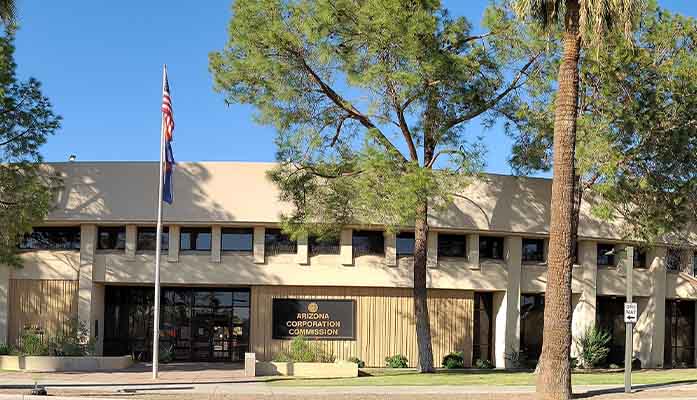
A commissioner with the Arizona Corporation Commission (ACC), Nick Myers, denies a power company is to blame for a woman’s death.
82-year-old Kate Korman died last May less than a week after the Arizona Public Service (APS) shut off her power for failure to pay. Per APS, Korman ceased paying in January and owed around $500.
The medical examiner’s report attributed Korman’s cause of death as chronic alcohol use with heart disease listed as a contributing factor and declared the manner of her death to be an accident caused in part by exposure to elevated temperatures.
ACC prohibits power shut offs based on a certain timeline — June 1 through October 15 — not based on temperatures. APS does offer a program allowing family members to oversee their loved one’s bills.
Myers opposed modifying policy to implement temperature-based shutoff restrictions. The commissioner also said the current shutoff restrictions have caused more problems than it aimed to solve.
“We are already at a point where the policies we have in place are causing massive debt within our lower income communities (an unintended consequence of those policies) and therefore I believe, and am attempting to verify, that the mental stress is actually CAUSING more deaths than they are saving (by way of suicides increasing). Furthermore, much of that debt, millions of dollars of it actually, are ultimately being transferred back to the rest of the customers, increasing bills, which is actually exacerbating the underlying problem of people not being able to pay their bills,” said Myers. “In a nutshell, at some point people (and their families, and possibly their communities, like churches) should be responsible, it shouldn’t all fall on utilities and the ratepayers of utilities. It’s ultimately an unsustainable catch-22, and we are possibly seeing that we are at that cusp right now.”
Myers defended APS in response to criticisms made by Jonathan and Adam Korman, the sons of the deceased woman. Korman maintains his mother died due to temperatures inside her home, and that APS bears responsibility for shutting off her power.
Myers asserted there existed no further remedies to mitigate heat exposure due to shutoffs. Myers indicated there were further details about the elder Korman’s death that would have cast her in a negative light.
“Alcoholism killed your mother, heat may have been a contributing factor, but the utility did go above and beyond what we require. There really are no more practical methods that can be implemented at this point,” said Myers. “We did address it and trust me, I’m sure the family doesn’t want made public what we found. This is another case where the utility did above and beyond what they needed to, and more importantly the shutting off of power for non-payment was NOT the cause of death.”
Myers also said the elder Korman’s children bore some of the responsibility for her death, since they were not keeping an eye on her.
“So you are really going to come after us, who have no control over the situation, when you failed to protect your own mother, even though there were multiple tools in place for you to use for that exact purpose?” said Myers. “I’m not just blaming your mom, I’m more blaming you for not looking out for your elderly mom. I refuse to tell utilities that they have to provide power to people that do not pay their bills. To be honest, I’m not even happy about many of the programs that they have in place to help, but I understand the need for them. The only problem is the customer, and their family, have to actually reach out to take advantage of those programs. Again, I am sorry for your loss, but you have to take responsibility here. This is not a problem that the rest of society should shoulder.”
AZ Free News is your #1 source for Arizona news and politics. You can send us news tips using this link.
by AZ Free Enterprise Club | Apr 30, 2025 | Opinion
By the Arizona Free Enterprise Club |
For the past decade, our organization has been fighting the Green New Deal agenda in Arizona, working to score a decisive victory for reliable and affordable energy. Thanks to President Trump, that decisive victory now appears within reach.
Earlier this month, President Trump released three new executive orders and one proclamation, all aimed at unleashing American energy abundance. These executive actions are all part of a coordinated White House effort to initiate a tidal shift in the ever-steady march toward the Net Zero nightmare being pursued by radical environmentalists, the green industrial complex, and public utilities across the nation.
For years, energy regulators have forewarned of the impending grid crisis due to the overreliance on costly renewable energy, yet the previous administration only accelerated the catastrophe. The new Trump Executive Orders, coupled with his declaration of a National Energy Emergency, will directly address this crisis by ending the regulatory discrimination against coal, empowering the domestic mining of coal resources, encouraging the development of coal energy generation, and allowing for these activities to take place on federal lands.
Reigniting the American coal industry couldn’t happen soon enough. While China and India are building new coal plants at unprecedented rates to power their economic growth, we have been aggressively shutting our plants down…
>>> CONTINUE READING >>>
by Matthew Holloway | Apr 27, 2025 | News
By Matthew Holloway |
During the Arizona Corporation Commission’s annual Summer Preparedness Workshop, Chair Kevin Thompson and Vice Chair Nick Myers essentially echoed the talking points of Arizona Public Service Company (APS) and Tucson Electric Power (TEP). Both utility companies implicitly refused to reactivate the Cholla and Springerville Coal-Fired Power Plants in defiance of President Trump’s Executive Order earlier this month. Thompson claimed doing so would “jeopardize the grid and burden ratepayers with millions of dollars in short-sighted costs.”
In early April, President Donald Trump issued an Executive Order (EO) using emergency authority to keep APS’ Cholla Power Plant in operation. In a statement issued with the EO, Trump said, “I am instructing Secretary Wright to save the Cholla coal plant in Arizona, which has been slated for destruction. We’re going to keep those coal miners on the job. We’re going to have that plant opening and burning beautiful, clean coal in a very short period of time.”
According to an emailed release from the ACC, the APS representative at the workshop “stated that the process that culminated in closing the plant began ten years ago because of new regulations from the U.S. Environmental Protection Agency (EPA) making the operation of the plant uneconomic for their customers.” The utility added, per the ACC that “because of the ongoing EPA regulations requiring new equipment for pollution control and significant deferred capital and maintenance investments that would have to be made, the re-opening and continued operation of the Cholla plant would come at a significantly high cost for customers.”
APS reiterated that it intends to preserve the infrastructure of the power plant and offered that it could be used as a potential site for nuclear or natural gas power later, implicitly refusing to bring the coal-fired plant back online.
Similarly, TEP confirmed that it still intends to move forward with the scheduled retirement of Units 1 and 2 at the coal-fired Springerville Generating Station after the summer of 2027 and after the summer of 2032. The utility is also exploring the possibility of repurposing the power station for an alternative fuel source.
Vice Chair Myers commented, “We’re all aware of the detrimental loss of electric capacity with the closure of Arizona coal plants, and in part because of ongoing EPA regulations. It is a day late and a dollar short when it comes to re-opening the Cholla plant. Trying to re-open Cholla at this point would result in significantly higher rates for customers,” repeating the APS talking point.
He added, “The utilities have already been planning for this retirement and replacement costs are already being born by the utility customers. Re-opening Cholla would also require significant capital and maintenance investments that have been deferred. Further, the EPA requirements that made the continued operation of Cholla not cost-effective are still in effect. The damage has already been done. Arizona utilities are prepared for that and already planning to repurpose those plants for future generation, such as nuclear or natural gas-fired power.”
“Bringing the Cholla plant into compliance with Obama era EPA requirements will require the installation of costly scrubbers on the coal-fired units that would cost ratepayers hundreds of millions of dollars,” said Chair Kevin Thompson.
Thompson added a subtle critique of the President’s movement to reactivate the Cholla Generating Station saying, “The Commission must hold utilities accountable and ensure that we have reliable and dispatchable generation to meet the load demands of the future. We also have to make sure we accomplish that goal in a manner that doesn’t jeopardize the grid and burden ratepayers with millions of dollars in short-sighted costs that fail to meaningfully address our long-term energy needs.”
Matthew Holloway is a senior reporter for AZ Free News. Follow him on X for his latest stories, or email tips to Matthew@azfreenews.com.
by Jonathan Eberle | Mar 29, 2025 | News
By Jonathan Eberle |
The Arizona State Legislature is advancing a measure to urge the Arizona Corporation Commission (ACC) to prioritize affordable and reliable energy sources over intermittent renewable energy alternatives such as solar and wind.
House Concurrent Memorial 2014 (HCM 2014), introduced by State Representative Justin Olson, calls on the ACC to prevent regulated utilities from shutting down dispatchable energy sources, including natural gas and coal, in pursuit of Net Zero goals.
The legislation, which does not carry the force of law but serves as a formal request to the ACC, asks the Commission to ensure Arizona’s electrical grid remains powered by affordable and reliable energy sources; prevent regulated utilities from phasing out critical, dispatchable energy sources such as coal and natural gas in favor of renewable alternatives that may be costly and unreliable; and adopt a national model policy, “Only Pay for What You Get,” which requires utilities to recover costs only from the reliable portion of new energy generation sources.
The bill passed the Arizona House of Representatives on February 26, 2025, with a vote of 33-26-1, and was referred to the Senate’s Natural Resources Committee for further consideration.
HCM. 2014 comes amid a broader debate on the future of Arizona’s energy policies. The ACC, which regulates the state’s investor-owned utilities, has faced increasing pressure from policymakers, industry groups, and environmental advocates over how to balance affordability, reliability, and sustainability in energy production.
Supporters of the measure argue that shifting too quickly to renewable energy sources without proper reliability safeguards could lead to increased costs for ratepayers and potential grid instability.
If approved by the Senate, copies of HCM 2014 will be transmitted to the Chairperson and each Commissioner of the ACC, urging them to align state energy policies with the resolution’s recommendations. While the ACC operates independently, legislative pressure could influence future regulatory decisions regarding Arizona’s energy transition.
As Arizona continues to navigate its energy future, the debate over affordability, reliability, and sustainability is expected to remain a contentious issue among lawmakers, utility providers, and consumers.
Jonathan Eberle is a reporter for AZ Free News. You can send him news tips using this link.
by AZ Free Enterprise Club | Mar 7, 2025 | Opinion
By the Arizona Free Enterprise Club |
From the Paris Climate Accords, to the Green New Deal (in the so-called “Inflation Reduction Act,”) the global “Net Zero” agenda has been steaming ahead at full speed. And it hasn’t been just in the form of government mandates. Across the world, electric utilities have been making their own Net Zero Commitments – whether it is in response to government regulations against fossil fuels, or subsidies from the government for unreliable power, explicit mandates, or from the influence of investors like Blackrock. No, it’s not just in Germany, and it isn’t just in California, either. The Net Zero agenda, unfortunately, is alive and well here in Arizona too.
We always knew it would be costly, and experience has proven that true. But now, in a newly released report published by the Arizona Free Enterprise Club and the AZ Liberty Network, the cost for Arizona’s largest utility to go “Net Zero” was found to be even more expensive than expected coming with a massive price tag of at least $42.7 billion by 2038.
History of the Green New Deal in Arizona
The “green” agenda is not new to Arizona. In 2006, then Chairman of the Corporation Commission Kris Mayes pushed through the first mandates in Arizona, requiring our utilities to get 15% of their energy generation from “renewables” by 2025. Those rules alone have already cost ratepayers $2.3 billion. In 2018, an out-of-state billionaire funded a proposition on the ballot that would have required utilities to obtain 50% renewable generation by 2035. That measure went down in flames, being rejected by a 2-1 vote.
Then in 2020, the Arizona Corporation Commission began pursuing another mandate – this time to require 100% renewable energy by 2050, also known as going “Net Zero” by 2050. The mandates almost passed without the Commission ever conducting an analysis to find out what it would cost ratepayers. Once an analysis was finally done, it was projected that the mandates would cost ratepayers $6 billion, leading to the proposal being rejected by the Commission.
But then, Arizona’s utilities, who opposed the 2018 initiative, announced publicly that they were voluntarily going “Net Zero” – mandate or no mandate. Or, for APS, Net Zero doesn’t even go far enough, and they have pledged to be 100% “carbon free” by 2050.
And these aren’t just public statements. The utilities have committed to going “Net Zero” in SEC filings to their shareholders, and they even compensate their top executives (page 68) based on how much “clean” energy they build in our state. Unsurprisingly, these commitments completely shape their resource plans…
>>> CONTINUE READING >>>