by Terri Jo Neff | Oct 25, 2021 | News
By Terri Jo Neff |
On Tuesday, Justin Olson will call on his fellow members of the Arizona Corporation Commission (ACC) to move forward with providing Arizona Public Service Company customers with alternatives for procuring electricity, and in turn avoid possible litigation stemming from the agency’s failure to comply with state law.
Olson told AZ Free News there is a mandate in Arizona law, specifically ARS 40-202(B), which clearly states that “a competitive market shall exist in the sale of electric generation service.” In fact, about a dozen applications have been filed with the ACC over the years by companies interested in providing such service.
However, those applications have not been acted on, Olson said.
“It’s time that the Corporation Commission complies with state law and authorizes competitive power companies to provide energy services to Arizona residents,” he said. “Customers deserve an alternative to the government granted monopoly.”
The monopoly Olson is currently focused on is held by Arizona Public Service Company (APS), whose October 2019 rate increase request is slated to be discussed at the commission’s Oct. 26 meeting.
APS, a for-profit owned by S&P 500 company Pinnacle West Capital, currently serves 2.7 million customers in 11 of Arizona’s 15 counties, from Coconino County in the north, Yuma County in the southwest, and Douglas in the southwest corner of Cochise County. The majority of its customers, however, are in the Phoenix metropolitan area.
During Tuesday’s meeting, Olson will introduce an amendment to APS’ current ratemaking case to call attention to the lack of competition enjoyed by the company. The amendment would move the ACC toward compliance with the statutory competitive market for electric generation mandate while bringing hope to APS customers who told commissioners about being dissatisfied with the company’s rates and customer service.
“My amendment frees captive APS customers and empowers them to choose what company will provide energy to their homes,” Olson explained. “This amendment will unleash the powerful forces of the marketplace to benefit all Arizonans.”
Even if his fellow commissioners vote down the amendment to the current APS rate case, Olson said he is committed to bringing the ACC into compliance with state law. Doing so is the right thing, he says, to bring more options and better service to Arizona’s electricity customers.
It will also ensure taxpayers won’t end up footing the bill if any of the stalled applicants initiate legal action.
“I will continue to advocate for the Arizona Corporation Commission to come into compliance with ARS 40-202(B) while doing what I can to improve options for all customers,” Olson said.
Olson has been on the ACC since 2017. He announced earlier this month that he has entered the race for the Republican nomination for U.S. Senate.
by Terri Jo Neff | Aug 20, 2021 | News
By Terri Jo Neff |
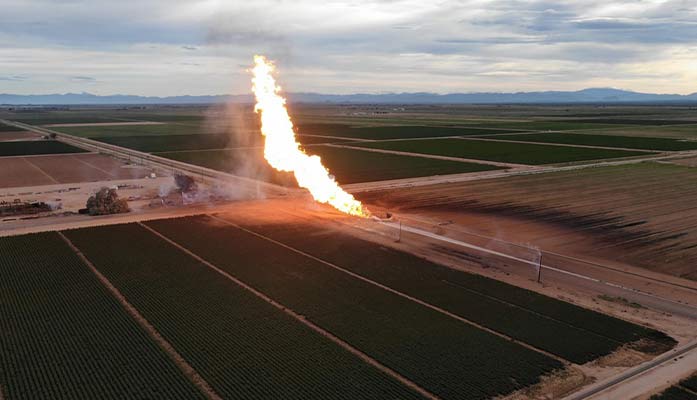
Three investigators with the National Transportation Safety Board are in Coolidge hoping to determine what caused a 30-inch El Paso Natural Gas pipeline to explode earlier this week, killing two members of a family and critically injuring a third.
Rosalita Alvarez remains hospitalized in Phoenix after suffering severe burns in a house fire which ignited shortly after 5:30 a.m. last Sunday. Her husband Luiz and their daughter Valeria, 14, died inside the house, according to the Pinal County Sheriff’s Office.
Authorities believe the fire was triggered by the explosion of the Kinder Morgan-owned pipeline. The ruptured portion of the pipeline is located about one football field’s distance from the Alvarez home, which was destroyed in the blaze.
According to Peter Knudson of the NTSB, the agency’s investigators arrived Monday and are expected to remain in the area for a few more days as they search for the probable cause of the explosion and fire. They are also looking for any contributing factors.
The NTSB is joined in the investigation by the Arizona Corporation Commission, the U.S. Department of Transportation’s Pipeline and Hazardous Materials Safety Administration, and Kinder Morgan. The Pinal County Sheriff’s Office and the Coolidge Police Department are also involved due to the fatalities.
Knudson told AZ Free News on Thursday that a preliminary report will be posted to the NTSB website in mid-September. However, a final report about the tragedy could take 12 to 24 months to complete.
In a statement released by Kinder Morgan shortly after the incident, the company said it experienced “a pipeline failure” but that the impacted pipeline segment was isolated. It took emergency responders until nearly 8 a.m. to shut off the flow of gas to the area, the Coolidge Fire Department reported.
Coolidge residents miles away from the pipeline reported hearing and feeling the explosion Sunday morning, and a large fireball was visible for miles, including in Casa Grande.
The NTSB is an independent federal agency responsible for determining the probable cause for pipeline incidents, as well as civil aviation, railroad, highway, and marine accidents.
by AZ Free Enterprise Club | Jul 18, 2021 | Opinion
By the Free Enterprise Club |
Some ideas need to be put to sleep. Maybe someone should tell that to the Arizona Corporation Commission.
About a year ago, the commission quietly released its plan to impose California-style energy mandates in our state. While following in California’s footsteps for just about anything seems like a bad idea, that certainly rings true when it comes to energy.
After all, last August, not too long after the Arizona Corporation Commission released its plan, California instituted its first intentional rolling blackouts since 2001. And the state’s residents were also asked to conserve electricity during a significant heatwave last summer.
But this year, it may be even worse. While electricity prices explode across California, more blackouts are almost guaranteed to happen again this summer. And Arizona could very well be affected…
>> READ MORE >>
by Justin Olson | May 28, 2021 | Opinion
By Arizona Corporation Commissioner Justin Olson |
On Wednesday, the Corporation Commission disregarded the clear will of the voters and advanced energy mandates nearly identical to what the voters overwhelmingly rejected just over two years ago. With 68.2% voting no, Arizonans resoundingly defeated Proposition 127 that would have required Arizona’s utilities to obtain 50% of their power from renewable sources. Voters sent a clear message that they do not support arbitrary mandates that will drive up the cost of their energy bills .
While Proposition 127 was a 50% renewable energy mandate by 2030, the draft energy rules adopted by the Commission yesterday include a 50% carbon emissions reduction mandate by 2032. But that’s not all, the Commission’s rule goes far beyond Prop-127’s 50% threshold and requires a 100% ban on carbon emissions by 2070.
Two years ago, California adopted a similar 100% standard and the result has been disastrous. Californians pay 50% more for their power than Arizonans, and, what do they get for this premium—rolling blackouts. In the heat of the summer last year, Californians found themselves with no ability to turn on their air conditioning units, power their appliances or even have a light to read. There was not enough power to go around due to California’s failed policies. Why would Arizona adopt the same mandates that led to these miserable results?
During the Commission’s deliberations, I offered an amendment to the energy rules that would have honored the will of the voters and protected ratepayers. With my amendment, the mandates would only apply if the projects available to meet the carbon reduction thresholds were the lowest-cost method of meeting customers’ energy needs. Unfortunately, the Commission rejected this commonsense amendment and made it clear that these rules are designed to drive up costs to ratepayers.
When I ran for the Commission, I promised to pursue policies that will lead to the lowest rates possible while still maintaining safe and reliable services. I have sought to honor this pledge with each of my votes at the Commission and my vote yesterday was no exception. I proudly voted to respect the will of the voters and to protect the ratepayers from unwanted rate increases. It’s disappointing that a majority of the Commission did not do the same.
by Terri Jo Neff | May 10, 2021 | News
By Terri Jo Neff |
Justin Olson says news reports that he is against getting Arizona’s electric utilities to a carbon-free or net-zero carbon level are incorrect. He whole-heartedly supports that goal, Olson insists, but believes it is more important to ensure Arizonans who pay for that electricity do not end up paying higher rates to reach the goal.
Olson is one of five members of the Arizona Corporation Commission, and one of three Republicans. He was joined last Wednesday by the ACC’s two Democrats in voting down a rules package which urged all electric utilities to a net-zero carbon level by 2050, but not mandate the goal.
The vote came nearly six months after the ACC -with a slightly different contingent of commissioners- voted 4 to 1 on a draft set of rules that included the net-zero by 2050 mandate. It had taken ACC staff and industry representatives about three years to get those rules worked out.
Olson cast the lone nay in that November vote. And he then voted nay last week even after he introduced an amendment to make the whole thing more palatable by switching the mandates to guidelines.
In the end, Olson says he could not get language into the rules to prevent utilities from using the mandates -or guidelines- as a justification for a rate increase to pay for something the company intended to do anyway. And that left customers at risk of paying more.
Olson insists that complaints directed toward any commissioners for “wasting” the time of ACC and industry staff are misplaced.
“The utilities would have undertaken all of that review and study anyway,” as part of determining their own future business plans, Olson told AZ Free News.
In fact, Arizona Public Service (APS) released an Integrated Resource Plan update for shareholders in February which listed its clean energy commitment for 100 percent “clean, carbon-free electricity” by 2050. Olson noted that the company’s plan was made without any regulatory mandate in place.
Olson also pointed out the “overwhelming” voter rejection of Proposition 127 in 2018 which sought to amend the Arizona Constitution to require nongovernmental electric utilities to increase the portion of their retail energy sales from certain types of renewable energy resources to 50 percent by 2030.
Refusing to support any type of renewable energy mandate without protecting ratepayers was simply “respecting the will of the voters,” says Olson. And that, he believes, means the ACC should be working to ensure ratepayers are charged lower rates in the future if utility companies benefit from lower costs by their own business decisions to use more renewable sources.
Some opponents of Olson’s position worry the Biden Administration will push Congress to pass legislation which may set net-zero mandates that do not serve the interest of Arizona’s utilities or its electricity users.
Olson says he understand that concern, but to preemptively enact “a bad policy” would be irresponsible given “there is no harm or penalty to Arizona the utilities, or the ratepayers at this time.”