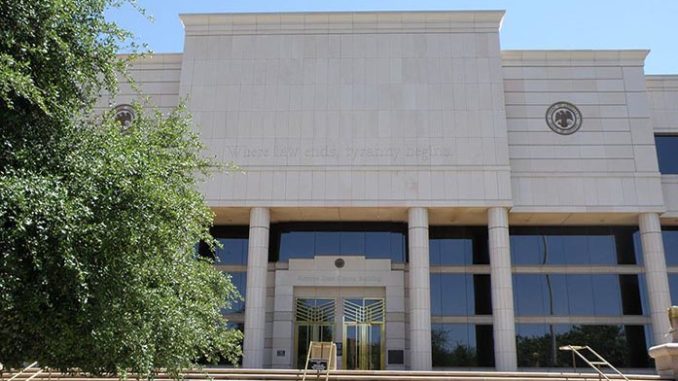
For more than 50 years, 89-year-old Robert Young has owned the historic Louis Emerson House. He was married on its front steps, and to him it is a priceless vestige of pre-statehood Arizona.
But Arizona State University (ASU) intends to force Young to put a price on his memories and Arizona history. ASU wants to build a new headquarters for ASU Health and a new AI-driven medical school, and Young’s home is in their way.
The Louis Emerson House predates Arizona’s statehood by a decade. It was built in 1902, and has a historic designation with the Phoenix Historic Property Register. Clark Churchill — adjutant general and attorney general for the territory of Arizona in the late 1800s — developed the property in 1888. Much of this history was recovered by Young, who told 12News that he’s spent much of his 50 years as the house’s owner preserving its history.
“I would describe it as being one of a kind, because Clark Churchill decided that he was going to have an important connection with a street railway right here; it was called the ‘Brill edition,’” said Young.
The home’s namesake, Louis Emerson, was a butcher with Phoenix’s Palace Meat Market. Emerson lived in the home with his wife, Clara, until his death in the 1920s. Clara remained there until the early 1930s. That’s what Young told the Arizona Republic in a 2013 feature on his home, along with his belief that at least two others may have lived there prior to the Emersons.
ASU has offered Young about $800,000 to sell, but Young denied. Young has said he may be open to an offer that could cover the costs to have the house relocated, which he said would cost between $2 million and $3 million.
“You can’t get back history,” Young told the State Press. “You can’t recreate a historical treasure.”
Following Young’s refusal, the Arizona Board of Regents (ABOR) filed an eminent domain lawsuit with the Maricopa County Superior Court to force Young to take the money.
ASU said in a statement that they issued several offers to Young based on an “experienced, state-certified appraiser,” some of which included options for moving the home, but didn’t offer further details.
The city of Phoenix has invested $50 million into the ASU Health development, though city officials have said in statements to the media that ASU’s proposal to them didn’t include Young’s house.
ASU Health will span 200,000 square feet and house the John Shufeldt School of Medicine and Engineering, which the university says is “a new kind of medical school” teaching the prioritization of data in medical decision-making, and blending medicine with engineering, technologies such as artificial intelligence, and humanities.
ASU plans to open ASU Health in the fall of 2028.
Over 3,700 community members have signed an online petition to save Young’s home as of this report, endorsed by Preserve Phoenix, city of Phoenix’s Historic Preservation Office, and Phoenix Historic Neighborhoods Coalition.
A hearing on the fate of the Louis Emerson House is scheduled for June 19.
AZ Free News is your #1 source for Arizona news and politics. You can send us news tips using this link.
The Arizona Supreme Court has agreed to take on a case determining whether Arizona State University (ASU) can mandate diversity, equity, and inclusion (DEI) trainings for its employees.
Professor Owen Anderson sued the Arizona Board of Regents in 2024 after ASU required him to take a DEI training called “Inclusive Communities” (ASU referred to their version of DEI as “DEIB,” or “diversity, equity, inclusion, and belonging”).
ASU requires the Inclusive Communities training as a condition of employment upon hire and every two years.
The Goldwater Institute, a Phoenix-based public policy and litigation organization, filed on Anderson’s behalf. Goldwater Institute attorney Stacy Skankey said the case represented Arizonans’ right to hold government agencies accountable for violating the law.
Arizona law prohibits any mandatory trainings which impart “blame or judgment on the basis of race, ethnicity or sex.”
“No one should be forced to participate in divisive DEI training or endorse race-based ideology as a condition for holding a government job,” said Skankey. “That’s exactly why Arizona lawmakers banned mandatory trainings that teach discriminatory ideas about race, ethnicity, or sex. But a law without enforcement is no law at all.”
The Inclusive Communities training included materials which taught that white supremacy exists as a structural phenomenon, minority faculty don’t have authority or control due to structural inequalities like racism and sexism, white privilege and white fragility exist and impact communities, white people have a duty to combat their privilege, racism can be implicit even if not intended, and sexual identities yield power.
Transcript examples from the training materials were included in the Goldwater Institute’s filing within the Arizona Supreme Court.
Along with the training, ASU formerly required employees to pass an accompanying module quiz. This exam graded certain answers as correct which served to advance DEIB ideology; the Goldwater Institute argued this final test further proved the training served as an impermissible mandate for employees to accept blame or judgment on the basis of race, ethnicity, and sex.
Anderson said ASU’s mandate violated state law because the training assigned “race blame” based on skin color.
Anderson added that ASU’s training was rooted in a Marxist dichotomy reducing the world to oppressor versus oppressed, and that the training imparted impermissibly discriminatory teachings that conflicted with his religious and political beliefs. Anderson is a tenured faculty member who teaches philosophy and religious studies.
“Arizona State leaders broke the law when they forced me and every other employee to take part in an ideological training that taught that it’s okay to judge people on their race, ethnicity, religion, and sex. I simply refuse to do that,” said Anderson. “Ultimately, the question before the Arizona Supreme Court isn’t a left or right issue — it’s about whether a state employee has the right to hold their employer accountable when it violates the law.”
The Arizona Court of Appeals previously rejected Anderson’s lawsuit. The court ruled that the law doesn’t have a provision allowing individuals like Anderson to seek legal recourse.
AZ Free News is your #1 source for Arizona news and politics. You can send us news tips using this link.
A new report from the Goldwater Institute alleges that Arizona’s public universities are not complying with state requirements to provide students with instruction in American civics, history, and economics. The findings follow previous Goldwater reports examining the integration of Diversity, Equity, and Inclusion content into both honors and American civics courses.
The policy requires universities to incorporate coursework covering key areas of American civics, explicitly stating:
“The study of American Institutions will include at minimum (I) how the history of the United States continues to shape the present; (II) the basic principles of American constitutional democracy and how they are applied under a republican form of government; (III) the United States Constitution and major American constitutional debates and developments; (IV) the essential founding documents and how they have shaped the nature and functions of American Institutions of self-governance; (V) landmark Supreme Court cases that have shaped law and society; (VI) the civic actions necessary for effective citizenship and civic participation in a self-governing society – for example civil dialog and civil disagreement; and (VII) basic economic knowledge to critically assess public policy options and to inform professional and personal decisions.”
The report asserts that some universities are allowing courses outside of traditional civics instruction to satisfy those requirements.
At @ASU, students can satisfy civics requirements with courses like:
• “Theatre and U.S. Democracy” • “Social Welfare, Work, and Justice in the US”
At @NAU: • “Indigenizing Museums” • “Sociology of Chicanx Communities”
This isn’t what the law requires.
— Goldwater Institute (@GoldwaterInst) April 9, 2026
Timothy Minella, director of higher education policy at the Goldwater Institute and the report’s author, said universities are not meeting the intent of the requirement.
“Arizona’s public universities are failing students by allowing niche courses steeped in DEI to satisfy the state’s robust history and civics requirements,” Minella said in a statement released with the report.
At Arizona State University, Minella states that courses such as “Anthropology of American Democracy,” “Social Welfare, Work, and Justice in the US,” and “Theatre and U.S. Democracy” are being used to meet civics requirements.
He argues that the first course, “ ‘Anthropology of American Democracy,’ fails to meet AMIT requirements and instead centers on the claim that American society oppresses certain groups.”
“The syllabus states that the course ‘emphasizes the relationship between personal narratives and broader historical forces, highlighting how belonging, rights, and obligations are experienced differently across diverse social, racial, and cultural contexts.’ … In the list of required readings for the course, there are only two that could plausibly be considered ‘founding documents’: the U.S. Constitution (which appears in only one section of the course) and the Declaration of Sentiments from the Seneca Falls Women’s Rights Convention.
Almost every other reading comes from specialized anthropological studies, including ‘I’m American, not Japanese!: The Struggle for Racial Citizenship among Later-Generation Japanese Americans’ and ‘Replicate, Facilitate, Disseminate: The Micropolitics of U.S. Democracy Promotion in Bolivia.’ Revealing the course’s leftist orientation, one module covers ‘anthropology’s role in American Empire Building,’ requiring students to read excerpts from Base Nation: How U.S. Military Bases Abroad Harm America and the World.”
At Northern Arizona University, Minella’s report identifies courses such as “Sociology of Chicanx and Latinx Communities” and “Indigenizing Museums and the Art World” as qualifying for civics and history requirements.
The report also alleges that the University of Arizona has failed to implement the American Institutions policy.
Minella wrote, “In utter defiance of ABOR’s directive, the University of Arizona (UA) has so far failed to implement AMIT at all. UA’s plan to integrate AMIT into general education has been mired in delays and troubling protocols.”
In December 2025, Mark Stegeman, an associate professor of economics at the University of Arizona, warned the university was failing to implement a civics program in accordance with the ABOR mandate, describing the U of A proposal for a single 3-unit course as “a car crash in the making.”
The report recommends that state lawmakers take action if universities do not fully comply with the policy.
Arizona’s honors colleges have been HIJACKED by activist faculty.
Our new report shows how bad it has gotten. Honors students are being required to take courses like: – “Eating the Globe: The Diverse, Weird, and Queer Food Politics” – Readings on “Compulsory Heterosexuality and…
The findings follow a separate March report from the Goldwater Institute examining honors colleges at Arizona public universities, including Barrett, The Honors College at Arizona State University, and the W.A. Franke Honors College at the University of Arizona, and the integration of Diversity, Equity, and Inclusion into honors programs and American civics courses.
The Civic Decline report is available on the Goldwater Institute’s website.
The Arizona Board of Regents (ABOR) grew by two new members last week.
On Monday, Gov. Katie Hobbs appointed Michele Halyard, an oncologist specializing in breast cancer, and Steve Peru, formerly Coconino County’s manager.
“Dr. Michele Halyard is a leader in medical education who will provide expertise to the Board as the universities work to meet the state’s healthcare needs,” said Hobbs in an announcement. “Steve Peru is a longtime public servant with decades of experience who will bring his pragmatic leadership and focus on accountability to the Board. Our public university students deserve the best, and I’m confident Michele and Steve will help ensure the continued excellence of higher education in Arizona.”
Halyard’s past and present accomplishments included in Hobbs’ announcement referenced a fellowship with the American Society for Radiation Oncology, professorship of radiation oncology, vice deanship of the Mayo Clinic Alix School of Medicine, board membership with the Arizona Community Foundation, and membership with the Arizona Bioscience Roadmap Steering Committee.
One thing not mentioned in Hobbs’ announcement was Halyard’s career-long DEI goals on reforming health care with health equity.
Halyard has spent her 40 years in medicine advocating for affirmative action and health equity in medicine, according to Mayo Clinic profiles on the doctor published in 2023 and 2024.
Halyard expressed her belief in the existence of structural racism in medicine, and its disparate impacts on patient suffering and mortality.
“I didn’t see a lot of people of color at the clinic either working or as patients, and I really thought what a shame that was because of the preeminence of healthcare that we deliver,” said Halyard. “People who, perhaps, feel shut out from the healthcare system, people who experience structural racism that prevents them from getting in for the best care, that really results in excess death, excess suffering among populations of people.”
It was under Halyard that Mayo Clinic initiated “antiracism efforts” by using affirmative action in recruiting.
Halyard’s husband is Phoenix City Councilman Kevin Robinson, a Democrat and former Phoenix Police Department assistant chief.
Peru’s historic dedication to DEI initiatives wasn’t mentioned in Hobbs’ press release, either.
Shortly after joining Coconino County as their manager, Peru took on a years-long effort by the county to recruit an individual for a DEI directorship position.
In the weeks following Trump’s inauguration last year, Peru posted a comment agreeing with another colleague’s LinkedIn post advocating for DEI in K-12 in the wake of the new administration’s policies.
Prior to joining Coconino County, Peru was the chief development and government relations officer at Coconino County Community College and former CEO and president of United Way of Northern Arizona.
Last September Hobbs appointed Jimmy McCain, the youngest son of John McCain, to ABOR. McCain’s appointment stirred controversy, not only for his conflict with Arizona legislative leaders and President Donald Trump, but with his role at a company that was a key sponsor of Hobbs’ inaugural committee.
Hobbs has also appointed Lee Stein, former assistant U.S. attorney and special assistant attorney general within the Arizona Attorney General’s Office.
The governor’s two picks for student regents have backgrounds in gun control advocacy. Their contributions to ABOR include expanding time and resources for students’ mental health.
AZ Free News is your #1 source for Arizona news and politics. You can send us news tips using this link.
Arizona State University (ASU) professor Dr. Owen Anderson has asked the Arizona Supreme Court to hear his case challenging mandatory diversity, equity, and inclusion (DEI) training after a lower court dismissed his lawsuit, according to a petition filed this week by the Goldwater Institute.
Anderson, a philosophy and religious studies professor at ASU, originally filed the lawsuit in 2024 against the Arizona Board of Regents. He argued that the university’s required “Inclusive Communities” DEI training violated an Arizona statute that prohibits public agencies from making employees participate in training that “presents any form of blame or judgment on the basis of race, ethnicity, or sex.” Arizona Senate President Warren Petersen (R-LD14) and then-House Speaker Ben Toma (R-LD27) filed an amicus brief in support of Dr. Anderson’s lawsuit.
According to the Goldwater Institute’s petition, Anderson objects to the DEI training materials, saying they include concepts about race and identity that he believes are unlawful under state statute.
“No one should be forced to participate in divisive DEI training or endorse race-based ideology as a condition for holding a government job. That’s exactly why Arizona lawmakers banned mandatory trainings that teach discriminatory ideas about race, ethnicity, or sex. But a law without enforcement is no law at all,” Goldwater attorney Stacy Skankey explained. “We’re asking the Arizona Supreme Court to correct the lower court’s error and restore Arizonans’ right to hold government agencies accountable when they violate the law.”
ASU forced a professor to take DEI training as a condition of employment.
Goldwater stated in a press release, “There’s no way around it—a law is meaningless if it can’t be enforced. If allowed to stand, the error by the Arizona Court of Appeals would eliminate an essential civil-rights safeguard for public employees and taxpayers. The ruling changes how Arizona laws are enforced by removing the ability of an ordinary Arizonan to ensure government officials obey the law.”
In its February filing, Goldwater said the Arizona Court of Appeals ruled that Anderson could not sue because it concluded the relevant law does not expressly provide an avenue for individuals to challenge such training in court.
The petition filed by the Goldwater Institute argues that allowing the Court of Appeals’ decision to stand would leave public employees without a means to enforce the statute and hold government employers accountable. It asks the Arizona Supreme Court to recognize an implied private right of action under the law, allowing employees to challenge alleged unlawful training mandates.
The case highlights a broader debate over DEI programs at public institutions. The previous lawsuit filed by the Goldwater Institute in March 2024 similarly challenged ASU’s DEI training and sought a court order preventing the Board of Regents from imposing or using public funds for the training, citing the same Arizona statute.
ASU has previously contested the Goldwater Institute’s claims, with university officials stating that its training reflects its commitment to inclusiveness and does not violate state law. However, as AZ Free News has previously covered, ASU lost 27 grants from the National Science Foundation (NSF) in 2025, worth approximately $28.5 million, in line with the NSF policy that ensures grants don’t prioritize certain groups or individuals.
Speaking of the ongoing lawsuit, Professor Anderson said in a statement, “Arizona State leaders broke the law when they forced me and every other employee to take part in an ideological training that taught that it’s okay to judge people on their race, ethnicity, religion, and sex. I simply refuse to do that. Ultimately, the question before the Arizona Supreme Court isn’t a left or right issue—it’s about whether a state employee has the right to hold their employer accountable when it violates the law.”
There is currently no set timeline for the Arizona Supreme Court to decide whether it will grant review of Anderson’s petition.