This week’s erroneous attack on Arizona’s popular Empowerment Scholarship Accounts (ESAs) is another example of how biased reporting is misleading lawmakers and the public.
When the Arizona Auditor General last week released its Single Audit Report on the state for fiscal year 2024, Craig Harris of Channel 12 News had another fairy tale ready for viewers and readers. The ESA program, he claimed, is “plagued by weak controls, questionable spending, and internal management failures.”
No mention was made of the Arizona Department of Education’s recent finding that only 2% of ESA funds were spent on unallowed items (mostly innocent errors like backpacks and lunch boxes), and only 0.3% of ESA funds were spent fraudulently.
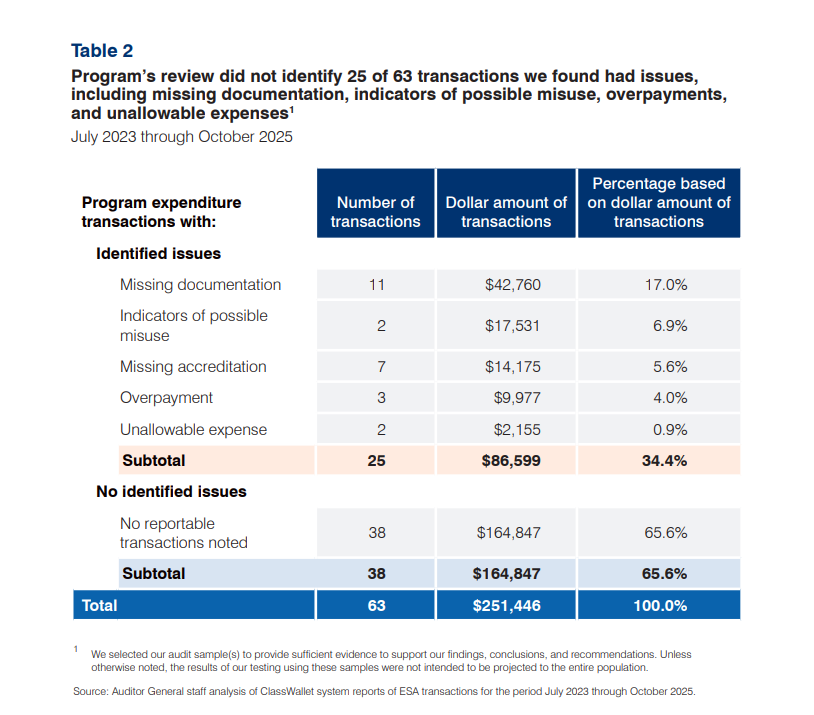
A new Arizona Auditor General report finds the the percentage of misspending in the state's Empowerment Scholarship program was a stunning 34 percent, based on a sample of transactions from July 23-October 25.
The report also is highly critical of @RealTomHorne management….
Both halves of that claim are false. And the falsehoods are not minor.
Start with “random.” The Auditor General’s report describes the relevant sample in unambiguous language: “we judgmentally selected 63 expenditure transactions for review occurring between July 2023 and October 2025 totaling $251,446.” [Emphasis added.]
A footnote on the same page adds, for the benefit of any reader who might be tempted to make the mistake that Harris did: “We selected our audit sample(s) to provide sufficient evidence to support our findings, conclusions, and recommendations. Unless otherwise noted, the results of our testing using these samples were not intended to be projected to the entire population.” [Emphasis added.]
Judgmental sampling and random sampling are not synonyms. They are distinct methodologies with distinct inferential properties. A random sample can be projected to a population; that is its entire purpose. A judgmental sample cannot, which is why auditors use it to probe suspected weaknesses rather than measure their prevalence.
In this case, the auditor general was testing the robustness of the Arizona Department of Education’s review process, not trying to determine the prevalence of misspending in the ESA program.
More responsible journalists, such as Garrett Archer of ABC 15, made sure to clarify that the auditor general’s findings were not generalizable to the entire program.
Note: This is not a program transaction error rate. The Auditor General's focus was on the review process itself.
— The AZ – abc15 – Data Guru (@Garrett_Archer) May 12, 2026
In other words, Harris completely misrepresented the auditor general’s methods and findings. That is sloppy at best, dishonest at worst.
Not only is the “34% misspending” figure not generalizable, it’s also not all misspending.
The 34.4% figure comes from dividing $86,599 in flagged transactions by the $251,446 sample. But Table 2 of Finding 2024-04 breaks those flagged transactions into five categories, and only two of them — “unallowable expense” ($2,155) and “overpayment” ($9,977) — involve money the program should not have disbursed.
The other three — missing documentation ($42,760), missing accreditation ($14,175), and “indicators of possible misuse” ($17,531) — are paperwork and compliance gaps. A tutor’s accreditation certificate that wasn’t uploaded is not the same thing as a misspent dollar. The actual confirmed misspending share within the sample (combining 0.9% unallowable expenses plus 4% overpayments) is about 4.9%, not 34%. Moreover, as the report concedes, even the 4.9% figure cannot be projected to the entire program.
In short, Harris conflates paperwork issues with misspending and treats a non-generalizable sample as generalizable, even though the auditor general warned readers not to do exactly that. Then Harris’s manufactured anti-ESA talking points are repeated ad nauseum by politicians and political activists.
Harris built an entire investigative series on a Department of Education internal review that supposedly reported a 20% misuse rate — except the internal review, like the auditors’ sample, was not designed to be projected. Harris projected it anyway.
When the same Department then produced a separate analysis suggesting misuse was minimal, Harris turned around and faulted that study for over-generalizing from its sample. For Harris, non-generalizable findings become generalizable when they damage ESA. Generalizable findings become non-generalizable when they don’t.
The convenient feature of this method is that the error always points the same direction. A reporter who genuinely struggled with the statistics of audit sampling would make mistakes in both directions over time. Harris’s don’t. They cluster.
And they remain uncorrected. Harris’s original 20% claim has never been retracted. The “random sample” language and the 34% framing are now circulating through campaign statements, legislative press releases, and social media posts, citing Harris’s distorted reading of the Auditor General report.
One cannot help but notice that Harris’s manufactured anti-ESA talking points come at a moment when anti-ESA groups are gathering signatures for two ballot initiatives to curb and regulate the ESA program. One also cannot help but wonder whether the downstream political effect is more than incidental to the reporting.
The Auditor General’s findings on ESA are real and worth engaging on their own terms. The program’s risk-based audit methodology is likely better than any other program in the state, but it could still be improved. The auditor has some substantive criticisms, and ADE will have to answer them.
Arizonans deserve honest reporting on those findings, not statistical fictions dressed up as “journalism.”
Jason Bedrick is a Senior Research Fellow and Corey DeAngelis is a Research Fellow at The Heritage Foundation’s Center for Education Policy.
Emerson famously noted that “a foolish consistency is the hobgoblin of little minds.” Opponents of Arizona’s school choice program seem determined to field legions of such monsters.
Exhibit A: the reporting of Craig Harris. Harris has over the years repeatedly filed anti-school choice stories which were riddled with errors. His latest salvo against Arizona’s popular Empowerment Scholarship Accounts (ESA) program is no exception.
In 2018 and 2019, Harris published articles in the Arizona Republic claiming charter schools underperformed district schools and faced mass closures, but both stories relied on flawed research—including counting schools that only went through 9th grade or had already closed as having 0% graduation rates and relying on “research” by anti-charter school activists that misunderstood basic accounting concepts.
More than six years later, the predicted mass closures have never materialized, and National Assessment of Educational Progress data actually showed Arizona charter students outscoring district peers by roughly two grade levels.
But Harris, unlike the students, doesn’t seem to have learned his lesson. These days he has fixated his efforts against Arizona’s ESA program—and the results are just as edifying.
With an ESA, parents can purchase a wide variety of educational goods and services using 90% of the state money that their child would have received at their local district school. The parent-managed accounts have state oversight to keep transactions focused on allowable education expenses. The program is wildly popular with Arizona families, with over 100,000 students participating.
However, the ESA program is not so popular with special interest groups tied to school districts and their allies in the press.
Now at Channel 12, Harris has produced misleading stories about Arizona’s ESA program, including claims that parents use accounts for “babysitting“—based on a since-corrected error by the Treasurer’s Office—and that families are “subsidizing vacations,” when in reality they’re purchasing tickets to museums, zoos, and aquariums, which are allowable educational expenses also used by public schools. The program uses risk-based auditing to detect fraud, the same widely accepted method used by the IRS and recommended by Arizona’s Auditor General.
In his latest salvo against ESAs, Harris has produced a so-called “analysis” claiming that 20% of ESA purchases constituted a misuse of funds—a huge jump from the less than 1% rate of misuse previously detected by the Arizona Auditor General.
Misuse of funds in publicly funded programs is a serious problem which the Arizona Department of Education has taken great pains to minimize in the ESA program. Harris, however, is once again playing games and tricks with the data.
First, Harris’s claim of that 20% misuse is based upon an examination only of a small portion of total ESA purchases—384,478 of the 1.8 million total ESA transactions since December 2024, or about 20% of the total. This smaller group of purchases had been selected by the Arizona Department of Education for additional scrutiny via risk-based auditing, so it’s not a random sample that one could use to extrapolate about rates of misuse in the ESA program generally.
In other words, among the 20% of ESA purchases flagged for additional scrutiny, 20% were found to be misspending. But 20% of 20% amounts to only 4% of total purchases. Harris’s claim that 20% of ESA purchases were misspending is a gross exaggeration.
In fact, even the supposed 4% misuse rate itself is an exaggeration, as it is 4% of total transactions, not 4% of total spending. The most recent data from the Arizona Department of Education show more than half of ESA funds are spent on private school tuition, so the rate of misspending is likely less than 2% of total spending—a rate of improper payments that is well below a variety of programs found in programs which ESA opponents support, such as Medicaid (7.4%), food stamps (9.3%), and unemployment insurance (14.4%).
Tears for Fears’s hit song “Everybody Wants to Rule the World” includes the line, “One headline—why believe it?” If the headline is followed by a Craig Harris byline, be very careful before you believe it as you are not getting the whole story—maybe even a false story.
Matthew Ladner is a Senior Advisor for education policy implementation and Jason Bedrick is a Research Fellow at the Heritage Foundation’s Center for Education Policy.
School bureaucrats who have mismanaged their finances are hoping that voters will blame a convenient scapegoat: families using Empowerment Scholarship Accounts (ESAs) to educate their children. As usual, their allies in the legacy media are trying hard to help them shift the blame—but the numbers don’t lie.
Channel 12 recently ran a story titled “Deer Valley teachers self-fund or rely on classroom wish lists for basics, while ESA parents buy luxury items with state tax dollars.” Most of the article reads like a press release from Deer Valley Unified School District Superintendent Curtis Finch, who claims that the ESA program has “zero accountability,” “no oversight,” and is “out of control.” Meanwhile, the article quotes teachers in Deer Valley who are spending hundreds of dollars from their own pockets to cover school supplies for their students.
The implication is clear: district schools are financially starved while ESA families waste money on frivolous luxuries. But the reality is exactly the opposite.
Misuse of the ESA program is vanishingly small. The Arizona Department of Education’s internal audit had turned up $622,000 in ESA funds that are “possible fraud or misuse.” That’s approximately 0.05% of total ESA spending over the past two years.
Misuse of funds in the ESA or any other public program must be detected, deterred, and punished. This is in fact happening in the ESA program, as the Arizona Department of Education had already found the misuse, suspended accounts of those responsible, and reports that it is “in the process of collecting more than $600,000” in improper spending. All of this makes the ESA program far more transparent and accountable than Arizona school districts, which do not post their purchases.
And while Deer Valley teachers may indeed purchase their own school supplies, it has nothing to do with the ESA program and everything to do with misplaced district priorities.
One of the oldest tricks in the school district advocate playbook involves pretending that teachers must buy their own classroom supplies because of a lack of funding. The Channel 12 story cites a Deer Valley biology teacher who said she “spends at least $500 of her own money every summer for her classroom.”
Days after the report aired, former Deer Valley school board candidate Tiffany Hawkins revealed that Deer Valley Unified had spent $560,407 to send students and staff on trips to Disneyland, Knott’s Berry Farm, Sea World, Universal Studios, and other destinations in Arizona, California, Hawaii, Indiana, and Texas. Apparently, the district leadership decided that these trips took precedence over classroom supplies for Deer Valley teachers.
Don’t hold your breath waiting for Channel 12 to cover that. Deer Valley Superintendent Finch—who recently faced charges of stonewalling public records requests and illegal electioneering on school grounds—attacked the ESA program for “out of control” spending with “zero accountability.” But his critiques of the ESA program much more accurately describe spending in his own district.
The Arizona Auditor General reports that Deer Valley spends $13,717 per pupil, meaning that a classroom of 25 students thus generates over $340,000 in total revenue. Where did this money go? Mainly not to teachers.
The Auditor General reports that Deer Valley average teacher pay is $2,163 below the state average. If Deer Valley is not prioritizing teachers, what is it prioritizing instead? The Auditor General report helpfully provides an answer: “high” and “very high” spending on administration and transportation, respectively, compared to a group of peer school districts.
The Goldwater Institute recently published a study of Arizona school superintendent compensation. Goldwater needed to use the open-records law to obtain this information, as districts compensate their superintendents in a variety of creative ways outside of their base salary, including providing either vehicles or “car allowances,” extra retirement benefits, and other perks.
The Goldwater Institute found that Deer Valley provides a total compensation package for their Superintendent of $290,505, including a car allowance of $10,000. This car allowance alone could have provided 20 teachers with $500 each for classroom supplies.
Even if one were to take the highly perverse view that students were the indentured servants of the school districts in which they reside, it would still be absurd for Deer Valley Unified officials to blame their problems on the ESA program. Arizona Department of Education reports show that 10,966 students lived within the boundaries of Deer Valley Unified but attended other public schools in 2024.
Deer Valley Unified meanwhile “drained” almost 3,000 students and their funding from other public schools. At the end of 2024, only 709 students had left a Deer Valley school to participate in the ESA program. Four different public schools outside Deer Valley Unified each have enrolled more students who reside in the district than the ESA program. Moreover 217 total public schools outside the district enroll Deer Valley Unified resident students.
Luckily, Arizona policymakers have decided that Arizona children are not merely funding units for their local school districts. Arizona families can use ESAs to choose the schools that are the best fit for the interests and aspirations of their children.
Arizona school districts have never had as much money as they have now, enough apparently to prioritize trips to California and perks for superintendents. If Deer Valley Unified officials hope to gain the enrollment of the thousands of resident students who have chosen to pursue their education elsewhere, a clear path forward would be to prioritize their funding.
Purchasing classroom supplies for teachers would be a great first step.
Matthew Ladner is a Senior Advisor for education policy implementation and Jason Bedrick is a Research Fellow at the Heritage Foundation’s Center for Education Policy.
Community members are questioning delays in Deer Valley Unified School District (DVUSD) releases of public records.
Tiffany Hawkins, a former board candidate and parent in the district, reported DVUSD “buried” about 3,000 emails in a public records request. Hawkins accused DVUSD officials of doing so to hide staff usage of school resources and time for electioneering.
DVUSD disgustingly buried 3k emails in a public records request to hide staff shamelessly hijacking school resources and time for election rigging, petition peddling, and political endorsements, flouting AZ law with reckless abandon! Taxpayers demand justice! @GoldwaterInstpic.twitter.com/Pvn6E2RSWB
DVUSD officials have previously faced accusations by parents of electioneering on school grounds. DVUSD Superintendent Curtis Finch was accused of doing so by placing political flyers on cars at school football games.
DVUSD is currently up for a budget override on the ballot this November. The 15 percent maintenance and operations (M&O) will cover approximately nine percent of all salaries, maintain maximum class sizes, pay for support services staff like counselors and nurses, and continue certain student programs such as free full-day kindergarten. This election is mail-in only.
Reporting from the Arizona Auditor General found that DVUSD spends more money on administrative costs in comparison to peer districts, ranking it as “high,” and noted that transportation spending per mile and per rider was “very high.” The report also noted that enrollments have declined steadily.
The auditor general also noted that the average teacher salary was over $2,000 less than the state average — even with the average teachers having over 12 years of experience. The district did apply its additional state monies intended to increase teacher salaries by 20 percent from the 2017 base fiscal year, which raised salaries by 35 percent.
Finch has blamed the state’s school choice program for their financial woes, manifesting as teachers struggling to come up with the funds for basic school supplies.
“Arizona has the most unusual (education) system in the nation. We have zero accountability,” said Finch in an interview with 12 News last week.
Hawkins also alleged that DVUSD denied 41 percent of her public records requests, along with withholding about 37,000 pages.
Arizona Women of Action (AZWOA), an affiliate of Hawkins, reported additional issues with public records requests being fulfilled in an untimely and incomplete manner.
AZWOA reported missing over 142,000 pages, collectively across multiple requests, and delays in responses taking anywhere from 100 to over 300 days.
A community member in Deer Valley Unified School District (@DVUSD) is exposing major delays and withholdings in public records requests, questioning compliance with Arizona’s public records law, which requires timely fulfillment.
DVUSD governing board member Kimberly Fisher said she has experienced “many games played” concerning public records retrieval. Fisher alleged “most” others wouldn’t speak up for “fear” of Superintendent Curtis Finch and his wife.
“Some excess redaction, some missing that suddenly show up, some taking over a year to receive, some they made me come in and scan myself if I wanted to see them only to find they already had them electronically,” said Fisher.
I, as an elected Governing Board member have had many games played with public records. Some excessive redaction, some missing that suddenly show up, some taking over a year to receive, some they made me come in and scan myself if I wanted to see them only to find they already…
Hawkins said she filed a complaint alleging “discrimination and retaliation.” The board dismissed the complaint.
Earlier this year, parents expressed concerns with DVUSD compliance with President Donald Trump’s orders to end Diversity, Equity, and Inclusion (DEI) teachings and programs.
AZ Free News is your #1 source for Arizona news and politics. You can send us news tips using this link.
Channel 12 continued its clumsy crusade against school choice this week with a breathless report about fraudsters abusing Empowerment Scholarship Accounts to buy diamond rings and necklaces, flights and hotel stays, and even lingerie.
It paints a picture of a program rife with abuse. But is it?
The Arizona Department of Education gave Channel 12 the records for more than 1.2 million ESA requests. Yet when askedrepeatedly what percentage of those requests were fraudulent, Channel 12’s reporter refused to comment.
Why? Because the truth undermines the anti-ESA narrative.
The salacious report is intended to persuade policymakers who support ESAs to impose regulations that would undermine the ESA program. It goes without saying that anyone engaged in fraud should be prosecuted to the fullest extent of the law, and the Arizona Department of Education is appropriately cracking down on fraudsters. But before policymakers rush to amend the ESA program, they should know the context that Channel 12 left out.
ESA Misspending Is a Tiny Fraction of Total ESA Spending
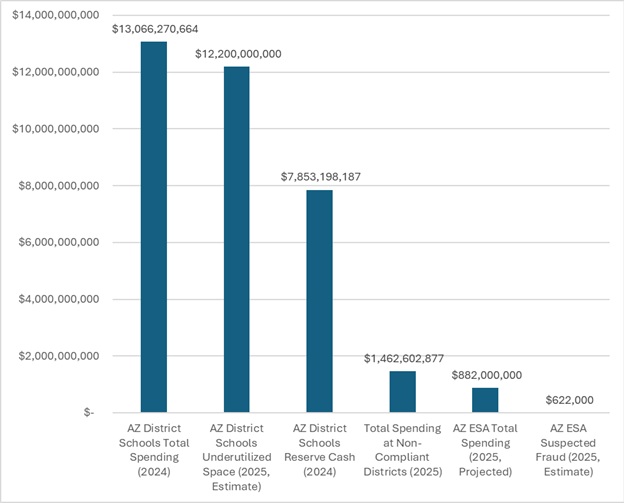
The ESA program currently serves about 90,000 students at a projected cost of $882 million this year and $939 million next year, or about 6.7% of the $14 billion spent on Arizona’s district schools. Families can use ESAs to purchase a wide variety of educational expenses to customize their child’s education.
The typical ESA student receives about $7,500 per year, compared with more than $15,300 per pupil at Arizona’s district schools. Students with special needs—who account for more than 19% of ESA students, compared with 14% of district school students—can receive more funding, although the accounts are still worth 90% of what the state spends on similarly situated students at public schools. According to the Common Sense Institute, “a disproportionate share of middle-income households use an ESA.”
On Tuesday, the Arizona Department of Education revealed that their internal audit had turned up $622,000 in ESA funds that are “possible fraud or misuse.”
That’s less than one-tenth of 1% of total ESA spending.
Ignoring Mountains, Covering Molehills
Meanwhile, there are 30 school districts that the Arizona Auditor General currently deems to be non-compliant with state reporting requirements or that have internal control deficiencies. The total spending in those districts is more than $1.4 billion, more than the total spending of the ESA program. Yet aside from its coverage of the disastrous overspending in the Isaac Elementary School District, Channel 12 has barely covered it at all.
For that matter, Channel 12 has ignored the $7.8 billion that Arizona school districts are holding in cash reserves. That’s about $7,000 per pupil. The reserves have grown $2 billion in two years, yet Channel 12 doesn’t evince even the slightest curiosity about why.
Nor is anyone at Channel 12 interested in the $12 billion worth of unused and underutilized buildings that districts are sitting on, often just to prevent private or charter schools from buying them.
Channel 12 found space in the aforementioned ESA exposé to mention that a judge recently ruled that the state supposedly “isn’t properly funding capital needs for its public schools,” but the station had no space to mention that school districts are sitting on $20 billion in cash reserves and underutilized buildings.
Indeed, Channel 12 has barely covered any of these facts even as they pump out multiple anti-ESA stories each week, despite the fact that the ESA program is dwarfed by the spending at non-compliant districts, district school cash reserves, and underutilized buildings.
School-choice opponents and their media allies are hyper-focused on ESA misspending because they want to pressure lawmakers to undermine the program via regulation.
The Arizona Department of Education adopted its risk-based auditing strategy—automatically approving ESA spending requests below $2,000, then auditing accounts on the back end—because Superintendent Tom Horne’s previous “review every penny” approach was causing massive backlogs and delays in approving expense requests and reimbursements.
There were nearly 11,000 transactions in quarter 3 of this year alone. It’s impossible for the department’s staff to review each transaction in a timely manner, but parents trying to teach their kids can’t wait months just to buy a textbook or pay their child’s tutor or school.
To Horne’s credit, he listened to parents and made some incremental improvements that make it easier for parents to use the program. Now a tiny percentage of ESA holders are taking advantage of the looser rules, but they will be forced to pay the money back and could face prosecution.
The Arizona Department of Education has suspended 400 accounts due to improper spending —just 0.4% of the total accounts—and has referred some to the Attorney General for further investigation and prosecution.
Punishing fraudsters is necessary. Every government program is subject to some amount of fraud and abuse, and it’s incumbent upon public officials to implement rules that keep fraud as close to zero as possible. But it is not in the public interest to undermine a program’s effectiveness, especially when that program is helping kids get access to a better education and a brighter future.
School-choice opponents are using misspending as a pretext. If that was their real concern, they’d be raising alarms about all the waste, fraud, and abuse in the district school system. They’re not really concerned with stopping the 0.4% of ESA holders committing fraud, they just don’t want the program to work for 99+% of families just trying to do right by their kids.
Supporters of education freedom and opportunity should ignore the manufactured outrage and work to ensure that the ESA program works well for the families it serves.
Jason Bedrick is a Research Fellow at The Heritage Foundation’s Center for Education Policy.