by Corinne Murdock | Sep 29, 2023 | Education, News
By Corinne Murdock |
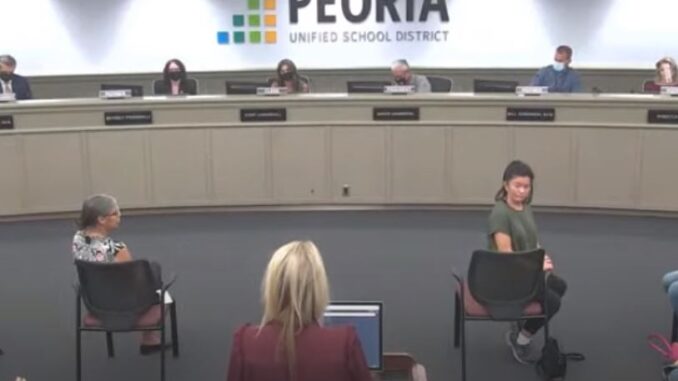
The Peoria Unified School District (PUSD) is facing a lawsuit from one of its own board members after prohibiting her from quoting Scripture during meetings.
The First Liberty Institute filed the lawsuit on Tuesday on behalf of board member Heather Rooks.
The lawsuit noted that public officials have a storied history of quoting Scripture and using religious references to solemnize public occasions, opening with President Joe Biden’s citation of the Book of Isaiah in his 2021 address to the nation following his withdrawal of American troops from Afghanistan. Accordingly, Rooks defended her Scripture citations as a continuation of a longstanding American tradition.
“Heather Rooks isn’t a famous historical figure or a household name, but she too wants to be part of the longstanding tradition of government officials solemnizing public occasions in this way,” stated the lawsuit. “To vindicate her statutory and constitutional rights as a Board member and citizen, Rooks respectfully brings this action to declare those rights — and to dispel the confusion that has regrettably clouded a practice as old as the Republic itself.”
Rooks joined the board in January. From her first board meeting until the district ordered her to stop in July, Rooks made it a regular practice of hers to cite Scripture as part of her comments to the public.
The lawsuit noted that after PUSD received a complaint from Secular Communities for Arizona about Rooks’ recitation of Scripture in February, the board’s legal counsel advised board members in an email that they couldn’t pray or recite Scripture during meetings because it allegedly violated the Establishment Clause.
READ THE LAWSUIT HERE
Rooks was one of two board members chastised by district counsel for quoting the Bible during board meetings. The other board member, Rebecca Hill, resigned last month.
Prior to Hill’s resignation, the Freedom From Religion Foundation (FFRF) threatened to sue PUSD in May if Hill and Rooks didn’t cease their religious speech.
“While board members are free to promote their personal religious beliefs however they wish in their personal capacities outside of the school board, as government officials they cannot be allowed to commandeer the board in order to impose their personal religious beliefs on district students, parents, and employees,” stated FFRF.
Around the time of the lawsuit threat, PUSD held a public presentation warning against Scripture readings. The presentation was reportedly shared later with staff and parents.
Andy Gould, senior counsel at First Liberty, said in a press release that Rooks’ use of the Bible was part of a historical American tradition.
“Heather takes her responsibilities serving the parents and students in her community seriously, and quotes Bible verses as a source of courage and strength in performing those duties,” said Gould. “Like so many dedicated public leaders throughout our history, Heather most certainly can use inspirational quotes from religious, historical, and philosophical sources and figures as a source of personal inspiration, as well as encouragement to the community at-large.”
Rooks stated in the press release that she was grateful for her membership on the PUSD board, and that Scripture serves as a source of encouragement.
“As a member of the school board, I understand the weight and significance of all of our decisions, and simply find quoting scripture out loud to be encouraging to myself and to many in attendance,” said Rooks.
Corinne Murdock is a reporter for AZ Free News. Follow her latest on Twitter, or email tips to corinne@azfreenews.com.
by Andrew Gould | Sep 11, 2021 | Opinion
By Andrew Gould |
Our Country is based on the rule of law. From the rights and liberties protected by our Constitution to the statutes enacted by federal and state governments, we are a nation of laws. Unfortunately, the Biden administration has abandoned this principle. The most shocking example is the administration’s refusal to enforce federal immigration laws on our southern border. This dangerous “Open Border Policy” has placed the health and safety of Arizonans in grave danger. The Biden administration has reduced our southern border to a zone of lawlessness run by criminals making billions of dollars from illegal immigration — $7,000 to $8,000 per illegal immigrant. Further, these lawless crooks profit off the sale of lethal drugs such as fentanyl and methamphetamine, all the while raping women, molesting children, and assaulting and murdering thousands of victims.
We have petitioned, complained — and, at times, begged — for the federal government to help, but to no avail. The sad reality is that there is no help on the way. We are on our own.
But all is not lost. Embedded in our Constitution is the principle of federalism. Specifically, under the Tenth Amendment, powers not delegated to the federal government are reserved to the States (and the People). Federalism provides states with the power and authority to protect the safety and welfare of their citizens through new and innovative solutions without relying on the federal government.
Thus, we do not have to rely on the federal government to secure our border with Mexico. Rather, we can use state law and resources to address it on our own. We can begin securing our border by enforcing state laws that protect our citizens and their property. This can be accomplished by creating a state enforced No Trespassing Zone along the border.
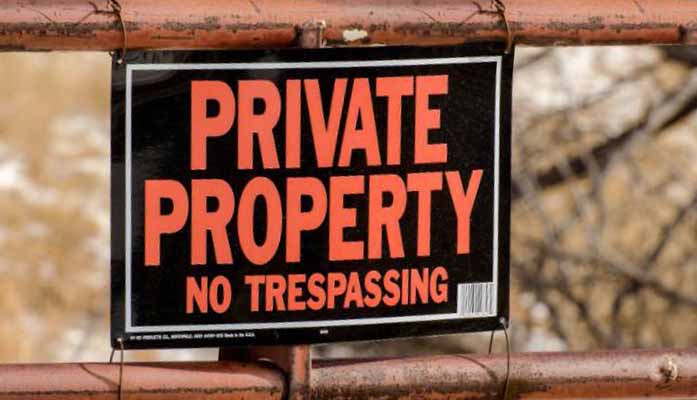
The No Trespassing Zone is a simple concept. First, persons entering the country illegally must, at some point, enter private or state land. If given reasonable notice that such entry constitutes trespassing (through the posting of “No Trespassing” signs), they can, and will, be arrested for trespassing. In addition to trespass, those entering the No Trespassing Zone may be arrested and prosecuted for the criminal damage they cause to state and private property. Additionally, the trespassers and the cartels will be prosecuted for any illegal drugs and weapons they carry into the Zone.
Second, entry into the No Trespassing Zone is detected by placing a “virtual wall” along the Zone. This technology, which employs hidden cameras placed in strategic locations, provides crystal-clear, real-time images of persons entering a surveilled area. This “virtual wall” technology is already in place on the border in Cochise County and has been funded by the Arizona legislature to extend to Yuma County.
Third, the policy requires the local county attorney’s offices and the Attorney General’s office to commit to a “zero-tolerance policy” regarding violations occurring in the No Trespassing Zone. Simply put, a “zero-tolerance policy” means that these agencies will dedicate staff and resources to prosecuting crimes committed in the Zone when there is sufficient evidence to do so.
Posting no trespassing signs would, of course, require the consent of private landowners. Additionally, much of the border includes locations, such as federal and reservation land, where state law enforcement and prosecutors have no jurisdiction. Thus, in some areas, the No Trespassing Zone will have to extend inside the state to the nearest adjacent private or state property where entry is made.
It is time for Arizona to act. As Arizona’s Attorney General, I will aggressively use the power of the Office to develop creative legal strategies to solve the problems we face together. The “No Trespassing Zone” initiative will put the law on our side to ensure border security.
Andrew W. Gould was appointed as a Justice to the Arizona Supreme Court in 2017 after serving 5 years on Division One of the Arizona Court of Appeals. He retired from the Supreme Court in March 2021. Prior to his appointment to the Court of Appeals, Justice Gould spent 11 years as a Judge of the Superior Court in Yuma County, where he served as both Associate Presiding Judge and Presiding Judge.
Andrew received his J.D. from Northwestern University School of Law in 1990. He began his legal career in Phoenix, Arizona, practicing in the field of civil litigation. In 1994, he became a Deputy County Attorney, prosecuting major criminal cases for Yuma and Maricopa Counties. He served as Chief Civil Deputy for the Yuma County Attorney’s Office from 1999-2001. Justice Gould has previously served on the Arizona Supreme Court Commission on Technology, as the President of the Arizona Judges’ Association, and has taught at the Judicial Conference and New Judge Orientations.
by Terri Jo Neff | Sep 3, 2021 | News
By Terri Jo Neff |
A former justice of the Arizona Supreme Court who used to prosecute cross-border criminals before becoming a judge says many Arizonans along the border feel abandoned by President Joe Biden, but he has an idea to help stop the influx of undocumented immigrants and smugglers coming into the state.
During an interview with KFYI’s James T. Harris on Thursday, Andrew Gould agreed with a recent assessment by Cochise County Sheriff Mark Dannels that the situation at the border is out of control, but the crisis “is far, far worse than you could imagine,” he said.
“We’ve created an open border, and the Biden Administration has essentially abandoned American citizens just like he did with Americans in Afghanistan,” Gould said.
Gould told Harris that there are options for making Arizona unattractive to those illegally entering the United States via Arizona. The options could be undertaken without the help of federal authorities such as the U.S. Customs and Border Protection and U.S. Border Patrol, which get their orders from Biden.
One option which Gould believes can be easily implemented is establishing a No Trespass Zone from Cochise County to Yuma County on state and private lands along the 325 miles of border between Mexico and Arizona.
According to Gould, Arizonans are now “at the mercy of these cartels who are making billions of dollars off crime. They are pushing illegal immigration, fentanyl, methamphetamine, sex trafficking, extortion, murder, bribery. And there‘s no help for us coming from the federal government.”
The answer, Gould believes, is for local and state officials to join with property owners to post no-trespassing signs on private property and state land. The signs are necessary to satisfy the “reasonable notice” requirement in state law before anyone can be arrested for criminal trespass.
Gould brings a unique perspective to the subject, as a one-time prosecutor for Maricopa and Yuma counties where he handled major felony cases. He went on to serve as a judge with the Yuma County Superior Court and the Arizona Court of Appeals before being appointed to the Arizona Supreme Court by Gov. Doug Ducey in 2016.
The appointment as a supreme court justice came with a practically guaranteed seat on the bench until age 70. In fact, Gould was retained by voters in the November 2020 General Election for a six term.
But in April, the 57-year-old Gould shocked court watchers when he stepped down to run for Arizona Attorney General, who is not only Arizona’s top prosecutor but also its top legal advisor to dozens of state agencies. With illegal immigration and drug / human smuggling among the biggest legal challenges facing the state, Gould says Arizonans cannot wait on the Biden Administration to address the public safety, public health, and environmental harms posed by an uncontrolled border.
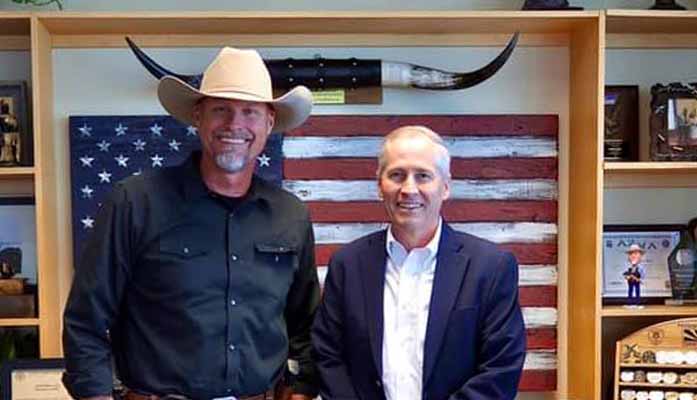
A no-trespassing zone is something Gould has discussed with border sheriffs, including Dannels and Yuma County Sheriff Leon Wilmot. Both expressed interest in the idea, he said.
A conviction for misdemeanor criminal trespass can carry a jail sentence of 30 to 180 days. Most non-U.S. citizens would be ordered held in custody pending resolution of the charges, so Gould says Arizona’s county jails would need financial support to handle the increased incarceration costs.
One option, he noted, is to aggressively target Cartel assets to help with the expense.
by B. Hamilton | Jul 8, 2021 | News
By B. Hamilton |
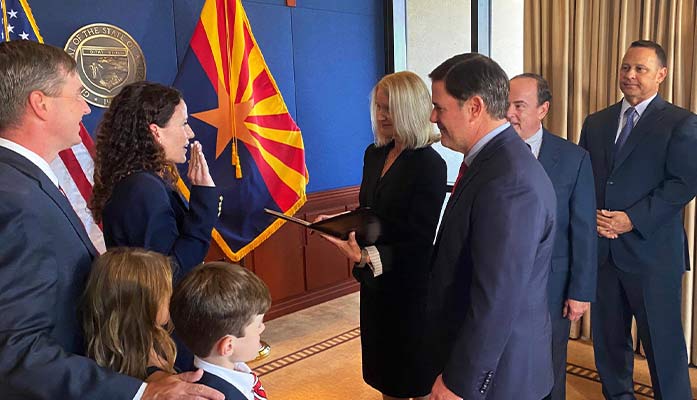
On Friday, Kathryn Hackett King, a member of the Arizona Board of Regents and University of Arizona College of Law graduate, was appointed to the Arizona Supreme Court.
Kin’s appointment by Governor Doug Ducey fills the vacancy created by the resignation of Justice Andrew Gould.
Gould is currently running in the Arizona Attorney General’s race.
King’s appointment to the court now leaves a vacancy on the Arizona Board of Regents
King is the fifth woman in Arizona history to serve on the Supreme Court.
King is currently a partner at Burns Barton PLC. The focus of her practice is the representation of private and public employers in employment litigation and related civil matters. King is a member of the Arizona Women Lawyers Association and a mentor for the Latina Mentoring Project.
King began her private practice career at Snell & Wilmer LLP, where she practiced in the areas of employment law and commercial and business litigation.
From 2015 to 2017, King served as Deputy General Counsel to Ducey, according to the Governor’s Office. King clerked for Arizona Supreme Court Justice Michael D. Ryan from 2007 to 2008.
King graduated from Duke University with a Bachelor of Arts, majoring in Political Science and minoring in History. She obtained her law degree from the University of Arizona James E. Rogers College of Law.
“Kate’s strong belief in the separation of powers and experience serving in all three branches of government will serve the people of Arizona well,” Ducey said in a released statement. “I have witnessed her intelligence and wisdom firsthand, and I know she is well-respected in the legal field.”
by Terri Jo Neff | Jun 14, 2021 | News
By Terri Jo Neff |
While some Arizona voters remain focused on last November’s election, dozens of candidates for state and federal offices in 2022 are already vying for voters’ attention and their dollars, even though early voting for primary contests won’t begin for 13 months.
The November 2022 General Election will bring major changes to Arizona’s executive branch, as Gov. Doug Ducey is termed out and Attorney General Mark Brnovich has announced his run for the U.S. Senate seat currently held by Mark Kelly. There will also be a new Arizona Secretary of State as current officeholder Katie Hobbs is seeking the governorship.
Hobbs announced her candidacy earlier this month, but faces a tough Democratic primary race with Marco Lopez Jr., a former mayor of Nogales and prior Chief of Staff for U.S. Customs & Border Protection. They currently have two other primary challengers, Steven “Paco” Noon Jr. and Trista DiGenova-Chang, although State Rep. Aaron Lieberman is rumored to be considering tossing his hat in the ring.
On the Republican side, 10 candidates are currently vying to get past the Aug. 2 primary and onto the Nov. 8 General Election ballot. Among the first to announce their candidacy were Arizona Treasurer Kimberly Yee and Karrin Taylor Robson, who is the secretary of the Arizona Board of Regents.
Former Phoenix-area television news anchor Kari Lake has also announced a run for the Republican nomination, along with Ameer El Bey, Kelly Garett, David Hoffman, Michael Pavlock Jr., Julian Tatka, Paola “Z” Tulliani, and Wayne Warren.
Meanwhile, two Libertarians -Bill Moritzky and Steve Remus- have already filed a Statement of Interest for governor.
With Hobbs giving up her position as Secretary of State, the Arizona Republican Party is pushing hard to take back the office in 2022. Five candidates, including Sen. Michelle Ugenti-Rita and Rep. Mark Finchem, are expected to be on the primary ballot, along with Remo Paul, Mark Sarchet, and Wade Wilson.
In addition, Rep. Shawnna Bolick, also a Republican, is expected to announce her candidacy for Secretary of State at a June 21 “Campaign Kick-off” event.
Whichever Republican clears the primary will likely take on Democrat Adrian Fontes, the former Maricopa County Recorder. Fontes informally announced on social media last week his interest in running for Secretary of State.
One of the state’s most influential offices is up for grabs in 2022 now that Brnovich is running for Congress. One Democrat -Diego Rodriguez- has filed a Statement of Interest, as have two Republicans- Andrew Gould and Tiffany Shedd.
Gould recently stepped down from the Arizona Supreme Court to announce his candidacy.
The U.S. Senate seat currently held by Mark Kelly is expected to be one of the most contested federal races in 2022, although the Republican primary to determine who takes on Kelly will be just as intense.
In addition to Brnovich, the Republican nomination is being sought by 15 other candidates as of June 12. They include recently retired Arizona Adjutant General Michael “Mick” McGuire and Fortune 500 executive Jim Lamon.
Other Republicans vying for the nomination are Wendy Acuna, Craig Brittain, David Buechel, Dan Butierez Sr., Ronald Coale, Eric Corbett, Mark Fisher, Vlad Hermann, Josh McElroy, Rob Paveza, Thomas Tripp, and Chad Yosick. They are joined by Kelly Garett, who also filed a Statement of Interest for governor.
But the Republican primary for Kelly’s seat in Congress could get even more crowded, as Blake Masters of the Thiel Foundation and Christopher Landau, who recently served as U.S. Ambassador to Mexico, are rumored to be considering a run.
As for Kelly, he appears to have only one Democratic Party challenger at this time- Trista DiGenova-Chang, who also filed a Statement of Interest for Governor.
Independent candidates still have several months to submit a Statement of Interest, which must be filed by a candidate before collecting the petition signatures needed to get on the ballot. However, a Statement of Interest is not a formal declaration of candidacy – which is done by filing a nomination paper.