by Matthew Holloway | Sep 14, 2025 | News
By Matthew Holloway |
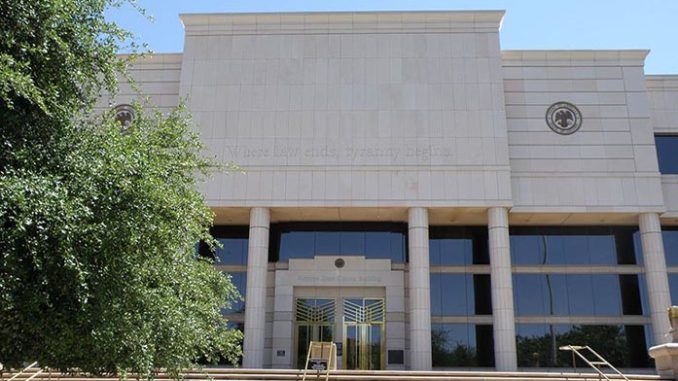
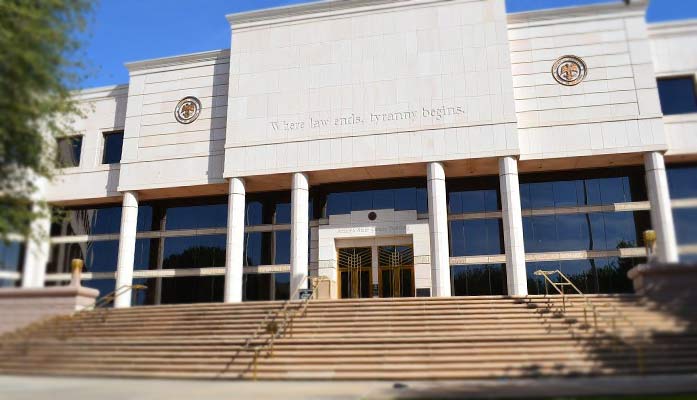
Attorneys from the Goldwater Institute, representing the Center for Arizona Policy and the Arizona Free Enterprise Club, joined former Arizona Supreme Court Justice Andrew Gould on Thursday to challenge Proposition 211. The measure, called the “Voters’ Right to Know Act,” is being contested on the grounds that it violates the state Constitution’s protections for free speech and privacy.
In the wake of Turning Point USA co-founder Charlie Kirk’s assassination—and a decade marked by attacks on political figures—the security risks of effectively doxxing political donors loom large in the case.
If upheld, the law would force nonprofit groups that weigh in on ballot measures or reference incumbents near an election to publicly disclose their donors—not just names and amounts, but also home addresses and employers—in a searchable database.
In today’s climate of escalating political violence—from death threats and swatting to vandalism, arson, and even assassinations—a database like this could essentially become a “hit list.”
In a press release the Goldwater Institute explained its position stating, “While proponents of the Voters’ Right to Know Act say they’re simply combatting so-called ‘dark money’ in politics, it is clear to Goldwater and its clients — the Center for Arizona Policy, the Arizona Free Enterprise Club, and individual donors — that their real intent is to intimidate their political opponents into silence.”
“Arizona’s Proposition 211 is as un-American as it is dangerous. No one should be exposed to retaliation or violence simply for supporting causes they believe in,” said Jon Riches, Goldwater’s Vice President of Litigation. “The law also violates Arizona’s Constitution, which provides stronger protections for freedom of speech and privacy than even the U.S. Constitution. That’s why we at the Goldwater Institute believe the Arizona Supreme Court will ultimately strike down Proposition 211.”
Arizona Free Enterprise Club President Scot Mussi added, “They’re afraid of the activist organizations out there. They’re afraid of politicians and others that want to exact retaliation because they simply support a position or belief that they disagree.”
Mussi characterized the law as “a dangerous threat to our right to free speech and association.”
“As drafted, the law can be used to unconstitutionally target and harass private citizens, including our organization and our supporters,” Mussi stated. “We are confident that the Supreme Court will recognize the danger this law poses and will rule in our favor.”
In a statement to AZ Free News in May, Mussi elaborated on the potential for political intimidation: “Both the U.S. Constitution and the Arizona Constitution guarantee citizens the right to speak freely, which includes the right to not be forced to speak. Prop 211 not only violates this right for donors by silencing them from supporting causes they believe in but impairs the speech of nonprofits like ours as well.”
Peter Gentala, President of the Center for Arizona Policy, stated in a press release that Proposition 211 “creates an atmosphere of fear among those who support nonprofits that engage in the most pressing issues in Arizona today.”
Matthew Holloway is a senior reporter for AZ Free News. Follow him on X for his latest stories, or email tips to Matthew@azfreenews.com.
by Matthew Holloway | Sep 1, 2025 | News
By Matthew Holloway |
Goldwater Institute attorneys and former Arizona Supreme Court Justice Andrew Gould are set to argue against Proposition 211 at the Arizona Supreme Court on September 11th. The Goldwater attorneys and Justice Gould argue that Prop 211, which requires nonprofit organizations to disclose the personal information, including names and addresses, of all their donors, violates the Arizona State Constitution’s guarantee of privacy.
According to Goldwater, “Under that law, donors to organizations that spend money on initiative campaigns must have their names, addresses, phone numbers, and employment information placed on a publicly accessible government list—thereby inviting retaliation, ostracism, and even violence.”
Goldwater Vice President of Litigation Jon Riches told AZ Free News, “Arizona’s Proposition 211 is as un-American as it is dangerous. No one should be exposed to retaliation or violence simply for supporting causes they believe in. The law also violates Arizona’s Constitution, which provides stronger protections for freedom of speech and privacy than even the U.S. Constitution.”
He continued, “That’s why we at the Goldwater Institute believe the Arizona Supreme Court will ultimately strike down Proposition 211 and offer the first clear roadmap for mounting state constitutional challenges to donor-disclosure laws across the country.”
The legal challenge was brought by Goldwater Institute on behalf of the Center for Arizona Policy and the Arizona Free Enterprise Club, working on the basis that “Arizona’s constitution forbids the state from stripping people of their confidentiality as the price of supporting or opposing a political view.”
The Arizona State Constitution, unlike its federal counterpart, offers explicit protections for privacy in Article 2, Section 8, which reads, “No person shall be disturbed in his private affairs, or his home invaded, without authority of law.” Likewise, under Article 2 Section 6, the right for all Arizonans to “freely speak, write, and publish on all subjects,” when coupled with the landmark Supreme Court of the United States case Citizens United v. Federal Election Commission would seem to overwhelmingly uphold the right of Arizonans to donate privately to support or oppose a political cause.
As the late Justice Antonin Scalia observed, “The dissent says that ‘speech’ refers to oral communications of human beings, and since corporations are not human beings they cannot speak. Post, at 37, n. 55. This is sophistry. The authorized spokesman of a corporation is a human being, who speaks on behalf of the human beings who have formed that association—just as the spokesman of an unincorporated association speaks on behalf of its members. The power to publish thoughts, no less than the power to speak thoughts, belongs only to human beings, but the dissent sees no problem with a corporation’s enjoying the freedom of the press.”
In May, Scot Mussi, President of the Arizona Free Enterprise Club, echoed that sentiment writing, “We are thankful that the Arizona Supreme Court accepted review of this vital case for our First Amendment liberties. Both the U.S. Constitution and the Arizona Constitution guarantee citizens the right to speak freely, which includes the right to not be forced to speak. Prop 211 not only violates this right for donors by silencing them from supporting causes they believe in but impairs the speech of nonprofits like ours as well. We are hopeful that the Arizona Supreme Court will rule in favor of the Constitution after considering the merits of the case.”
Matthew Holloway is a senior reporter for AZ Free News. Follow him on X for his latest stories, or email tips to Matthew@azfreenews.com.
by Matthew Holloway | Aug 31, 2025 | News
By Matthew Holloway |
The legal fight between Maricopa County Recorder Justin Heap and the County Board of Supervisors escalated Monday. America First Legal filed two motions on Heap’s behalf, and Arizona’s legislative leaders submitted an amicus brief supporting him.
In a press release, the County Recorder’s Office stated that the motions filed by America First Legal “reveal how the County Board of Supervisors and County Attorney Rachel Mitchell have weaponized county government against duly-elected Recorder Justin Heap simply because he dared to fulfill his statutory duties and protect the sanctity of Arizona elections.”
Heap said in a statement, “It’s unfortunate that the Board’s unprofessional and bad faith actions have forced us to litigate this issue; however, it’s significantly more unfortunate that the Board continues to deny the voters of Maricopa County the positive, common sense election integrity reforms that they voted for last November when they elected me. As I’ve promised from day one, I am working to ensure honest, secure, and transparent elections for every voter in Maricopa County. I am not, and will not, waiver in my commitment to executing on this promise. I’m grateful to America First Legal for standing by my side in this battle.”
America First Legal detailed Heap’s allegations in the first filing: “The Defendants — the members of the Maricopa County Board of Supervisors (‘BOS’) — have crossed from fiscal oversight into outright sabotage. Ignoring [state law] and decades of precedent, the BOS has refused to fund the Recorder’s ‘necessary expenses’ — from modern ballot-processing equipment to indispensable IT staff — while simultaneously seizing control of the very election functions its stonewalling endangers. The BOS’s obstruction is not mere bureaucratic foot-dragging; it is a calculated power grab that throttles the Recorder’s constitutional duty to administer secure, timely elections.”
In an amici filing in support of Heap, Arizona House Speaker Steven Montenegro and Senate President Warren Petersen’s legal representation call for a strict interpretation of state statutes which govern the responsibilities of the county recorder and board of supervisors. They argue that the “court should narrowly conclude that, based on the statutes’ plain language, when the statute authorizes ‘the county recorder or other officer in charge of elections’ to act, it is the recorder’s duty to ensure the statute is complied with unless the recorder expressly agrees to delegate that duty to another ‘officer in charge of elections.’”
As previously reported by AZ Free News, the months-long negotiations between Heap and the Board, led by Chairman Thomas Galvin, devolved steadily since Heap’s election and the replacement of Stephen Richer in January until finally collapsing into litigation in June.
The crux of the disagreement between the Board of Supervisors and County Recorder Heap rests upon a Shared Services Agreement (SSA) agreed to by Heap’s predecessor, Richer, who ardently opposed the election integrity efforts that Heap ran for office to enact. For nearly six months, the two county offices negotiated; however, Heap and the Supervisors were unable to reach an agreement, culminating in a lawsuit filed by Heap.
Since then, Heap has alleged that the Supervisors have “taken retaliatory actions” describing a series of measures that “make it impossible for him to do his job, including removing nearly all his election-related IT staff; seizing the servers, databases, and websites necessary to fulfill his duties; and restricting access to necessary facilities and equipment,” as reported by The Federalist.
In a second filing, Heap and America First Legal introduced allegations involving Maricopa County Attorney Rachel Mitchell, bringing a third County office into the fray in a dispute over who may represent the County Recorder, an attorney chosen by Heap or Maricopa County Attorney Rachel Mitchell. In the legal brief, they allege, “Attorney Mitchell originally appointed a criminal defense attorney to advise the Recorder; however, in April, America First Legal agreed to represent Heap pro bono, a move that Mitchell objected to.”
“When the Recorder complained that the original attorney appointed for him lacked sufficient subject matter expertise, County Attorney Mitchell appointed former Arizona Supreme Court Justice Andrew Gould to advise the Recorder only during negotiations with the Board. However, County Attorney Mitchell and the Board did not allow Justice Gould to litigate on the Recorder’s behalf,” the filing revealed.
But according to AFL, that wasn’t the end of it. “In May of 2025, Justice Gould specifically asked the Maricopa County Attorney’s Office for permission to litigate on Recorder Heap’s behalf but was not allowed to do so because the scope of his representation was limited to negotiation of the SSA and did not include litigation, and, accordingly, the County would not compensate him for litigation-related work.”
Mitchell responded by penning a letter to the AFL attorneys, writing in part, “This letter is to inform you that I am the Recorder’s attorney and that you do not represent the Maricopa County Recorder’s Office or Recorder Heap in his official capacity.”
Per The Federalist, AFL attorney James Rogers retorted that the “County Recorder is allowed to pick his own lawyer in litigation,” adding that Heap “is not subject to the whims of the county attorney.”
In the midst of the complex legal battle between the Recorder’s Office and the Board of Supervisors, which has drawn the attention of legislative leaders, the dispute with Mitchell adds yet another layer of infighting within the already divided county government, with the calendar counting down to the 2026 elections.
Matthew Holloway is a senior reporter for AZ Free News. Follow him on X for his latest stories, or email tips to Matthew@azfreenews.com.
by Matthew Holloway | May 10, 2025 | News
By Matthew Holloway |
The Arizona State Supreme Court has granted a petition for review in the case Center for Arizona Policy v. Hobbs, which revolves around Proposition 211 and the right of political donors to privacy.
The case, brought by the Goldwater Institute on behalf of the Center for Arizona Policy and the Arizona Free Enterprise Club argues that the protections of the Arizona Constitution, which are stronger than even the First Amendment to the U.S. Constitution, forbid Prop 211’s forced disclosure of donors and nonprofits who support or oppose ballot initiatives. The Goldwater Institute cited the Arizona Constitution in a press release, “The state constitution, after all, provides stronger protections for freedom of speech and privacy than does the federal constitution—promising both that ‘every person may freely speak, write, and publish on all subjects,’ and that ’no person shall be disturbed in his private affairs.’”
In Goldwater’s case summary, the organization warned, “Everyone has the right to support causes they believe in without fear of harassment, retaliation, or being canceled. Unfortunately, a new measure in Arizona—Proposition 211—tramples on this foundational right. It requires individuals who donate to nonprofits to risk having their private information reported to the government and disclosed to the public. It was sold to Arizonans under the guise of transparency and ‘disclosure.’ But voters weren’t told the full story.”
Goldwater Senior Attorney Scott Day Freeman explained, “This is a very exciting development. There are few rights more precious to Arizonans than their rights to free speech and to the ballot initiative process. The anti-privacy law undermines these freedoms by telling people that if they dare to support a political position, they have to give up their confidentiality and potentially become a target for retaliation and even violence.”
A lower Arizona court rejected the Goldwater’s arguments under the guise that “having an informed electorate,” in service of the government’s interests overrides campaign donors’ right to confidentiality, claiming that they can simply “opt out of contributing to campaign media spending.”
Former Arizona Supreme Court Justice, Andrew Gould, disagrees. Back in legal practice with the law firm Holtzman Vogel, and representing the plaintiffs alongside the Goldwater Institute, Gould said, “That’s just not true. Even under the law’s ‘opt-out’ provisions, some donors’ information must still be made public, and donors don’t really have a way of controlling how an organization spends donations, which means they can’t really control whether their information is made public.”
Because the case raises claims based on the Arizona Constitution, the burden of protecting donors’ privacy is even greater than in other states according to Gould who wrote, “Our state constitution provides stronger security for individual rights than the U.S. Constitution does. The authors of the state constitution intended to protect the right to donate to ballot initiative campaigns and the right not to have one’s ‘private affairs’ made public by the government. This law violates both those promises and says that if you donate to a nonprofit group that supports or opposes a ballot initiative, the government’s going to paint a target on your back.”
The Goldwater Institute referenced several serious incidents in the past decade which saw political donors and non-profits become targets for threats, vandalism, and violence from radical political extremists. It noted that donors to California’s anti-same-sex marriage initiative in 2008 became targets of property destruction and physical assault when they were effectively ‘doxxed’ by the state. A similar incident in 2020 unfolded when a group of non-profit organizations engaged California in a lawsuit after Sacramento published approximately 2,000 documents with donors’ personal identifying information. Inevitably this led to a campaign of violence and harassment by far-left extremists.
The California law that allowed this to happen was subsequently struck down by the Supreme Court of the United States in Americans for Prosperity Foundation v. Bonta in 2021.
Scot Mussi, President of the Arizona Free Enterprise Club said in a statement, “We are thankful that the Arizona Supreme Court accepted review of this vital case for our First Amendment liberties. Both the U.S. Constitution and the Arizona Constitution guarantee citizens the right to speak freely, which includes the right to not be forced to speak. Prop 211 not only violates this right for donors by silencing them from supporting causes they believe in but impairs the speech of nonprofits like ours as well. We are hopeful that the Arizona Supreme Court will rule in favor of the Constitution after considering the merits of the case.”
Matthew Holloway is a senior reporter for AZ Free News. Follow him on X for his latest stories, or email tips to Matthew@azfreenews.com.
by Matthew Holloway | Apr 27, 2025 | News
By Matthew Holloway |
Maricopa County Supervisor Mark Stewart is hoping the latest Shared Services Agreement (SSA) approved unanimously this week by the Maricopa County Board of Supervisors wins approval by Maricopa County Recorder Justin Heap.
In a statement, Stewart wrote, “Yesterday, the Board of Supervisors voted unanimously to send a new draft of the Shared Services Agreement (SSA) concerning election responsibilities to Maricopa County Recorder, Justin Heap. This updated draft incorporates feedback from the Recorder’s Office. To be clear, this is not the final version of the SSA. The Recorder will now have the opportunity to review the document, propose additional revisions, and return it to the Board for further consideration.
He added, “Based on my discussions with Recorder Heap and members of the Board, we are 95% of the way towards finalizing the SSA. I am more optimistic about this process than at any point previously and am confident that we will reach a signed agreement in the near future.”
Board Chairman Thomas Galvin wrote in a statement Thursday, “For months, the Board and its staff have been negotiating details of a new SSA in good faith. It’s time the public knows the full story, and this latest agreement includes many concessions from our Board.”
In a statement released the same day, and later retracted, shared by several outlets, Heap wrote, “The Maricopa County Board of Supervisors presentation today was one side of an ongoing negotiation. Recorder Heap disagrees with some statements that were made; however, his focus remains on getting an elections agreement in place that best serves the voters of Maricopa County. The agreement put forth by the Board today represents the framework of a deal, but the devil is in the details, and those details still need to be ironed out. Recent delays in the negotiation stem from the Recorder’s need to secure more adequate counsel.
“With the appointment of former Arizona Supreme Court Justice Andrew Gould to assist in the negotiations, Recorder Heap anticipates and looks forward to a successful resolution and agreement in the near future.”
Under Arizona law, the responsibility for the management of elections falls between the County Boards of Supervisors and County Recorders. Ostensibly Shared Service Agreements delineate the responsibilities of each body to increase efficiency and prevent unnecessary spending.
Supervisor Debbie Lesko expressed herself as being “beyond frustrated,” with the process saying, “After the April 11th meeting between Recorder Heap and Supervisors Galvin and Brophy-McGee, Justin texted me saying the meeting ‘went very well, we seem to be in agreement on 95% and are only discussing minor details on how to effectively split the IT team.’ Our lawyer writes up the agreement based on the meeting and then, next thing I know, Justin fires his attorney and we seem to be back to square one.”
Supervisor Kate Brophy McGee laid the difficulties directly at the feat of the County Recorder saying, “Recorder Heap has not been a trustworthy partner in these negotiations. He doesn’t seem to know what he wants. He doesn’t seem to understand his statutory responsibilities. The only thing he seems to be really good at is threatening lawsuits. But there’s time for him to change. He can come back to the table and sign this agreement. I hope he does. Successful elections in Maricopa County depend on it.”
As of this report Recorder Heap has not released a revised statement, nor explained why the initial statement was taken down.
Matthew Holloway is a senior reporter for AZ Free News. Follow him on X for his latest stories, or email tips to Matthew@azfreenews.com.