Arizona Republicans selected their nominees for several of the state’s highest-profile offices on Tuesday, with several races called later in the evening. Additional ballot counting continued Wednesday in closely divided legislative, congressional, and county races.
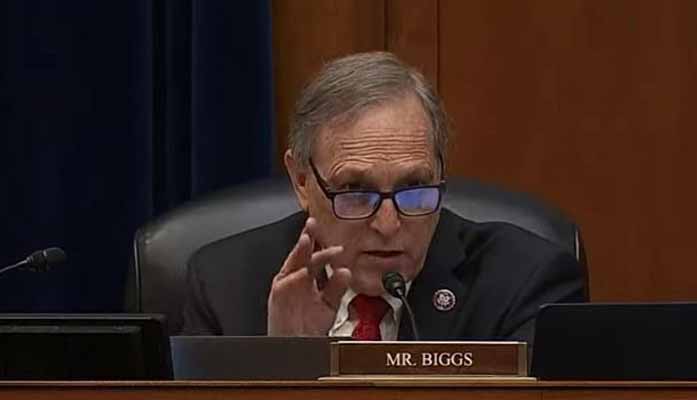
The Associated Press called Rep. Andy Biggs (R-AZ05) the winner of the four-way Republican primary for governor, setting up a November contest against Democrat Gov. Katie Hobbs. The AP also called the Republican secretary of state primary for state Rep. Alexander Kolodin.
The attorney general primary race was subsequently called for State Senate President Warren Petersen shortly before midnight in Arizona. Petersen led attorney Rodney Glassman by 56.4 percent to 43.6 percent as of publication.
WASHINGTON (AP) — Warren Petersen wins Republican nomination for attorney general in Arizona. #APRaceCall at 2:58 a.m. EDT. https://t.co/TS3eIpQI5W
Republican Elijah Norton defeated Katherine Haley for the state treasurer nomination, leading 56.1 percent to 43.9 percent at the time of publication. Norton will now face Democrat nominee Nick Mansour.
Decision Desk HQ called State Treasurer Kimberly Yee the winner of the Republican primary for superintendent of public instruction. Yee led incumbent Superintendent Tom Horne 53.2 percent to 46.8 percent with approximately 89 percent of the expected vote counted in the highly competitive race. Former state lawmaker, Democrat Teresa Leyba Ruiz, had nearly 80 percent of the vote against Brett Newby and will advance to the general election.
Decision Desk HQ projects Kimberly Yee wins the AZ Superintendent of Public Instruction Republican Primary#DecisionMade: 8:18 AM EDT pic.twitter.com/hCr78WcgTt
Commissioner Kevin Thompson secured one Republican nomination for the Arizona Corporation Commission, while former lawmaker Ralph Heap appeared set to secure the second after Commissioner Nick Myers conceded the race in a statement posted to X. Thompson led with 291,934 votes, or 35.89 percent. Heap followed with 267,085 votes, or 32.84 percent, while Myers had 254,321 votes, or 31.27 percent, leaving Heap ahead by 12,764 votes at the time of publication.
Congressional Primaries
Former state Rep. Amish Shah has won the Democratic nomination for U.S. House in Arizona’s 1st Congressional District against former television journalist Marlene Galán-Woods, 39.8 percent to 34.1 percent, according to the AP. Jonathan Treble held 17.62 percent, and Rick McCartney had 8.51 percent. Shah will face Thomas “Jay” Feely in one of Arizona’s most competitive congressional districts.
WASHINGTON (AP) — Amish Shah wins Democratic nomination for U.S. House in Arizona's 1st Congressional District. #APRaceCall at 10:07 p.m. EDT. https://t.co/TS3eIpQI5W
Rep. Greg Stanton held a commanding lead over progressive challenger Kai Newkirk in the Democratic primary for the Fourth Congressional District, 63.5 percent to 36.5 percent.
Former Pinal County Sheriff Mark Lamb won the Republican primary for Biggs’ open Fifth Congressional District seat, defeating Daniel Keenan 58.3 percent to 41.7 percent. The Associated Press also called the Democrat primary for Elizabeth Lee, who received 65.5 percent. Chris James received 21.2 percent, and Brian Hualde received 13.28 percent.
WASHINGTON (AP) — Elizabeth Lee wins Democratic nomination for U.S. House in Arizona's 5th Congressional District. #APRaceCall at 11:18 p.m. EDT. https://t.co/TS3eIpQI5W
Bernadette Greene-Placentia defeated Raymond Keeler approximately 65 percent to 35 percent in the Democratic primary for the Eighth Congressional District. She will challenge Republican Rep. Abe Hamadeh in November.
WASHINGTON (AP) — Bernadette Greene-Placentia wins Democratic nomination for U.S. House in Arizona's 8th Congressional District. #APRaceCall at 11:20 p.m. EDT. https://t.co/TS3eIpQI5W
Republicans currently hold narrow majorities in both chambers of the Arizona Legislature, giving several down-ballot primaries consequences extending well beyond the individual districts.
In Legislative District 2, Republican Sen. Shawnna Bolick led Timothy Ferrara 71.4 percent to 28.6 percent. Democrat Amelia Gallitano led Daniel Toporek 77.3 percent to 22.7 percent in the same district.
Republican Sen. John Kavanagh led Robert Wallace 85.2 percent to 14.8 percent in Legislative District 3.
In the Democratic primary for Legislative District 6, former Sen. Jamescita Peshlakai led Rep. Myron Tsosie 54.8 percent to 45.2 percent.
Sen. Lauren Kuby, a former Tempe city councilwoman, led Deborah Nardozzi 76 percent to 24 percent in the Legislative District 8 Democratic primary.
Christopher King led Anthony Dunham 63.2 percent to 36.8 percent in the Republican primary for Legislative District 17.
Rep. Alma Hernandez led Rocque Perez 53.8 percent to 46.2 percent in the Democratic primary for Legislative District 20.
The closest contested Senate primary was in Legislative District 27, where Republican Sen. Kevin Payne led former Sen. Anthony Kern with 8,368 votes to 8,096, a margin of only 272 votes.
State House Primaries
Arizona House districts elect two representatives, meaning the two leading candidates in each party primary generally advance to November.
In Legislative District 1, Republican Reps. Selina Bliss and Quang Nguyen held the two qualifying positions. Bliss led with 42.45 percent, Nguyen followed with 42.04 percent, and Shawn Wildman trailed with 15.51 percent.
George Khalaf led the four-candidate Republican contest in Legislative District 3 with 33.69 percent. Cody Reim held the second nomination position with 27.12 percent, only 612 votes ahead of Jay Schlum, who received 26.21 percent. Thomas Walsh held 12.8 percent.
Republican Rep. Matt Gress led Legislative District 4 with 45.28 percent, while Pamela Carter held the second position with 33.67 percent. Sandra Christensen trailed with 21.05 percent.
In Legislative District 6, Democratic Rep. Mae Peshlakai led with 42.5 percent. Ian Teller held the second qualifying position with 29.76 percent, followed by Angela Maloney with 27.73 percent.
Rep. Walt Blackman led the Legislative District 7 Republican primary with 34.73 percent. Rep. David Cook held second with 27.25 percent, followed by Andrew Costanzo with 21.34 percent and Barby Ingle with 16.67 percent.
Brian Garcia and Janeen Connolly held the two Democratic nomination positions in Legislative District 8 with 42 percent and 32 percent, respectively. Claudia Kline trailed with 26 percent.
Rep. Justin Olson, a former corporation commissioner, led the Republican primary in Legislative District 10 with 43.82 percent. James Rogers held second with 34.41 percent, followed by Ciara Anderson with 21.77 percent.
Chandler Mayor Kevin Hartke led the Legislative District 13 Republican primary with 43.31 percent. Janet Weninger held the second nomination position with 34.62 percent, while Debra Schinke trailed with 22.07 percent.
In Legislative District 14, Tyler Farnsworth led with 41.63 percent, and Rep. Laurin Hendrix followed with 38.29 percent. Jed Lyons received 20.08 percent.
Sen. David Gowan, a former Senate president, led the Legislative District 19 Republican House primary with 43.98 percent. Rep. Lupe Diaz held the second position with 32.09 percent, followed by Cheryl Caswell with 23.93 percent.
On the Democrat side, Rep. Sally Ann Gonzales led the Legislative District 20 House primary with 33.37 percent. Rep. Betty Villegas, a former Pima County supervisor, held second with 31.81 percent, followed by Genoveva Diaz with 19.41 percent and Ben Koehler with 15.42 percent.
Rep. Consuelo Hernandez led the four-way Democrat primary in Legislative District 21 with 30.21 percent. Miranda Lopez held the second nomination position with 24.92 percent, ahead of Rep. Stephanie Stahl Hamilton at 24.24 percent. Maritza Higuera held 20.63 percent.
Rep. Elda Luna-Nájera led the five-candidate Democratic primary in Legislative District 22 with 29.36 percent. Betsy Munoz held second with 27.60 percent, followed by Veronica Bejarano-Malone with 24.78 percent, Steve Chapman with 9.86 percent, and Gwen Johnston with 8.4 percent.
Rep. Mariana Sandoval led the Legislative District 23 Democratic primary with 38.35 percent. Emilia Cortez held the second nomination position with 25.49 percent, followed by Juan Manuel Guerrero at 18.3 percent and Naomi Miguel at 18.19 percent.
In Legislative District 24, Alberto Flores and Lisbeth Arescurenaga held the two qualifying positions with 39.87 percent and 37.02 percent. Democratic Rep. Lydia Hernandez trailed with 14.34 percent, followed by Rosa Cantu with 8.77 percent.
Republican Reps. Beverly Pingerelli and David Livingston led the Legislative District 28 contest with 41.72 percent and 38.98 percent, respectively. Heather Rooks received 19.30 percent.
Mike Gannuscio led the five-candidate Republican primary in Legislative District 30 with 33.97 percent. David Rose held the second nomination position with 29.16 percent, followed by Grace Hecht with 19.89 percent, Catherine Lopez-Rajaniemi with 10.68 percent, and Caroline Strecker with 6.29 percent.
County Races
Most countywide offices on Tuesday’s ballot had only one candidate seeking each party’s nomination. Contested county and local races included the Apache County clerk of the Superior Court primary, the Santa Cruz County school superintendent primary, the Yavapai County Board of Supervisors District 2 primary, and the Yuma County clerk of the Superior Court primary.
In Apache County, Samceita Begay led Wendy Shepherd in the Democratic primary for clerk of the Superior Court. Begay received 5,653 votes to Shepherd’s 4,195 at the time of publication.
In Santa Cruz County, incumbent County School Superintendent Maya Donnelly led Sonia Sanchez by 2,545 votes to 2,222 in the Democratic primary. Miguel López also led Adriana Olaiz by 2,754 votes to 2,066 in the Democratic primary for justice of the peace at the time of publication.
Camp Verde Mayor Marie Moore led Wiley Cline in the Republican primary for the Yavapai County Board of Supervisors District 2 seat. Moore received 3,633 votes, approximately 57 percent, while Cline received 2,746 votes or approximately 43 percent.
In Yuma County, Chief Deputy Clerk Bobbie Jo Daily led Malba Alvarez by 6,801 votes to 2,530, or 72.9 percent to 27.1 percent, in the Republican primary for clerk of the Superior Court. The Arizona Secretary of State’s county-results portal continued to list Yuma County’s results as pending Wednesday afternoon, although the county had opened its separate online results system.
Additional Ballots Remain
The results remained unofficial on Wednesday as county election officials continued processing ballots. The Arizona Secretary of State’s Office estimated that voters deposited 93,368 early ballots at polling locations on Election Day. That figure represents Election Day ballot drop-offs and does not represent the number of ballots remaining to be counted. The Secretary of State’s Office reports outstanding ballots separately through its ballot-progress reports.
The early results demonstrated President Donald Trump’s continued influence in Arizona’s Republican statewide and congressional primaries. The legislative contests followed a more localized pattern, with incumbency, district organizations, and candidate-specific disputes producing several close races beneath a decisive statewide result.
Margins of only a few hundred votes in several legislative primaries could shape the composition of Arizona’s Republican and Democrat legislative caucuses as the parties prepare for the larger fight over control of the House and Senate in November. The statewide canvass is scheduled for Aug. 6.
Vote totals and percentages are current as of 8 p.m. MST on July 22.
Congressman Andy Biggs is projected to win the Republican nomination for Arizona governor. The Associated Press also called several of the state’s closely watched primary races, including the Republican secretary of state contest for Rep. Alexander Kolodin.
Biggs led Rep. David Schweikert and businessmen Ken Miceli and Scott Neely when the AP called the four-way Republican primary in his favor. He will face Democratic Gov. Katie Hobbs, who ran unopposed for her party’s nomination, in the Nov. 3 general election.
The AP declares a winner when its decision team determines that trailing candidates no longer have a path to victory. The election results remain unofficial, pending the official statewide canvass on August 6.
Biggs has represented Arizona’s Fifth Congressional District since January 2017 and previously served as president of the Arizona Senate. He chaired the House Freedom Caucus from 2019 to 2022 and entered the gubernatorial primary with endorsements from Turning Point USA and President Donald Trump.
Schweikert has represented Arizona in Congress since 2011 and currently holds the First Congressional District seat. He remained in Washington during Tuesday’s election as the House considered a government funding bill.
In the secretary of state race, Republican state Rep. Alexander Kolodin defeated former Arizona Republican Party Chair Gina Swoboda for the GOP nomination. Kolodin will face Democratic Secretary of State Adrian Fontes, who ran unopposed in his party’s primary, in the Nov. 3 general election. The secretary of state serves as Arizona’s chief election officer and oversees statewide election administration, business filings, and state records and archives.
WASHINGTON (AP) — Alexander Kolodin wins Republican nomination for secretary of state in Arizona. #APRaceCall at 11:17 p.m. EDT. https://t.co/TS3eIpQI5W
The AP also called the Republican primary for Schweikert’s open First Congressional District seat for former Arizona Cardinals kicker and sportscaster Thomas “Jay” Feely IV.
Feely defeated former state Rep. Joseph Chaplik and technology and telecommunications executive John Trobough. President Trump endorsed Feely after he moved from the Fifth District race into the contest to succeed Schweikert.
WASHINGTON (AP) — Thomas Feely wins Republican nomination for U.S. House in Arizona's 1st Congressional District. #APRaceCall at 11:13 p.m. EDT. https://t.co/TS3eIpQI5W
The First District includes northeast Phoenix, Scottsdale, Fountain Hills and Paradise Valley. Republicans hold a voter-registration advantage in the district, although the seat has become increasingly competitive in recent elections. Schweikert defeated Democratic nominee Amish Shah with 51.9 percent of the vote in 2024.
Former television journalist Marlene Galán-Woods led the initial Democratic First District results against Shah, publisher Rick McCartney, and entrepreneur Jonathan Treble. The Associated Press had not called the Democratic contest Tuesday night.
The Democratic Congressional Campaign Committee supported Galán-Woods in the primary. Shah won the party’s nomination for the district in 2024 before narrowly losing the general election to Schweikert.
Former Pinal County Sheriff Mark Lamb won the Republican nomination to succeed Biggs in the Fifth Congressional District. Lamb defeated construction company owner Daniel Keenan.
WASHINGTON (AP) — Mark Lamb wins Republican nomination for U.S. House in Arizona's 5th Congressional District. #APRaceCall at 11:11 p.m. EDT. https://t.co/TS3eIpQI5W
President Trump endorsed Lamb, who previously sought the Republican nomination for U.S. Senate in 2024. The Associated Press described the Fifth District as a safely Republican seat.
The Democratic Fifth District primary included Elizabeth Lee, Chris James and Brian Hualde. The Associated Press had not called that contest at the time of publication.
Republican Rep. Juan Ciscomani and Democratic challenger JoAnna Mendoza advanced without primary opposition in the Sixth Congressional District, establishing the general-election matchup in one of Arizona’s most competitive congressional seats.
The results remain unofficial while Arizona counties continue processing ballots and complete their required canvasses. County boards of supervisors face an Aug. 3 deadline to canvass the primary results, followed by the official statewide canvass on Aug. 6.
Several races, including the GOP nominations for Attorney General, Treasurer, Corporation Commission, and Superintendent of Public Instruction, remained too close to call as of 10 PM Tuesday.
Three Arizona Democratic congressional candidates received a combined $34,600 from Jonathan Soros, the son of billionaire political donor George Soros, and his wife, Jennifer, across the 2024 and 2026 election cycles, according to Federal Election Commission records.
JoAnna Mendoza, a Democratic candidate seeking to challenge Republican Rep. Juan Ciscomani in Arizona’s Sixth Congressional District, received a combined $14,000 from Jonathan and Jennifer Soros for the 2026 election cycle. Jonathan Nez, a Democrat seeking Arizona’s Second Congressional District seat, received another $14,000 from the couple.
Dr. Amish Shah’s congressional campaign received a combined $6,600 from Jonathan and Jennifer Soros during the 2024 election cycle. Shah was the Democratic nominee in Arizona’s First Congressional District that year and is seeking the seat again in 2026.
The contributions were publicly disclosed and fall within federal campaign-finance limits. During the 2025-2026 election cycle, an individual may give a candidate committee up to $3,500 for each election, with the primary and general elections treated separately. Two married donors can therefore contribute a combined $14,000 to a candidate participating in both elections. The individual limit was $3,300 per election during the 2023-2024 cycle.
The contributions represent a smaller, more direct form of Soros family involvement than Arizona has seen in previous election cycles. In 2016, the Associated Press reported that a Soros-funded political group contributed $2.3 million in the Maricopa County sheriff’s race, supporting Democrat Paul Penzone and running advertisements against Republican incumbent Joe Arpaio. Another Soros-funded group spent $1.3 million as the sole contributor to a group opposing Republican Maricopa County Attorney Bill Montgomery. Penzone defeated Arpaio, while Montgomery won reelection against Democrat Diego Rodriguez.
The Soros political network also spent heavily on an Arizona ballot measure during the 2024 election. State campaign-finance records show the Open Society Action Fund contributed $1,999,999 to Arizona for Abortion Access, the committee supporting Proposition 139. The measure amended the Arizona Constitution to establish a right to abortion. George Soros founded the broader Open Society Foundations network, which includes the Open Society Action Fund.
Unlike those earlier expenditures, the money given to Mendoza, Nez, and Shah was contributed directly by Jonathan and Jennifer Soros to the candidates’ authorized campaign committees and was subject to federal individual contribution limits.
Jonathan Soros is an investor who previously served as president and deputy chairman of Soros Fund Management. He is also a director of the Jennifer and Jonathan Allan Soros Foundation and has participated in Democratic and progressive political organizations.
The contributions come as Mendoza and Nez have accumulated multimillion-dollar campaign accounts ahead of Arizona’s July primary election. The NRCC highlighted the contributions on X and cited comments from Arizona Republican Party Chairman Sergio Arellano published by the Arizona Daily Independent.
Arizona Dems pocket massive Soros checks while posing as ‘working class’
“Democrats love calling themselves the party of the working class,” Arizona Republican Party Chairman Sergio Arellano observed according to the Arizona Daily Independent. “That’s funny because they seem to spend a lot more time listening to radical billionaire donors than the people actually working overtime to pay the bills. Maybe that’s why hardworking Americans aren’t buying what they’re selling anymore.”
Mendoza’s campaign reported raising approximately $7.35 million and spending about $4.09 million through July 1. The campaign ended the reporting period with approximately $3.26 million in cash on hand. Mendoza is a retired Marine and former political consultant running against Ciscomani in a district Democrats have repeatedly targeted.
Nez, a former president of the Navajo Nation who unsuccessfully challenged Republican Rep. Eli Crane in 2024, reported raising approximately $3.52 million during the current cycle. His campaign spent approximately $1.67 million and reported about $1.91 million in cash on hand through July 1.
Shah’s campaign reported raising approximately $1.83 million during the current election cycle. The former Arizona state representative is competing for the Democratic nomination in the First Congressional District after losing the 2024 general election to Republican Rep. David Schweikert.
The National Republican Congressional Committee cited the Soros contributions while attacking Mendoza and Shah over their political positions.
“Democrat lobbyist JoAnna Mendoza and socialist Amish Shah sold out Arizona the moment they cashed these massive Soros checks,” NRCC spokesman Ben Petersen said in a statement. “These liberals serve the radical left-wing agenda of a billionaire family pushing dangerous socialist, defund the police, open borders policies.”
Congressional candidate Amish Shah vowed to represent a further left faction of the Democratic Party should he be elected.
Shah made the promise during a recent candidate forum hosted by LD3 Democrats. His shift represented a reflection on his 2024 loss against Rep. David Schweikert (R-01), who is running for governor. Shah served in the Arizona House of Representatives from 2019 to 2024.
Per Shah, the Democratic Congressional Campaign Committee (DCCC) told him that he was too much of a “nice guy” to win the 2024 election. The DCCC refused to endorse Shah this time around, instead endorsing his primary opponent, Marlene Galan-Woods, earlier this month.
Elites in Washington should not be meddling in this race. This election will be decided by Arizona voters, not by establishment insiders in back rooms. Here is my full statement. pic.twitter.com/ajE9J9nSIP
It appears Shah’s response was to move aggressively to the left on policy.
“I am not hesitating one bit to use my platform to be able to prosecute [President Donald Trump and Republicans] as vigorously as I can, sometimes with expletives or whatever it takes,” said Shah during the LD3 virtual forum.
Shah also promised to repeal Trump’s tax cuts for working families. He called them “abominable.”
National Republican Congressional Committee spokesman Ben Peteresen told The Yellow Sheet, which first reported on this virtual forum, that Shah’s statements were “radical.”
“Democrat Amish Shah said he lost because Biden and Harris were toxic, then ran even further left by calling for massive tax increases, socialism and open borders,” said Petersen.
The version of his candidacy that Shah presented on that virtual forum diverges slightly from the public version of his candidacy.
Shah has publicly claimed that he doesn’t recognize party differences and would work across the aisle to solve problems.
“When I served in the Arizona House, I didn’t see ‘Democrats’ and ‘Republicans.’ I saw problems that needed to be solved,” said Shah. “I’m running for Congress to bring that same mindset to Washington; focus on solutions, find common ground where we can, and actually deliver results that improve people’s lives.”
When I served in the Arizona House, I didn’t see “Democrats” and “Republicans.” I saw problems that needed to be solved.
That’s how we got things done; working across the aisle to pass commonsense legislation on healthcare access, public safety, and lowering costs for everyday… pic.twitter.com/xXgSu00ri1
Shah’s platform on his campaign website focuses on expanding federal healthcare, codifying abortion, ending tariffs, and increasing public school funding and teacher pay. On his “resources” page targeting primary opponent Galan-Woods, Shah promised to pass a ban on stock trading by members of Congress.
Similarly, in his failed 2024 challenge to incumbent Schweikert, Shah styled himself as an “independent” candidate — despite his consistently progressive actions in the state legislature and a past admission to his alliance with socialists.
In a town hall with the Phoenix Democratic Socialists of America and the Progressive Democrats of America in 2019, Shaw encouraged the adoption of government-run universal healthcare. Months prior to that town hall, Shah proposed replacing capitalism with socialism.
Shah received national recognition by the American College of Obstetricians and Gynecologists for successfully defending the abortion drug mifepristone against attempts to outlaw it.
Shah was also behind legislation to expand anti-discrimination laws to afford protections to gender identity and sexual orientation, and to redefine marriage within the state constitution.
Shah has funneled over $230,000 of his own money into his congressional campaign according to Federal Election Commission records. So far, Shah has raised nearly $1.9 million.
Top donors include the D.C. organizations IA Victory Fund and 314 Action Impact Slate; Illinois entrepreneur Purav Kapadia; and Chandler doctor Snehal Bhoola.
AZ Free News is your #1 source for Arizona news and politics. You can send us news tips using this link.
Democratic infighting is escalating in Arizona’s First Congressional District race after former state lawmaker Amish Shah publicly criticized the Democratic Congressional Campaign Committee (DCCC) over its involvement in the primary contest.
During a televised interview this week, Shah accused national Democratic leaders of interfering in the race despite prior assurances that the primary would remain open and competitive.
“We had been told multiple times there was not going to be any interference,” Shah told 12News’ Brahm Resnick on Sunday, criticizing what he described as “hubris” from national party officials.
The dispute follows the DCCC’s recent endorsement of Democrat Marlene Galán-Woods in Arizona’s First Congressional District, a seat currently held by Republican Congressman David Schweikert. The district is expected to be one of the nation’s top battlegrounds in the 2026 midterm elections.
Galán-Woods has already faced early controversy tied to her campaign’s use of Findraiser, an artificial intelligence-based fundraising company tied to embattled former California Congressman Eric Swalwell. The California Democrat resigned from Congress earlier this year and suspended his gubernatorial campaign following multiple allegations of sexual misconduct and sexual assault, which he has denied.
The endorsement was viewed by some Arizona Democrats as the national party “playing favorites” in a contested primary race. Shah previously won the Democratic nomination in the district in 2024 before losing to Schweikert in the general election.
Shah also criticized Galán-Woods directly during the interview, arguing that she had previously worked “to defeat Obama in two different elections,” a reference to her past political activity before becoming a Democratic candidate.
The DCCC endorsement has reportedly intensified tensions among Democratic activists and consultants in Arizona. Following the endorsement, Democratic consultant Stacey Pearson of Lumen Strategies compared the move to the “Sports Illustrated cover curse,” suggesting the backing could politically damage Galán-Woods rather than strengthen her candidacy.
Shah additionally acknowledged broader dissatisfaction among Democratic voters with national party leadership.
“Democratic voters right now, when they’re talking to me, aren’t exactly happy with the Democratic establishment,” Shah said during the interview.
The endorsement of Galán-Woods is part of the DCCC’s broader national effort to shape competitive House races through its “Red to Blue” program, which provides select candidates with fundraising and organizational support. The committee identified Galán-Woods as one of its preferred candidates in its effort to reclaim control of the U.S. House of Representatives.
The controversy in Arizona mirrors broader tensions within Democratic politics nationwide, as progressive groups and some party activists increasingly criticize the DCCC’s involvement in contested primaries. According to Axios, some progressive-aligned Democrats and Congressional Progressive Caucus PAC leaders have argued that primary voters, rather than national party organizations, should determine Democratic nominees in competitive races.
Supporters of Galán-Woods have argued that she enters the race with significant institutional support, including backing from the Arizona AFL-CIO and national Democratic organizations. Polling circulated by CHC BOLD PAC showed Galán-Woods leading in a hypothetical matchup with Republican candidate Gina Swoboda.
Swoboda, however, reportedly abandoned her congressional race and filed a statement of interest for the Secretary of State’s race in February. The polling from CHC BOLD PAC did not address former Arizona Rep. Joseph Chaplik or Trump-endorsed candidate Jay Feely, who led District 1 primary polling from NextGen Polling in April with 24 percent and 15 percent, respectively.
Chaplik Holds Early Lead in AZ-CD1 GOP Primary
BALLOT TEST Chaplik 24% Feely 15% Trobough 6% Undecided 54%
Joseph Chaplik holds the highest net approval rating at +20% while Jay Feely follows at a +8% net approval rating and John Trobough has a net approval rating of +3%
Shah’s campaign, meanwhile, has pointed to a February local independent poll from HighGround Public Affairs Consultants showing him leading in the race with 32.6 percent support, while Galán-Woods trailed by more than twenty-one points.
In a statement released following Shah’s comments, National Republican Congressional Committee (NRCC) spokesman Ben Petersen criticized Democratic leadership for intervening in the Arizona race.
“D.C. Democrat elites’ ham-fisted interference blew up spectacularly,” Petersen said. “When Democrats are this busy destroying each other, they’re proving they’re far too liberal and too chaotic to represent Arizonans.”