by Matthew Holloway | Aug 23, 2025 | Education, News
By Matthew Holloway |
Controversy has once again embroiled Arizona State University (ASU), threatening the credibility of the institution, Arizona PBS, and the Walter Cronkite School of Journalism. Emails uncovered by the Arizona Republic reveal that ASU President Michael Crow, former Arizona Republic publisher Mi-Ai Parrish, and other officials allegedly favored Democratic gubernatorial candidate Katie Hobbs over Republican Kari Lake during the 2022 Arizona gubernatorial election.
Lake has accused them of “collud[ing] to prevent me from having a debate forum.”
Reporting from the Arizona Republic’s Stacey Barchenger earlier this month exposed internal discussions among ASU leadership that appeared to prioritize Hobbs while sidelining Lake. The emails, obtained through public records requests, show that Parrish emailed Arizona PBS leaders, writing, “We may have issues,” after discussions with PBS Senior Director of Content, Ebonye Delaney. They expressed concerns about equal time laws and the risk to ASU’s relationship with the Arizona Citizens Clean Elections Commission.
Crow emailed Parrish, stating, “Whatever the format there remains the fact that it is our venue and brand. We need structure…and format…….and….people who believe in elections as participants.” He later instructed his chief of staff, James O’Brien, and Parrish to “make sure you are both on the same page here,” prompting Parrish to ask, “What outcome are you seeking?”
ASU offered Hobbs a solo interview on Arizona PBS, a move that severed the university’s long-standing partnership with the voter-approved Clean Elections Commission. This decision was influenced by Crow’s reported disagreement with Lake’s views on election integrity and his labeling her an “election denier.”
Barchenger’s report, citing expert opinions, stated “That ASU leaders would consider one candidate’s views, and then reach down and influence television programming, called into question Arizona PBS’ independence as a news organization and its autonomy from university influence, experts said.”
“And it could have risked legal repercussions for Arizona’s largest university, they added.”
The Arizona Republic’s Robert Anglen shared the findings on X, writing, “Newly released emails detail how ASU’s top leaders sought to muzzle Kari Lake in 2022 for her election-denial views and give preferential treatment to Katie Hobbs on Arizona PBS during the governor’s race.”
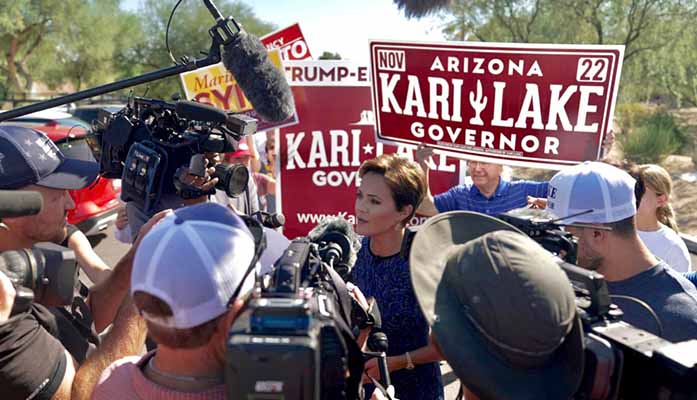
Lake rejected Arizona PBS’s offer of a 30-minute solo interview, insisting on a joint debate with Hobbs. She told reporters at the time, “If she doesn’t appear with me, they should kick her out. If Democrats don’t have to sit on the debate stage with the Republicans, if they can just stomp their feet and demand a safe space … then we’ll never have a debate system again.” Lake instead participated in a Clean Elections-sponsored interview on another station and vowed to avoid PBS-related events.
In a statement responding to the exposé, Lake said: “Taxpayer-funded Michael Crow and taxpayer-funded ASU, along with taxpayer-funded PBS, colluded to prevent me from having a debate forum for fear I would talk about election fraud, and because their chosen candidate Katie Hobbs would’ve been destroyed in a debate with me. They interfered in the 2022 Arizona Gubernatorial election and trampled on my First Amendment rights. Their actions were not just unethical; they were likely illegal, too.”
ASU spokesman Jay Thorne defended the university’s actions, however, stating, “The shared objective of ASU and Arizona PBS after the gubernatorial debate was cancelled was to provide a forum for the voters of Arizona to hear from the two candidates for Governor in an interview format. It was an opportunity provided under identical conditions to each candidate, and only one accepted the offer.”
The controversy has raised serious questions about Arizona PBS’s journalistic independence and ASU’s impartiality. Crow, who received a contract extension with a pay raise and bonuses in 2024 despite prior scandals, faces renewed scrutiny over allegations of partisan interference in the electoral process. The decision to prioritize one candidate’s platform over another has sparked outrage and could have lasting repercussions for the institutions involved. This rewritten version organizes the information into clear sections, eliminates redundancy, and enhances readability while preserving all original quotes.
The Arizona Free Enterprise Club (AZFEC) announced August 20th that it has filed a Hatch Act complaint against ASU “for using taxpayer-funded resources to meddle in the 2022 Governor’s race.”
Scot Mussi, President of AZFEC, stated, “This was a blatant misuse of taxpayer-funded university resources to tilt the scales of a gubernatorial election. Arizona law is clear: universities must remain impartial and neutral in election-related activities.”
Matthew Holloway is a senior reporter for AZ Free News. Follow him on X for his latest stories, or email tips to Matthew@azfreenews.com.
by Staff Reporter | Jun 3, 2025 | News
By Staff Reporter |
Although uncounted ballots from the highly contested 2022 election were destroyed, a former Arizona Secretary of State employee and current reporter is claiming that Congressman Abe Hamadeh is delusional for believing counties followed the law.
Last November, all ballots from the 2022 election were destroyed in accordance with Arizona law. Over 9,000 of those destroyed and allegedly valid ballots were never counted in the election — all provisional votes that may have resulted in Hamadeh winning the attorney general’s race over then-Democratic candidate and current attorney general Kris Mayes.
One of those ballots belonged to the husband of State Senator Wendy Rogers, according to the lawmaker.
These provisional ballots belonged to voters who were forced to cast provisionally due to failures by the state’s voter registration system, according to legal discoveries that would emerge over the course of Hamadeh’s challenge of the election.
The counties reportedly did not discover the thousands of uncounted provisional ballots due to a delay in response from the counties to Hamadeh’s legal team. The tardiness of the counties’ response times — along with a superior court judge’s months-long delay in signing his orders — jeopardized and ultimately resulted in the defeat of Hamadeh’s legal challenge to the 2022 election.
The statewide recount announced late December 2022 reduced Mayes’ lead over Hamadeh from just over 500 votes to less than 300 votes out of millions of ballots cast. The slashed lead resulted from major ballot-counting errors by Pinal County. The county failed to account for nearly 400 votes cast for Hamadeh and about 100 for Mayes due to “human error” — a vote difference of over 500 that grew Hamadeh’s margin.
About 70 percent of Election Day votes were for Hamadeh.
In an X post on Monday, Hamadeh accused Democrats of stealing the 2022 attorney general’s race.
“No, they stole [the election],” said Hamadeh. “Burned 9,000 uncounted ballots.”
Yet, the former Secretary of State staffer and data and elections reporter for ABC 15 Arizona, Garrett Archer, called Hamadeh “delusional” and unserious for reminding the public of the uncounted ballots that were destroyed and claiming the possibility of those ballots being valid.
“Abraham Hamadeh has a former troll run his social media. I have to think this is coming from that person. Because this take is delusional,” said Archer. “Why do people take this garbage seriously? Is it just a game or is it a complete capitulation of critical thinking in favor of an emotion driven reaction?”
Beyond the thousands of destroyed uncounted ballots, it was argued by Hamadeh’s counsel in his case contending the 2022 election that Maricopa County included hundreds of invalid early ballots for Mayes.
Around the date the ballots were set to be destroyed last November, the Arizona Supreme Court rejected Hamadeh’s challenge to the 2022 election results.
The disenfranchisement of thousands of voters wasn’t an unlikely occurrence in the 2022 election. While secretary of state that year, Governor Katie Hobbs admitted about 6,000 Arizonans were mistakenly registered as federal-only voters.
A year later in November 2023, Hobbs issued what critics called a “confession” of sorts describing potential disenfranchisement caused by the state’s voter system in her Elections Task Force final report.
AZ Free News is your #1 source for Arizona news and politics. You can send us news tips using this link.
by Matthew Holloway | Feb 28, 2025 | News
By Matthew Holloway |
A series of posts to X on Tuesday sparked a firestorm of controversy when Merissa Hamilton of Strong Communities Action-EZAZ.org made a bombshell allegation that Maricopa County Election officials were made well aware of the potential for printing and supply issues during the 2022 statewide elections. Hamilton alleged that county officials moved forward without addressing the issues, citing a series of emails detailing the Maricopa County GOP raising concerns to then-Recorder Stephen Richer and Maricopa County Board of Supervisors’ Election Manager Scott Jarrett.
The post gained national attention when it was shared by X owner and de facto head of the Department of Government Efficiency Elon Musk.
In the initial post Hamilton wrote, “Remember in 2022 when the nearly 70% of voting centers in Maricopa County failed on Election Day causing massive, long lines and voter disenfranchisement resulting in @KariLake and @AbrahamHamadeh barely losing? Maricopa County knew in advance their Election Day plan was set up for failure, and THEY LET IT FAIL!”
Hamilton noted that the emails were obtained for Strong Communities Action by The Gavel Project and civil rights activist and Arizona election attorney Ryan Heath saying, “Without his legal muscle we wouldn’t have secured it!”
In the thread that followed, Hamilton released several emails from then-Chairwoman of the Maricopa County Republican Committee Mickie Niland to Richer and Jarrett saying, “I remember hearing from Scott (Jarrett) at some point after the primary that there was a problem during the primary with some tabulators not reading correctly due to low ink. How long does it take you to get paper or ink to them if they run out? Is there a process for the voting locations to report when they are half out of paper? How far are the restocking trucks from the voting centers? Are you using the length of the lines to help you determine when more supplies are brought to the centers?“ She also asked if there was any way she could help.
Jarrett responded, “We’ve been monitoring turnout and are prepared,” adding that there was plenty of ballot paper and normal paper to print control slips as well as “sufficient toner and printer drums.”
Hamilton explained, “Several days ahead of Election Day, the Maricopa County GOP leadership warned Maricopa County that their Election Day plan would fail and disenfranchise voters. The Maricopa County BOS Election Director Scott Jarrett insisted everything would be fine saying he was ‘confident.’”
Niland, representing the Maricopa County GOP, even followed up with an email warning, “Trust is low and voting in person is the topic everyone wants to discuss with us. To us if you are basing your decisions off of history, we think things are different now.” Niland added, “Please consider this email the official raising of that flag.”
According to an investigation of the 2022 Maricopa County Election, former Arizona Supreme Court Chief Justice Ruth McGregor found that “many of the Oki B432 printers were not capable of reliably printing 20-inch ballots on 100-pound paper under election-day conditions.”
McGregor added, “The combined effect of the heavy paper, longer ballot, and intermittent burst of print demand pushed the printers to perform at the very edge of or past their capability, so that any decrease in fuser performance in an individual printer could result in problems.”
Replying to the post by Musk, Hamilton thanked the X owner for “bringing attention to this vital matter!” She also raised allegations that Maricopa County Board of Supervisors Chairman Thomas Galvin has blocked newly elected County Recorder Justin Heap from accessing “the IT staff and responsibilities assigned to him in AZ law to secure and run our elections!”
Later in the afternoon, Maricopa County published a post to X that outlined the October 2024 agreement, which demarcated the election responsibilities of the Board of Supervisors and the Recorder’s Office. Galvin shared the post as well.
Matthew Holloway is a senior reporter for AZ Free News. Follow him on X for his latest stories, or email tips to Matthew@azfreenews.com.
by Corinne Murdock | Jan 23, 2024 | News
By Corinne Murdock |
The Maricopa County Superior Court has denied an attempt by Secretary of State Adrian Fontes to bar the release of Maricopa County’s absentee ballot envelopes from the 2022 election.
Last Thursday, Judge John Blanchard denied Secretary of State Adrian Fontes’ motion to dismiss the request for the ballot data made by election integrity activists: We the People Arizona Alliance (WPAA), represented by failed gubernatorial (now Senate) candidate Kari Lake’s counsel challenging the 2022 election results, Bryan Blehm.
Blanchard ordered Fontes to work on a solution with WPAA and, at minimum, provide a sworn affidavit of the difficulties his office would have in providing the envelopes. The judge also gave WPAA permission to resolve these difficulties with Fontes or bring suggested remedies to the court.
“[T]he parties have not had a meaningful opportunity to discuss, test, and explore the stated technological and practical reasons why [the secretary of state] cannot comply with the public records request,” said Blanchard. “[T]he parties shall meet and confer regarding the Secretary of State’s reasons for refusing to produce the data that is responsive to [the request].”
During last week’s hearing on the case, Kyle Cummings with the attorney general’s office claimed that election officials would have to pull each individual voter file in order to access the ballot envelopes. Cummings said that such an undertaking would be far too time-intensive and costly for the secretary of state.
“The secretary [of state’s] folks who manage their database and their systems said that, ‘Hey, we can’t produce this, it would have to be done individually, we cannot just gather it all together,’” said Cummings. “The secretary’s office does not have the time, resources, or manpower to pull at least one million individual entries for the request[.]”
Blehm countered that a database administrator could “easily” pull that data and consolidate it into one electronic file. He noted that the database lead for the secretary of state’s office should be made to testify on why that isn’t the case.
“If they’re going to continue to take the approach that they have to run an individual query for each of these five things of data for over a million voters, I would like the opportunity to depose their database administrator or data manager to dive into this,” said Blehm.
Lake said the ruling was “great news.”
Absentee voting remains the primary method of ballot casting in Arizona. As of Monday, Fontes reported over 4.1 million registered voters in the state, with Republicans wresting the majority from independent voters: about 1.42 million Republicans and over 1.41 million independents.
Over 1.2 million voters registered as Democrats, over 32,400 registered as libertarians, over 25,900 registered as No Labels Party, and just over 2,500 registered as Green Party.
Corinne Murdock is a reporter for AZ Free News. Follow her latest on Twitter, or email tips to corinne@azfreenews.com.
by Corinne Murdock | Dec 3, 2023 | News
By Corinne Murdock |
The Maricopa County Superior Court is refusing to facilitate any further investigations into the 2022 election by former gubernatorial candidate Kari Lake.
On Thursday, Judge John Hannah ruled in Lake v. Richer against Lake’s petition to obtain all Maricopa County ballot envelopes from the 2022 election; despite their status as public record, Hannah expressed concern over the potential harm that could occur to voters, including future voter fraud, harassment of voters, and identity theft.
“The ballot affidavit envelopes from the 2022 election include the signatures of some 1.3 million Maricopa County voters, each conveniently presented with the voter’s name, address, and telephone number on the same page,” said Hannah. “Disclosure of the ballot affidavit envelopes therefore would create a risk of widespread fraud where none exists at present.”
Hannah cited testimony from two voters who had strangers appear at their homes to question the 2022 election. The judge also said that the perception of potential identity theft would dissuade voters from casting early mail-in ballots.
The judge further rejected Lake’s claim that voters lack a privacy interest concerning their ballot affidavit envelope signatures. He pointed out that Lake had failed to identify cases in which Maricopa County Recorder Stephen Richer had wrongly verified an individual ballot using a faulty signature match.
“An individual has a privacy interest in his or her signature precisely because the signature serves as a badge of personal identification for legal documents and in commercial transactions,” stated Hannah.
Hannah concluded with a comparison of Lake’s petition to the famed Aesop Fable about the goose who laid the golden egg. The judge said that Lake had overlooked democratic self-governance in an effort to vindicate her cause.
“Ms. Lake regards the electoral process much like the villagers in the famous fable regarded the goose that laid the golden egg, except that her goose failed to lay the egg she expected. She insists that something must have gone wrong. If only she could cut open the electoral process and examine each of its 1.3 million pieces, she says, she would be able to figure out what happened and show that the prize has been there waiting for her all along. And even if she doesn’t find what she’s looking for, she suggests, the act of disassembly will strengthen everyone’s confidence that the machinery produces reliable outcomes. We will know it lays the right eggs.”
Richer said that Thursday’s ruling was vindication for his opposition to Lake’s investigatory attempts. Richer had testified that release of the ballot envelopes would lead to reduced voter participation and even disenfranchisement.
“After six hours on the witness stand… I was right on the law. Again,” said Richer.
Lake’s campaign indicated that the ruling prioritized prospective safety over transparency.
“Silly us. We thought transparent elections were in the best interest of our state,” said the campaign.
Though she has continued her challenge of the 2022 election, Lake announced last month that she is running for Senate in 2024.
Corinne Murdock is a reporter for AZ Free News. Follow her latest on Twitter, or email tips to corinne@azfreenews.com.