by Corinne Murdock | Jun 4, 2023 | News
By Corinne Murdock |
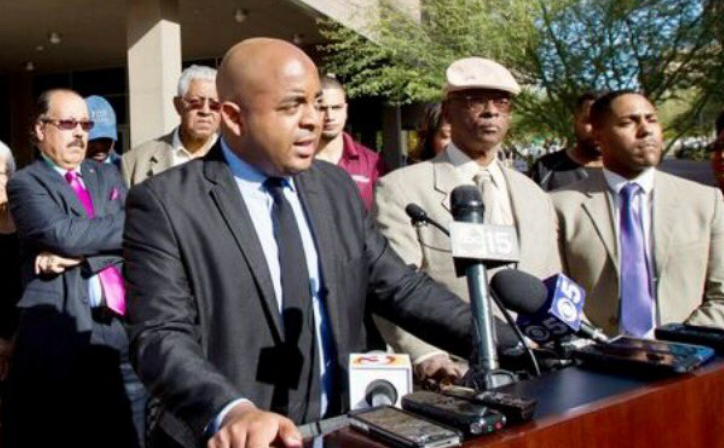
Arizona civil rights activist Jarrett Maupin, Jr., characterized the 2022 attorney general election contest as the “civil rights issue of our time.”
Maupin referenced the allegations of disenfranchisement, which he claimed would bring American society back to a time where Black citizens couldn’t vote under the Democratic Party.
“Without the right to vote and to have every vote counted, we will return to the dark days of the Democrats of the Old South. If you cannot vote, you are a slave,” said Maupin. “Period.”
Maupin has run multiple times for different offices, including Congress and Phoenix mayor.
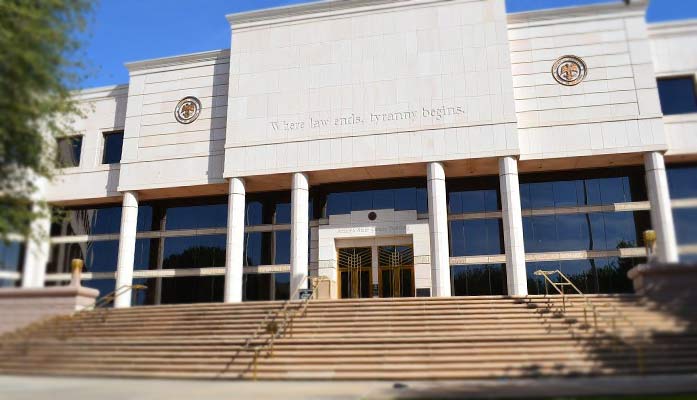
Republican attorney general candidate Abe Hamadeh is challenging the validity of Kris Mayes as the elected attorney general. The Mohave County Superior Court granted oral arguments earlier this month. As AZ Free News reported, Judge Lee Jantzen expressed interest in the sampling of evidence provided by Hamadeh’s team during the arguments.
Hamadeh’s team focused on evidence of allegedly disenfranchised voters, specifically uncounted votes from undervotes and provisional ballots. Opposition representing Mayes, Secretary of State Adrian Fontes, and Maricopa County argued that too much time has passed since the initial December hearing and swearing-in.
A ruling in the oral arguments is pending but should be made available soon. Jantzen promised a ruling in several weeks’ time; it’s been over two weeks since the hearing.
While the outcome of Hamadeh’s oral arguments remains pending, a nonprofit organization filed a lawsuit against Gov. Katie Hobbs for failing to fulfill a public records request related to the election while in her capacity as secretary of state.
America First Legal (AFL) submitted its public records request 10 days after Election Day last year, on Nov. 18.
AFL requested all emails from Nov. 8-16 sent to and from Hobbs; Hobbs’ former assistant secretary of state and, most recently, former chief of staff Allie Bones; Hobbs’ former communications director as both secretary of state and governor, C. Murphy Hebert; and Hobbs’ former deputy communications director while secretary of state and current deputy communications director, Sophia Solis.
Bones resigned from Hobbs’ office several weeks after AFL filed its lawsuit. Hebert was dismissed in March, just days after Hobbs’ former press secretary, Josselyn Berry, resigned over a tweet indicating a call for gun violence against transphobes. Berry issued the tweet hours after the Covenant School shooting in Nashville, Tennessee, perpetrated by a woman who identified as a transgender male. The Covenant School is a private Christian school; the shooter has an unreleased manifesto corresponding with the murders.
Hebert was hired earlier this month by the current secretary of state, Adrian Fontes.
AFL reported that though Hobbs’ administration never responded to their request, Fontes did. Fontes denied the request on Feb. 1 of this year. His administration claimed that the request covering the emails between four employees over the course of nine days constituted “an unreasonable administrative burden.” The secretary of state’s general counsel, Amy Chan, said the request concerned “many thousands of emails” in her rejection letter.
READ THE LAWSUIT
AFL argued that Fontes’ office failed to fulfill their statutory duty of providing “sufficiently weighty reasons” for denying the request. This includes, according to court precedent cited by AFL — ACLU v. Arizona Department of Child Safety — the resources and time it took to locate and redact the materials, the volume of materials requested, and how much it disrupted the secretary of state’s core functions.
Corinne Murdock is a reporter for AZ Free News. Follow her latest on Twitter, or email tips to corinne@azfreenews.com.
by Corinne Murdock | Mar 23, 2023 | News
By Corinne Murdock |
On Wednesday, the Arizona Supreme Court granted a review to gubernatorial candidate Kari Lake in her challenge of the 2022 election’s validity.
The court dismissed six of the seven issues presented by Lake. The one granted review concerned Maricopa County’s signature verification policies. Chief Justice Robert Brutinel determined that the trial court had wrongly dismissed this issue by interpreting it as a challenge to the policies themselves rather than the application of the policies.
The issue asks:
“Did the panel err in dismissing the signature-verification claim on laches, mischaracterizing Lake’s claim as a challenge to existing signature verification policies, when Lake in fact alleged that Maricopa failed to follow these policies during the 2022 general election?”
Lake alleged that Maricopa County violated A.R.S. § 16-550(A), claiming that a material number of early ballots cast in the election were transmitted in envelopes containing an affidavit signature that election officials accepted despite determining that it didn’t match the signature on that voter’s registration record.
In a press release, Lake characterized the ruling as a win. She called Maricopa County’s signature verification system “completely broken,” and claimed the county was “absolutely terrified” of transparency.
Court watchers say the court has remanded the signature verification issue to the trial court to reconsider the motion to dismiss on grounds other than laches. If the court determines there are no legally sufficient grounds to dismiss, then the court must hold a trial to review the relevant evidence to determine if an outcome determinative number of early ballots were accepted without appropriate signature verification.
While this ruling offers Lake the opportunity to review the signature process, it likely won’t change the outcome of the trial based on the lead in votes by Gov. Katie Hobbs: over 17,100. On the other hand, the court’s signal that it would allow a trial may be favorable for attorney general candidate Abe Hamdeh.
Hamadeh is recorded as losing the election to Democratic opponent, Attorney General Kris Mayes, by just under 300 votes.
Hamadeh appealed the election after the recount discovered that Pinal County undercounted hundreds of ballots, halving Mayes’ original lead from over 511 to under 300.
Mass failures of election machines on Election Day, specifically stemming from the printers, caused long waiting times at vote centers and, in some instances, caused voters to either be discouraged from voting or unable to vote due to time constraints. Those who did stay and were unable to cast a regular ballot due to tabulator issues were forced to cast provisional ballots. Over 17,000 voters filed provisional ballots.
Corinne Murdock is a reporter for AZ Free News. Follow her latest on Twitter, or email tips to corinne@azfreenews.com.
by Abraham Hamadeh | Mar 20, 2023 | Opinion
By Abraham Hamadeh |
There have been multiple times where provisional ballots were initially deemed illegal by the government but later counted as legal after election challenges.
One example of this occurred during the 2000 presidential election, when thousands of provisional ballots in Florida were initially deemed invalid because they were cast by voters who were not on the official voter rolls. However, after legal challenges and court orders, these provisional ballots were ultimately counted.
In 2019, election officials in Georgia were found to have improperly removed thousands of voters from the rolls, including some who had not actually moved and were still eligible to vote at their registered address. However, a judge ordered that these ballots be counted. Similarly, in 2018, election officials in Florida were found to have mistakenly removed thousands of voters from the rolls due to a data error.
My team has discovered that many Arizonans were wrongfully disenfranchised, due to system or process error. Prior to running for Attorney General, I served as a prosecutor at the Maricopa County Attorney’s Office and overseas with the U.S. Army Reserve. I swore an oath to uphold the laws and defend the Constitution. My commitment to fight is instilled in my values, and I will continue to seek justice and accountability for those who were wrongfully disenfranchised.
In the closest race in Arizona history with a margin of 280 votes out of 2.5 million there remains thousands of uncounted Election Day provisional ballots. Not only is this the closest race in Arizona history, but it is also the race with the biggest recount discrepancy in statewide history. Making sure the legitimate candidate who received the most votes won is paramount for the success of democracy.
The courts are the proper venue for these ballot disputes, not the corporate media or political consultants who act as spokesmen and propaganda for the government. I will continue to fight relentlessly to make sure the will of the people is honored and that all lawful votes are counted.
Abraham Hamadeh is the Republican nominee for Arizona Attorney General. You can follow him on Twitter here.
by Dr. Thomas Patterson | Dec 23, 2021 | Opinion
By Dr. Thomas Patterson |
In 1952, Dwight Eisenhower announced he was a Republican 10 months before the general election. In June, he resigned his military office to devote full time to his presidential campaign.
Adlai Stevenson was already a Democrat by 1952 but resisted multiple efforts by Democrat partisans to nominate him as their candidate. After his stirring speech at the convention that summer, they did so anyway. Three months later, a president (Eisenhower) was duly elected.
Modest candidates and brief campaigns are now in our receding past. The 2020 presidential race lasted 1,194 days after the first candidate declared. The 2024 election, for practical purposes, started immediately after the previous election. Fully three years out, news and opinion outlets are brimming with the latest poll numbers, candidate statements, and expert speculation.
No other nation subjects itself to such an exhausting ordeal. Elections in Canada, the UK, and Australia all last about six weeks. In Japan, they get it done in 12 days.
Admittedly, these are parliamentary systems where elections are triggered by political events, but France gives candidates just six months to qualify for the second-tier ballot, then two weeks to campaign in the finals.
American campaigns weren’t always ultramarathons. Warren Harding, for example, announced his candidacy 321 days before the 1920 election. Most American presidential candidates operated under a similar timeline.
The “modern” era began with the contentious 1968 Democrat convention when the party rank-and-file wrested control from the smoke-filled rooms, and the popular primary system was established. In 1976, the obscure Jimmy Carter was able to build momentum in the primaries by campaigning early. Ambitious politicians ever since have taken note.
But super-long campaigns have consequences, most of them undesirable. The most obvious is that length favors deep pockets, the ability to finance a years-long, money draining effort.
Few candidates can self-fund. Instead, they have to spend immense amounts of time and do a lot of promising to raise the many millions required for the campaign. Many political leaders are distracted from their duties by the minutiae of campaigning.
Never-ending campaigns simultaneously exhaust and entrance voters. Competitions are naturally interesting and easy to understand. It’s simple and inexpensive for the media to churn out horse-race stories, so NATO, supply chains, and housing policy get short shrift while mountains of articles are written about the prospects of the candidates far in the future.
It has long been a truism that more challenging, risky issues are harder to tackle in an election year. But if every year is effectively an election year, then it’s never the right time for heavy lifting.
Instead, governing in the midst of a campaign creates constant pressure to “do something,” so that politicians appear active and effective. Populist policies and handouts which favor the growth of government are thought to attract voters. Moderation and fiscal restraint don’t sell well, so they are kicked to the curb.
The Build Back Better bill was the perfect campaign legislation, something for everyone. No wonder Democrats are panicked over the electoral consequences of its possible failure.
But long campaign seasons also have their clear winners. Potential candidates are already dropping by Iowa, New Hampshire and South Carolina, which happen to be crucial early primary states just to, you know, see how the folks are doing.
These states fiercely protect their primary position and with good reason. Iowa particularly has successfully exploited the candidates’ need to ingratiate themselves into the long-term protection of ethanol mandates, regulations and subsidies. It’s foolish policy with no environmental or other benefit except to corn farmers and producers, another result of our long and complicated presidential elections.
Compared with other countries, the U.S. has a short presidential term and an unusually long election process. This near constant turnover lengthens the period in which we are vulnerable to foreign actors exploiting us for their benefit.
Other democracies have laws which limit elections. Exactly nobody is clamoring for longer elections in those countries. Still, politicians are unlikely to reform their own system.
In the absence of other options to rid ourselves of these expensive, dysfunctional election campaigns, maybe we should take a look.