While the left has been lecturing us for decades that requiring ID to vote is somehow an overt example of systemic racism, they’re now planning to require ID for the privilege of shopping in government run grocery stores.
Democratic New York Mayor Zohran Mamdani announced in a recent press conference that he intends to spend over $70 million in taxpayer dollars to launch five government run grocery stores across New York, promising a 30% discount on all groceries.
And when questioned on how he intends to ensure people won’t just travel to New York and buy up the inventory for resale elsewhere in a predictable arbitrage play, his answer was both astounding and hypocritical. This is par for the course with his failed promises.
He said that they would implement a “library-esque” ID card that only New York citizens could obtain.
Yep, you heard that right — according to Democrats, it’s racist to ensure that only United States citizens are voting in our elections, but it’s totally fine to require ID to buy a box of Hot Pockets.
Someone else will have to make it make sense, because I sure as hell can’t.
For now, let’s set aside the absurdity of government run grocery stores. Let’s also set aside the fact that Democrats are claiming they have the magical ability to provide a 30% discount in an industry that operates on a 1-3% profit margin. And last but not least, let’s set aside the fact that every single industry the government gets involved in instantly experiences massive cost increases that destroy the budgets of hard working Americans.
Instead, let’s unpack their initial claim that requiring ID to vote is somehow racist.
What explanation have they used to justify that claim?
Across the board, nearly every Democrat politician, lobbyist, activist, and political pundit has consistently stated that black Americans either don’t know how or can’t afford to get a government issued ID.
Democratic Pennsylvania Gov. Josh Shapiro has consistently been one of the most vocal critics of voter ID, and recently made the ridiculous statement that, “We are not going to turn our elections over to Donald Trump.”
Democratic California Gov. Gavin Newsom recently signed a law to completely ban local voter ID requirements.
And Matt Dietrich, spokesman for the Illinois State Board of Elections, said that Illinois does not require voters to show any type of photo ID at the polls, and went on to say voters only need to sign a sworn statement on their voter registration application that they are a U.S. citizen.
These are just a handful out of hundreds of examples.
Personally, I think the claim that black Americans either don’t know how or can’t afford to get a government issued ID, in and of itself, is pretty racist.
Virtually every single human of every race in America knows that getting an ID is a simple matter of going to your local Department of Motor Vehicles. And even if someone doesn’t know where one is, it’s hours of operation, or even what documents they’ll need, finding those answers is as simple as a quick Google search. (Although Democratic New York Gov. Kathy Hochul did claim in May 2024 that black children don’t know what computers are, so I can see why Democrats might be confused here.)
So the claim that voters of any race don’t know how to get an ID is absurd.
The claim that black Americans can’t afford a government ID is equally absurd because the cost of a driver’s license ranges from $10 to $90, depending on your state.
But beyond that, an ID is already required for typical life in America anyway.
You need to show ID to drive a vehicle, visit a doctor, pick up prescriptions, travel on an airplane, buy a firearm, get a job, open a bank account, join the military, rent an apartment, enter a casino, purchase alcohol, tobacco, cannabis, and some video games, register for government benefits, get married, get divorced, cash a check, rent a car or hotel room, register for health insurance, get a piercing or tattoo, donate blood, go hunting or fishing, sign any legal document, and countless other activities that most Americans do every single day.
And now, apparently, we can add shopping at Democrat run grocery stores.
According to Democrats, requiring an ID for all of these activities is perfectly fine, but when it comes to voting in our elections, it’s somehow an egregious burden that disenfranchises black voters.
What’s clear to me is that Democrats don’t want secure elections because they know they can’t win without cheating the system.
We’ve seen case after case of voter fraud. Recent examples include illegal aliens who were registered to vote, dead citizens still on the voter rolls, and harvesting ballots from the homeless population.
And in nearly every single case, this fraudulent voting favors Democrat candidates.
You don’t have to be a statistician to realize that it’s mathematically impossible for that to just be a coincidental fluke. It’s a clear case of systemic voting fraud perpetuated by the Democratic political machine.
The bottom line is that if Democrats think ID should be required to buy groceries, then the least we can do is require the same for our elections.
If it’s good enough for Hot Pockets, it’s good enough for the voting booth.
On July 14, the UN’s Adaptation Committee put fund managers, negotiators, and development bankers on a video call to work through a problem that clearly has them rattled. The money is drying up.
The Green Climate Fund, the Global Environment Facility, and the Adaptation Fund all sent people to explain how developing countries can tap them for cash. What they mostly did was ask for more. The reason they are running short, though, is news that ought to please anyone who pays U.S. taxes. In February 2025, the United States rescinded roughly $4 billion in outstanding pledges to the Green Climate Fund. We were the first country to do it. This spring, the United Kingdom followed, halving its pledge from £1.6 billion to about £815 million.
The people on the call treated this as a crisis. For anyone who works for a living and pays the bills, it looks more like a rescue.
It’s worth being clear about what these funds are. They hand out grants, not loans. Hansol Park of the Green Climate Fund said about 80% of its public-sector adaptation money is grant based, and the Adaptation Fund gives grants exclusively. Grant means gift — no repayment, no return, nothing back. When Washington pledged $4 billion, it was pledging to give $4 billion away and call it climate policy.
Where does the money go? The funds prefer to answer that in their own vocabulary. Ask what they finance, and you get “readiness,” “institutional capacity,” “capacity building,” “accreditation support,” “project preparation,” and “locally led adaptation.” Some of it does buy physical things, water systems and farms and flood defenses. A good deal of it, though, pays to build and staff the offices that write the grant applications in the first place.
The Green Climate Fund has placed outside experts inside developing-country governments, with more on the way. It runs multi-year “readiness” programs to prop up national agencies, with eight approved and 93 countries waiting in line. Over at the Adaptation Fund, staff run proposal-writing workshops and report that the workshops produce stronger proposals, which tells you the process is complicated enough to need a training seminar just to fill out the forms. Roxanne Valentine-Donegan of the Development Bank of Jamaica, one of the few speakers who had actually tried to pull money through the system, said getting it is “genuinely difficult,” slowed by shifting requirements and document-heavy applications.
So the recipients themselves say the system is too slow, too technical, and too expensive to navigate. And the answer on offer is not less paperwork; it is more staff and more workshops to process the paperwork. That is how bureaucracies grow. Every new hurdle becomes the reason to hire someone to help you clear it.
“Institutional capacity” is the polite expression that makes reference to the permanent layer of coordinators, accredited entities, and consultants standing between a donor’s check and an actual project on the ground. The Adaptation Fund alone works through roughly 62 accredited entities. The NDC Partnership, which helps developing countries navigate climate finance, says it has received more than 7,000 requests for support since 2016. Yet after nearly a decade and tens of billions of dollars, the people running this system are still saying they need more funding, more staff, and more capacity. The bureaucracy never seems to reach the point where it decides it has enough.
The Adaptation Fund reported an active pipeline worth about $1.9 billion with an appetite that seems to have no ceiling.
Adaptation Fund specialist Alyssa Gomes said flatly, “We do need more finance.” The Green Climate Fund talked up a board decision that could unlock roughly $4 billion in new programming capacity. No number is ever sufficient, because the demand is set by the funds themselves, not by any budget a taxpayer ever approved.
The dialogue ended the way these things invariably do, with appeals for donors to give more, at a faster pace, with fewer strings attached. The honest answer from the American side is already on the record. We are keeping the $4 billion.
Melanie Collette is a contributor to the Daily Caller News Foundation and a senior policy analyst for the Committee For A Constructive Tomorrow (CFACT), a Washington, D.C.-based nonprofit that champions free markets, property rights, and innovation as the keys to protecting both people and the environment.
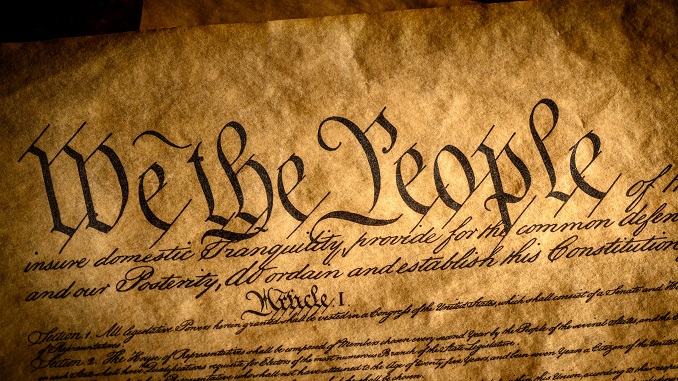
The U.S. Constitution is very clear with regards to the requirements to hold any public office in the United States. One of the requirements is as follows:
“Before he enter on the Execution of his Office, he shall take the following Oath or Affirmation:—’I do solemnly swear (or affirm) that I will faithfully execute the Office of President of the United States, and will to the best of my Ability, preserve, protect and defend the Constitution of the United States.’” (Article 2, Section 1, U.S. Constitution)
Also:
“The Senators and Representatives before mentioned, and the Members of the several State Legislatures, and all executive and judicial Officers, both of the United States and of the several States, shall be bound by Oath or Affirmation, to support this Constitution…” (Article 6, Clause 3 of the U.S. Constitution)
The requirement of taking an oath is in addition to other qualifications listed in the Constitution to hold public office, such as age, birth, citizenship, residency, and more. No person, even if elected, may legitimately hold any office in the United States or any particular state unless that person promises under oath to support, protect, and defend the principles of the U.S. Constitution.
Some may ask, then, what about candidates today who have announced they want to eliminate some basic constitutional provisions, such as the executive or judicial branches of our government? Such actions would destroy our system of checks and balances and limited government. The nation first tried this type of government in the Articles of Confederation, which had neither executive nor federal courts. It was a disaster and led to the Founders wisely adopting the U.S. Constitution in its place with limited, enumerated powers distributed among three branches.
The Founders also provided that the Constitution may be amended, allowing for changes to be made within the document as time and circumstances required, but not to throw out the whole document. It has been amended 27 times.
Those who advocate for the complete dismantling of our system of government should be stopped at the gate—not allowed to lie their way into public office by taking an oath to “preserve, protect, and defend the Constitution” while intending to destroy the very heart and structure of the Constitution they have sworn to uphold. That’s especially true when America’s enemies have openly pledged to do precisely that. The Founders called such action by would-be public officials treason, which they defined as giving aid and comfort to enemies of the United States.
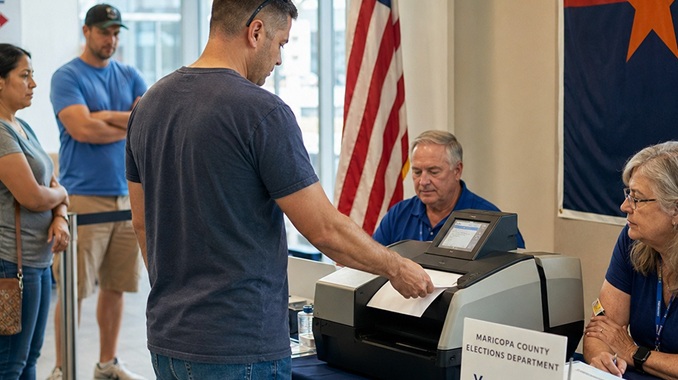
It’s pretty rare in politics to find a policy that is considered across the political spectrum as a true win, win. In the most recent primary election, Maricopa County implemented a new process that may actually be considered a win, win, win for elections.
Win number one: more options for voters, not fewer.
Win number two: faster election results.
Win number three: more integrity in the process.
What is it? On-site tabulation of early ballots. That’s right, a policy we spearheaded with Senator J.D. Mesnard in 2022. Then, it was SB1362. It was introduced on the heels of an election taking weeks to get election results and one of the largest drivers of the delay were early ballots that voters did not mail back, did not drop off during early voting, but instead held onto until election day and dropped them off en masse at polling locations. Hundreds of thousands of ballots dropped off, that later had to be transported to the county, signature verified, cured, removed from the envelope, and finally tabulated.
That wasn’t novel, and you can see why so many would choose to vote this way. For some, they simply forgot to return their ballot in time. Now it is election day, they don’t want to wait in line to fill out a two-page ballot again, so they drop it off. Or they filled out their ballot at home, and they don’t trust the mail to get it delivered and would prefer the assurance of dropping it off themselves. Or they like filling out their ballot at home, but they also like to go to the polling place on election day. Whatever the reason, a large portion of voters choose to do it every year. Most of them do not realize it delays results for weeks.
SB1362 began as a mandate on the counties, requiring them to provide this option to voters. Believe it or not, the counties fought it tooth and nail the entire session. Eventually, the bill was amended to make it optional for counties to implement. They still opposed it. Why? They knew that if voters found out that their county officials could be doing this but are refusing to do so, voters would get mad at them.
By U.S. Secretary of Agriculture Brooke L. Rollins |
Recently, I visited the port of entry in Douglas, Arizona, which has been traversed by cattle nearly 150 years. Last year alone, over 57,000 live cattle were imported into the United States from Mexico through the port—that is, until we closed it in May 2025 to protect American livestock from the New World screwworm (NWS). Thanks to our round-the-clock efforts, in partnership with state and local animal health officials, it is now safe to begin a coordinated, phased reopening of southern cattle ports.
Every model showed NWS entering our country by late summer of 2025, but by increasing oversight of containment efforts in Mexico and strengthening border protections, we bought critical time to prepare. Since January 20, 2025, the Trump administration has invested a record $1.3 billion in emergency funding to combat the pest—one of the largest animal health responses in U.S. history.
Our defensive plan is robust. We have expanded the number of staff working on NWS by 1,000 percent, and over the past two months, we have conducted more than 1,000 drone flights observing over 21,000 wildlife in Texas. To prevent NWS from reproducing, we are also dropping 100 million sterile flies per week over Texas and Mexico. This spring at Moore Air Base in Texas, we opened a new sterile fly dispersal facility and broke ground on a sterile fly production facility. Last month, a production facility we helped upgrade in Metapa, Mexico, officially opened, and another facility we support in Panama is currently producing sterile flies at maximum capacity.
But we’re not stopping there. In Arizona, I announced a $25 million U.S. Department of Agriculture (USDA) investment to construct a brand-new sterile fly dispersal facility in the Grand Canyon state, which is coming into being thanks to the visionary leadership of Arizona’s own U.S. Representative Juan Ciscomani. Ranchers can rest assured that we are working with state officials to advance this project as soon as possible. Sterile flies were key to eliminating NWS from the U.S. in the 1960s, and they remain so today.
Just as important are surveillance and preparedness on the ground, which are led in Arizona by the Arizona Department of Agriculture, and in Texas by Governor Abbott, the Texas Animal Health Commission, and the Texas Parks and Wildlife Department. The Trump administration is reinforcing their efforts at every turn, including by ramping up outreach to producers and veterinarians and monitoring over 120 dedicated NWS traps and over 8,000 fruit fly traps along the border.
The results have been remarkable. Since the first confirmed case of NWS in the U.S. on June 3, the same month only saw 31 total cases within our borders, all of which are now inactive. Even better, July saw just 12 cases, and only 3 cases overall are active today. To put that in perspective, Mexico had over 30,000 cases last year alone. Clearly, our efforts are bearing fruit.
The fight is not over, but as the presence of NWS declines, so does the threat to our ranchers. That’s why it is now safe to reopen U.S. livestock ports of entry on our southern border, which have historically played a critical role in the American cattle trade—especially in recent years, as the U.S. cattle herd has reached a 75-year low. Live imports from Mexico make their way to U.S. feedlots and eventually end up on dinner tables across America.
The port in Douglas will be the first to reopen on August 24 due its low-risk profile and because the bordering Mexican state of Sonora remains the lowest-risk Mexican state for NWS and maintains some of the strongest livestock inspection and movement controls anywhere in Mexico. After evaluating the success of the initial reopening, we will then consider reopening the ports in Santa Teresa, New Mexico, and Columbus, New Mexico, to live cattle, bison, and horses.
Make no mistake, these reopenings are contingent on Mexico making continued forward progress and meeting all enhanced USDA requirements. Every animal entering the U.S. will fully comply with our comprehensive import protocol, which requires preventive treatment for NWS, multiple inspections before an animal approaches our border for import, and inspection by USDA for any trace of NWS.
If at any point we determine there is an imminent threat to our domestic herd, we will not hesitate to immediately pause the reopenings. Protecting American livestock will always come first, and we will continue using every tool at our disposal to support the ranchers who raise them and to eliminate NWS once and for all. Our nation’s food security—and, therefore, our freedom—depend on it.
Brooke Rollins serves as the U.S. Secretary of Agriculture
Anyone who can look you in the face and lie without batting an eye is a morally reckless person.
I watched the KTAR interview featuring Peoria USD board members Jeff Tobey and Becky Proudfit. What should have only taken 13 minutes took me nearly two hours to digest with all the pausing. I struggle listening to people shamelessly weave false narratives. There’s no way I can stay silent.
When host Mike Broomhead asked if mandated reporting laws were followed in the case of former Centennial High School teachers Haley Beck and Angela Burlaka, Tobey claimed he was “evidence driven, process driven” and that Peoria PD “said there was no misstep when it came to mandatory reporting.”
Common sense tells me that Peoria PD’s initial investigation was primarily focused on finding evidence that would lead to the arrest and prosecution of suspected child abusers. Mandatory reporting isn’t exactly a high priority for PUSD employees since these kinds of failures have occurred before without consequences. Is it not possible for investigators to miss something, especially if sufficient evidence was withheld?
Thankfully, PUSD board member Heather Rooks sounded the alarm after she read the police report, reviewed state statutes, and discovered more laws were broken.
When Broomhead said:
“The board president [Rooks] was removed for not following protocol…I thought it was a bad look for the district that you went after somebody that was saying ‘I just want to protect kids,’ and it looked in the end like she was right that there needed to be a further investigation.”
Proudfit declared:
“I don’t think that’s a fair assessment. And I think there were a number of things that led to that change in the board presidency…The former prosecutor who would have done the in-house investigation encouraged us to wait until after the police had wrapped up their investigation for fear that we would meddle up [sic] the investigation.”
Once Rooks learned that a mandated reporting probe wouldn’t interfere with open investigations, she went to the Maricopa County Attorney’s Office in her capacity as a parent and taxpayer. Rooks was within her First Amendment right to speak. It’s also her duty as a civil servant to pursue truth, even while her left-leaning colleagues vote against it.
When Broomhead stated:
“It’s been reported that, Mr. Tobey, you are the one that requested that your attorney try to limit the search warrants. So, is this full cooperation if you were trying to limit the search warrants? Did you try to limit the search warrants?”
Tobey replied:
“So, the misinformation on that part was I proofread something that was drafted by legal. So, our superintendent is the de facto executive of the district and is responsible for making those decisions. As the board president, I am the legal liaison with the board and the attorney. It’s my role to kind of have that interface with the attorney and the superintendent. So, it wasn’t my direction at all. It was the direction of the district.”
So, you took part in a coup to remove Rooks from the board presidency only to abdicate your authority and defer to your subordinates in a time of crisis? Some leader you are…
On July 6, 2026, 12News reported, “The police department had previously served a search warrant earlier this year to PUSD in order to obtain documents related to the investigation into the Centennial High controversy. Attorneys representing PUSD filed a motion in Maricopa County court to restrict their access to certain records.”
Quoting PUSD Chief Communications Officer Danielle Airey, the article said, “‘Because the Governing Board has not voted to waive attorney-client privilege, legal counsel has an obligation to preserve those protections and comply with federal student privacy laws unless directed otherwise by the board or ordered by the court.’”
In other words, Tobey could have called for a vote to waive attorney-client privilege at any time. That’s what Rooks would have done if she were still board president. Tobey—who works for Phoenix PD—should know a criminal search warrant supersedes FERPA, Title IX, and all administrative rules.
As I’ve explained in previous posts, Tobey didn’t have the popularity to get elected. He relied heavily on Rooks’ support and the grassroots campaign led by West Valley Parents Uniting (WVPU). In a twist of irony, Tobey and Rooks were two of WVPU’s founding board members. They served in the organization together until they both resigned to run for public office.
A few years later, on a quest for power, it would be Tobey who teamed up with leftists and accused Rooks of political grandstanding as she aspired to higher office. Rooks also supposedly broke protocol by speaking to the media as an active board member.
But wait, there’s more.
On July 21, 2026, this same Tobey character appeared in an ABC15 interview to address Peoria PD’s days-long raid at the district office. Tobey said he was speaking up now because “it’s important to reach more individuals in the community…and I want to be able to share what I can.” While explaining his vote to appoint Darien Schoolcraft as Centennial’s new principal, Tobey verbally identified himself as an active board member. This fits the definition of a hypocrite: A person who tells other people how to behave or claims to hold certain moral, religious, or political beliefs, but then does the exact opposite in their own actions.
To everyone attacking and plotting against Rooks—including the RINOs on LD28’s executive leadership team who publicly supported her demotion—you seem to have lost the real narrative. Let me refresh your memory.
This entire situation, which has gone national and inspired action from the U.S. Department of Education, started with district employees who allegedly victimized their students. Following accusations and concerns from students and community members, former Centennial principal Scott Hollabaugh (and other employees) failed to notify law enforcement.
This is not a matter of perspective or interpretation. For all the “evidence driven, process driven” hypocrites watching this saga unfold, the reality of it all can be ascertained from the investigation report. What difference does it make whether you “like” Rooks or think she’s out for political gain—she’s trying to protect children! Rooks isn’t the issue. Cover-up culture is the issue.
Proudfit—who also serves as LD28’s 4th Vice Chair—voted with Tobey and Melissa Ewing to ineffectively silence a voice calling attention to the alleged sexual exploitation of PUSD students. When Broomhead pointed out the possibility that school leadership ignored students’ complaints about Beck and Burlaka, Proudfit deflected and said:
“This is the part of the story as a mother that makes me see red…We don’t have [a] record of any of those students coming to actual authorities, but instead they went to TikTok and it became a social media centered conversation…As a school district we don’t have control over what your child does on social media. And that’s where I think it’s really important to remember that the number one mandated reporter is parents. They also fall under that [law]. The system only works when everyone is cooperating.”
Is this not what “social emotional” gurus call victim blaming? Again, the lie about there being no record of students approaching administrators is debunked by the police report and is most likely contained in those documents Peoria PD had to pry out of the district’s hands. Hm…it seems there was a lack of cooperation somewhere that caused the system to fail.
School board members are not elected to parent the district. They sit as a body of government to hold official proceedings, not family therapy sessions. Everyone knows students use social media to express themselves. What we don’t know is how they’re responsible for employee misconduct. And why would a public official think it’s appropriate to lecture parents about their kids’ online activities when PUSD is being vetted for alleged child sex crimes that started and/or occurred on campus?
Unless I missed it, by the end of the KTAR interview, Tobey or Proudfit never condemned the alleged perpetrators’ actions. There was no warning for district employees to conduct themselves with professionalism and self-control. No apology was offered to any alleged victims or their families. I swear they were both reciting passages from a restorative justice handbook, or something. It was truly bizarre. Now do you see why it took two hours to watch?
It’s worth noting that Tobey and Proudfit have privately acquired a PR team. I guess this means we can expect their media charade to continue. No worries, keeping the record straight is what I do and I’m not going anywhere. I see 2028 on the horizon.
School board candidates often campaign on “truth,” “transparency,” and “accountability.” Tobey specifically ran on “student safety.” These are the promises K-12 parents want to hear—need to hear—before entrusting someone with their kids. I’m sorry to say those in the highest leadership positions have betrayed the public’s trust. All promises were broken the day Rooks was removed from the board presidency.
I don’t know about you, but I can clearly see who’s in this for political gain. We are where we are today because we have people in power who choose to protect institutions over children.