Every time you think the energy policies pushed by the Democratic Party can’t possibly get any crazier, they go and fool you again.
Politico’s E&E News published an article Friday with a headline that should scare the bejeebers out of anyone who hopes for sanity in energy policy: “Progressives look to recharge the Green New Deal for the AI era.”
The piece quotes Melat Kiros, the socialist who unseated longtime incumbent Democratic Colorado Rep. Diana DeGette in the party’s recent Colorado primary as saying, “The Green New Deal, frankly, is a floor now, not a ceiling, for what we need to actually be looking at doing.”
This, of course, parrots the classic mantra of every generation of new socialists, who, when presented with the reality that socialism fails disastrously everywhere it is tried, invariably claim that it just hasn’t been done the right way, and they know better.
But they never really do know better.
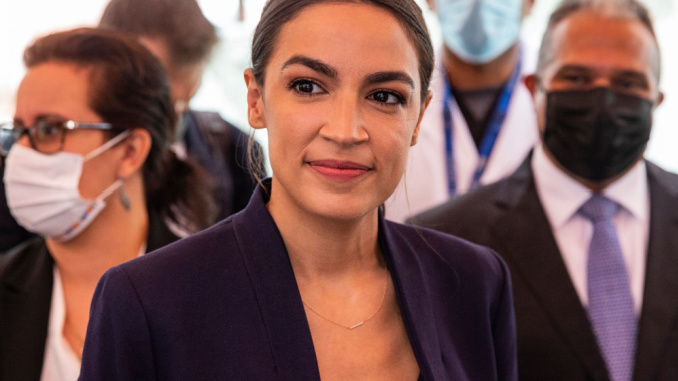
Let’s be clear: what any version of the Green New Deal introduced by Democratic New York Rep. Alexandria Ocasio Cortez and Democratic Massachusetts Sen Ed Markey in 2019 would kill the AI era. Why? Because it is a classically socialist program by its very nature. It is a program which would seize the means of production through the central government, invoke a gigantic array of top-down command-and-control regulatory structures and utterly destroy the spirit of human initiative and innovation that leads to human flourishing and prosperity.
All the various socialist candidates quoted in the E&E piece are supported by The Sunrise Movement, a far-left activist NGO funded mainly by leftwing billionaire interests like the Rockefeller Foundation, the Tides Foundation and the Soros-affiliated Open Society Policy Center. What a surprise – it’s like a who’s who of far leftwing astroturf protest funders who have been behind every U.S. protest movement since Occupy Wall Street.
The Green New Deal as proposed by AOC and Markey seven years ago involved ending discretionary air travel; heavily restricting all other travel; heavily restricting personal driving; de facto banning oil, natural gas, and coal; building a vast network of high-speed rail lines which would cost trillions of dollars and take a century or more to develop (assuming the economy didn’t enter a major depression in the meantime); and destroying power grid reliability by forcing mass adoption of wind and solar.
To this new generation of Sunrise-supported socialists, that array of destructive and frankly impossible options is now the “floor” for what really needs to be done. You just can’t make this stuff up.
“The Democrat Party – the socialists, the Marxists – have nominated some of the most radical candidates to ever run for office, and they’re running for Congress. The insurgent left is on the rise,” House Speaker Mike Johnson said after New York voters nominated three socialist candidates.
The speaker isn’t wrong; in fact, he’s a master of understatement. The insurgent left is not just on the rise, it is being funded by the same leftwing billionaire interests who funded the destruction of America’s coal industry, the anti-fracking movement and the effort to kill the shale revolution that has generated hundreds of billions of dollars in economic growth and made the United States the world’s dominant energy powerhouse.
Any revitalization of the Green New Deal would be intentionally designed to destroy all of that and much more. Any effort to apply a renewed Green New Deal to the AI industry would be designed to destroy it, too. Because socialism at its base is never about building anything, but about destroying things, with human flourishing being its main target.
David Blackmon is a contributor to The Daily Caller News Foundation, an energy writer, and consultant based in Texas. He spent 40 years in the oil and gas business, where he specialized in public policy and communications.
Cecily Myart-Cruz, the immediate past president of United Teachers Los Angeles (UTLA), carried almost 70% of the vote, a signal that the NEA is likely to double down on its leftwing political power play and far-left social justice activism.
This is hardly breaking news. It reflects the union’s longstanding trajectory and echoes outgoing NEA President Becky Pringle’s recent call for a “political revolution.”
For decades, the teachers unions have built a political machine that channels members’ dues into political campaigns, activist organizations and ballot initiatives. Since 2016 alone, the NEA, AFT and their affiliates have directed more than $1 billion to political groups and activist organizations.
Despite the unions’ constant drumming on about protecting “democracy” from “fascists,” the virtue signaling is nothing more than cover for their Machiavellian-light tactics.
So, it should not come as a surprise that the NEA’s Representative Assembly (RA) just adopted a bylaw to increase yearly member dues by $10 to be directly “allocated to the Ballot Measure/Legislative Crises and Media Campaign Fund.” That means an additional $20 million per year will be injected into state and local politics to advance the NEA’s agenda.
To understand how this functions in practice, look to the current school choice fight in Arizona over the state’s Empowerment Scholarship Account (ESA) program. Through astroturf proxies, the NEA is attempting to stop or handicap Arizona families’ ability to choose the best school for their children.
Leading the current anti-school choice movement in The Grand Canyon State is Protect Education, Accountability Now, a recently registered Political Action Committee (PAC) that took in almost $4.5 million from the NEA in the first three months of 2026.
It is more than a union-funded PAC — it is run by union leadership. In fact, the chairman of the PAC, Delia Lynding, is the president of the Kyrene Education Association and a highly active union member. At a No Kings rally this past March, Lynding parroted national leadership rhetoric by declaring that the “unions are the antidote to fascism.”
Apparently, we do not share the same understanding or definition of “fascism.”
But this is not an isolated case of the unions wielding their collective power and resources to influence and control state and local policy and legislation. Over the last few years, the teachers unions have dumped tens of millions of dollars into activist nonprofits to stop or challenge school choice measures in states like Colorado, Kentucky, Maine and Nebraska.
Expanding this political hydra, the NEA has partnered with Public School Strong, an “organizing and visibility campaign of Race Forward’s HEAL Together initiative” that is headed up by a lead organizer with a lengthy history of antisemitic posts and statements. The initiative’s expressed purpose is to support “equity” and protect schools from the “rising tide of extremist attacks against public education” by training up students, parents, and community members as local activists for the union’s interests. In 2024, the NEA gave Race Forward over $300,0000.
At this year’s NEA annual meeting and assembly, the Representative Assembly has reaffirmed the future direction of the organization – the nation’s largest teachers union wants more power and control over schools and culture, and they are willing to use the education system to achieve it.
In order to thwart these efforts, we need to continue to expose their tactics and agenda to the public, offer up alternatives like the Teacher Freedom Alliance, and promote legislation that neuters and defunds this far-left political monstrosity.
It is way past time that we end the teachers unions’ professional activist funding pipeline.
Rhyen Staley is a contributor to The Daily Caller News Foundation and a researcher for Defending Education. He holds a master’s degree in elementary education and has over a decade of classroom experience in both public and private schools. He has over 25 years of coaching experience from junior high to Division I.
Arizona taxpayers can’t catch a break from their local governments. From water rates and utility bills to property taxes and sales taxes, city councils have spent the last several months approving one increase after another. No matter the justification, the result is always the same: higher costs for the people paying the bills.
Here are some of the top offenders of the last couple of months:
Florence
In the Town of Florence, the town council approved a multi-year water and wastewater rate hike plan that starts with roughly 6–8% increases but compounds over several years into what many residents estimate will amount to around a 64% increase in total utility costs. At a time when families are already struggling with affordability, approving rate hikes of that magnitude is a serious burden on Florence residents. With increases that steep, one would think they’re trying to compete with Gilbert (100%+ increase over 3 years). The increases will start on July 1st, just in time for summer, so get your pocketbooks ready, Florence residents.
Tempe
Tempe has their own slew of problems that deserves an article of its own, self-imposed by mismanagement, obviously. The Tempe City Council recently voted on sending a 0.5% sales tax increase to the ballot for voters in November. This will tax all non-grocery food and is said to give 0.3% to public safety, 0.1% to transit such as light rail and buses and 0.1% to Tempe PRE, a city run free preschool.
As usual, local leaders are putting all blame on the legislature. One Tempe councilmember said, “Let me remind you what we set out to do with this initially: to address a … deficit that was created not by us but by the Arizona Legislature and the federal government.”
Meanwhile, this is occurring while the council has decided on things like a $2 million “Mill Ave” sign. Just plain, silver metal. Nothing special or aesthetic and $2 million is going towards this thing? Right, and it’s the legislature’s fault that they are in a budget deficit of about $24 million. It’s almost as if they didn’t spend your tax dollars on stupid things, they wouldn’t need to keep raising taxes…
As we celebrate America’s 250th birthday, one of the finest blessings our Founders gave our nation stands out with particular clarity: the system of free enterprise. That system did not merely enable liberty and prosperity in the abstract.
It unleashed the human ingenuity, risk-taking, and capital allocation that turned America into the world’s unrivaled energy superpower.
From the coal age that fueled the Industrial Revolution, through the oil age that powered the 20th century, to the LNG age we now dominate, American free enterprise has repeatedly delivered technological leadership and abundance. No central planner designed these revolutions.
Entrepreneurs, engineers, and investors did, operating in a system that rewards results above political connections.
Today that legacy is unmistakable. The United States leads the world by a wide margin in the production of both oil and natural gas. We have also become the world’s largest exporter of liquefied natural gas, shipping reliable energy to allies across Europe and Asia who once relied on less friendly suppliers.
While some critics like to call this an accident of geology, they’re wrong. America’s LNG dominance is the direct result of the shale revolution, advanced drilling techniques, and a policy environment that, when properly structured, lets markets work.
America once held a similar commanding position in nuclear power. We built the world’s first commercial reactor and led in reactor technology for decades. Then came the 1979 Three Mile Island incident. Irrational fears, amplified by media and activists, led to a bureaucratic paralysis in the Nuclear Regulatory Commission which stalled new construction for two generations. Promising projects died in paperwork as existing plants faced endless regulatory hurdles. America fell behind while other nations pressed forward.
Today, that era is ending. The Trump administration is delivering a major push to revitalize America’s nuclear power industry. Energy Secretary Chris Wright and Interior Secretary Doug Burgum have announced major project milestones in recent weeks, including new loan programs to support large-scale reactors and breakthroughs on advanced designs such as microreactors that have already achieved criticality.
These steps signal a return to regulatory sanity and a recognition that abundant, reliable, carbon-free baseload power is essential for both economic growth and national security.
Wind and solar have also established a robust presence on every major U.S. regional grid. These intermittent sources now deliver meaningful power to homes and businesses when the weather cooperates. American companies and workers have built real expertise and infrastructure in these sectors. Yet the United States remains far behind China in manufacturing scale and deployment speed, and subservient to the Chinese Communist Party for the raw materials that make them work.
As Secretary Wright posted on X this week, the massive Biden-era subsidies that distorted markets and enriched foreign supply chains begin phasing out this month. That transition will test the true competitiveness of these technologies without artificial support. Their future contribution will depend on genuine cost reductions and technological improvement, not ever-rising subsidies from taxpayers and ratepayers.
America’s dominant position across fossil fuels, its returning strength in nuclear power, and its established role in renewables together form an unmatched energy portfolio. This abundance has been no small factor in making the United States the world’s dominant geopolitical power. Reliable, affordable energy underpins manufacturing resurgence, data-center growth, and an enduring military edge that deters adversaries. It keeps our economy the envy of the world, with lower energy costs than most competitors and the flexibility to adapt to new demands.
Most importantly, energy dominance sustains the God-endowed freedoms our Founders secured. Cheap, reliable power frees families from energy poverty. It powers the innovations that improve daily life. It supports the industries that create the jobs and wealth that let individuals and communities flourish according to their own lights rather than government dictates.
On this 250th anniversary, we should give thanks not only for the Declaration of Independence and the visionaries who created it, but for the practical system of ordered liberty that turned a resource-rich continent into the engine of global progress.
Free enterprise did not merely discover America’s energy wealth. It developed it, refined it, and continues to expand it. That is a blessing worth celebrating not just this weekend, but every day.
David Blackmon is a contributor to The Daily Caller News Foundation, an energy writer, and consultant based in Texas. He spent 40 years in the oil and gas business, where he specialized in public policy and communications.
For many Christians, a large ethical question looms over America’s 250th birthday: biblically speaking, should America ever have come to be? Was it right for the Founding Fathers to rebel against the British crown and establish an independent nation? Or did their actions run afoul of what Romans 13 states about submitting to governing authorities?
I’ve been repeatedly asked whether it was right for the Founding Fathers to rebel against Britain and establish the United States of America. Was this country founded in an unbiblical way? If the founders were truly following Scripture, would they have ever started this nation, or would they have willingly paid the taxes, submitted to the British government, and remained part of the United Kingdom?
Christians have answered this question many ways. Some argue that the United States should never have rebelled against Britain and that the reasons given were not biblically justified. We need to ask what the Bible says about this situation. The American Revolution was a unique circumstance in history: an unprecedented effort to overthrow a government and establish a new nation that has ultimately thrived in independence for 250 years.
When we think about biblical teaching on submission to government, passages like Romans 13 and 1 Peter 2 are primarily addressed to individuals. As individuals, we are to submit to governing authorities. I do not have the right to decide that I will not honor the authorities God has established over me, whether in my own nation or one I visit. As a Christian, I am obligated to obey the authorities God has established, honor those over me, obey laws insofar as they do not contradict Scripture, and pay taxes because God has established these authorities.
The question is different when it comes to the founding of the United States. Was July 4, 1776, the same as if I, as an individual, said, “I’m going to rebel against the government and start my own state or country”? No. The founding was not a collection of individuals choosing anarchy. It was a different set of circumstances. The founders were steeped in literature, philosophy, theology, and, in many cases, Scripture. They derived much of their theory of government from what the Bible teaches about government, governing authorities, and their role. In the circumstances with Great Britain and the colonies, they recognized an important biblical principle: government is established by God.
Biblically speaking, however, government is designed to exist by the consent of the governed—and we see this throughout Scripture. We can especially see this truth in a place we might least expect it: the establishment of the monarchy in Israel when King Saul arose to power and God anointed him to be king. Saul did not become king by imposing his power tyrannically over the people. Instead, God gathered the people together, and the Israelites recognized Saul as the rightful king. Saul was king by divine appointment, but he was also king by the consent of the governed.
In other words, God’s plan brings both realities together as complementary; it is not one or the other. A properly established government is designed to function in both ways: God ordains the authorities, and those under the authorities recognize them as God-ordained and submit.
We see this truth as well with King David. For seven years, he was king only over Judah while the northern tribes still recognized Saul’s line. David did not simply dominate the north and say, “I’m the rightful king.” Rather, over time it became apparent David was God’s anointed ruler. Then all Israel gathered to recognize him as the king God had ordained. David first reigned over Judah with the consent of the governed, and then for the remaining 33 years over all Israel with that same consent.
As our Founding Fathers thought about a biblical philosophy of government—how government should function and who the rightful leaders should be—they recognized both realities coming together in Scripture. A government functioning as God designed does so under His authority and with the consent of the governed, who recognize it as the rightful government. They also recognized Britain was acting in a tyrannical and unjust way toward them, violating the governmental contract, as it were, between the governed and the government.
It’s important to understand the American Revolution was not merely individuals throwing off the British crown. The participants formed a counter-government. Our founders established the Continental Congress, a standing army, and the structures necessary to form a nation under the consent of the governed in the colonies. Those residents who recognized British tyranny no longer consented to be governed by Britain; instead, they consented to a newly established American government. This was very different from guerilla warfare or people taking matters into their own hands because they disliked their rulers.
We can see the difference by contrasting the American Revolution with the French Revolution. The American Revolution recognized the consent of the governed, established a functioning government before independence, and then signed the Declaration of Independence to mark that reality. The French Revolution, by contrast, did not create a unified counter-government with the consent of the people. It became a struggle among factions and led to totalitarianism, dictatorship, and great loss of life. The difference shows the importance of applying biblical principles to a theology and philosophy of government.
When we look at this country’s founding, I believe one reason it worked—and one reason God blessed it—was that it was done in a biblical way. The founding of the United States was not a violation of Romans 13 or 1 Peter 2. It was not simply a group of people saying, “We’re sick of this government. We don’t like our leaders. We’re going to get rid of them.” No, they did something positive. They created a new nation and a new government. Then the people of the United States said, “This is now our government.” They came together as one nation to establish a government that would replace the one previously over them under the British crown.
Therefore, when we look at the founding of the United States, we can thank God for it. We can recognize how the Founding Fathers sought to apply biblical principles. Obviously, they did not do so perfectly, and not all were Christians; but they sought to establish government in a way that aligned with Scripture’s teachings about how it ought to be established and its right to rule over those it governs. We see the fruit of this biblically sound founding to this day. That is also a good lesson for us as individual Christians: Romans 13 and 1 Peter 2 still apply to us. We are to submit to our governing authorities, pray for them, thank God for them, and honor them. It is not our obligation or right to rebel against our governing authorities. Instead, we should recognize they are duly established by God.
These truths should shape how we think about government and voting. With an election coming up, we should seek to elect officials who understand a biblical philosophy of government and uphold the principles this nation was founded upon, governing with the consent of the governed. When that does not happen, tyranny follows. God has given us the responsibility to vote wisely for those who will preserve the principles given in His Word and reflected in this country’s founding.
I’m thankful for America as it turns 250. I hope you all have a wonderful time celebrating this country as a great gift from God to us and the world. We pray God will continue to use this nation, and especially the church within, to advance His kingdom. God bless, and happy 4th of July!
Dr. Robb Brunansky is the Pastor-Teacher of Desert Hills Bible Church in Glendale, Arizona. Follow him on Twitter at @RobbBrunansky.
The Fourth of July is undoubtedly a special time for every American. It is an opportunity to reflect on the meaning and origin of American freedom. It is a day full of picnics, parades, barbecues, and fireworks. It is a highlight of patriotism and a celebration of proud sovereignty and independence.
250 years ago, July 4 wasn’t marked by the festivities we experience today. July 4, 1776, was mired in a time of uncertainty, sacrifice, fear, and desperation. Yet through all this, bravery, courage, and perseverance persisted, and a nation was born.
There is no way we can put ourselves in the shoes of the American colonists, nor will there likely be a time in our lifetimes where we engage in a violent revolution for the inherent right to life, liberty, and the pursuit of happiness. This is both a blessing and a curse.
Americans are a blessed people, and our birthrights are coveted by countless people around the world. Sadly, we take our blessings for granted all too often and forget the great sacrifices that have been fought on behalf of freedom. New generations of Americans are dulled by apathy and are content to surrender their country’s sovereignty to the international community.
How can we fight this surrender of American greatness? On July 4, we can start by remembering the stories of the American Revolution that gave birth to a nation “conceived in liberty and dedicated to the proposition that all men are created equal.”
Three such stories stand out to me.
The first is Washington crossing the Delaware River for a Christmas week attack on a band of Hessians. General Washington led men who were weary and unfit to fight against the greatest army in the world at that time. He knew that this surprise attack had a high chance of failure, but he knew that success in this battle would mark a turning point in the war.
His gamble paid off. The American army scored a partial victory, boosting the spirits and resolves of war-weary colonists around the eastern seaboard of North America. Without a successful outcome in this battle, history would have likely been drastically altered. American success here, though, was a steppingstone to independence.
The second story is that of Cesar Rodney from Delaware. Rodney was a delegate to the Continental Congress. He was a marked man – both by Britain and by cancer, which had begun to ravage his body. He was not present for the initial voting for independence, yet his vote became (arguably) the most sought-after in world history when Delaware needed to break a tie to ratify the Declaration of Independence. When summoned, Rodney, very sick, traveled 80 miles, exposed to fierce elements, to break the tie. Without his vote, the results from the states would not have been unanimous, and the Declaration of Independence may have been left unsigned.
The third and final story is that of Robert Morris. Morris is one of the most forgotten men of the Revolution, yet he was one of the most influential. Initially, Morris was opposed to the war; however, when the fight for independence became the objective, Morris’ abilities to finance the efforts became invaluable to the colonists.
These stories – and many more – demonstrate how close America was to losing the war and remaining under a tyrannical British rule. They are linked together by a miraculous undercurrent that no one could start to explain.
What if Washington had decided not to cross the Delaware?
What if Cesar Rodney had not made his ride?
What if Robert Morris had not come around to support a long-shot effort for independence?
Thankfully, those “what-if’s” became reality. Because of heroism and commitment to independence, our children can walk in freedom.
With this freedom, though, comes great responsibility. Former President Ronald Reagan once said that “freedom is never more than one generation away from extinction.” He was right then – and even more so today.
So, on this Independence Day, let us resolve to remember the patriotism of our American forefathers and do our own unique parts to keep the flame of liberty burning brightly for all the world to see. We should do no less for the country that gives us the opportunities and license to live the American dream.
Have a safe and happy Fourth of July!
Rep. Andy Biggs serves Arizona’s Fifth District in the U.S. House of Representatives. He is currently running for Governor of Arizona in the 2026 election.