by Riley Gaines | Nov 1, 2024 | Opinion
By Riley Gaines and Sami Keddington |
By now, my story is pretty well-known. I (Riley Gaines) swam against Lia Thomas (who had previously competed on Penn’s men’s team before switching to the women’s team) in the spring of 2022, and we tied for fifth place. Officials told me Thomas needed to hold the trophy for “photo purposes” and that they would mail me mine. What a degrading way to finish my swimming career.
Thomas made headlines early this year after suing World Aquatics (and losing) in hopes to compete as a woman in the 2024 Paris Olympics. World Aquatics, understanding that testosterone suppression doesn’t eliminate male athletic advantage, prohibits individuals who have gone through male puberty from competing in women’s events.
If Thomas would have been allowed to compete as a woman, it’s very possible that the women’s Olympics might have had a different outcome. Thomas had the fastest time in the nation in the women’s 500 freestyle in 2022. And, as we’ve seen in various sports across the nation and the world, over 500 medals, honors, and trophies meant for women have gone to males who identify as such. This is demeaning and discouraging at best.
That’s exactly what Title IX protects against. Under the Title IX Congress passed 52 years ago, women were promised equal opportunities, including in athletics, in an educational program (like high school and college) that accepts federal money, even indirectly.
But radical and illegal interpretations of Title IX say it doesn’t protect women, but rather subordinates women to males who identify as women. The Biden-Harris administration released a controversial revision in April (in effect as of August 1), unilaterally rewriting the landmark sex equality law. This is a dangerous game to play. Several states have challenged the law and preserved single-sex sports in their states. Arizona is not one of them, thanks to Democrats in charge deciding to support the Biden-Harris regime.
Not only did Arizona leaders fail to sue, but Congress had a chance to undo the Biden-Harris Title IX revisions. A Congressional Review Act (CRA) joint resolution was introduced and voted on by the House to overturn this rewrite, but the Senate failed to act.
U.S. Congressman Ruben Gallego (AZ-3), now running for a hotly-contested Senate seat in Arizona, was one of 205 Democratic members of Congress who voted not to protect women’s sports, signaling his disdain for the integrity of women’s spaces.
As both of us have said before, the allowance of men in women’s sports is discrimination at the highest level. I (Sami) played women’s disc golf professionally since 2012 and recently stepped down so that I could join the fight for women’s rights.
This is truly one of the top civil rights issues of our time, and so much is at stake.
It’s not just sports that are affected, either. Across the country, we’ve seen males dominate women’s prisons, sororities, locker rooms, and other intimate spaces. This is nothing less than the attempted erasure of women.
This year, the Arizona legislature passed the “Arizona Women’s Bill of Rights” to codify common sense definitions of sex-based terms, such as “woman,” “man,” “female,” and “male.” Sadly, it was vetoed by Governor Katie Hobbs.
Time and time again, elected officials on the federal and state levels have signaled that they do not stand with women. And we’ve had enough.
That’s why I created the Riley Gaines Stand With Women Scorecard with Independent Women’s Voice. This first-of-its-kind resource scores every candidate for federal office on whether they stand with women and promise “to uphold legislation that preserves female opportunities and private spaces.”
Senate Candidate Kari Lake, for instance, signed the Stand With Women Commitment, making her the only Arizona Senate candidate to be Riley Gaines-Approved.
As former athletes, we desperately hope the next generation of girls have the same opportunities we had to compete and win, with privacy and safety in mind. The integrity of women’s spaces hangs in the balance. Do your leaders stand with women? Visit the scorecard to find out.
Riley Gaines is an ambassador with Independent Women’s Voice and a former 12x All-American swimmer at the University of Kentucky. She is the host of “Gaines for Girls” on OutKick and author of Swimming Against the Current: Fighting for Common Sense in a World That’s Lost its Mind. Sami Keddington is the Chandler, Arizona, Chapter leader of Independent Women’s Network and a former professional disc golfer.
by Katarina White | Nov 1, 2024 | Opinion
By Katarina White |
The Arizona Abortion Access Campaign has engaged in a widespread misinformation campaign, suggesting that if Proposition 139 fails, women in Arizona could lose access to vital miscarriage care. Nothing could be further from the truth. Current Arizona law already makes clear distinctions between abortion procedures and care for miscarriages and ectopic pregnancies, as outlined in ARS 36-2151.
According to the law, miscarriage management is not considered an abortion. ARS 36-2151 specifically excludes from the definition of abortion any procedures used to “terminate an ectopic pregnancy or to remove a dead fetus.” Dr. Anthony Levatino, a practicing OB-GYN and attorney, explains this distinction: “Miscarriage care is protected as it is explicitly excluded from the definition of abortion; abortion does not include birth control devices to terminate an ectopic pregnancy or to remove a dead fetus.’”
In light of these misrepresentations, Arizona Right to Life and the It Goes Too Far Campaign held a joint press conference to highlight the myths versus truths embedded within the language of Prop 139. Several medical doctors addressed the confusion stirred by the Arizona Abortion Access Campaign, clarifying that Arizona’s current laws ensure women will continue to receive necessary and compassionate care for miscarriage or ectopic pregnancy—care that is already protected and is unaffected by whether Prop 139 passes or fails.
While some in the abortion lobby have attempted to blur these distinctions, our laws are clear. The current statutes guarantee that women experiencing miscarriage or ectopic pregnancy will have access to the appropriate medical treatments, regardless of the fate of Prop 139. The push for Prop 139 is less about women’s health and more about expanding abortion access through all nine months, using fear and misleading information to drive support.
In voting on Proposition 139, Arizonans should see past the Arizona Abortion Access Campaign’s expensive attempts to mislead voters. With millions of dollars poured into a campaign designed to blur the truth, it’s clear their goal is not to protect women’s health, but to open the door to a broader revenue stream. Current Arizona law already safeguards critical medical care for miscarriages and ectopic pregnancies. This push for Prop 139 is simply a gateway to unrestricted abortion access, using fear to pave the way. Arizona voters deserve the truth—not a profit-driven agenda.
WATCH THE PRESS CONFERENCE
Katarina White serves as Board Member for Arizona Right to Life. To get involved and stay informed, visit the Arizona Right to Life website.
by Mike Bengert | Oct 30, 2024 | Opinion
By Mike Bengert |
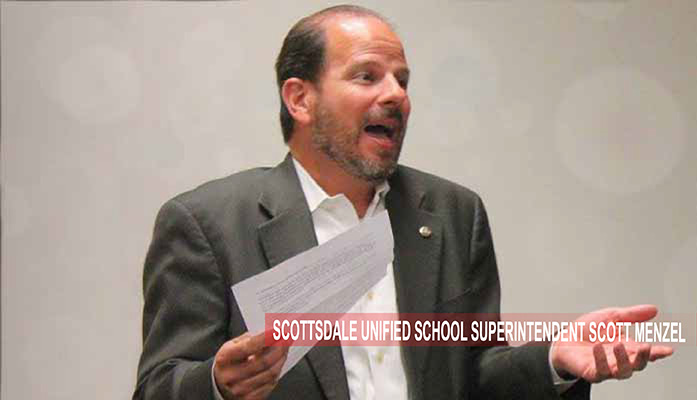
Can we truly take the American Association of School Administrators (AASA) seriously? They claim to be the premier association for school system leaders and the national voice for public education and district leadership. But do they speak for the majority of parents with children in public schools across America?
The AASA being the voice for public education on Capitol Hill might explain why public education has been failing our children for years. The education professionals who run the AASA and the Arizona School Administrators (ASA) seem more focused on promoting social-emotional learning, DEI, and gender identity rather than prioritizing academic excellence in public schools.
How else do you explain the prior selection of Dr. Donna Lewis as the superintendent of the year when she was the superintendent of a district where math and ELA proficiency were below 15%? And how do you explain the selection of Dr. Menzel as the 2024-2025 national superintendent of the year?
By selecting two failed superintendents for recognition, these organizations demonstrate that they are not concerned with academics.
Contrary to the Scottsdale Unified School District’s (SUSD) claims, Menzel has not enhanced educational outcomes; it is just the opposite. Last year, Menzel failed to meet his academic performance goals, and academic achievement in math, ELA, and science declined. In 2023, SUSD had over 8,000 students who were NOT proficient in ELA, over 9,000 who were NOT proficient in math, and over 12,000 students who were NOT proficient in science. Thirty-five percent of 3rd graders were not proficient in ELA in 2023. Being able to read by 3rd grade is critical to a student’s academic success. By continuing to promote them without being proficient, Menzel is setting them up for academic failure.
Despite these deficiencies, hundreds of SUSD students are promoted and graduate each year.
Under Menzel’s tenure, SUSD experienced a 10% drop in enrollment, with nearly half of the eligible students choosing not to attend SUSD. Additionally, the district has faced record staff turnover due to the fear-driven environment Menzel has created. Yet he is celebrated as the superintendent of the year.
Enough is enough. Scottsdale cannot afford another failed superintendent of the year.
Mike Bengert is a husband, father, grandfather, and Scottsdale resident advocating for quality education in SUSD for over 30 years.
by John Huppenthal | Oct 30, 2024 | Opinion
By John Huppenthal |
This analysis looks at President Trump’s first three years in office—2017, 2018 and 2019, the pre-COVID era—to get a more unbiased view of the policy impact of his approach.
In Trump’s first three years:
Trump extended economic growth to achieve the longest economic expansion in the history of the U.S.: 10.5 years.
Trump had the largest single year increase in 2019 median household income in history, increasing income by $5,420 to a level, $81,210, that Biden/Harris still haven’t reached.
To do this, Trump created 7.1 million full-time jobs in his first 3 years as president, the jobs that count: full-time jobs, in the pre-COVID era. This is more than an amazing feat because Trump only created 6.7 million total jobs. How did Trump increase full-time jobs by more than his total job increase? By making every job he created a full-time job, and, most importantly, converting 400,000 of Obama’s part-time jobs into full-time.
By comparison, Harris/Biden only created 1.0 million full-time jobs in the last two years, September 2022 to September 2024, the post-COVID era. Most of their job creation has been part-time jobs.
Trump created so many jobs that job openings exceeded the number of unemployed for the first time in history, not only exceeded but went on to double the number of unemployed.
The open job force was so strong under Trump’s first three years that he was stripping 160,000 people per month out of welfare for a total reduction of welfare recipients of 8.5 million, 19% of the total recipients.
The open job force was so strong that, for the first time ever, a million people left Social Security Disability and went from consuming Social Security tax dollars to paying into the system.
Trump pushed the bankruptcy date for the Social Security system back by years through welfare enrollment reduction and increased employment and wages.
Trump’s lowest unemployment rate of 3.5% was the lowest level since Eisenhower, just 0.1%, a tenth of a percent from its lowest level ever.
When Trump’s USMCA treaty was put in place, it created the world’s largest international trade confederation.
Trump set 12 all-time records for Black employment, pushing Black unemployment to its lowest level in recorded history, 5.3%, far below Obama’s lowest rate of 8.0%.
Trump reduced the personal income taxes for all families of four or more making $53,000 or less to zero. In the other 150+ countries of the world, such families are considered rich and pay tens of thousands in taxes. Economists have not begun to understand the full ramifications of this feat. In chess, it’s called checkmate. No other country can get the upper hand.
As a result, the wealth of the bottom 50% of the U.S. increased by $1.4 trillion under Trump. Under Obama’s last four years? 0.8 trillion
In a sane, rational world, Trump would have earned three economics Nobel prizes, setting records for trade, unemployment reduction, economic growth, and achieving economic equality. (That’s equality, not equity).
Trump’s strategy for his second term: the roaring 20s, where growth was 40% as compared to Obama’s 11%. The 1922 Fordney-McCumber tariffs of 40% were combined with a reduction of the personal income tax rate from 76% to 25% under Calvin Coolidge.
I am confident that Trump is eyeing a massive trade deal with China, just like Trump’s USMCA, which has shifted the trade balance of the world.
If Trump is successful at combining a modest and carefully designed broad tariff of 20% or less with equal or greater business tax rate reduction, we are likely to have the roaring 20s all over again. Hard to believe that the U.S. economy of $28 trillion could grow another 40% in the next four years but hold on to your hats.
John Huppenthal was the Arizona Superinterndent of Public Instruction from 2011-2015. Prior to this role, John served as a member of the Arizona State Senate and the Arizona House of Representatives. You can follow him on Twitter here.
by Dennis Liles | Oct 29, 2024 | Opinion
By Dennis Liles |
School board elections in Arizona are a non-partisan race, by law. In an ideal world, candidates should be focused on the well-being of students, academic achievement, and facilitating as much parental involvement as possible. That’s definitely true in Mesa, where the school board should be comprised of members who want to ensure that students are educated rather than indoctrinated.
But a recent news item by the local NBC affiliate chose to highlight partisan political party affiliation instead of focusing on how each candidate views their role as a potential Mesa school board member.
The story focused on three candidates running for the Mesa School Board as a slate: Courtney Davis, Josh Chilton, and Lacy Chaffee. Courtney Davis, in particular, is a current board member who was appointed by Steve Watson to replace Laura Ellingson in August 2023. The night she was sworn in was the first time she had ever attended a Mesa School Board meeting. The legacy media conveniently left this out. But that’s not all they left out.
In a typical biased move that’s become commonplace for the legacy media, the two opposing candidates—Sharon Benson and Ed Steele—were not offered an opportunity to be interviewed for the story. On top of that, they were given only a few hours to respond before the segment aired.
But here’s the truth about the three slate candidates. Davis, Chilton, and Chaffee have focused their campaign on social issues rather than actual student achievement. All three candidates have endorsements and stated positions that run counter to the values that are expected of elected school board officials. They all support males in female spaces, special transgender rights, Critical Race Theory, and eliminating school choice.
Davis, Chilton, and Chaffee have also been endorsed by Legislative District 9 Democrats, the anti-school choice group “Save Our Schools,” and the teachers’ union, Mesa Education Association.
Digging deeper, the Arizona Education Association endorsed legislative candidate Lorena Austin who promotes drag show fundraisers for her campaign. They have also endorsed Proposition 139, which will allow abortion up to fetal viability and would allow minors to get an abortion without any parental involvement, including notification.
Right now, the Mesa School District faces some significant headwinds with declining enrollment, reduced funding, and competition for students and teachers from charter and private schools. Shouldn’t that be the top priority rather than radical social issues?
Fixing Mesa’s problems requires new board members like Sharon Benson, who brings both a teaching background and small business expertise, and Ed Steele, who brings a wealth of business expertise and problem-solving ability to tackle the problems facing the Mesa district. Both Sharon and Ed have had children enrolled in the Mesa district and have a vested interest in keeping the district at the forefront of educational excellence.
Their goal is to support academic excellence, parental involvement, fiscal responsibility, teachers, safety, transparency, and accountability.
For this election, voters need to decide what they want: a radically aligned slate that is more interested in indoctrinating rather than educating students, or Sharon Benson and Ed Steele, who have the expertise, conservative values, and vision to keep Mesa Public Schools a leader in public education.
Dennis Liles is a Mesa resident and Precinct Committeeman in Legislative District 10.
by Christy Narsi | Oct 28, 2024 | Opinion
By Christy Narsi |
This November, Proposition 140, the Make Elections Fair Arizona Act, will be on the ballot. Prop. 140, if passed, would create a Rank-Choice Voting (RCV) system, where voters rank candidates in order of preference. Supporters of the proposition claim it will incentivize candidates to reach out to as many voters as possible, regardless of party affiliation and “liberate us from the grip of partisan primary elections.”
But will it really make Arizona elections more fair?
RCV may seem logical on the surface, but in reality, it introduces a complex vote tabulation system that lacks transparency and often leads to weird election outcomes.
In most elections, a voter casts a single ballot for the candidate he or she likes most. With RCV’s ranking system, if one candidate receives more than 50 percent of first place votes, the election is over and the candidate with the most votes wins. If, however, no candidate receives more than 50 percent of the votes, election officials conduct a series of closed-door instant runoffs by eliminating the candidate with the fewest first place votes and redistributing those votes to the second choices on those ballots. This process continues (eliminating the last place finisher and redistributing his or her votes) until a faux majority is created for a single candidate.
Today, there is bipartisan support for ensuring every vote counts. Yet RCV guarantees the opposite, and instead will create confusion, dropped votes, and a convoluted system of ballot counting that does not represent the will of the people.
“Ranked Choice Voting can lead to bizarre outcomes where a person who was the first choice of very few voters can still win,” explained Independent Women’s Law Center’s Jennifer C. Braceras. Democratic principles are actually sidelined as RCV encourages candidates and interest groups to play games and try to manipulate outcomes by introducing additional candidates to divert attention from stronger opponents, rather than try to simply bolster their own support.
A study of ballot data from New York City’s 2013 and 2017 general election, and of New York City’s 2021 Democrat mayoral primaries, showed “ballot errors in RCV elections are particularly high in areas with lower levels of education, lower levels of income, higher minority populations, and a higher share of limited English proficient voters.”
Policymakers should be working to make voting easier and more accessible for all Arizonans. Therefore, we should reject schemes such as RCV that make voting more complicated, less accessible, and less transparent.
Voting should be simple: one person, one legal vote; may the best person win. RCV violates this principle by allowing some voters to effectively cast more than one ballot while excluding other voters whose ballots were exhausted prior to the ultimate run-off. RCV is a dangerously complex process that confuses voters and disincentivizes participation. This is a real threat to our democratic process.
Christy Narsi lives in Surprise, AZ. She is the National Chapter Director at Independent Women’s Network (IWN). Christy is passionate about developing and empowering women who make an impact in their communities.