by Paul Parisi | Sep 25, 2026 | Opinion
By Paul Parisi |
On November 3, 2026, Arizona voters will decide the fate of Proposition 142. The measure would prohibit preferential treatment based on race or ethnicity in public institutions. Supporters call it a return to the constitutional promise that all Americans are equal under the law. Critics call it a rollback of programs meant to correct past inequities.
But there are two visions behind this fight, and they are older than the ballot measure itself.
One vision holds that the government should weigh group history to correct group-based disparities, a position shaped by theories of structural and systemic power. The other vision holds that equality means the law treats every person the same, without regard to group identity, a position shaped by classical liberal and natural rights philosophy. Merit, character, and individual effort determine outcomes under this view, not government classification.
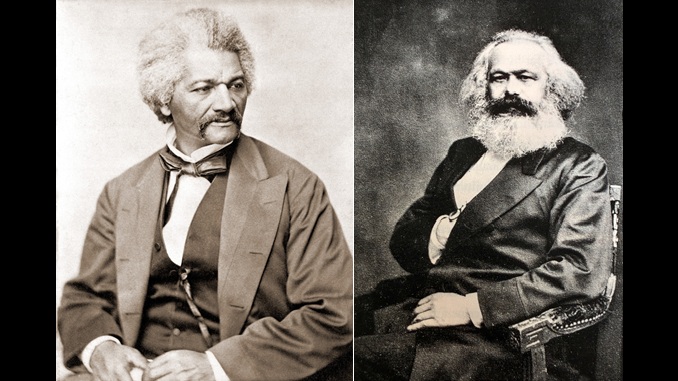
Frederick Douglass, born a slave in Maryland who taught himself to read after his lessons were forbidden, had this exact vision. He fought for the 13th, 14th, and 15th Amendments, for equal protection under law, and for the plain idea that all men are created equal. He never asked the government to rank citizens by race. He wanted it to stop.
Karl Marx, born the same year as Douglass into comfort and support from Friedrich Engels, built a different framework, one where history is a struggle between oppressor and oppressed classes, resolved only through state power. He sought the type of government classification that is before Arizona today, where people are not seen as individuals but part of their respective collective.
Arizona Proposition 142 forces a choice between descendants of these two arguments, in the operation of public schools, employment, and contracting.
The ballot language is public record. The debate deserves the same clarity Douglass demanded in his own time. Read the text, weigh the history, and decide what equal protection actually requires.
Actual Referral Language
What Appears on Ballot
Paul Parisi is the Arizona Grassroots Director for Our America.
by Paul Parisi | May 19, 2026 | Opinion
By Paul Parisi |
In 1949, George Orwell wrote the novel 1984, in which the fictional character Winston works for the Ministry of Truth in a totalitarian government. His job is to manipulate historical records to justify the Party’s present and future actions. Orwell captures this idea in the chilling line: “Who controls the past controls the future. Who controls the present controls the past.”
Today, there is a growing concern that Artificial Intelligence (AI) could play a role in shaping and distorting our understanding of history. AI systems rely on vast and ever-expanding databases of information to generate responses and conclusions. As more data is added the interpretation of what is considered “true” shifts over time.
We can already see examples in modern society where new revelations about historical figures lead to dramatic changes in how they are remembered. Statues are removed, holidays reconsidered, and achievements reevaluated or diminished. In Orwell’s dystopian vision, this process was called being “unpersoned”—erased from history altogether.
Orwell’s story was influenced in part by real events, particularly the manipulation of information in the Soviet Union. It served as a warning about the dangers of centralized control over truth and historical narrative. Today, while our society is very different, some see parallels in how information is shaped and distributed through AI and social media, raising concerns about influence over public thought.
As the United States approaches its 250th anniversary, an important question emerges: will our nation’s rich historical heritage remain intact, or will it be reshaped by evolving interpretations amplified by AI? Some critics argue that certain modern historical narratives present interpretations that are more opinion-driven than fact-based. An example is the book 1619 that paints a distorted view of the history of the United States of America. This type of invented history is part of the data base AI uses to determine truth
Truth is a human characteristic. The Constitution of the United States contains passages that reflect truth. The words in the Declaration of Independence that refer to the “Laws of Nature and of Nature’s God” reflect absolute truth as does the reference to “Unalienable Rights”. As AI becomes a more prominent tool in our daily lives, it is essential that we remain aware of its limitations.
AI can be a powerful resource, but it does not replace human judgment, critical thinking, or a commitment to truth. If we are to preserve an accurate understanding of history, we must remain engaged, thoughtful, and discerning in how we use and interpret the technologies shaping our world.
Paul Parisi is the Arizona Grassroots Director for Our America.
by Paul Parisi | Dec 6, 2024 | Opinion
By Paul Parisi |
Free speech is under attack in America today. When the government or social media platforms, often working together, accuse someone of spreading “misinformation,” what they’re really saying is that person is lying. But who decides what’s true and what isn’t? The power to label something as misinformation or disinformation is the power to suppress free speech, and that’s a dangerous weapon.
Social media “fact checkers” routinely suppress opposing views by labeling them misinformation. This censorship is a direct attack on free speech. When the government and the media control the narrative, they manipulate public opinion to maintain their power. Just think about this: The federal government has repeatedly told us the southern border is secure. Yet, over 11 million foreign nationals have crossed illegally in less than 3 ½ years. That’s not misinformation or disinformation—it’s a bold-faced lie.
Our constitutional republic cannot survive if we allow our leaders and their allies in the media to deceive us with lies and propaganda. When the Soviets did it, we called it propaganda. Why are we afraid to call it out when it happens here?
The American people deserve the truth—the whole truth and nothing but the truth.
The terms “misinformation” and “disinformation” actually originated from a Russian word, dezinformatsiya, which means deliberately deceiving public opinion. In fact, Joseph Stalin established a Special Office of Disinformation in 1923, and the Great Soviet Encyclopedia defined it as a way to manipulate public perception. Propaganda was a cornerstone of Soviet control, rewriting history to align with the government’s ideology. Statues were replaced, public holidays were altered, and the past was reshaped to serve the present.
Does any of this sound familiar? In America today, our founding fathers are being vilified, statues are being torn down, and holidays like Columbus Day are now considered controversial. Meanwhile, new holidays are created to rewrite the narrative. Even school names are changed to reflect disdain for our past. As George Orwell warned in 1984, “Who controls the past controls the future; who controls the present controls the past.”
The Soviets used propaganda to divide people and create class struggles, all to maintain totalitarian control. Are similar tactics being used in America today under the guise of combating “misinformation” and “disinformation”? Truth was once a cornerstone of American values, as seen in the mythical story of young George Washington admitting, “I cannot tell a lie.” But today, lies and deception have become tools to manipulate public opinion.
The American people deserve better. They deserve leaders who revere the truth and hold it sacred—not ones who weaponize misinformation to cling to power. It’s time to demand the truth, the whole truth, and nothing but the truth.
Paul Parisi is the Arizona Grassroots Director for Our America.
by Paul Parisi | Sep 3, 2024 | Opinion
By Paul Parisi |
On August 26, 2024, Our America Hometown Heroes made their voices heard at the Phoenix City Council meeting, standing up for local control and the autonomy of the Phoenix Police Department (PPD). Wearing their signature yellow T-shirts, several Hometown Heroes rallied and spoke during the public comment period, advocating for the city’s ability to manage its own police force without federal intervention.
In stark contrast, a smaller group of Black Lives Matter (BLM) activists attended the same meeting, calling for a DOJ Consent Decree that would place the PPD under court-ordered oversight. Their demands stemmed from a controversial June report issued by the U.S. Department of Justice (DOJ), which criticized the PPD and pushed for federal oversight despite the department’s voluntary efforts to implement sweeping reforms.
Our America’s presence at the meeting was bolstered by leaders of organizations representing minority communities, such as BLEXIT Arizona, the Hispanic Liberty Alliance, and the Independent Women’s Network. This coalition underscores the broad support for local control.
During the meeting, four speakers from Our America took to the podium, urging the Phoenix mayor and council to continue the reforms that have already significantly reduced crime while safeguarding all citizens’ civil rights.
Reflecting on her long history of positive engagement with law enforcement, Bella Ceballos-Viner shared, “For over 25 years, I have had nothing but great experiences, and I speak on behalf of my Hispanic community and many African-Americans who support the police.” Her words resonated with the room, highlighting the importance of community trust and collaboration with local law enforcement.
Christy Narsi, another Hometown Hero and part of Independent’s Women’s Network spoke passionately about the failures of DOJ Consent Decrees in other cities, warning the council against relinquishing local control.
Christy emphasized, “I urge you not to surrender local autonomy by allowing federal overreach to steal control of our local law enforcement and the city they serve.” Her argument underscored the belief that decisions about local policing should be made by those who know the community best.
The debate over the future of the PPD is a microcosm of a larger national conversation about the balance between federal oversight and local autonomy in law enforcement. Our America firmly believes that the best way to achieve safer streets and a brighter future is through a combination of police and criminal justice reforms tailored to the unique needs of each community. The reforms that the PPD has already implemented are a testament to the power of local action and the effectiveness of community-driven solutions.
As the City of Phoenix faces pressure from the DOJ to enter into a Consent Decree, the voices of local residents and activists like those from Our America will play a crucial role in determining the path forward.
By continuing to advocate for local control, Our America Hometown Heroes are not only standing up for the autonomy of the Phoenix Police Department but also for the principle that communities are best served when they have a direct say in how they are governed.
Paul Parisi is the Arizona Grassroots Director for Our America.
by Paul Parisi | Aug 19, 2024 | Opinion
By Paul Parisi |
A modern-day example of voter integrity is the picture of an Iraqi woman holding up her finger colored in purple indelible ink, indicating that she voted. In 2005, an Iraqi woman posed for an iconic picture after leaving a polling station in Southern Iraq in the country’s first free election in over a half-century. She did so in defiance of deadly suicide bombings and mortar strikes at polling stations.
The recorded history of democracy dates back to the 5th century in ancient Greece. The word democracy is derived from two Greek words – demos, which means people and kratos, which means rule. In the first elections in Athens, only the ruling class could vote.
Even though the United States of America is a democratic country, the path to “one person, one vote” has been a checkered one. In 1789, when the US Constitution was ratified, most states only allowed white landowners to vote.
The 15th Amendment to the US Constitution in 1870, gave Black men the right to vote. It wasn’t until 1920 when the 19th Amendment was passed that women in all states were allowed to vote. The passage of the Voting Rights Act of 1965 put teeth in prohibiting racial discrimination when voting.
Though we have come a long way since the concept of democracy was born, voter integrity is still on the forefront. The recent phenomena of widespread mail-in ballots have created a whole new potential of voter fraud. Ballot harvesting, which is legal in many states, puts the concept of the secret ballot into question. Is the person filling out the ballot actually the person registered to vote?
Congress has recently passed the Safeguard American Voters Eligibility Act (SAVE). This bill is waiting to be heard in the Senate. The act requires that all people registering to vote provide proof of citizenship in federal elections. Though it’s already against the law for non-citizens to vote in federal elections, the National Voter Eligibility Act of 1993 prohibits states from confirming citizenship status in federal elections.
On August 1, 2024, the 9th Circuit Court put a stay on a recent Arizona law that required showing proof of citizenship in all elections including federal. In 2020, 11,600 individuals voted in Arizona on federal only ballots without showing proof of citizenship. The 9th Circuit Court decision is now being appealed to the US Supreme Court.
With the recent influx of undocumented individuals entering the United States, the importance of citizens only voting is a front burner issue that the SAVE Act might resolve. Just showing ID when registering to vote and casting your ballot at the polls will bring back a level of confidence in our elections.
With stronger legislation addressing voter integrity, Americans may have even more trust in our elections—akin to the Iraqis proudly holding up their purple-stained fingers.
Paul Parisi is the Arizona Grassroots Director for Our America.