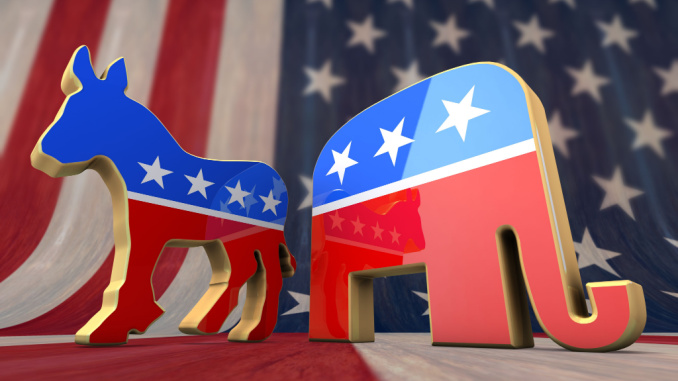
Though most attention was directed at the top of the ticket in the 2024 election, many groups on the Left waged high stakes on flipping Arizona’s barely Republican-controlled legislature.
In the two years since the 2022 election, when Republicans dwindled to 31 members of the 60-member House and 16 members in the 30-member Senate, Democrats have been busily planning and building their election takeover. After sweeping the top 3 statewide offices, including the Governorship, 2024 was the inflection point in the story of how Arizona went from red – to purple – to blue.
But that didn’t happen.
Under the leadership of Governor Hobbs and an orbit of well-funded organizations that raised upwards of $10 million to target key swing districts in Arizona, the Left failed to secure their legislative victories. Instead, the Republican-controlled Arizona House and Senate, in fact, expanded their majorities. Despite being outspent in every single race, Republicans now hold 33 members in the House and 17 members in the Senate, a small but meaningful gain. It’s a disaster for Katie Hobbs, who is already fighting low favorability and criticism by her own party for her inability to best Republican legislative leadership and rack up any wins for the Left’s agenda…
Democrats in the last election insisted that re-electing them was necessary to “protect our democracy.” But it turns out that for many of them, democracy only deserves protection when the democratic process produces their preferred result.
Prop. 314 was proposed to allow police to arrest immigrants who don’t cross the border at a legal point of entry and to deny public benefits to illegal immigrants. It was approved by over 60% of the voters. Sounds like democracy at work, right?
Not to Phoenix councilmember-elect Anna Hernandez, who vowed that the “Phoenix Council must move immediately to protect immigrant refugee residents in the city from the violence of 314… I am ready for this fight.” Phoenix Mayor Kate Gallego, like many others, was also on board with the resistance, promising that neither the Phoenix Police Department nor “any city resources whatsoever” would be involved in enforcing this particular law. So much for respecting the democratic process.
Yet more Americans are beginning to realize our immigration policy sorely needs major corrections. In 1995, the Chairwoman of the Commission on Immigration Reform, Barbara Jordan, herself a civil rights icon, told Congress, “Deportation is crucial. Credibility in immigration policy can be summarized in one sentence: those who should get in, get in; those who should be kept out are kept out; and those who should not be here will be required to leave…For the system to be credible, people have to be deported at the end of the process.”
She’s right. There is no way to fix Kamala’s “broken immigration system,” (her words) that doesn’t involve deportation to undo the damage done.
Here’s where we are. The low hanging fruit is the 1.3 million aliens who have been given their due process and are legally qualified for deportation. They are part of an Immigration and Customs Enforcement (ICE) “non-detain docket” of 7 million aliens, including criminals, who have not yet been processed but otherwise are eligible for deportation. Congress already has authorized ICE to deport all these individuals.
The obstacle is that their “recalcitrant” home countries refuse to provide the travel documents needed for the return of their own nationals. (Hmm. Wonder why.). The Supreme Court has ruled that all those, even the criminals, who are not deported within six months must be released.
However, under U.S. law, once the Department of Homeland Security (DHS) has notified the State Department that a foreign country “denies or unreasonably delays” the return of its nationals, the Secretary of State must order consular officials to discontinue granting all visas to that country. That would surely get the attention of “recalcitrant” like China and India. Yet the Biden/Harris administration, ever loathe to stem the inflow of future Democrats, refused.
Despite the massive surge at the border following the 2021 inauguration, fewer than half as many aliens were removed by the Biden/Harris administration as during the previous four years. Instead, they alternated between laughably claiming the border was safely closed and that the only way to “fix” the problem was a comprehensive amnesty program combined with greater funding at the border but only to expedite the processing of immigrants.
There are other remedies that would mitigate the damage. The DHS secretary is allowed by law to require all aliens without a green card to be registered and fingerprinted. This would not only get a handle on the “gotaways” and criminals who have melted into the population. History suggests it would also trigger voluntary departures.
Finally, we could enforce the E-Verify program and compel employers to check on their workers’ immigration status. Many employers prefer cheap, compliant employees, but the long-term costs to our nation are too great. Absent the economic incentives, both public and private, few illegal immigrants would remain.
We are inviting many long-term economic and political problems by accommodating a cohort that will inevitably demand increased government support as they age. But more importantly, the Rule of Law is our legacy as Americans, the key to our freedom and prosperity. Ignoring the law at our border is a horrible mistake.
Border control and deportation don’t require more funds, more laws, or military action. It is a matter of simply enforcing the law for the protection of us all.
Dr. Thomas Patterson, former Chairman of the Goldwater Institute, is a retired emergency physician. He served as an Arizona State senator for 10 years in the 1990s, and as Majority Leader from 93-96. He is the author of Arizona’s original charter schools bill.
Starmer’s remarks came as he disembarked from a carbon-spewing jet upon arrival in Azerbaijan to attend the UN-sponsored COP29 climate conference.
The annual COP conferences, remember, are where the world’s elites gather each year to discuss ways to leverage climate-alarm dogma as a means of destroying western democracy and trapping the world’s masses in energy poverty while they consume $1,000 Wagyu steaks and $2,000 bottles of wine over dinner.
“I have repeatedly emphasized the importance of global leadership when it comes to the climate challenge,” said Starmer, “and therefore it is very important for me to come to COP… I see the climate challenge as a huge opportunity for the UK if we get it right, and that is why we have made it one of our missions to have clean power by 2030.”
Among the means Starmer’s government is using to show “global leadership” on the climate alarm front is to provide heavy subsidies for costly, low-efficiency offshore wind farms and cover up vast swaths of the UK’s farmlands and countryside with enormous solar arrays. Starmer’s government has simultaneously presided over the closing of the UK’s last remaining coal power plant and one of its last steelmaking factories as part of what appears to be a focused effort to deindustrialize its once-powerful economy.
Trump has made it crystal clear that his approach to energy policy will be diametrically opposite that of Starmer’s Labor government. Trump has already said he plans to pull the United States out of the Paris Climate agreement again, an action he took during his first term, but which was reversed by President Joe Biden.
Trump has also laid out plans to re-industrialize America’s economy with a carrot-and-stick approach that will include incentives for companies building new factories and assembly plants in the United States and imposing tariffs on those who choose to invest in capacity overseas. In a recent pre-election interview, Trump detailed plans to address instability and capacity shortages on the U.S. electric grid by implementing policies to speed up permitting and building of new natural gas and nuclear power generation.
“We have to produce massive electricity that we don’t have. But the environmental impact statements won’t allow us to do that. The rules and regulations that we currently have won’t allow us to do any of it,” Trump said. “But if I’m president, we’ll be able to do it and we’ll do it through natural gas, which is clean. And we’ll do it through primarily natural gas and nuclear.”
While on the campaign trail, Trump repeatedly promised to bring back his first-term policies designed to stimulate the domestic oil-and-gas industry and return the United States to the position of “energy dominance” it enjoyed under his previous administration.
In kicking off the COP29 festivities, Azerbaijan leader Ilham Aliyev created a stir among the climate zealots who make up the preponderance of attendees by appearing to endorse the Trump approach.
Referring to oil and natural gas as a “gift of God,” the Azerbaijani President said, “Countries should not be blamed for having them and should not be blamed for bringing these resources to the market because the market needs them. The people need them.”
At another point, Aliyev appeared to lecture western elitists like Starmer, saying: “Unfortunately double standards, a habit to lecture other countries and political hypocrisy became kind of modus operandi for some politicians, state-controlled NGOs and fake news media in some Western countries.”
In an interview at the summit, Starmer displayed a shocking lack of self-awareness by claiming his government has no plans to “start telling people how to live their lives. We are not going to start dictating to people what they do.”
That is of course exactly what Starmer is doing, and exactly the sort of thing Trump plans to avoid doing regardless of any demands from the globalist climate-alarm industry. Americans stand to be the main beneficiaries from the contrast in policy approach.
David Blackmon is a contributor to The Daily Caller News Foundation, an energy writer, and consultant based in Texas. He spent 40 years in the oil and gas business, where he specialized in public policy and communications.
How do you waste $15 million? Just ask the folks over at the Make Elections Fair Committee. Last week, their insane attempt to force a California-style elections system of ranked choice voting and jungle primaries went down in flames. Prop 140 failed miserably with nearly 60 percent of the electorate voting “No.” And it wasn’t for lack of funding.
With a huge amount of money coming from the pockets of out-of-state billionaires, the Make Elections Fair Committee spent at least $15 million—giving them a 20:1 spending advantage. That’s right. For every $1 spent trying to defeat the initiative, the Prop 140 committee spent $20 trying to pass it! And they still lost by a wide margin!
That’s legendary. If any business idea ever failed that badly, it would be banished and never spoken of again. And that’s exactly what should happen with ranked choice voting and its ugly cousin jungle primaries (which was already overwhelmingly rejected by Arizona voters back in 2012)…
Americans sent a resounding message to the Democrat Party on Tuesday evening, rejecting the pronoun-declaring, virtue signalers whose radical ideas include normalizing humans identifying as animals and men competing in women’s sports.
For years Democrats and their allies in the mainstream media have lectured the American people about morality, inclusivity and the all-importance of identity politics. We have been told that not embracing a far-left radical agenda makes us bigots, racists and misogynists.
Clearly, the American people have had enough.
President-elect Donald Trump won all seven battleground states, captured the popular vote (the first Republican to do so in decades) expanded the map in blue states like California, New York and Virginia, and flipped traditional Democrat counties such as Miami Dade in Florida and Hispanic-heavy Starr County in Texas.
Trump’s message on the economy and immigration and closing the campaign with messages like, “It doesn’t have to be this way,” and “Trump will fix it,” given that nearly 75% of Americans believed the nation was on the wrong track, resonated with voters across the board.
Trump won married women by a large margin (so much for the gender gap), along with married men (e.g. parents). He also won suburban voters, Catholics, Protestants, those making $50,000 or less, those with no college degrees, Gen X (between the ages of 45-64), and first-time voters.
Trump also improved with non-traditional Republican voters including urban voters, Latinos and black men.
Simply put: Trump won the majority of America. He won suburban parents who want good schools and safe communities for their children. He won the hardworking folks in rural areas with no college degrees. He improved with young people who want to buy their first home but can’t afford to thanks to inflation.
The effects of Trump and the complete repudiation of the Democrat agenda happened down the ballot as well. Republicans now control the Senate with significant victories by Dave McCormick in Pennsylvania, Tim Sheehy in Montana and Bernie Moreno in Ohio.
The House remains in play, and it is possible that the GOP enters Washington next January with the trifecta: White House, Senate and House of Representatives.
Meanwhile, the Democrat Party, once the party of the working class, has now become the party of out-of-touch elitists.
Sen. Bernie Sanders (I-Vt.) put it this way: “It should come as no great surprise that a Democratic Party which has abandoned working class people would find that the working class has abandoned them.”
Vice President Kamala Harris’ success was limited to high income voters (those making $100,000 or more and those making $200,000 or more), those with bachelor’s or advanced degrees, and those who have no religious affiliation.
In other words, Harris’ coalition consisted of a bunch of rich snobs or “smarty pants,” to quote longtime Democrat strategist David Axelrod.
Many Democrat strategists will say the loss was because Harris’ $1 billion war chest was unwisely spent. They will blame bad messaging, and a heavy focus on the abortion issue instead of the economy. They will say they had a bad candidate, or there wasn’t enough time to run a full campaign (which would be ironic, given it was the Democrat machine that installed Harris at the last minute).
But the rot runs much deeper. For the betterment of the nation, Democrats would do well to use this time for introspection and re-evaluating their principles.
Republicans had to undergo a restructuring following former President Barack Obama’s back-to-back victories in 2008 and 2012. Now, it’s the Democrats’ turn to do some self-reflecting. Until they do, Republicans will enjoy majorities in Washington and in state governments, winning races up and down the ballot for years to come.
But we live in a two-party system – for now. If one of our major parties continues to cater to radicals while isolating the majority of Americans, yes, it is a recipe for their side to continue to lose elections, but it is also bad news for the country. America is better off when both Republicans and Democrats operate in common sense and challenge each other on the best economic policy or how to solve the immigration crisis.
Doubling down and ignoring the will of the people will extinguish the Democrat Party for good.
Carly Atchison Bird is a contributor to The Daily Caller News Foundation and the former national spokeswoman for the Ron DeSantis presidential campaign. She is the founder and president of Bird’s Eye Consulting and lives in Virginia Beach.
Anyone could have predicted that Christians and pro-lifers would be outvoted on the abortion issue. We all know spiritual leaders are guilty of telling their people to “stay out of politics,” “be spiritual, not political,” “turn off the news,” and “God’s in control.” Okay…
As of publication, just over 1.9 million voted in favor of abortion on demand—potentially up to birth—while 1.2 million voted against Proposition 139. All we needed to do was tell 800,000 people to fill in a circle on their ballot. Wow.
Was it God who dropped the ball?
As I said on my Facebook live and most recent Substack, I believe the passage of Prop 139 is an indictment of the Church (body of Christ) in Arizona. For emphasis, I’ll restate my thoughts here:
“What are the churches doing in Arizona? If you weren’t speaking to your congregations about Proposition 139—but you’re calling yourself a minister or a ministry, you’re taking money, you’re not paying any taxes on tithes and offerings—then, what are you doing? To me, pro-life is the one issue that shows whether or not the church is effective in the state. And we’re not effective.”
I’m glad to hear at least one minister mobilized 700 of his peers in some sort of effort against Prop 139. I’m sure a faithful remnant of church leaders mentioned it in their sermons and asked their congregations to pray about it. But these efforts fell woefully short.
Again, we all know the silent ministers are bewitched by false ideologies like “separation of church and state.” The rest are afraid to offend big donors or they’re unwilling to risk that coveted 501(c)(3) status. This is idolatry. One megachurch is literally buying up all the real estate and branding everyone’s bumper, yet those of us outside the organization have no clue what they’re doing to change Arizona.
For the record, abortion is not a political issue. According to the Sixth Commandment, abortion is a moral issue. Plainly stated: abortion is murder. For those who are quick to say, “What about cases of rape, cases of incest, the life of the mother?” I will defer to this report from the Guttmacher Institute.
Screenshot is sourced from a 2019 article published by USA Today.
I’ve heard many call Arizona a “purple” state, meaning there’s a near even split of conservatives and liberals, Republicans and Democrats, who occupy this territory. Well, we’re slowly slipping into denial with this statement as dark forces are working overtime to flip this state. From a governmental perspective, Arizona is about as blue as they come with our highest-ranking leadership positions currently in the hands of leftists (note: the following is not an exhaustive list).
A call to pastors and ministry leaders:
If you want to save Arizona, please stop telling your congregations to avoid the news and politics.You have 66 Books to preach from that will help everyone discern false narratives and make wise decisions. You simply need to trust God and say what He said.
Intercession and evangelism are not in competition. Both are essential for reformation (see the Four Gospels and Acts 1-28). Prayer is absolutely necessary, but the Great Commission is not fulfilled by sitting in prayer closets and kneeling at the altar. Fellowship is important, but the Great Commission is not fulfilled by perfect church attendance or inviting people to sign membership papers.
Only a small percentage are called to full-time ministry. The rest of us are created to do far more than warm the pews and fund your “vision for the ministry.” Please stop trying to build nonprofit organizations and start building the Kingdom of God. It’s time to leave the four walls, stop over separating “the sacred from the secular,” and teach your people how to contend for righteousness in the marketplace. Persecution is our inheritance in Christ.
Fear God, not man.
Lastly, I want to correct the false ideology that says, “We can’t legislate morality.” On the contrary, politics and government are nothing more than spheres of influence whereby morality is enforced through law and order. Legislation, then, is simply morality applied to a society.
Which set of morals best serves a nation—God’s morality or man’s morality? One brings us closer to life. The other, as we can see, brings us closer to death.
So, to all Christians and pro-lifers (whether you’re a believer or not), what are we going to do about Proposition 139?