With all the pre-election hype about possible violence at polling stations for Tuesday’s primary election, the most serious election day misconduct appears to have been a town councilman removing opposition campaign signs.
AZ Free News has confirmed that current Gilbert councilman Scott September is the subject of a criminal investigation initiated Tuesday when a Gilbert police officer was dispatched to the Southeast Regional Library off South Greenfield Road and East Guadalupe Road for a report of a man pulling up campaign signs.
In Arizona, it is a Class 2 misdemeanor for an unauthorized person to “knowingly remove, alter, deface or cover any political sign of any candidate for public office” in the days leading up to an election unless the sign’s location “is hazardous to public safety, obstructs clear vision in the area. or interferes with” the requirements of the Americans with Disabilities Act, or is otherwise in violation of state law.
September has been a councilman since April 2020 and was seeking to remain in office on this year’s primary election ballot.
According to public records, September was at the library which serves as a Maricopa County voting center on Tuesday morning when at least two witnesses say they saw him pulling up campaign signs which opposed his election.
Andrew Adams, the Republican chairman of Legislative District 14, had reportedly placed some of the campaign signs near the library property but well outside the mandated 75-foot “no electioneering” buffer zone around official voting locations. It was Adams who told police he actually witnessed September tampering with the signs.
Richard Young, another witness, told the responding officer that he took images of September at the library. Young also reportedly snapped a photo of September’s vehicle to share with police.
September reportedly handed over the signs to Adams at the library. There is no indication any of the signs were damaged.
As of press time, AZ Free News is awaiting a response from the Gilbert Police Department as to whether the investigation has been referred to an outside law enforcement agency given the conflict of interest with the suspect being a town councilman.
If cited and convicted, September faces a sentence of four months in the county jail and / or a fee for each count contained in the conviction.
The Flagstaff City Council approved expenditures of over $1.1 million for what it said would improve Americans with Disabilities Act (ADA) compliance for the public library entrance — yet the majority of the project accomplishes sustainability and artistic ends, and the conceptual rendering removed current handicap parking. Construction began Monday.
Of the seven initiatives outlined in the project’s executive summary, only one directly addresses an ADA item: safety railing. The executive summary noted that the project’s priorities and objectives align with diversity, inclusivity, sustainability, and carbon neutrality initiatives, in addition to benefiting a local artist.
That artist, Maria Salenger, received a $75,000 contract in December 2020 to create exterior artwork for the library, which includes miniature steel sculptures of open books that will line the pathway and be illuminated at night.
The Flagstaff City-Coconino County Public Library entrance renovations include new asphalt, curbs, gutters, and sidewalks; railing and ground-mounted art pieces; project lighting and electrical components; conduit and pull boxes for ITS Fiber and APS charging stations; a concrete plaza, pathways, and stairs with integral color and architectural finishes; hydronic heating in certain concrete pathways; and expanded landscaping.
Noticeably absent from the conception drawing are the two handicap parking spaces currently positioned directly in front of the building; there, the city projected the installation of a garden bed. There’s no handicap parking anywhere near the library entrance in the drawing.
According to the ADA: “Accessible [parking] spaces must connect to the shortest accessible route to the accessible public entrance or facility they serve.” For every 25 parking spaces in a lot, there must be at least one accessible parking space and at least one van accessible parking space.
(Source: U.S. Department of Justice, “ADA Compliance Brief,” ada.gov)
A conceptual rendering of the renovations depicts the library with a zigzag of sloped wheelchair-accessible concrete ramps lined with benches, plant beds, and safety railing. One side of the building will have stairs, whereas the current library entrance doesn’t. The new library entrance will also have porch tables and chairs.
The current exterior of the library has two straight, wide concrete pathways leading directly to the entrance, and no stairs.
The city announced early last year that the library’s front entrance wasn’t ADA compliant.
The city awarded the “Main Library ADA Entrance Project” contract to Scholz Contracting, the only company to submit a bid for the job. The city posted a solicitation for construction last month and closed it after two weeks. In that time, the city received only one bid: Scholz Contracting.
According to the city’s procurement code, invitation for bids must be issued 21 days before the closing date and time for receipt of bids, unless a shorter time is determined necessary in writing by the purchasing agent pursuant to a written request from the department requiring the contract. The city charter requires that public notice of bid invitations must be published at least once in the newspaper, five days prior to the opening of bids.
Funds for the renovation come from the general government and BBB funds for the library. The project is scheduled to take 130 days.
Corinne Murdock is a reporter for AZ Free News. Follow her latest on Twitter, or email tips to corinne@azfreenews.com.
On Tuesday, Maricopa County sent a cease-and-desist letter to board of supervisors candidate Gail Golec for advising voters to steal election pens. The county gives voters a specific type of felt-tipped pen to fill out their in-person ballots.
Maricopa County Deputy Attorney Joseph La Rue requested that Golec issue a public retraction urging voters not to steal the pens.
“As you well know, theft of any sort is unlawful; moreover encouraging theft of the fast-drying ink pens specifically recommended for election day voting is a deliberate attempt to interfere with election administration and will have the harmful effect of delaying the vote tabulation of election day ballots, as the wet ink harms the vote center tabulation machines,” wrote La Rue.
La Rue’s letter came hours after Golec persuaded voters to steal pens via Telegram, an encrypted messaging service increasingly relied on by right-wing individuals as an alternative social media platform.
“I just had someone give me an idea. When voting take the pentel pen with you and leave a blue pen behind. Eventually they will run out,” wrote Golec.
Later on Twitter, Golec alluded to her advice to steal pens with the hashtag, “#LeaveNoPentelBehind.”
Election Day in AZ! Do not drop off your ballot. It will not be counted today b4 they call the races. Exchange your ballot after voiding it and get an Election Day ballot. Vote in Blue Ink! #StopTheSteal#LeaveNoPentelBehind
— Maricopa Cty Candidate for Supervisor Gail Golec (@GailGolec) August 2, 2022
Golec dismissed the county’s warning as a distraction from election integrity. She doubled down with a hashtag associated with her call to action, #UseBlueInk. As of press time, the Telegram post wasn’t removed.
Ironically, concerned about law breaking, Maricopa County is really afraid that people will steal the pens. What if they ran out and they did not get enough ballots into the adjudication cycle? My intention is to Protect Our Vote, not encourage you to steal pens. #USEBLUEINKpic.twitter.com/FrkdvMrwMf
— Maricopa Cty Candidate for Supervisor Gail Golec (@GailGolec) August 2, 2022
Several hours before Golec shared Maricopa County’s cease-and-desist letter, AZ Free News inquired with the county whether voters were stealing poll pens and/or replacing them with their preferred pens. The county didn’t respond by press time.
The county’s elections department announced Tuesday morning that they resolved reports of stolen pens, as well as other minor technology issues.
More than 18K voters have successfully cast a ballot in person so far today! Minor tech issues have been resolved as well as reports of stolen pens. Please do not remove any voting materials from the polling place, including pens.https://t.co/WXsuEj0sDe
— Maricopa County Elections Department (@MaricopaVote) August 2, 2022
Golec’s advice was based on her claims that the tabulation machines wouldn’t be able to read ballots marked with the county’s felt-tipped pens. Golec also claimed that the felt-tipped pens were part of a bigger conspiracy to rig elections.
— Maricopa Cty Candidate for Supervisor Gail Golec (@GailGolec) August 2, 2022
The candidate advised voters repeatedly to use a blue ink pen of their choice, not the felt-tipped pens provided by the county.
Do not drop off your ballot. Exchange your Early Ballot for an Election Day ballot and put it through the machine so that it will count on Election Day. They will call the Election without counting your vote! Be sure to #UseBlueInk if possible, NO Felt Tip pens. https://t.co/wg8uJpqN05
— Maricopa Cty Candidate for Supervisor Gail Golec (@GailGolec) August 1, 2022
Golec made headlines last month for her claim that former President Donald Trump endorsed her campaign. The Arizona Daily Independent reported that sources close to Trump denied that the former president ever issued a formal endorsement for Golec.
The county supervisor candidate substantiated her claim of Trump’s endorsement with a brief exchange the two shared: Golec interrupted part of Trump’s speech addressing Maricopa County at Mar-A-Lago, telling the former president that she needed him to get her into office. Trump replied that he endorsed her, but didn’t mention her by name and never issued a formal endorsement later.
During the Arizona Senate’s audit of the 2020 election, Golec communicated frequently with Ken Bennett, the audit liaison, to share concerns that Antifa and Black Lives Matter (BLM) activists were attempting to undermine the audit. Those exchanges came to light through the release of communications data related to the audit.
As proof of her claims that BLM was near the site of the audit, Golec sent Bennett a picture of a bus with “Black Lives Matter” wrapping. The bus belonged to the Toronto Raptors, an NBA team, not BLM.
Golic submitted numerous questions and requests about election security to Bennett as well as Senate President Karen Fann (R-Prescott).
Gail Golec was very concerned about Antifa and BLM interfering with the Maricopa audit. These are texts she sent to AZ Audit Senate Liaison Ken Bennet. To Ken's credit he did basically brushed her off. pic.twitter.com/jEG7afaCCM
Golic characterized Fann in a recent campaign ad as a politician willing to undermine election integrity to serve her own interests. She cited the timeline of the State Senate’s settlement concerning its subpoena of Maricopa County in September, followed by the state’s contracting of Fann’s family company and 10 other developers in October to widen the I-17. Golic claimed that the settlement meant the county didn’t have to supply its routers.
However, the county did agree to hand over its routers. Fann summarized that the settlement gave the senate everything they wanted and had the county drop its $2.8 million lawsuit.
HUGE win for the Az Senate today! Maricopa settlement gives us all the data needed to complete the review of the routers & splunk log to the most comprehensive election audit in history. We got everything we need and more. Maricopa County goes home with its tail between its legs
Maricopa County announced earlier this year that it would cease using Sharpies at the polls, instead relying on Pentel felt-tipped pens. Election officials offered multiple reasons for the change, with some noting public distrust of Sharpies following the 2020 election and the ensuing “Sharpiegate” controversy.
The county’s chief reason for the switch concerned faster ink drying times for improved ballot processing by the tabulation machines.
Corinne Murdock is a reporter for AZ Free News. Follow her latest on Twitter, or email tips to corinne@azfreenews.com.
A joint effort by the Republican National Committee (RNC) and the Republican Party of Arizona (AZGOP) resulted in engagement with one million voters this election cycle.
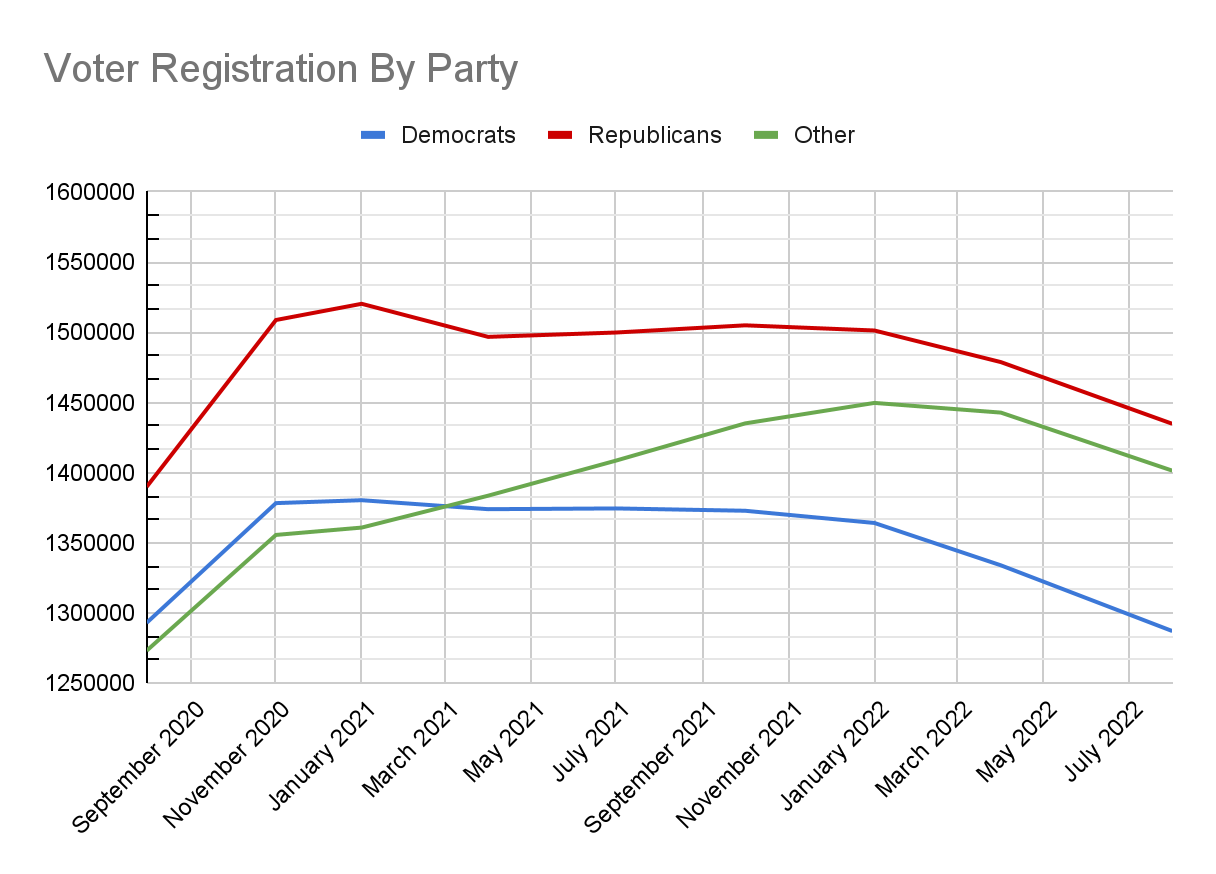
That effort, “Arizona Victory,” relied on volunteers to carry out door knocking, phone calls, and communications to encourage voting. The latest voter registration data revealed that well over 1.4 million voters (34 percent) registered as Republicans, slightly over 1.4 million (33 percent) registered in the catch-all “other” listing (independent voters, those without a party preference, and those whose party isn’t considered major), while just under 1.3 million (31 percent) registered as Democrats. As the dominant group, Republicans have over 147,600 more voters than Democrats and nearly 33,400 more voters than the “other” category.
That reflects an increase in Republican and “other” voter registrations, and a loss in Democratic voter registration since the 2020 primary election. Republican registrations increased by nearly 44,900 voters, and “other” registrations increased by over 128,200 voters. Democrat registrations decreased by nearly 5,900 voters.
All parties lost registrations when compared to the 2020 general election. Democrats lost over 91,100 voters, Republicans lost over 73,900, and “other” registrations reduced by over 107,300.
Despite having a lead in voter registrations in the 2020 general election, former President Donald Trump amassed nearly 10,500 less votes than current President Joe Biden.
The Libertarian Party’s presidential candidate earned over 51,400 votes: 13,000 more voters than total registered libertarians. The other five presidential candidates representing either no party, the “Constitution” party, or the “Socialism and Liberation” party earned just over 2,000 votes, cumulatively.
The current state voter registration numbers reflect a shift in voter outlooks between 2020 and this year, from party affiliation to “other.” This is a shift also reflected by the state’s largest county (over half of all voters reside in Maricopa County). As AZ Free News reported in June, over 5,000 voters in Maricopa County switched their party affiliation to “other.” A majority of those voters were Democrats, numbering over 2,1000, followed by Republicans, over 1,700, and over 1,000 individuals switching between classifications within the “other” category.
In a video congratulating the RNC and AZGOP for engaging more voters, Congresswoman Debbie Lesko (R-AZ-08) urged further GOP mobilization.
“We need every volunteer out there making phone calls, going to doors, doing everything that they can, telling their neighbors and their friends to vote Republican,” said Lesko. “You know as well as I that President Biden and the Democrats are ruining our country, and we have to take it back.”
This year’s primary election has nearly 170,900 more registered voters than the 2020 primary election. It’s the highest voter registration for a primary, ever. However, nearly 296,100 voters registered between the 2020 primary and general elections. There were about 125,000 more voters registered in the 2020 general election than the current primary.
The primary elections are Tuesday, August 2.
Corinne Murdock is a reporter for AZ Free News. Follow her latest on Twitter, or email tips to corinne@azfreenews.com.
The amount of smuggled marijuana seized at the Arizona border dropped 91 percent so far this past fiscal year while seizures of other, harder drugs have increased. It appears from Customs and Border Patrol (CBP) data that hard drugs like methamphetamine, fentanyl, and cocaine supplanted marijuana as smugglers’ preferred substances.
Ajo Station agents performed a vehicle stop near Gila Bend, AZ. Following a #K9Alert, agents seized 44 pounds of meth. Two U.S. citizens were arrested and face criminal charges.
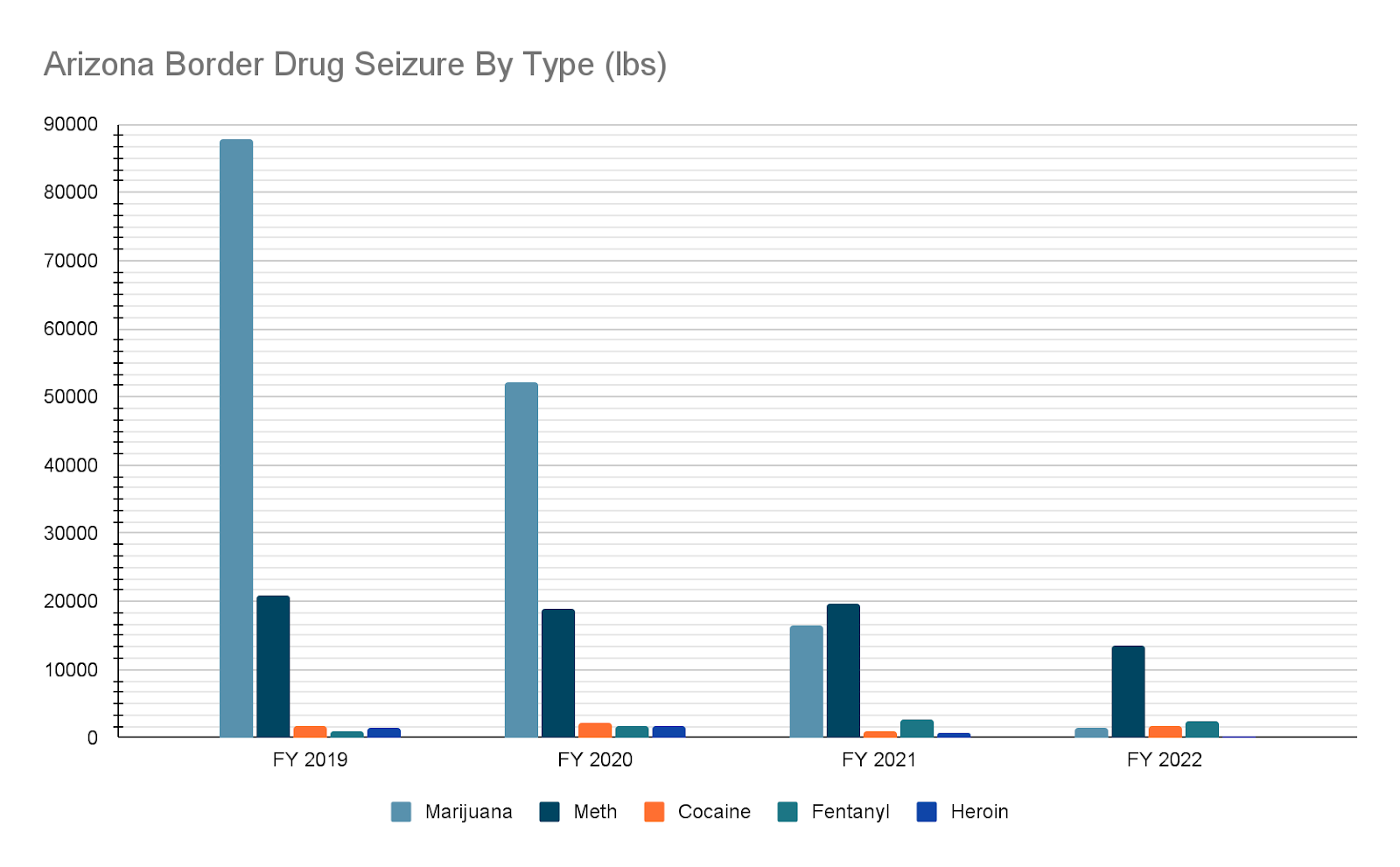
The decreased seizures correlate somewhat with Arizona’s marijuana legalization through Prop 207, or the “Smart and Safe Arizona Act,” during the 2020 election. Arizona’s marijuana seizures dropped about 35 percent from fiscal years 2019 to 2020, and 71 percent from 2020 to 2021. (The CBP fiscal year runs from October to September).
Arizona’s seizures of meth dropped from nearly 20,800 pounds to nearly 18,900 pounds, nine percent, from 2019 to 2020, then increased by three percent from 2020 to 2021. It appears that this year’s meth seizures will remain within margin, though at present agents have seized 1,100 pounds less than this time last fiscal year.
Conversely, the state’s fentanyl seizures grew over the past three fiscal years. From 2019 to 2020, seizures increased 79 percent, then 65 percent from 2020 to 2021. If seizure rates continue as they have this year, there will be more fentanyl seized than in 2021: over 2,600 pounds.
Fentanyl, one of the deadliest street drugs per CDC overdose data, comes in the form of a pill to resemble its legal counterpart prescribed by doctors. Cartels like the notorious Sinaloa Cartel mark the synthetic opioid with an “M30” stamp to disguise it as the painkiller oxycodone, which is manufactured by pharmaceutical companies.
Overdoses may occur with as low as two milligrams of fentanyl. The National Institute of Health (NIH) reports that fentanyl accounts for the majority of opioid overdose deaths in the U.S.
According to the CDC, Arizona has one of the leading overdose death rates in the country.
Cocaine seizures dropped off in fiscal year 2021, but they’ve remained consistently high over the past three years. Seizures increased from over 1,800 pounds to a high of nearly 2,200 pounds, 19 percent, from 2019 to 2020 before falling by 59 percent in 2021. This year, however, cocaine seizures have rebounded at rates that may surpass 2019 levels and fall slightly behind or run even with 2020 levels.
Heroin seizures have dropped significantly since 2020.
John Modlin, chief patrol agent of Border Patrol (BP) Tucson Sector, last posted about the seizure of personal use marijuana in February, and a major seizure of marijuana in January 2021.
Ajo #USBP agents encountered a United States Citizen at the SR-85 Checkpoint with an extraditable warrant. Upon a search of the vehicle, agents seized personal use marijuana and methamphetamine, 40 fentanyl pills, and a loaded handgun. The case was turned over to @Arizona_DPS. pic.twitter.com/6miEVlmD8m
Ajo #BorderPatrol Agents seized over 235 pounds of marijuana with an estimated value of $81,779.60. So far this fiscal year through December, agents in #Tucson Sector have seized a total of 5,073 pounds of Marijuana. Great Work! @CBPpic.twitter.com/l00dhCv5bd
By comparison, Modlin has posted frequent updates about meth and fentanyl busts over the past year.
Busy day at the Port of Nogales. #CBP officers prevented large quantities of methamphetamine, cocaine, and fentanyl from reaching our communities. Outstanding work! https://t.co/keSC28rYf8
The chief patrol agent for BP Yuma Sector, Chris Clem, hasn’t posted about a major marijuana seizure since last March. However, Clem’s offered more frequent updates on meth, fentanyl, cocaine, and heroin seizures.
— Chief Patrol Agent Chris T. Clem (@USBPChiefYUM) June 22, 2022
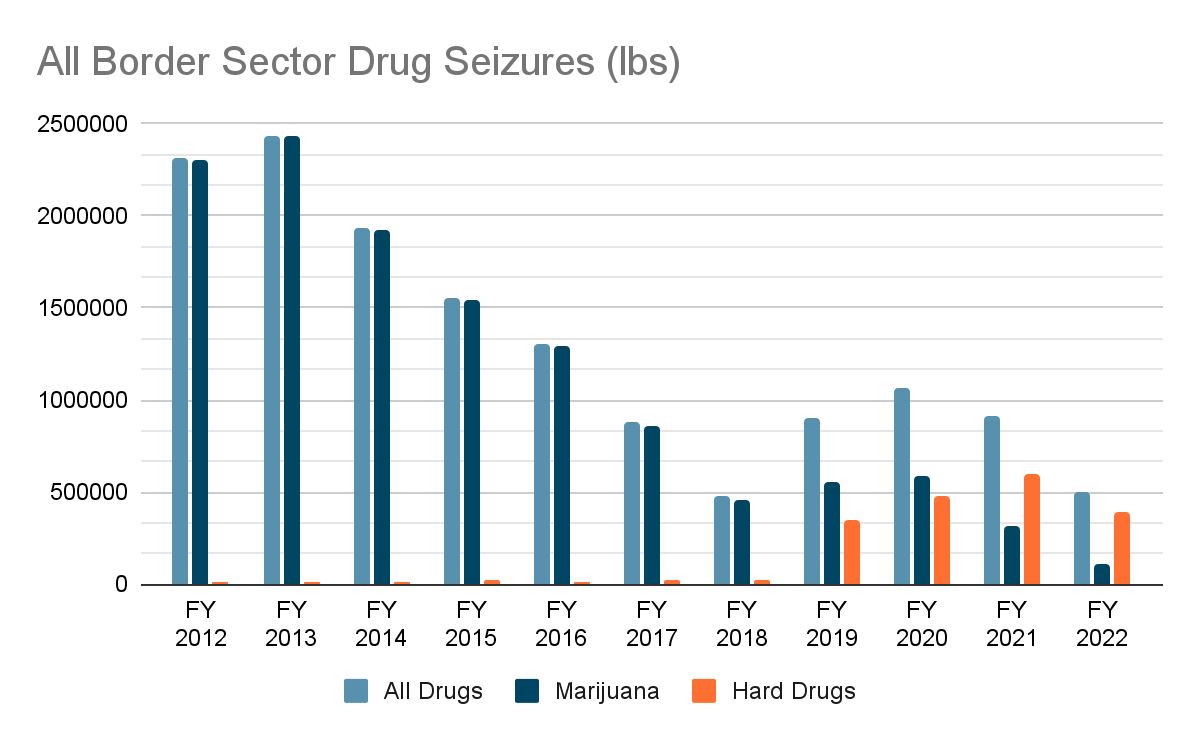
According to CBP data, the number of drug seizures across all border sectors have dropped consistently since 2013. The reduced seizures appear to correlate with marijuana legalization across numerous states, considering the vast majority of drug seizures were marijuana in eight of the past 10 years. All border states except Idaho, Indiana, Wisconsin, North Carolina, South Carolina, and Texas have legalized marijuana for recreational purposes.
In addition to Arizona, the following states have legalized recreational marijuana usage: Alaska, California, Colorado, Connecticut, Illinois, Maine, Massachusetts, Michigan, Montana, New Jersey, New Mexico, New York, Nevada, Oregon, Rhode Island, Vermont, Virginia, and Washington. Additionally, recreational marijuana is legal in Washington, D.C.
Corinne Murdock is a reporter for AZ Free News. Follow her latest on Twitter, or email tips to corinne@azfreenews.com.
Last week, a Pinal County man pleaded guilty to falsely attesting to his felon status when registering to vote. It’s the latest case investigated and prosecuted by the attorney general office’s Election Integrity Unit (EIU).
35-year-old San Tan Valley resident Roberto Garcia voted in the 2020 general election, despite having six previous felony convictions. Garcia was indicted in the Pinal County Superior Court in March.
Garcia faces a minimum of six months and a maximum of 2.5 years. He will receive his sentencing on August 22 by Judge Jason Holmberg. Probation wasn’t made available.
Public court records reveal that one of Garcia’s previous felony convictions concerned theft in 2006.
Another EIU case was convicted last month. As AZ Free News reported, a Scottsdale woman voted for her dead mother in the 2020 election. The court revoked the voter registration of that woman, 56-year-old Krista Michelle Conner of Cochise County. Conner’s fraudulent ballot wasn’t counted, according to Cochise County Recorder David Stevens.
Prior to that, another Scottsdale woman that also cast a ballot in her dead mother’s name in the 2020 election — 64-year-old Tracey Kay McKee — was sentenced to two years’ probation.
Other recent convictions of voter fraud concerned several elections over the past decade. Those were 70-year-old Marcia Johnson of Lake Havasu City, who cast a ballot in her dead father’s name in 2018, and 62-year-old Joseph John Marak of Surprise, who voted as a felon six times since 2016.
The EIU was formed in 2019 and launched its online complaint form in the summer of 2020.
Our Election Integrity Unit recently launched a new online complaint form to report allegations of voter fraud and file elections-related complaints. Read more about the EIU and how to file an elections-related complaint here:https://t.co/H3kNxxRrwt