by Terri Jo Neff | Jun 16, 2022 | News
By Terri Jo Neff |
Should Arizona’s largest public transportation entity be allowed to use taxpayer funds to pay lobbyists to obtain even more taxpayer funds? And if so, can Maricopa County taxpayers be assured their money isn’t used to influence a possible vote to extend a transportation tax set to expire in 2025?
On Thursday, the joint board of Valley Metro Regional Public Transportation Authority (RPTA) and Valley Metro Rail will meet in Phoenix to vote on several matters, including two agenda items involving “legislative consulting services” which includes lobbying of federal and state lawmakers.
The meeting starts at 11:15 a.m. at the Valley Metro boardroom at 101 North 1st Avenue on the 10th Floor.
However, there will be no discussion of either item, as they are listed under the meeting’s Consent Agenda instead of the Regular Agenda. That is of concern due to the fact one of the agenda descriptions refers to Prop 400, a half-cent tax many state lawmakers want voters to extend for yet another 20 years
The prospect of Valley Metro using taxpayer dollars to lobby for more money from taxpayers -whether via Congress, the Legislature, or with Prop 400 voters- has raised the question of why the joint board meeting has the two lobbying items on the Consent Agenda where there can be no discussion and where individual board members do not have to publicly state their position.
According to the June 16 agenda, Item 4G is listed as “Authorization to Issue a Request for Proposals for Federal Legislative Consulting Services” for a two-year period with three one-year options. The estimated cost is listed as between $180,000 and $240,000 per year.
Valley Metro is currently contracted with Cardinal Infrastructure for federal lobbying activities through Dec. 31. Staff recommends continuing with some sort of contract to assist Valley Metro in achieving “specific federal legislative, lobbying and funding objectives” with Congress, the Executive Branch, and various federal agencies.
This is especially timely, according to the agenda item, in light of “opportunities in the federal passage of the infrastructure bill.” Those opportunities include federal taxpayer funds which Valley Metro staff wants to ensure the region “is not missing out on.”
Meanwhile, Item 4H on the agenda seeks authorization for Valley Metro’s CEO to issue an RFP for state consultant services in dealing with the Arizona State Legislature, the Governor’s Office, and other state agencies. The cost would likely run $60,000 to $90,000 per year.
The current contract issued in 2018 is a joint venture between Highground Public Affairs Consultants and The Kruse Group, described in the agenda as “a well-known Republican and Democrat lobbyist to access bipartisan relationships.”
Among the services the contract would cover is Governmental Relations -monitoring and lobbying public transit issues- at the state level along with Strategic Planning.
“Due to the ongoing dialogue with respect to the possible extension of Proposition 400, staff supports this request,” the agenda states.
The Prop 400 extension is a longshot to get on the ballot this year given that the tax does not expire until 2025. However, many voters are wary of the prospect that public entities such as Valley Metro and the Maricopa Association of Governments will use taxpayer funds behind the scenes to sway voters to approve the extension when it does get on the ballot.
Whether any of Valley Metro’s board members will acknowledge those concerns and remove the two items from the Consent Agenda to the Regular Agenda remains to be seen.
Valley Metro RPTA’s board members are:
Veronica Malone, Avondale Vice Mayor;
Clay Goodman, City of Buckeye;
Kevin Hartke, Chandler Mayor;
Monica Dorcey , Vice Mayor of El Mirage;
Mike Scharnow, Fountain Hills Town Council,
Brigette Peterson, Gilbert Mayor;
Lauren Tolmachoff, City of Glendale;
Bill Stipp, Goodyear City Council;
Francisco Heredia (Chair), Mesa City Council;
Jon Edwards, Peoria Councilman;
Laura Pastor (Vice Chair), Vice Mayor for City of Phoenix;
Leah Martineau, Town of Queen Creek;
Betty Janik, Scottsdale Councilwoman;
Chris Judd, City of Surprise;
Robin Arredondo-Savage, Tempe Councilmember;
Adolfo Gamez, City of Tolleson;
Rui Pereira, Wickenburg Mayor; and
Michael LeVault, Youngstown Mayor.
Four of Valley Metro RPTA’s board members also serve as the board of Valley Metro Rail: Arrendondo-Savage (Tempe), Hartke (Chandler), Heredia (Mesa), and Pastor (Phoenix).
by Corinne Murdock | Jun 15, 2022 | Education, News
By Corinne Murdock |
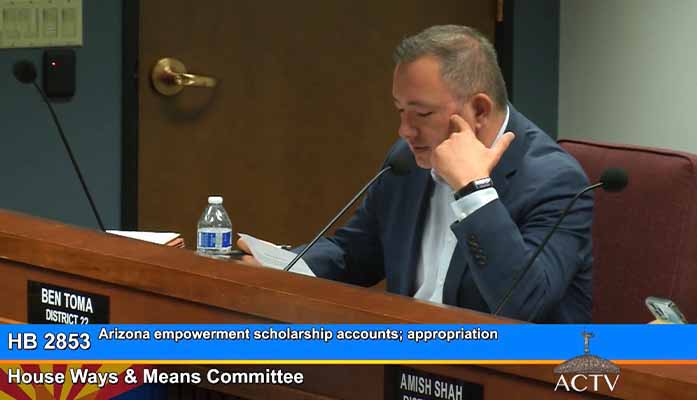
On Wednesday, the State House Ways and Means Committee passed legislation establishing school choice for all parents who choose to use it. The 6-4 approval marks a historic advancement for expansion of the state’s school choice program, Empowerment Scholarship Account (ESA).
The legislation, HB2853, comes from State Representative Ben Toma (R-Peoria) about 11 years after the ESA Program launched.
Bipartisanship was far from the committee during discussion of this bill. Democrats insisted that voters in the past rejected universal ESA expansion, that families would spend their ESA dollars frivolously or wastefully, that there weren’t enough regulations on non-public schools, and that public schools would be bled of crucial funds. Republicans insisted that post-pandemic voters support universal school choice, and that parents knew what was best for their children and would choose accordingly.
Toma challenged the idea that Arizona’s public schools were underfunded, something that Democrats like State Representative Kelli Butler (D-Paradise Valley) and Arizona Education Association (AEA) President-elect Marisol Garcia testified. Toma asked for a definitive number that constituted “fully funded.” Garcia suggested that outranking other state’s funding totals would constitute “fully funded.” In response, Toma pointed out that education funding increased by 48 percent during his tenure in the legislature, adding that much of those funds didn’t end up in teacher’s salaries.
State Representative Brenda Barton (R-Payson) concurred with Toma’s assessment, saying that in her 11 years she’s never gotten a hard answer from any public school proponents or officials of what “fully funded” meant for them.
Chairwoman Shawnna Bolick (R-Phoenix) estimated 25,000 students might utilize the ESA program if expanded under HB2853.
“If we’re helping a student get a lifeline, at the end of the day I’ll actually know we’re doing a good job as a legislature,” said Bolick.
Several Democrats insisted that they wanted to see long-term data on ESA students’ performance rates. Toma said there wasn’t a way to issue a fair comparison of those students because a majority of current users had disabilities, and comparing performance across different disabilities wasn’t an “apples to apples” comparison.
State Representative Pamela Powers Hannley (D-Tucson) argued that program effectiveness could still be measured through methods like sheer counts of private and charter school students.
“I think it’s important to know how many students are enrolled across the state because this is state money,” said Powers Hannley.
There are about 1.1 million charter and public school students.
State Representative Mitzi Epstein (D-Chandler) compared private schools to Walmart stores, insinuating that they were a less desirable option that communities were stuck with. Epstein also challenged why taxpayers should have to pay for children to visit the school they desire.
As a rebuttal for worry over potential private waste of public dollars, Toma pointed out the controversy over Buckeye Elementary School District paying its superintendent over $1.7 million in “additional compensation” from 2016 to 2021. Toma doubted that one individual’s misuse of ESA funds would reach that amount. He added that whenever people are involved, misuse is bound to happen.
“There are issues with any sort of system in which human beings are involved,” said Toma. “Fraud [with ESAs], if there is fraud, is less than one percent.”
In an attempt to cite waste of school funds, Butler listed allowable ESA expenditures she found objectionable, such as a bouncy castle and a tonal home gym costing thousands of dollars. Both Bolick and Toma reminded Butler that the Arizona State Board of Education (SBE) and the Arizona Department of Education (ADE) approved the handbook, clarifying further that Superintendent Kathy Hoffman’s office was responsible for writing it.
The two GOP legislators suggested that their Democratic peer take up her grievances with Hoffman.
Bolick also noted that bounce houses are within individualized education plan (IEP) parameters for curriculum-related therapies. Butler said that was besides her point. She went on to claim the state can’t afford to give every special needs child in the state their own bounce house for several hundred dollars — rather, schools should just purchase one for all special needs students. Butler called the tonal home gym “beyond the pale,” at which point Bolick cut her off for “beat[ing] a dead horse.”
Bolick and Butler contended over whether the entirety of Arizona’s 1.1 million charter and private school students would actually use ESAs.
Butler referenced access to ESA funds as “debit cards” repeatedly, to which Toma and Cobb objected. They, along with Bolick, explained to Butler that she was referring to an outdated system. They also contended with Butler’s attempted characterization of ESA funds as “thousands of dollars in a bank account.” At that point, Bolick suggested again to Butler that she seek out instruction from Hoffman about how the ESA Program works currently.
Among those to testify in favor of ESA Program expansion was Jennifer Clark, a mother of five. She explained that ESAs have helped several of her children with special learning needs like dyslexia and disabilities.
Clark further described how the public school system was currently failing her daughter with its stalled processing of her educational needs. She insisted that HB2853’s allowance for outside assessments would expedite solutions for situations like her daughter’s.
“All Arizonan families deserve equitable access to ESAs regardless of their income or zip code,” said Clark.
Drew Anderson, a South Phoenix Democrat and pastor, pointed out that the majority-white crowd protesting with the likes of Save Our Schools against the bill didn’t represent or understand the needs of minority parents — especially those in inner city schools like the Roosevelt School District.
“I don’t see anybody screaming ‘save our schools’ in south Phoenix,” said Anderson. “I hear them screaming ‘save our children.'”
Anderson described how inner-city children in his area, many from the Roosevelt School District, had to do school at McDonalds during the pandemic because they didn’t have internet at home.
The pastor then explained that one of his church members admitted to selling drugs on the side to get his siblings out of public schools. Their mother is deceased, Anderson explained, and one of the man’s younger sisters was attacked by a group of 14-year-old girls at her school.
“He had to find whatever means he could to try to get his brothers and sisters into private schools. He’s putting his freedom on the line to do that,” said Anderson. “Why is it that the rich kids can afford to go to these better schools, but these poorer kids can’t?”
HB2853 would empower parents with access to taxpayer funds already allocated for their students to apply to the schooling of their choice. The bill would appropriate $2.2 million and 26 full-time equivalent positions from the state general fund in 2023 to the ADE.
HB2853 would also enable ESA funds to be used for public transportation; computer hardware; educational technology like calculators, personal computers, laptops, tablets, microscopes, telescopes, and printers; consumable educational supplies like paper, pens, and markers; and additional disability services and education plan costs.
As for enrollment eligibility, the legislation would reduce the number of hours needed for K-12 online students to qualify by about half. It would also require students in grades 3-12 take nationally standardized tests, which may be swapped out for exams chosen by parents or qualified schools. Students with disabilities would be exempted from that examination requirement. Additionally, qualified schools with 50 or more ESA students must issue the aggregate test scores of all enrolled students or all ESA students annually.
Furthermore, the bill would expand the appeal deadline to 15 business days, and allow parents to represent themselves or designate non-attorney representatives in appeals hearings.
If passed as introduced, HB2853 includes a retroactivity clause rendering it effective as of July 1 of this year.
HB2853 angered school choice opponents. They claimed that the bill would rob public schools of their funding and award it to private schools and special interests.
At the time of press, GOP gubernatorial candidates Matt Salmon and Karrin Taylor Robson signaled support for HB2853.
Corinne Murdock is a reporter for AZ Free News. Follow her latest on Twitter, or email tips to corinne@azfreenews.com.
by Corinne Murdock | Jun 15, 2022 | News
By Corinne Murdock |
On Sunday, Arizona’s two Democratic senators announced a sweeping gun control proposal to curb gun ownership of the mentally ill and domestic abusers, as well as expand mental health and school safety programs.
The proposal hasn’t been introduced as formal legislation, let alone a formal, standalone document. It proposes to prevent court-ruled dangers to the public from obtaining firearms; expand community behavioral health centers, mental health and suicide prevention programs in communities, schools, and telehealth networks, and other similar community support services; add convicted domestic violence abusers and those with domestic violence restraining orders to the National Instant Criminal Background Check System (NICS); increase funding for K-12 school safety programs and training; increase punishment for evading firearm dealer licensing requirements and for illegal straw purchasing and trafficking; and require juvenile and mental health background checks for firearm buyers under 21 years old.
The legislation is a bipartisan effort, with 10 senators from each party issuing support. Republican senators who signed on were Bill Cassidy (R-LA), Susan Collins (R-ME), Roy Blunt (R-MO), Richard Burr (R-NC), Thom Tillis (R-NC), Rob Portman (R-OH), Pat Toomey (R-PA), Lindsey Graham (R-SC), John Cornyn (R-TX), and Mitt Romney (R-UT).
Democrats who signed onto the proposal were Senators Chris Murphy (D-CT), Richard Blumenthal (D-CT), Chris Coons (D-DE), Debbie Stabenow (D-MI), Cory Booker (D-NJ), Martin Heinrich (D-NM), Joe Manchin (D-WV).
One independent, Senator Angus King (I-ME), agreed to the proposal.
This latest gun control proposal comes less than three weeks after the school shooting in Uvalde, Texas.
In a statement, President Joe Biden commended Sinema for the legislation specifically, along with Cornyn and Tillis.
“Obviously, it does not do everything I think is needed, but it reflects important steps in the right direction, and would be the most significant gun safety legislation to pass Congress in decades,” stated Biden. “Each day that passes, more children are killed in this country: the sooner it comes to my desk, the sooner I can sign it, and the sooner we can use these measures to save lives.”
According to the CDC’s Web-based Injury Statistics Query and Reporting System (WISQARS) latest data, there were over 45,200 total firearm deaths in 2020. Nearly 24,300 of those deaths were suicides, nearly 19,400 were homicides, just over 600 were legal intervention, and 535 were unintentional. 400 firearm deaths had an undetermined intent.
A vast majority of the firearm deaths occurred in males: nearly 39,000 versus just over 6,200 females. As for race, about twice the number of white men were killed by firearms in 2020 over black men. 21,000 of the men who died were white, non-Hispanic males; over 12,500 were Black, non-Hispanic males; and just under 4,200 were white Hispanic males.
Just under 3,900 of the women who died were white, non-Hispanic females; nearly 1,600 were Black, non-Hispanic females; and over 500 were white Hispanic females.
Blue counties accounted for the top ten highest firearm death rates of all counties in the country. They’ve been ranked below from the greatest to least number of homicides.
- Cook County, Illinois: 82 percent were homicides, or 862 out of 1040 deaths; Biden won with over 74 percent of the vote in the 2020 presidential election.
- Los Angeles County, California: over 62 percent, or 524 of 837 deaths; Biden won with 71 percent of the vote.
- Harris County, Texas: over 61 percent were homicides, or 475 of 773 deaths; Biden won with over 56 percent of the vote.
- Philadelphia, Pennsylvania: over 84 percent were homicides, or 453 of 538 deaths; Biden won with over 81 percent of the vote.
- Wayne County, Michigan: over 75 percent were homicides, or 344 of 458 deaths; Biden won with over 68 percent of the vote.
- Dallas County, Texas: nearly 61 percent were homicides, or 251 of 412 deaths; Biden won with over 65 percent of the vote.
- Maricopa County, Arizona: over 35 percent were homicides, or 249 of 702 deaths; Biden won with over 50 percent of the vote.
- Marion County, Indiana: 69 percent were homicides, or 219 of 317 deaths; Biden won with nearly 64 percent of the vote.
- Miami-Dade County, Florida: 64 percent were homicides, or 208 of 325 deaths; Biden won with over 53 percent of the vote.
- Tarrant County, Texas: over 45 percent were homicides, or 140 of 309 deaths; Biden won with over 49 percent of the vote.
Corinne Murdock is a reporter for AZ Free News. Follow her latest on Twitter, or email tips to corinne@azfreenews.com.
by Terri Jo Neff | Jun 15, 2022 | News
By Terri Jo Neff |
The State of Arizona and all public entities within the state will be prohibited from contracting with any company which does not provide a written certification that the company does not, and will not, use or rely on the forced labor of ethnic Uyghurs in China.
Gov. Doug Ducey signed House Bill 2488 on Monday to help combat the forced labor practices of the People’s Republic of China.
Uyghurs are a Turkic ethnic group originating from and culturally affiliated with the general region of Central and East Asia. The people, the majority of whom are Muslims, are recognized as native to the Xinjiang region in northwest China, but for the past several years the Chinese government has come under criticism for placing tens of thousands of Uyghers at a time into detention or “reeducation” camps.
A Congressional report published earlier this year states that the Chinese government has compelled as many of 1 million of the 12 million Uyghurs in the region to work in textile, apparel, agricultural, consumer electronics, and other labor-intensive industries. Refusal to comply with such government orders can result in surveillance, political indoctrination, even further restrictive detention.
According to a recent BBC report, the Uyghurs speak their own language which is similar to Turkish. They make up less than half of the Xinjiang population, and have been the target in recent years of mass migration by Han Chinese, the nation’s ethnic majority. The intent appears to be an orchestrated effort by the government to further dilute the minority population there.
by Corinne Murdock | Jun 14, 2022 | News
By Corinne Murdock |
Hours before a scheduled appearance on Monday with former Vice President Mike Pence, Governor Doug Ducey’s office announced that he’d tested positive for COVID-19. Ducey’s communications director, C.J. Karamargin, told KTAR News that the governor was asymptomatic and “feeling well.”
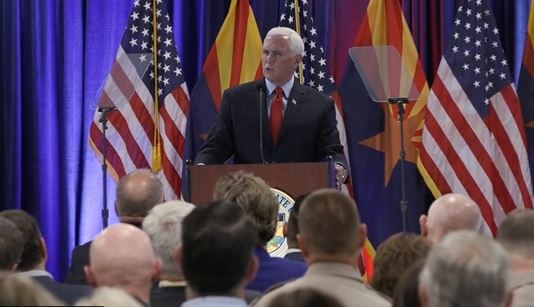
Originally, Ducey was to accompany Pence on a tour of the southern border, followed by attendance at a border security speech by the former vice president at the Arizona Commerce Authority in Phoenix.
During his speech, Pence argued that the Biden administration was exacerbating the border crisis.
“[This border crisis] can be ended almost overnight, if President Biden will just put back the policies the Trump-Pence administration put into effect that reduced illegal immigration by 90 percent,” said Pence.
Pence also lauded Ducey for his leadership and wished him a speedy recovery from COVID-19. In April, the governor coordinated with half of the country’s governors to launch a strike force modeled after his 2015 state-level initiative to address the border crisis.
“Let me say: how fortunate the people of Arizona are to have a leader so principled and devoted to securing the border and keeping our families and our neighborhoods safe,” said Pence.
Among those that met with Pence on Monday were Cochise County Sheriff Mark Dannels and his department, along with Arizona Department of Homeland Security Director Tim Roemer.
According to the latest Customs and Border Patrol (CBP) data, there have been nearly 1.3 million border encounters since last October.
The Biden administration’s attempt to rescind Title 42, policy under former President Donald Trump to expedite expulsion of illegal immigrants, failed last month. The program was slated to end on May 23, but a federal court in Louisiana issued a temporary restraining order preventing the Biden administration from ending the policy.
Ducey contracted the virus despite being fully vaccinated and boosted; he has advertised the vaccine as “safe, effective, and free” repeatedly.
Ducey credited the senior advisor on the pandemic and lead for statewide vaccination efforts, Dr. Richard Carmona, for ensuring that the vaccine was the best tool to fight COVID-19. As AZ Free News reported, Carmona serves on the board of directors for a major distributor of the COVID-19 vaccine, McKesson.
From home, Ducey provided commentary on the former vice president’s visit.
Favorability polls conducted last week through YouGov, Politico, and Harris indicated that voters largely had an unfavorable view of the former vice president. The latest polling for 2024 presidential picks reflected that Pence falls behind Florida Governor Ron DeSantis with or without former President Donald Trump in the running.
Corinne Murdock is a reporter for AZ Free News. Follow her latest on Twitter, or email tips to corinne@azfreenews.com.
by Corinne Murdock | Jun 14, 2022 | Education, News
By Corinne Murdock |
Correction: A former version of this story identified Anytown Leadership Program as the source of the controversial programming. Anytown Leadership Program responded to our request for comment post-publication to clarify that the programming came from their predecessor organization, identified as Anytown Arizona.
On a further note: As news of this controversy circulated, threats against the campers and staffers were reported. This is impermissible. AZ Free News does not condone or encourage threats of violence of any kind.
Another club within Scottsdale Unified School District (SUSD) has stirred up controversy over its social justice programming, “Unitown,” for its engagement with hot-button issues like sexuality and anti-racism. Though they’ve attracted national attention, SUSD’s Unitown clubs aren’t new or unique to the district. Unitown clubs and camps have existed within Arizona schools for decades.
The Arizona Daily Independent first reported on SUSD’s Unitown. They shared emails in which SUSD staff and teachers discussed implementation of the sexuality programming offered by the now-defunct social justice instructional organization Anytown Arizona: the “Safe Zone” and “Sexual Orientation” curriculum.
The Sexual Orientation curriculum included a skit titled “Herman’s Head,” in which a gender-confused child deals with their upset and confused parents, church, best friend, and current partner while dealing with the happiness of their potential partner. The minor playing the role of the gender-confused child is encouraged to pretend to contemplate suicide with a toy gun after pretending to handle the pressures of their friends and family.
That curriculum also included a “Sexual Orientation Exercise,” which asked the following questions of students:
- What do you think caused your heterosexuality?
- When and how did you first decide that you were a heterosexual?
- Is it possible that your heterosexuality is just a phase that you may just grow out of?
- Is it possible that your heterosexuality stems from a neurotic fear of others of the same sex?
- If you’ve never slept with a person of the same sex, is it possible that all you need is a good gay/lesbian lover?
- To whom have you disclosed your heterosexual tendencies?
- Why do you heterosexuals feel compelled to seduce others into your lifestyle?
- Why do you insist on flaunting your heterosexuality? Can’t you just be who you are and keep quiet?
- Would you want your children to be heterosexual, knowing all the problems they’d face?
- A disproportionate majority (side note: the actual figure is 98 percent) of child molesters are heterosexuals. Do you consider it safe to expose our children to heterosexual teachers?
- Even with all the societal support marriage receives, the divorce rate is spiraling. Why are there so few stable relationships among heterosexuals?
- Why do heterosexuals place so much emphasis on sex?
- Considering the menace of overpopulation, how could the human race survive if everyone were heterosexual?
- Could you trust a heterosexual therapist to be objective? Don’t you fear that the therapist might be inclined to influence you in the direction of his/her own learnings?
- How can you become a whole person if you limit yourself to compulsive exclusive heterosexuality and fail to develop your natural, healthy homosexual potential?
- There seem to be very few happy heterosexuals. Techniques have been developed that might enable you to change if you really want to. Have you considered electro-shock therapy?
Anytown Arizona wrote on the questionnaire that the goal was to reduce homophobia and create more straight allies. They wrote that homophobia was “an unrealistic fear or generalized negative attitude based on sexual orientation or gender identity.”
The Safe Zone curriculum included the “Gender Unicorn,” one of the common visuals to argue that gender and sexuality exist on a spectrum — similar to “Genderbread,” as reported on last year by AZ Free News. The visual was paired with reading assignments explaining further what’s taught using the Gender Unicorn.
SUSD launched their Unitown decades ago alongside a “Minitown.” Former SUSD Superintendent David Peterson described the programs in 2015 as opportunities to recognize and address racism, bigotry, bullying, prejudice, and intolerance. However, Unitown existed in SUSD for years before that. Back in 2005, students told East Valley Tribune that they were focusing on stereotyping, racial issues, and diversity in the SUSD club.
Other Arizona schools hosted or advocated for Unitown clubs and camps for decades. Up until around 2015, Greenway High School in the Glendale Union High School District engaged in Unitown activities.
As reported in the East Valley Tribune, the city of Chandler launched Unitown camps in 2003 based on the Anytown Leadership Camp. Even then, they focused on social justice issues in addition to leadership. It doesn’t appear that the Chandler-sponsored Unitown camp occurs anymore.
Some are confusing SUSD’s Unitown with the Unitown offered by Anytown Leadership Program, whose predecessor and affiliated organizations came up with Unitown decades ago. Their president, Amber Checky, told AZ Free News that SUSD has been running their Unitown independently since Anytown Arizona was shuttered around 2009.
In addition to Unitown, Anytown Leadership Program offers “Anytown Junior” workshops on social-emotional learning for K-5 students, the “Empowertown” in-school program on social justice issues for grades 6-12, and the “Minitown” condensed version of the summer camp for middle school students.
Anytown Leadership Program announced that they’re working on “CampusTown” for college students. The program plans on contracting with Arizona’s colleges to “create inclusive campuses and support activism and advocacy.”
Checky told AZ Free News that no schools are utilizing these current school programs at present.
The organization classifies their school programs as condensed versions of their $490 annual week-long camp occurring for 75 high schoolers. Of note, program staffers confiscate campers’ phones and prohibit them from speaking to their families while attending. In return, the high schoolers receive 50 hours of certified leadership training/service.
This year, the program has over 42 high schools represented.
The woke, TikTok famous elementary school teacher nominated by the Arizona Secretary of State’s office last year for her classroom activism, Amanda Delphy, is one of the camp staffers. In a TikTok posted this week, Delphy credited the camp for making her into the person she is today.
The Anytown Leadership Program receives taxpayer dollars for work. The organization recently received a grant from Arizona Humanities, a nonprofit and affiliate of the National Endowment for Humanities — the funding source of their grants.
Anytown Leadership Program began in the 1950s, arising from a 1927 initiative responding to anti-Catholic and anti-Jewish sentiments at the time: the National Conference for Christians and Jews (NCCJ), later renamed in 1998 to the National Conference for Community and Justice (NCCJ). They closed their operations and had a brief hiatus in the early 2000s before relaunching under new leadership.
Prior to 2009, each Arizona high school nominated two students to represent them at one of the program’s eight Anytown Leadership Camps held every summer.
The 2008 recession caused the original Anytown Leadership Camp to be shuttered in 2009. Alumni resurrected the program in 2014, making it into its present-day form focusing on social justice issues like diversity, equity, and inclusion.
NCCJ offers an “Anytown” programming similar to the Phoenix-based Anytown Leadership Program.
Upcoming sessions for virtual NCCJ Anytown programming concern “dismantling anti-blackness,” anti-racism, DEI (short for diversity, equity, and inclusion), and “understanding sizeism” (prejudice or discrimination against individuals based on their weight). These sessions focus on one or several of the “9 Identities”: ageism, dress code sexism, heterosexism, human trafficking, microaggressions, racism, religionism, sexism, and sizeism.
The 9 Identities have forthcoming bulletins on the NCCJ resource page to explain their place in the world of social justice. The other bulletins address social justice definitions as a whole, ableism, adultism, Black Lives Matter, cissexism, classism, colorism, consent, cultural appropriation, environmental justice, homelessness, internalization, intersectionality, neurodiversity, privilege, veteran’s affairs, and women’s rights.
State Senator Nancy Barto (R-Phoenix) lamented Anytown’s shift in focus.
SUSD parent Amanda Wray — one of the individuals included in the dossier compiled by former SUSD board president Jann-Michael Greenburg’s father, Mark Greenburg — told AZ Free News that the programming should inspire parents to rethink their approach when addressing these controversial topics.
“Conservatives need to stop using the term ‘CRT.’ What’s happening isn’t about a legal framework being taught in schools — we know K-12 students are not learning legal theories. What is happening is radical, racial division being taught not only to distract from the decline in public school academics, but it is indisputably to train students to become social activists,” said Wray. “This camp, which started out years ago as a wonderful way to unite students and respect other‘s differences, seems to have morphed into yet another form of social justice activist training. And it’s unwittingly being funded by taxpayers.”
A number of recognizable names are listed among Anytown Leadership Program supporters: the Arizona Coyotes, the Fiesta Bowl, Starbucks, Peoria Diamond Club, Amazon, Bank of America, PayPal, Target, Aldi, and CVS Health.
Those who fund over $7,500 to Anytown Leadership Program include the Arizona Community Foundation, the Arizona Coyotes Foundation, the David Frazier Endowment Fund, and the Fiesta Bowl Charities. Those who fund between $5,000 to $7,500 include Phoenix Pride, the Robert Cialdini and Bobette Gorden Family Foundation, Rob Jaimes, Sandy Fromm, and Voya Financial.
Those who fund between $1,000 to $5,000 include the Peoria Diamond Club; the Starbucks Foundation; David Gass; Fromm, Smith, & Gadow, P.C.; and Matt Case. Those who fund over $500 to $1,000 annually include Bank of America, Brock Insurance Services, David Gale, Diane Geimer, Jennifer Gadow, John Boyle, Leida and Greg Davis, Lisa Stone, Nancy Fromm, Phoenix Pediatrics, and Spire Health Club.
Corinne Murdock is a reporter for AZ Free News. Follow her latest on Twitter, or email tips to corinne@azfreenews.com.