Benjamin Franklin once famously said, “[I]n this world, nothing is certain except death and taxes” — true, unless you’re a leftist political nonprofit. For many of them, taxation isn’t certain, even if they run afoul of tax-exempt status requirements.
Funding sources, expenditure recipients, and even those operating these nonprofits may remain secretive under the current state of lax federal enforcement. These tax-free and opacity perks are possible through two interrelated federal tax classifications: 501(c)(3), or “C3,” and 501(c)(4), or “C4.” There are over 27,000 C3s and just over 1,200C4s registered in Arizona. The big difference between the two classifications is that donations to IRS-recognized C3 organizations are deductible under our income tax code. And the Left has learned how to exploit this tax status for their political benefit.
In Arizona, many liberal C3 and C4 nonprofits work in tandem, each executing symbiotic duties while coordinating their activities and sharing data and resources. Sometimes, these C3 and C4 duos are “sister” organizations — meaning, they’re affiliated rather than independent entities allied over common goals.
These arrangements are legal so long as clear distinctions are made between charitable and non-charitable activities. Over the last several months, AZ Free News has conducted an extensive review of over a dozen different liberal nonprofits in the state, examining their websites, tax documents, and social media accounts. Our research has found that many of these organizations have blurred the lines on their political activities via various C3 and C4 groups. In some cases, there appeared to be no distinction at all, with some C3 organizations providing completely different accounts of their tax-deductible program activities to the IRS compared to what they shared publicly.
How the IRS Intended for C3 and C4 Organizations to Operate
C3s have two major qualifiers: they’re supposed to be nonpartisan and apolitical—meaning, they can’t expend funds or use resources to coordinate with political activity being conducted by C4s.
C3s must organize and operate exclusively for purposes that are one or more of the following: charitable, religious, educational, scientific, literary, testing for public safety, fostering national or international amateur sports competition, and preventing cruelty to children or animals.
The IRS defines “charitable” as relief of the poor, the distressed, or the underprivileged; advancement of religion; advancement of education or science; erecting or maintaining public buildings, monuments, or works; lessening the burdens of government; lessening neighborhood tensions; eliminating prejudice and discrimination; defending human and civil rights; and combating community deterioration and juvenile delinquency.
The IRS expressly prohibits C3s from being an “action organization”: those engaging in political or legislative activities. Political activities include the direct or indirect participation or intervention in any political campaign on behalf of or in opposition to any political candidate. The IRS also prohibits political campaign fund contributions or public statements of positions, either verbal or written, on behalf of the organization in favor of or opposing any candidate.
The IRS does condone voter education activities, such as get-out-the-vote (GOTV) efforts like voter registration. However, any evidence of political bias is forbidden: favoritism of a candidate, opposing a candidate in any way, or “hav[ing] the effect of favoring a candidate or group of candidates.” Lobbying is also largely forbidden.
Comparatively, the IRS classifies C4 organizations into one of two categories: social welfare organizations or local association of employees. The former concerns civic leagues or organizations organized exclusively for social welfare promotion, not profit. The IRS clarifies that social welfare promotion doesn’t include direct or indirect participation or intervention in political campaigns on behalf of or in opposition to any candidate. Those that do must not render that activity as their primary activity, and risk being subjected to taxation. The latter concerns membership-based organizations with net earnings devoted exclusively to charitable, educational, or recreational purposes.
How Leftist C3 and C4s Operate in Arizona
Our review of leftist C3s in Arizona appears to indicate that their activities are overtly partisan and political. They coordinate with politically active C4s to achieve shared, partisan goals, and receive political action committee (PAC) funding while doing so. Often, these leftist C4s have either direct or indirect participation or intervention in political campaigns on behalf of or in opposition to one or more candidates.
Progressive activists leading these C3s have effectively mastered the art of exploiting the IRS code for partisan advantage, helping to maximize liberal donor partisan impact with their dollars while still hiding their identity. The C3s will claim that their allowable vote (GOTV) efforts, such as voter registration, are nonpartisan. They will claim they’re reaching out to certain, “marginalized” demographic groups; however, these groups turn out to be known Democratic voter bases.
One example of this is Mi Familia Vota Education Fund, the C3 sister organization of Mi Familia Vota, the C4. The former admitted on their 2020 tax filing to coordinating political activity with the latter. The executive director of Mi Familia Vota Education Fund, Hector Sanchez Barba, has publicly advocated for the losses of Republican candidates.
“We will keep working to keep extremism, Trump and MAGA out of our democracy,” wrote Sanchez Barba. “@MiFamiliaVota.”
In response to a Politico article documenting the GOP’s underperformance in last year’s midterm elections, Sanchez Barba thanked Latino voters for having Democrats win.
Meanwhile, their partner C4s pay for media and partisan activities like ad campaigns for candidates. It’s uncertain whether the funding for these activities comes from their C3 partners since those grant or cost-sharing agreements aren’t public. The IRS requires that C3 funds given to C4s be restricted to charitable uses — not electioneering activity.
The C3-C4 duo targets certain voter demographics to achieve a partisan outcome. They contact Democrat-leaning voters to get their vote cast, convince newly registered voters to vote Democratic through mailers and ads supportive of Democratic candidates and causes, and publicly support certain partisan ballot initiatives.
The C3-C4 sister organizations thinly veil their efforts that a division exists between them. For example, Mi Familia Vota spent tens of thousands on TV advertising that advocated for the election of Reginald Bolding ahead of last year’s primary. However, they listed a staffer for their C3 sister organization, Mi Familia Vota Education, as the point-of-contact on that campaign filing.
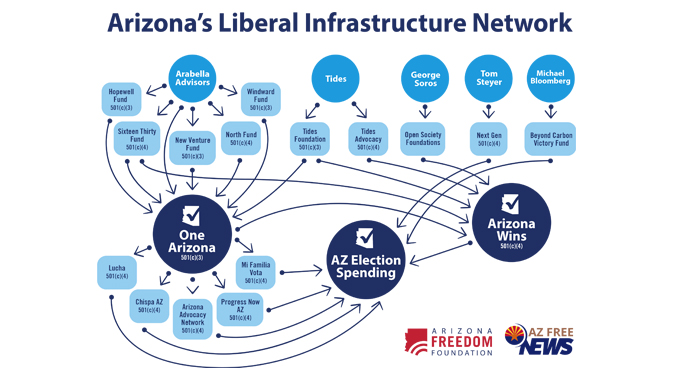
As AZ Free News reported in Part One of this series, Mi Familia Vota receives funding from One Arizona, a C3, which in turn receives its funding from the Tides Foundation, George Soros’ Open Societies Foundation, and several different organizations under Arabella Advisors.
.@RealMarkFinchem, a MAGAmigo, lies, & says that the 2020 election was fraudulent. If elected, he would use his position to help Trump. We are fighting for free and clear elections this cycle. Our democracy is at stake in Arizona, we must fight back. We say #BastaFinchempic.twitter.com/WPVSjflt2L
Ahead of the midterm election last June, One Arizona advertised a job opening for an independent expenditure (IE) campaign manager. The position appears to be one for a political staffer, which would constitute prohibited electioneering.
While not a complete pitcure, the above graphic illustrates some of the connections in the left’s secretive infrastructure and how they relate to Arizona elections.
Leftist C3s also hire for both the C3 and C4, resulting in shared jobs and salaries. One Arizona (C3) and Arizona Wins (C4) co-hired staff including a field director, field program coordinator, and finance and compliance director. That shared salary should not be used for political work. One recent example of this was a job listing by Arizona Coalition for Change (C3) and Our Voice Our Vote (C4) for a data manager that would work within the duo’s political and grassroots lobbying arms.
These blurred lines surrounding co-hires don’t just apply to staff. Arizona Center for Empowerment (ACE, a C3) and LUCHA (C4) share an executive director, Alejandra (Alex) Gomez, as well as staffers. This relationship is further complicated by the fact that ACE listed LUCHA as its “Employer of Record” on their latest tax return. Under Gomez, both organizations have expressed their partisanship.
Last year, LUCHA launched an initiative to get Democratic candidates elected: “LUCHA Blue.” The nonprofit pledged to prioritize certain races and voter bases in its GOTV efforts. On its hiring page for the initiative, LUCHA disclosed that it would staff between 70 and 105 people.
“We believe that not all candidates align with the mission of LUCHA, and this is why we created a campaign not only to flip Arizona Blue — but LUCHA Blue!” stated LUCHA. “Overall, the goal of the campaign is to win these targeted races, increase Latin/Hispanic voter turnout, and educate voters on the voting process.” (emphasis added)
In one post following Sen. Mark Kelly (D-AZ) winning re-election last November, LUCHA appeared to affirm that both it and ACE assisted in organizational efforts to assure Kelly’s victory.
Wealthy dark money donors have a greater financial incentive to back C3s. 75 percent of their donations can go to politics and qualify as tax deductible — effectively maximizing their gift-giving while affording them a tax break. C4 donations aren’t tax deductible.
The IRS has long been aware of the disparity between the lawful intent for C3 and C4 entities, and the current reality of C3-C4 relationships. As ProPublica revealed in 2019, the IRS essentially gave up on holding nonprofits accountable.
The following are some of Arizona’s liberal C3-C4 nonprofit duos: One Arizona and Arizona Wins, Arizona Center for Empowerment and Living United for Change in Arizona, Mi Familia Vota Education Fund and Mi Familia Vota Victory, Chispa AZ/League of Conservation Voters Education Fund and League of Conservation Voters, Arizona Coalition for Change and Our Voice Our Vote, Instituto Lab and Instituto Power, Rural Arizona Engagement and Rural Arizona Action, and Voto Latino Foundation and Voto Latino.
The relationships between these nonprofits and the awareness of their straining tax law will be further explained in the next installment of this series.
This is Part Two in a series on the Left’s secret infrastructure to turn Arizona blue. Be sure to sign up for our newsletter to be notified of Part Three in the series.
Corinne Murdock is a reporter for AZ Free News. Follow her latest on Twitter, or email tips to corinne@azfreenews.com.
It’s been just over a month since new Arizona Superintendent of Public Instruction, Tom Horne, was sworn into office, and his hire to run the Empowerment Scholarship Account (ESA) Program has been delivering significant results for Arizona families.
Christine Accurso, the new ESA Executive Director, has been a longtime pro-life and school choice advocate in the East Valley. Her family has benefited from the ESA program for years – well before the Arizona Legislature expanded its scope in 2022. After the bill was signed into law by former-Governor Doug Ducey, Accurso singlehandedly led a grassroots army of moms and dads from around Arizona to defeat a campaign meant to refer ESA expansion to the ballot and delay the implementation of school choice and freedom for tens of thousands of children in our state.
Since coming on with the Arizona Department of Education, Accurso has been hard at work to save the expanded ESA program a second time, bringing staffing up to the levels intended by the legislature, handling the huge backlog of funding and reimbursement requests, vetting and approving new applications for the program, and ensuring that parents are receiving timely and relevant information from her office.
To that end, Accurso has been extremely diligent in sending out weekly emails to account holders, explaining what her program is working on, clarifying any previous misconceptions about ESAs, and giving updates on the number of students benefiting from school choice in Arizona. Her first email, sent January 3 (which was her inaugural day leading the program), alerted parents and guardians that there were 45,170 students receiving an ESA. In her email this week, that number was up to 46,971 – and Accurso briefed readers that the program is “receiving a minimum of 150 new applications a day.”
Accurso’s latest email also gave an update on her processing que, which is very helpful for account holders to realize the reasons behind some delays in payment processing or approval of desired resources for students. The Marketplace has a backlog of 4,578; Direct Pay of 4,032; Reimbursements of 24,409; and pre-paid debit cards of 63,125 – and there are 4,000 orders coming in each day to be processed. These numbers are significantly down from the original backlog Accurso inherited from the previous administration (and shared in her January 13 email), which was 171,575 orders.
The ESA Executive Director has also been planning and executing the formation of a parent advisory committee – an action she forecasted in her January 13 email to account holders. Accurso announced in her January 25 email that the application process for this committee was open – with 15 to 30 members selected to serve in a volunteer capacity. There were 140 applications received by the ESA Program for this committee, per Accurso’s February 8 email, and she informed interested readers that “we will be finalizing the candidates and communicating with them soon.”
The February 8 email to account holders was lengthy, which Accurso apologized for, but it was filled with necessary information. Accurso explained that she had “spent her first month as the executive director adjusting our office’s approach to everything in the ESA program to align with the state law.” She clarified the law and requirements for an “individual vs facility/business offering tutoring or teaching services,” and she gave an update on “accessing your ESA funds.” She gave a lot of information on the four ways account holders could access their ESA funds, including some new directives on using the pre-paid debit card. Accurso warned that her office “does plan to cancel the use of debit cards for all accounts that have not submitted the appropriate receipts by the (required) deadline or have purchased unallowable items with the card (For example: Chevron, Chick-Fil-A, Taco Bell and Dillard’s).”
Accurso realizes that one of the deadliest attacks toward ESA programs is the lack of oversight by those entrusted to distribute and steward the funds, and the propensity of some account holders to misuse funds that have been earmarked for specific educational purposes – whether intentionally or unintentionally. This is why she appears to be laser focused on bringing the Arizona ESA program into conformity with the law and the original intent of the legislature. Her weekly updates will continue to provide much-needed guiderails for parents and guardians as the program moves forward under the watchful eyes of Superintendent Horne.
Daniel Stefanski is a reporter for AZ Free News. You can send him news tips using this link.
On Monday, Attorney General Kris Mayes announced that her office would no longer investigate social credit scores imposed by banks and other financial institutions.
Mayes said in a press release that social credit scores — or, Environmental, Social, Governance (ESG) rating — were “politicized” issues that don’t merit investigation.
“While my predecessor’s administration spent time and resources launching politicized investigations into the environmental sustainability efforts of major financial institutions, my administration is committed to using the tools and resources at our disposal to protect and secure the rights of Arizonans on matters that affect their daily lives,” said Mayes. “Arizonans can expect my office to be laser-focused on issues like protecting Arizona’s natural resources – including water, combating fraud and scams, and safeguarding vulnerable groups like seniors and children.”
An ESG rating reflects the long-term environmental, social, and governance impacts an individual or company may pose, which in turn informs a banking or financial institutions’ decisions regarding investments, loans, membership, and so on. Examples of what could impact ESG scoring could include a company’s reliance on fossil fuels or an individual’s gun ownership. Last September, Treasurer Kimberly Yee prohibited the use of ESG scoring when determining state investments.
Mayes also asserted in Monday’s press release that governments couldn’t dictate corporations or their investors concerning how to invest.
“Corporations should be permitted to access capital markets in ways that they feel are necessary for the advancement of their investor objectives and for society, as long as they are doing so in a lawful manner,” stated Mayes. “Corporations increasingly realize that investing in sustainability is both good for our country, our environment, and public health and good for their bottom lines. The state of Arizona is not going to stand in the way of corporations’ efforts to move in the right direction.”
Mayes had already pulled Arizona out of an investigation involving 18 other attorneys general looking into six major American banks launched last October: Bank of America, Citigroup, Goldman Sachs, JP Morgan Chase, Morgan Stanley, and Wells Fargo. The attorney general toldKTAR News last month that this move was part of her effort to clean house of “political lawsuits,” which she said also included challenges to President Joe Biden’s student debt forgiveness.
Mayes gave notice at the time that her office would be pulling out of a number of lawsuits, though she didn’t clarify which ones.
“You can anticipate that there will be a number of announcements in the coming weeks of us withdrawing from these lawsuits,” said Mayes.
Mayes’ predecessor, Mark Brnovich, launched multipleinvestigations over the last few years into banks and other financial institutions due to their ESG practices.
Early on in her candidacy, Mayes pledged to make fighting climate change her top priority. Mayes promised to appoint a climate director on her first day in the office; if that appointment was made, it hasn’t been made public.
“Arizona is on the precipice of a water catastrophe that is being exacerbated by our state leaders’ inaction to historic drought and climate change,” the plan says.” You can read my plan here: https://t.co/nHh14WcA8M
Mayes, who also served as an Arizona State University (ASU) energy law professor, pledged to impose stricter enforcement of water quality and pollution laws.
“Mayes, a former Republican utility member on the Arizona Corporation Commission, has made environmental issues one of her campaign pillars. The ASU energy law professor has a 16-point plan for how she would preserve water quality and punish polluters.” https://t.co/d8PSPM7xKc
Arizona Governor Katie Hobbs has made no secret of her desire to dismantle the state’s school choice benefits for tens of thousands of children and their families, and this weekend, she was challenged on her desires by Fox News Sunday host, Shannon Bream, during an exclusive interview leading up to the Super Bowl in Glendale.
During the interview, Bream asked the governor why all students shouldn’t have a chance to have the educational opportunities that she had growing up – a reference to Hobbs’ high school graduation from Seton Catholic Preparatory. Governor Hobbs appeared to embrace the rhetoric of school choice proponents as she searched for justification for her positions, responding that her parents “made that choice” and that they “sacrificed a lot” to give her the chance at a private education.
Hobbs went on to say that she wants every student in Arizona to have access to high-quality public education – access that she claimed would not happen under Arizona’s historic Educational Scholarship Account (ESA) program, which was passed last year by the Arizona Legislature. Bream followed up by asking the governor if students should not have a chance to go elsewhere if their school system was failing. Hobbs’ reply was that “the schools are failing because we are failing to invest in them.”
But Governor Hobbs’ rampant claims of the ESA program bankrupting and failing Arizona schools were met with facts from several individuals. Corey DeAngelis, one of the nation’s premier “evangelists” of school choice, tweeted thanks to Shannon Bream for citing his January Wall Street Journal article, showing that Arizona’s ESA program could actually save the state more than $100 million.
And Andrew Clark, Executive Director of Yes. Every Kid. Foundation, tweeted, “The average cost for a family to homeschool is year is about: $2k per kid. Micro-schools and pods are about $5k. Private schools average $10k, charters around $12k. Public schools clock in around $15k. But sure it’s a spending problem for public schools…let’s ignore the facts…”
The average cost for a family to homeschool is year is about: $2k per kid. Microschools and pods are about $5k. Private schools average $10k, charters around $12k. Public schools clock in around $15k. But sure it’s a spending problem for public schools…let’s ignore the facts… https://t.co/b0Rgjq4JAd
Governor Hobbs’ answers on school choice quickly went viral after the recorded interview went live Sunday morning, and Arizona Republicans, who are at the front lines of protecting the landmark ESA program, wasted no time in making their thoughts known.
The Arizona Senate Republicans Twitter account posted: “.@GovernorHobbs response makes absolutely zero sense, other than reinforcing why expansion of ESA school choice is so desperately needed.”
Senator Justine Wadsack tweeted, “So #HypocriteHobbs attended PRIVATE school, and her parents made “sacrifices” to put her there. Even found themselves on food stamps! Had #ESA/#SchoolChoice existed back then, her parents would have been given $7,000 to help with the cost of Katie’s education.”
So #HypocriteHobbs attended PRIVATE school, and her parents made "sacrifices" to put her there. Even found themselves on food stamps!
Representative Quang Nguyen stated, “So if your parents afforded you this great opportunity, shouldn’t you make it possible for other parents to give their children the same opportunity you received as a child? Asking for Arizonans.”
So if your parents afforded you this great opportunity, shouldn’t you make it possible for other parents to give their children the same opportunity you received as a child? Asking for Arizonans. https://t.co/ffMnjxSRMo
Representative Cory McGarr disagreed with Governor Hobbs’ characterizations of district school funding, saying: “Our government schools are failing because we are supposedly starving them of resources?? 73% increase in funding since 2016… Perhaps they are failing because they focus on woke sexualization, feelings and racism and have no accountability because of politicians like this.”
Our government schools are failing because we are supposedly starving them of resources??
73% increase in funding since 2016…
Perhaps they are failing because they focus on woke sexualization, feelings and racism and have no accountability because of politicians like this. https://t.co/xXGMqiFyUq
Representative Matt Gress underlined the foundation of the school choice argument, writing: “.@GovernorHobbs’ parents struggled to provide her with an education THEY thought best. It’s unfortunate she wants AZ families to choose between being on food stamps or sending their kids to the school they choose. Let’s help families. Give them a choice, not push them down.”
.@GovernorHobbs’ parents struggled to provide her with an education THEY thought best.
It’s unfortunate she wants AZ families to choose between being on food stamps or sending their kids to the school they choose.
Representative Austin Smith said, “Booed at the Phoenix Open, health nominee failed in the senate committee and called out for her hypocrisy on school choice on national Sunday show. Bad weekend for Hobbs. Is there anyone who thinks she’s actually an effective leader?”
Booed at the Phoenix Open, health nominee failed in the senate committee and called out for her hypocrisy on school choice on national Sunday show. Bad weekend for Hobbs.
Representative Justin Heap tweeted: “@katiehobbs is committed to ending Az’s ESA program which allows thousands of Arizona children to receive the same private school education she received. Katie Hobbs definitely believes in pulling the ladder up behind her.”
@katiehobbs is committed to ending Az's ESA program which allows thousands of Arizona children to receive the same private school education she received. Katie Hobbs definately believes in pulling the ladder up behind her. https://t.co/zI9tjtBJ53
On Thursday, Rep. Debbie Lesko (R-AZ-08) introduced a resolution to protect women by preventing gender ideology from redefining biological sex.
Lesko was joined in the resolution by Sen. Cindy Hyde-Smith (R-MS), titling it the “Women’s Bill of Rights.” In a press release, Lesko declared that the resolution would not only protect but affirm the importance of women.
“Now more than ever, we must protect women’s rights and combat the left’s attempts to erase women,” stated Lesko.
The resolution would define “sex” as a person’s biological sex from birth, “female” as an individual whose biological reproductive system is developed to fertilize their ova, “woman” and “girl” as human females, and “man” and “boy” as human males. The resolution also would declare that “equal” doesn’t mean “same” or “identical,” and that “separate” didn’t indicate inherent inequality.
With these definitions, the resolution would require schools and all levels and divisions of government to identify subjects of data gathering as either male or female at birth, such as for public health, crime, and economic data. It also would make all policies and laws distinguishing sexes subject to intermediate constitutional scrutiny, a test employed by courts to determine the constitutionality of a statute that negatively impacts certain protected classes. Statutes pass scrutiny if they further an important government interest and employ means of accomplishing that interest that are substantially related to that interest.
Further, the resolution would warrant discrimination in certain circumstances.
“There are legitimate reasons to distinguish between the sexes with respect to athletics, prisons or other detention facilities, domestic violence shelters, rape crisis centers, locker rooms, restrooms, and other areas where biology, safety, and/or privacy are implicated,” stated the resolution.
Lesko and Hyde-Smith first introduced the resolution last May, in the 117th Congress. It was referred to the Constitution, Civil Rights, and Civil Liberties Subcommittee last November, but never made it any further. During a press conference last year, Lesko argued that the necessity of her resolution proved that the country has gone “to hell in a handbasket.”
“The world is totally upside down when I have to introduce legislation to define a woman versus a man,” said Lesko. “More and more often our colleagues on the left are trying to erase women.”
Today at the @RepublicanStudy’s press conference, I spoke about the Women’s Bill of Rights that I introduced to stand up for the rights of women and ensure our safety. Watch my remarks below: pic.twitter.com/AcvQI2Om3i
— Congresswoman Debbie Lesko (@RepDLesko) May 19, 2022
That version of the Women’s Bill of Rights was included in the Republican Study Committee (RSC) Family Policy Agenda ahead of the midterm elections. The agenda issued over 80 recommendations to better align the GOP with its goal of advancing families’ interests, focusing on child protections, increased economic power for working families, additional parental rights, increased flexibility to child care, elimination of policies discouraging family formation, incentives to work, school choice, higher education reforms, foster care and adoption reforms, and abortion abolition.
I’m pleased that my Women’s Bill of Rights was included in the @RepublicanStudy’s Family Policy Agenda. Republicans are fighting to stop the left from erasing women and to strengthen America’s families to secure a better future for our nation! https://t.co/UD8yXOo6nM
The RSC was established 50 years ago for the purpose of coordinating research efforts by conservative congressmen.
Lesko and Hyde-Smith were assisted in crafting the resolution by the Independent Women’s Law Center and Independent Women’s Voice, two related women’s advocacy organizations.
Thank you to @SenHydeSmith for reintroducing a resolution in the Senate that would establish a Women's Bill of Rights to reaffirm legal protections afforded to women under Federal law!
Independent Women’s Law Center Director Jennifer Braceras said that rooting out sex discrimination won’t be possible without proper definitions of biological sex.
“We can’t fight sex discrimination if we can’t agree on what it means to be a woman. And we can’t collect accurate data regarding public health, medicine, education, crime, and the economic status of women if we redefine sex to mean ‘gender identity,’” said Braceras.
Corinne Murdock is a reporter for AZ Free News. Follow her latest on Twitter, or email tips to corinne@azfreenews.com.
Northern Arizona University (NAU) will provide free tuition regardless of income to Native Americans from Arizona tribes but requires other races to fall below a certain financial threshold to qualify. NAU President José Luis Cruz Rivera described the arrangement as a cornerstone for the university’s equity work.
“Ensuring access to an affordable, high-quality education is a key part of NAU’s vision to deliver equitable postsecondary value,” stated Cruz Rivera.
Celebrating NAU's Access2Excellence expansion with a round dance with members of NAU's Native community 🪶 pic.twitter.com/GIg2hw5DlV
This arrangement falls under NAU’s financial aid program “Access2Excellence” (A2E) which launched last April. However, the university didn’t offer this free tuition for Arizona tribal members until last November, after NAU’s Native American Advisory Board pushed for its creation.
Initially, A2E was intended to provide tuition-free college for all students, regardless of race, if their household incomes were at or below $65,000. When A2E launched last spring, approximately 50 percent of Arizona households met that threshold.
✨ Introducing the @NAU Access2Excellence initiative 📚NAU will provide a tuition-free college education for EVERY AZ resident with a household income of $65,000 or below – assuring tuition will be fully covered by scholarships and financial aid. ➡️ https://t.co/O4qAcFxMeupic.twitter.com/xbRhOpF7Ja
NAU stated in a press release that the special free tuition offer for Native American students was part of its “strategic priority” to be the leading university serving Indigenous people nationwide. Ann Marie Chischilly, vice president of the Office for Native American Initiatives, said that this offering represented NAU’s commitment to prioritizing Native Americans.
“We are dedicated to being the nation’s leading institution serving the indigenous peoples and providing a clear and affordable pathway to an exceptional education,” said Chischilly.
"We pride ourselves on our service to Native American students & the communities they represent. Extending #A2E eligibility for our Arizona tribal members is an important step as we plant seeds for the success of future generations of Native American students." –@NAUPresidentpic.twitter.com/T1bLhtvuz1
Free tuition is one of the latest in NAU’s latest initiatives focused on uplifting Native Americans. In January, NAU pledged $10 million to prioritize Native American and Indigenous people in curriculum and recruitment efforts.
Through the work of Seven Generations Signature Initiative, NAU will contribute to the advancement of Indigenous knowledges and scholarship, strengthen partnerships & propel Indigenous student success. pic.twitter.com/P5P8NoNv14
Last March, NAU launched multiple initiatives totaling $1.3 million to increase the number of both Native American and Hispanic science, technology, engineering, and math (STEM) graduates. These initiatives focus on training STEM faculty in anti-racism, revising graduate admissions processes to increase inclusivity and diversity, creating additional supports exclusively for Indigenous and Hispanic students, offering exclusive campus opportunities for Indigenous and Hispanic students’ families.
Department of Biological Sciences professor Catherine Propper predicted that these initiatives would increase anti-racist educational practices in education beyond NAU.
“In this way, we can bring about equity-oriented change in STEM fields by building leadership among faculty to contribute to institutional change, eliminate structural barriers and reduce disproportionality and systemic inequities in STEM fields,” said Propper.
Cruz Rivera asserted that greater funding and research efforts for recruitment, training, and placement on Native American and Hispanic students was an equitable necessity to spur these groups’ economic mobility.
“Together, we can propel more low-income, first-generation students and students of color to the middle-class and beyond,” said Cruz Rivera. “Support for HSIs will pave the way for less inequality, more social mobility and broader economic prosperity in America.”
In June 2021, the Arizona Department of Education (ADE) awarded NAU with $1 million to advance culturally responsive Native American pre-K-12 educators.
The A2E program goes into effect this fall. Those admitted to NAU for fall 2023 or spring 2024 semesters qualify.
Corinne Murdock is a reporter for AZ Free News. Follow her latest on Twitter, or email tips to corinne@azfreenews.com.